
Series 'Texas Historical Marker'
.jpg)


Texas Historical Marker #02709
Jacob Frederick Elsasser. Born in Germany in 1834, Jacob Frederick Elsasser migrated to this country with his father and brothers. They operated a cigar factory in Chicago until it was destroyed in the great Chicago fire of 1871. Elsasser moved to Texas with his Swiss-born wife, Catharine (1832-1903), and built a 2-story farm house east of Sanger. After it burned, they erected this residence in 1901. One of Elsasser's daughters, Mrs. J. M. Peery, and her family occupied the house until 1939. It was purchased in 1952 by Mr. and Mrs. Willard Bounds. (1976) #2709
700 N. 7th St., Sanger, TX, United States
.jpg?width=250)
Texas Historical Marker #02710
Jail Square. First mapped in 1825 as "Market Square," but had become "Jail Square" prior to 1836 when Gonzales was burned by order of Gen. San Houston to prevent buildings and supplies falling into possession of oncoming enemy, Gen. Santa Anna. #2710
?, Gonzales, TX, United States
Texas Historical Marker #02711
Jalufka-Govatos House. A first generation Texan, James Jalufka (1879-1969) was born in Lavaca County, the son of Moravian (Czech) immigrants. A veteran of the Spanish-American War, he also served as a soldier in World War I. He was a prominent south Texas cotton grower and owned a local cotton gin. Jalufka and his wife, Helen J., had this home built about 1905. Originally located at 1408 North Mesquite Street, it was part of the neighborhood known as "Old Irishtown". They continued to live in the house until 1919, after which time it was used as rental property. Pete and Minnie Lee Govatos, members of a family active in the city's Greek community since the 1920's, purchased the home from the Jalufkas in 1944. Residents of Corpus Christi since 1940, they operated a local restaurant and lived in the house until Minnie Lee's death in 1960. The house changed ownership several times after the Govatos family sold it, and eventually it fell into disrepair. Acquired by the city in 1987, it was moved to Heritage Park and renovated on its new site. (1990) #2711
1513 North Chaparral, Corpus Christi, TX, United States
Texas Historical Marker #02712
James Abijah Brooks. (Nov. 20, 1855 - Jan. 15, 1944) Illustrious Texas Ranger for whom this county is named. Born in Kentucky; came to Texas 1876; became rancher-trail driver. Served in Texas Rangers 1882-1906. By order of the governor, aided in preventing Fitzsimmons-Maher World Title Prize Fight, El Paso, 1896. Helped solve and halt South Texas cattle thefts. Served in Texas Legislature, 1909-1911; was County Judge of Brooks County, 1911-1939. Married Virginia Wilborn. #2712
?, Falfurrias, TX, United States
Texas Historical Marker #02713
James Azle Steward. Tennessee native James Azle Steward came to Texas prior to 1860. He and his wife, Mary E. Fowler Steward, were among the early settlers of this area. Steward was a well-known, respected pioneer physician. The settlement, which had been known by several different names at various times, was renamed Azle when Dr. Steward gave land for a townsite in 1883. He was also instrumental in the establishment of Ash Creek Cemetery. Azle Christian Church was built on land donated by the Doctor. A Mason, he was buried in Ash Creek Cemetery. #2713
124 W Main Street, Azle, TX, United States

Texas Historical Marker #02714
James B. Dosher. James B. Dosher moved to Texas in 1847 and served in Cureton's Company of the Texas Rangers. Discharged in 1848, he married Velma Eddings in 1851. They settled in Jack County in early 1855 and worked their farm south of Jacksboro. Dosher also served with Captain Tackett's Company of Texas Rangers. During the Civil War he was active in the Texas State Troops and the Confederate Army. In 1870 as a civilian guide for the U.S. Army, he received the Medal of Honor for gallantry in action during an engagement at Bluff Creek, Texas. (1997) #2714
?, Jacksboro, TX, United States

Texas Historical Marker #02715
James Buchanan Gillett. A very famous Texas Ranger. Born in Austin, son of Adjutant General of Texas. At 16 became cowboy on western frontier. At 19 joined Rangers; hunted down raiding Indians, rustlers, feuding settlers. After serving 1875-1881, became El Paso city marshal. Ranched 41 years in far West Texas (living in and near Marfa) and New Mexico. His book, "Six Years with the Texas Rangers", is read as an Old West classic. Recorded 1969. #2715
?, Marfa, TX, United States
Texas Historical Marker #02716
James Buckner "Buck" Barry, C.S.A.. (1821-1906) Came to Texas from North Carolina in 1845. Fought in Mexican War and Indian campaigns. In the Civil War, commanded Confederate cavalry regiment in Texas outposts from Red River to Fort McKavett. Camps were a day's horseback ride apart. Patrols protected outer settlements and prevented Indian attacks and threatened Federal invasion from Indian territory. Elected to Texas Legislature 1883. Died on ranch near here. Left personal records of his years in frontier defenses. (1964) #2716
?, Walnut Springs, TX, United States
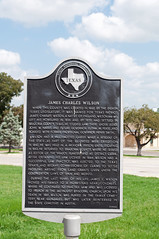
Texas Historical Marker #02717
James Charles Wilson. When this county was created in 1860 by the Eighth Texas Legislature, it was named for Texas patriot James Charles Wilson. A native of England, Wilson (1818-1861) left his homeland in 1836 and by 1839 had settled in Brazoria County, Texas. He studied law there under Judge John W. Harris and future Governor Elisha M. Pease, and boarded with former Provisional Governor Henry Smith. Wilson had a multifaceted career while a resident of the state. As part of the ill-fated Mier Expedition in 1842, he was held in a Mexican prison until escaping in 1843. He returned to Brazoria County, where he served as editor of the "Brazos Planter" and a district clerk. After obtaining his law license in 1844, Wilson had a successful law practice, was elected to the Texas Senate, and became Commissioner of Claims to settle problems arising from land grants given under the colonization laws of Spain and Mexico. During the last years of his life, James C. Wilson moved his family to a homestead near Gonzales, where he continued to practice law and was licensed to preach in the Methodist Episcopal Church. Upon his death in 1861, Wilson was buried in the family cemetery near Gonzales but was later reinterred in the State Cemetery in Austin. (1985) #2717
1420 Third Street, Floresville, TX, United States
Subjects

Texas Historical Marker #02718
James Cunningham. Born in Alabama, settled in Comanche County, 1855. Commander of Texas Ranger Company stationed in Comanche County, 1858. Helped bring law and order to county--drove out renegades and wild Indians. Cunningham commanded men from Comanche County in Dove Creek Battle, Jan. 8, 1864 (500 white men against 1,000 Indians). His sons became sheriffs in Comanche, Mills and Taylor counties. Recorded - 1967 #2718
?, Comanche vicinity, TX, United States
Texas Historical Marker #02719
James D. Owens. Star and Wreath Born December 7, 1811. A volunteer soldier in the Texas army during the Texas War for Independence. Served in the San Jacinto Campaign; died August 14, 1843. Erected by the State of Texas, 1962 #2719
?, Gonzales, TX, United States
Texas Historical Marker #02720
James E. Guinn School. After Fort Worth public schools were organized in the fall of 1882, black students continued to be taught in black churches for more than a year. The city completed a schoolhouse for blacks on E. 9th Street at Elm in December 1883. The son of a former slave, James Elvis Guinn was born in Fort Worth. Though neither of them could read nor write, his parents placed a great value on education, and James attended Fort Worth's early schools for blacks. He later pursued a college degree and became a professor of chemistry at Prairie View College, now Prairie View A&M University. Guinn returned to Fort Worth as principal of South Side Colored School in 1900. Construction of a new three-story brick school building, designed by the prominent architectural firm of Sanguinet and Staats, began at the corner of Louisiana and Rosedale Avenues in April 1917. Shortly before its completion, Guinn died on July 11, 1917. Six days later the school board voted to name the new school building James E. Guinn School in his honor. It was the largest black school in Fort Worth in 1930. After sixty-three years of service it, it was closed in 1980. Texas Sesquicentennial 1836-1986. #2720
1100 Louisiana St., Fort Worth, TX, United States
Texas Historical Marker #02721
James F. Blair. Born in Tennessee. Parents were James and Catherine Jordan Blair. Served in Mexican and Civil wars. Rose from Confederate ranks to captain of Company G, 36th Texas Cavalry. Later served as Texas Ranger and was appointed Sheriff of De Witt County by Governor Throckmorton in 1866. Married Lucy Elizabeth Ainsworth in 1851. They had 8 children. Was a member of Texas Veterans' Association and Coletto Masonic Lodge. #2721
?, Cuero, TX, United States
Texas Historical Marker #02722
James Franklin Byrd. (December 18, 1844-June 9, 1915) Born in Kentucky. Joined the Confederate army at Gonzales, Texas, 1862. Was in Co. F., Willis' Battalion of Cavalry, army of Virginia. Fought in battles of Holly Springs, Harrisburg, Fort Pilow, and others. Captured, he became prisoner of war on Ship Island. Escaped by volunteering to help load boat, then joining prisoners to be exchanged. Married Eliza Elizabeth May. Made permanent home at Pecan Mott, West of Hayrick Mountain. Recorded -- 1968 #2722
?, Robert Lee, TX, United States
Texas Historical Marker #02723
James H. Isbell. San Jacinto Veteran born in Tennessee 1814 died in 1858. His wife Amanda Isbell. Born April 8, 1819 died September 1, 1880. #2723
?, Belton, TX, United States
Texas Historical Marker #02724
James Henry Dishman. (February 22, 1858-July 30, 1934) James Henry Dishman was forced at the age of six to assume a man's role after his father's death in the Civil War in 1864. A native of Cherokee County in East Texas, he eventually moved to Kaufman County and developed a successful ranching operation. He sold his ranch in 1892 and headed to the South Texas Gulf Coast in search of lucrative ranching opportunities. In 1893 James purchased a remote and undeveloped section of school land in this area of northern Cameron County. He built a homestead and by 1895 had establised a working ranch. He increased his land holdings and within a short time gained a reputation for industriousness and uncommon generosity. He was gravely wounded by a cattle rustler in 1897. Aided by brothers Dr. Fred and Dr. Joe Combes of Brownsville, he was able to recover in six months. In 1904 Dishman donated acreage for the railroad right-of-way that led to the creation of the town of Combes. In 1924 he donated over 5 acres to the Combes community as a site for a Baptist church and cemetery. In 1928 he donated money and this site for the construction of an elementary school which when completed in 1930 was named for him. Dishman was buried beside his mother at Harlingen City Cemetery. #2724
309 Madeley, Combes, TX, United States

Texas Historical Marker #02725
James Hodges, Sr.. James Hodges, Sr., came to Gonzales in April 1835. Soon after his arrival he purchased four leagues (17,721 acres) of land at the forks of the San Marcos and Guadalupe Rivers for $3,000 in silver. On September 26, 1835, in a election held under the auspices of the Gonzales Committee of Public Safety, Hodges was elected one of six delegates to the Consultation of 1835. Convened in San Felipe de Austin on November 3, delegates to the Consultation created a provisional government and organized an army under the command of Sam Houston. Returning to Gonzales after the Consultation, Hodges provided supplies for the Texas army in 1836. He and his family left the area during the runaway scrape, but later returned to Gonzales County. In 1838 Hodges served on the County's Board of Land Commissioners. Twice married, James Hodges was the father of eight children. He and his family continued to live on their land on the San Marcos and Guadalupe rivers. After his death on December 24, 1846, Hodges was buried on the family farm in a plot which became known as the Hodges Family Cemetery (about one mile southeast). #2725
?, Gonzales, TX, United States
Texas Historical Marker #02726
James House. This two-story limestone house is believed to have been built about 1880 by Ives Brown for Ichabod and Alice Kingsbury. In 1925 it was purchased by Maria (Williams) James (1859-1940), the pioneer surveyor and early community leader who platted the town of Boerne in 1852. Named "Puccoon" by Maria for her ancestral home in Hanover County, Virginia, the residence remained in her family following her death. Recorded Texas Historic Landmark - 1982 #2726
114 Oak Park Street, Boerne, TX, United States
Texas Historical Marker #02727
James Jackson Beeman. (December 21, 1816 - December 7, 1888) One of the first settlers in Dallas and Weatherford. Born in Madison County, Ill., came to Texas 1840. He helped cut first road in Trinity Bottoms, name Turtle Creek (1841), and plat city of Dallas, 1842. He guided Texas President Sam Houston to Indian parley, 1843; joined California Gold Rush, 1849; pioneered, Parker County, 1854; aided in rescue of Comanche captive Cynthia Ann Parker, 1860. Returned to Dallas to live, 1864. Died in Lampasas. #2727
?, Lampasas, TX, United States
Texas Historical Marker #02728
James M. Benbrook. In 1876 Indiana native James M. Benbrook brought his family to this settlement, then known as Marinda. A veteran of the Union Army during the Civil War, he became a prominent area farmer and landowner. In 1880, when rail lines were completed here and a depot was constructed, the community was renamed Benbrook in his honor by the Texas and Pacific Railroad Company. Twice married, Benbrook was the father of six children. Recorded - 1982. #2728
?, Benbrook, TX, United States