
Series 'Texas Historical Marker'

Texas Historical Marker #02642
Indianola. Many currents of the mainstream of Texas history flow in this onetime port. Pineda explored the coast in 1519 and La Salle planted a settlement near here in 1685. Once an Indian trading point, it was a major seaport from 1844 to 1875. Texas colonists, including Germans led by Prince Carl of Solms-Braunfels, entered through Indianola. "Forty-niners", supplies for frontier forts, and experimental Army camels were landed here landed here. During the Civil War Indianola and Fort Esperanza, which controlled the gateway to Indianola through Pass Cavallo, were objectives of Federal blockading vessels. Pass Cavallo, ten miles south, was one of several entrances to the inside waterway created by Matagorda Peninsula and the offshore islands extending to the Rio Grande. To deny Confederate use of this waterway for commerce through Mexico the Federals had to seize control of these entrances. Before Confederate defenses at Fort Esperanza were completed, two Federal steamers slipped through Pass Cavallo to Indianola and on October 31, 1862 demanded the surrender of Lavaca (now Port Lavaca) to the northwest. The Confederate command refused, stood off the naval guns with land batteries, and forced the withdrawal of the Federal ships. Federal forces attacked Fort Esperanza November 22, 1863. The Confederates withstood the assault of naval and land forces for six days then spiked their guns, destroyed their magazines, and withdrew to the mainland. Indianola then fell December 23. On Christmas Eve, Federal and Confederate forces clashed at Norris Bridge, eight miles north. Two days later Lavaca was occupied and the entire Matagorda-Lavaca Bay area remained in Federal control until the war's end. Indianola was partially destroyed by a hurricane in 1875 and completely destroyed by another in 1886. A memorial to Texans who served the Confederacy. (1963) #2642
?, Indianola, TX, United States
Texas Historical Marker #02643
Indianola Cemetery. Many of the graves in this cemetery reflect the hardships encountered by residents of Indianola, one of Texas' leading 19th-century ports. The earliest marked grave is that of a child, William Woodward. His death occurred in 1852, a year when cholera and yellow fever epidemics swept through Indianola. During the Civil War, the town was occupied by Confederate and Union soldiers, and men from both sides are buried here. Victims of the 1875 and 1886 hurricanes, which devastated the town, are also interred in this cemetery. Texas Sesquicentennial 1836-1986 #2643
?, Port Lavaca, TX, United States
Texas Historical Marker #02644
Industry. Site of the first permanent German settlement in Texas, 1831. Founded by Friedrich Ernst, born at Varel, Oldenburg, Germany. Immigrated to America, 1829 and to Texas in 1831. Died here in 1858. The town was laid out in 1838. #2644
?, Industry, TX, United States
Texas Historical Marker #02645
Industry United Methodist Cemetery. Organized 1847 by the Rev. Henry Bauer, missionary to the German settlers. In 1867, this building was erected under the leadership of the pastor, the Rev. Karl Biel. This was an era of financial difficulty, and the funds were raised only by very great sacrifices on the part of the people. Men of congregation did the construction work. The Rev. A. M. Roos was pastor of the 100th anniversary. Recorded Texas Historic Landmark, 1967 #2645
1914 Main Street, Industry, TX, United States
Texas Historical Marker #02646
Ingenhuett-Faust Hotel. The older section of this hotel, with its jig-cut brackets and balustrade, was built in 1880. Additional facilities were constructed in 1894, seven years after the coming of the railroad to Comfort. Both sections of the inn were designed by Alfred Giles of San Antonio. Members of the Peter Ingenhuett family operated the hotel until about 1903. It was owned and managed by Louis and Matilda Faust from 1909 until 1946. Recorded Texas Historic Landmark - 1985 #2646
818 High Street, Comfort, TX, United States
Subjects
Texas Historical Marker #02647
Iowa Park Lodge No. 713, A.F. & A.M.. The town of Iowa Park was platted in 1888 on the route of the Fort Worth and Denver City Railroad. A Masonic Lodge was also being organized in Iowa Park, and in 1891 a warrant of dispensation was granted by the Grand Lodge of Texas, Ancient Free and Accepted Masons. Iowa Park Lodge No. 713 received its charter in December 1891. A building owned by Kriedler and Windle served as the first lodge hall until 1892 when Birk Hall was secured as a meeting place. In 1896 the second floor of the First National Bank building was obtained for lodge meetings. The organization continued to meet in the bank building until 1969 when the lodge completed a building at 700 West Washington Street. Iowa Park Lodge members maintain a strong tradition of supporting community education, and have laid cornerstones for local public schools in 1901 and 1923. An award named for Republic of Texas President Mirabeau B. Lamar has been given annually to a deserving high school student. Many charitable causes have received assistance from the Iowa Park Masons, who continue to serve the community as they have for more than a century. (1997) #2647
700 W Washington, Iowa Park, TX, United States
Texas Historical Marker #02648
Ira. Named for Ira Green, who had a crossroads store near this site. First homes and school were half-dugouts (cellars with windows set above ground level). Post office established 1896. On opening of block 97 to settlers, 1899, area became active farm and ranch community. Oil production since 1923. (1966) #2648
SH 320 & FM 1606 junction, Ira, TX, United States
Texas Historical Marker #02649
Ira Ingram. First alcalde of Matagorda municipality, 1834. Member of the Congress of the Republic and first Speaker of the House of Representatives, 1836. Pioneer patron of public school. Born in Vermont August 18, 1788 died September 22, 1837. #2649
?, Matagorda, TX, United States
Texas Historical Marker #02650
Iraan. In 1922 three local businessmen, O. W. Parker, George Thompson, and I. G. Yates, leased the drilling rights on twenty sections of ranch land to Transcontinental Oil Company. After two dry holes were drilled the I. G. Yates well No. 1 blew in on October 28, 1926. The area around ranch headquarters became a boom town. Because it was isolated, support of the increased population became difficult. Yates converted a barn into a hotel and the area became known as Red Barn Community. In April 1927 Yates commissioned H. L. George of San Angelo to survey a townsite at this location, 3 miles north of Red Barn. A contest was held to choose a name for the new town. The winner was "Iraan", submitted by C. R. Hallmark who combined the names of Ira Yates and his wife Ann. His prize was a city lot. The first business to operate in Iraan was a service station run by K. P. Looney. A Post Office was opened in 1928. A nondenominational chapel known as union church was set up from contributions by Yates and Mid-Kansas Oil Company. During the boom days of Iraan, V. T. Hamlin worked as a free-lance writer. It was here that he created the comic strip "Alley Oop" . A park honoring his cartoon characters is located in the city. #2650
6th and Farr St., Iraan, TX, United States
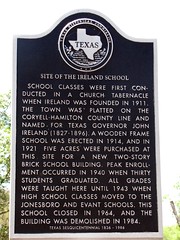
Texas Historical Marker #02651
Ireland School, Site of the. School classes were first conducted in a church tabernacle when Ireland was founded in 1911. The town was platted on the Coryell-Hamilton County line and named for Texas Governor John Ireland (1827-1896). A wooden frame school was erected in 1914, and in 1921 five acres were purchased at this site for a new two-story brick school building. Peak enrollment occurred in 1940 when thirty students graduated. All grades were taught here until 1943 when high school classes moved to the Jonesboro and Evant Schools. This school closed in 1964, and the building was demolished in 1984. #2651
?, Ireland, TX, United States
Subjects

Texas Historical Marker #02652
Irish Immigrants in Refugio. The history of settlement in Refugio is closely associated with Ballygarrett, County Wexford, Ireland. Irish natives James Power (c. 1788-1852) and James Hewetson (1796-1870), both of whom immigrated to the United States in the early 19th Century and later became citizens of Mexico, obtained permission from the Mexican government to oversee the immigration of more than 200 Irish families to Texas in the 1830s. The first group of Irish settlers arrived on the Texas Gulf Coast in 1834. A cholera epidemic and the loss of provisions and equipment in rough waters as the immigrants reached the shore delayed their arrival in Refugio, where they were to settle near the former Spanish mission of Nuestra Senora del Refugio. The colony soon was established, however, and almost immediately the new settlers were embroiled in the cause of Texas independence from Mexico. Many Irishmen fought in the Texas Army and later served in the Republic of Texas Congress. The Irish people established a lasting presence in the Refugio area. Many descendants of the early immigrants still reside in the area, some on land granted to their ancestors in the 1830s. #2652
Purisima & Osage Streets, Refugio, TX, United States
Texas Historical Marker #02653
Irwin Ranch House. Only building remaining in old Shafter Lake, first settlement in Andrews County and at one time its largest town. Built 1908. Concrete blocks, hand pressed from sand of Shafter Lake, are the original frame. Recorded Texas Historic Landmark - 1967 #2653
?, Andrews, TX, United States
Texas Historical Marker #02654
Isaac D. Hamilton. Came to Texas from Alabama in January 1836. A member of Captain Jack Shackelford's Red Rover Company under Colonel Fannin's Command, March 18-19, 1836. Miraculously escaped from the Goliad Massacre. Erected by the State of Texas 1956 #2654
?, Moulton, TX, United States
Texas Historical Marker #02655
Isaac Parker. A native of Georgia, Isaac Parker came to Texas in 1833 as part of the pioneer family that built Fort Parker in Limestone County. He fought in the Texas Revolution and served in the Republic of Texas Congress, representing part of East Texas. He participated in the 1845 Statehood Convention and later represented Tarrant and Ellis Counties in the State Legislature. In the 1850s, Parker introduced the bill creating this county, which was named in his honor. Recorded, 1986. #2655
Eagle Rd. off FM 730, NE of Weatherford, Weatherford, TX, United States
Texas Historical Marker #02656
Isaac Parker. To the memory of Isaac Parker pioneer, soldier and law maker. Born April 7, 1793 in Elbert County, Georgia. Came to Texas in 1833. Served in Elisha Clapp's Company in 1836. Member of Congress of the Republic of Texas, 1839-1845, of the Constitutional Convention in 1845. State Senator. Died April 14, 1883 in Parker County. (1936) #2656
Eagle Rd. off FM 730, NE of Weatherford, Weatherford, TX, United States
Texas Historical Marker #02657
Isgrig House. Late Victorian house with art glass windows, shingled gables, ornate gingerbread trim. Large rooms have 12-foot ceilings. Built in 1898 of clear lumber, hand-picked by the owners, John H. Luck, assisted by Jeff Tanner, a highly respected Negro builder working out of lumber yard of S. K. Seymour. B. F. Isgrig bought the property in 1916; descendants, including a son, Nathan Powderly Isgrig, have since occupied and preserved it. RTHL - 1973 #2657
436 Smith Street, Columbus, TX, United States

Texas Historical Marker #02658
Isham Cemetery. The Rev. W. Marion Isham (1831-1904) and his family came to Tarrant County from Georgia about 1870. Soon after arriving in the area Isham donated a one-acre plot of land to be used for a community cemetery. The oldest remaining legible grave marker here is that of N.L. Sweet (1824-1870), although earlier burials are documented by plain sandstone markers. Approximately five acres were added to the graveyard in 1941. Still in operation as a community burial ground, the historic graveyard is maintained by the Isham Cemetery Association. Texas Sesquicentennial 1836-1986. #2658
7100 block of John T. White Boulevard, Fort Worth, TX, United States
Texas Historical Marker #02659
Isham Chapel Methodist Church. Named for its founding Minister, the Rev. Marion Isham (1831-1904), this congregation was organized in the 1870s with eleven charter members. In 1876 B.H. Ross donated land (2 Mi. S) for a church and school, and a small frame church building soon was erected. A community school met in Isham Chapel until 1891. Over the years the church membership increased steadily, and in 1952 the congregation relocated to the rapidly growing community of Hurst. Now known as First United Methodist Church of Hurst, the fellowship has worshiped at this site since 1964. (1983) #2659
530 Elm St., Hurst, TX, United States
Texas Historical Marker #02660
Ilse-Rau House. Built in 1887 by Henry Ilse, a farmer, rancher, saloon owner. In symmetrical Victorian style, house is constructed of cypress, with pine floors and jigsaw decorations. It contains three fireplaces with marble mantels. Roof is made of stamped metal rectangles. Contractors were Jacob and Lewis Wirtz. Ilse family home until 1954, house was purchased in 1965 and restored by Mr. and Mrs. R. F. Rau in empire and Victorian manner. Since purchased by Raymond Rau family in 1965, the structure has been known as "Raumonda." RTHL - 1970 #2660
1100 Bowie Street, Columbus, TX, United States
Texas Historical Marker #02661
Itasca Railroad Depot. The second railroad depot for Itasca, this Victorian structure was built in 1895, fourteen years after the town was founded along a line of the Missouri, Kansas & Texas Railroad. It was constructed large enough to accommodate both passenger and freight service. A landmark in the town and a symbol of the area's early economic growth, the depot served as a transportation center until the late 1960s. In 1972 it was moved to this site. Recorded Texas Historic Landmark - 1982 #2661
?, Itasca, TX, United States