

Texas Historical Marker #03110
Locklin Bartholomew Murray. (June 17, 1849-April 29, 1923) Born in Jackson, Miss. Came to Texas with family in early 1860's. Married Susan Lucinda McSpadden (1855-1917), and had 7 children who lived to adulthood. Settled near Sanco, in Yellow Wolf Valley, about 1888, and began ranching. In 1894 he was elected sheriff and tax collector by Coke county citizens. He held the position for 4 consecutive terms, until 1902, earning a reputation as an honest and efficient lawman. Recorded - 1973 #3110
?, Robert Lee, TX, United States
Texas Historical Marker #03111
Loma Alta. First settlers moved into region in early 1880s. Community was named for Loma Alta/Hills. School, built 1896, moved several times in area until consolidation, 1943. Post office, established Jan. 3, 1910, was discontinued April 15, 1921. School and post office served large area of this ranching country. 1973 #3111
?, Loma Alta, TX, United States
Texas Historical Marker #03112
Lombardy Irrigation Ditch. Dug in 1868, in pick-and-shovel operation, by Lombardy Irrigation Company, whose officers were N. M. C. Patterson, W. F. Smith, and T. Watkins. Besides channeling water to irrigate over 800 acres, the 2-mile ditch furnished power for a cotton gin, and shingle, grist, and flour mills. The settlement which grew up in the area was known as "The Ditch" until a post office was established in 1875. It was then named "Rio Frio" ("Cold River"). For a century the ditch has irrigated lands of families of two original company officers. (1968) #3112
RR 2748 and 1120 intersection,, Rio Frio, TX, United States
Texas Historical Marker #03113
Lon C. Hill Home. City's first home, built 1904, by the founder, Lon C. Hill, promoter of railroads and irrigation to the lower Rio Grande Valley. Climate-adapted victorian house. Here valley pioneers met and planned important developments. #3113
?, Harlingen, TX, United States
Texas Historical Marker #03114
Lone Oak Cemetery. This community burial ground originally served the pioneer settlers of the surrounding area. Trustees of the Lone Oak School purchased the site in 1880 from A.C. Neil and L.M. Cravens. Although set aside for a church and school, it was used as a cemetery by September 1881 when the infant son of J.C. and S.D. Goodman was buried here. Also interred here are several Confederate veterans and one Union veteran of the Civil War. The Lone Oak Cemetery Association was established in 1949 and a perpetual care trust fund was started in 1967. #3114
?, Mart, TX, United States
Texas Historical Marker #03115
Lone Oak Cemetery. On January 17, 1897, German immigrants living in the Geronimo area met at Specht School to discuss the need for a community cemetery. The group formed a "Friedhof Gesellschaft," or cemetery association, and within a week purchased a five-acre plot of land from Ernst Puls and designated it the Lone Oak Cemetery. The following year the first burial, that of the one-week-old, unnamed son of Ernst and Bertha Puls, took place. Since its founding, over 900 burials have taken place, and several older 19th century graves have been relocated here as well. (1992) Incise at bottom: In Memory of Kenneth Engler by George and Sylvia Engler #3115
?, Seguin, TX, United States
Texas Historical Marker #03116
Lone Star Fair. Henry L. Kinney (b. 1814), founder of Corpus Christi, began by October 1851 to organize the Lone Star Fair to boost local economy. The fair was publicized to attract new settlers to the area, but was a thinly-veiled attempt to recruit men for the army of Gen. Jose J.M. Carbajal, a Virginia-educated revolutionary who was trying to liberate northern Mexico. Kinney called on Dr. Ashbel Smith of Galveston, Governor P.H. Bell, and ex-governors J.P. Henderson and G.T. Wood to help promote the fair. Kinney advertised internationally and went deeply into debt to build the facilities. When the fair opened, May 1, 1852, main attractions included races on a new racetrack, bullfights by the noted Mexico City Matador, Don Camarena, the popular Maltby's Circus, a theatrical troupe from New Orleans, philosophical oratory, stock and agricultural shows, and exhibitions of horsemanship and wild bull riding, with prizes for all competitive events. Kinney planned for an attendance of 30,000, but only 2,000 visitors appeared. The failure of the fair was attributed to the remoteness of Corpus Christi, poor transportation, and the revolutionary activity the fair supported. The venture bankrupted Kinney and he soon departed for Nicaragua to recoup his fortunes. #3116
Peoples St. at Broadway, Corpus Christi, TX, United States
Texas Historical Marker #03117
Lone Wolf Community. (5 mi. N of Lone Wolf Mountain) Named for Kiowa chief whose tribe roamed area until 1870s. Community development when John Mahoney donated cemetery and school sites. A schoolhouse, erected 1901, was used also for church services. First teacher, W. F. Knowlton, had 35 pupils. Local post office was Winston (June 26, 1901-April 30, 1909). Mail later came by rural route. In 1906, D. C. Hazelwood built local store. Lone Wolf School, operated at different locations, served the community until consolidated. Cemetery (with oldest grave date 1892) continues in use as burial place for area families. (1970) #3117
FM 644, S of Hermleigh, Hermleigh, TX, United States
Texas Historical Marker #03118
Lone Wolf Mountain. Named for Chief of Kiowa Indians, held hostage by General Custer after the Washita campaign. Later released. Swore revenge on white man after son was killed. A clash took place on El Paso Road north of Ft. Concho, the location of Lone Wolf Mountain. Chief died 1879. (1967) #3118
FM 644, Loraine, TX, United States
Texas Historical Marker #03119
Lonesome Dove Baptist Church and Cemetery. N/A - Adopted as State Marker #3119
2380 Lonesome Dove, Southlake, TX, United States
Texas Historical Marker #03120
Long Branch Baptist Church. Formally organized on July 16, 1885, the Long Branch Baptist Church held its first worship services in an old schoolhouse on land donated by R.B. Covington. The thirteen charter members were served by W.B. Cobb, the church's first minister, until August 1886. Missionary pastors continued to hold monthly services over the years. The congregation, which built its first sanctuary on this site in 1905-06, has provided significant service to the Long Branch Community and the surrounding area throughout its history. (1985) #3120
?, Rising Star, TX, United States
Texas Historical Marker #03121
Long Cove Baptist Church. The organizational meeting for the Long Cove Baptist Church was held on February 22, 1876, by The Rev. Noah T. Byars, a prominent early Texas Baptist minister. There were eight charter members in the congregation, which originally was known as Sims Creek Baptist Church. By 1885, the name Long Cove had been adopted. Membership grew under the leadership of itinerant pastors. The fellowship met for worship services for many years in the Long Cove schoolhouse, which was located near this site. The schoolhouse also served as a community social center. When the structure burned in 1925, the congregation, under the leadership of The Rev. D. K. Smith, constructed a wooden sanctuary. By 1981, membership had dwindled such that those remaining voted to disband. For more than a century, the church provided significant service and leadership to the Long Cove community and, through former members, to other areas as well. The cemetery at this site was long associated with the Baptist congregation. It is located on the grounds of the early school building and contains the graves of Civil War and World War II veterans, and pioneers of the rural community. #3121
?, Lometa, TX, United States
Texas Historical Marker #03122
Lorena Cemetery. The original two-acre tract of this burial ground was set aside for the pioneer settlers of the area by Daniel Aerl, who is interred here. The establishment of the cemetery on December 12, 1881, was in conjunction with the sale of sixty acres of land to financier Gen. Grenville M. Dodge. He had the property platted for the town of Lorena,which developed along a line of his Missouri, Kansas and Texas Railroad. Dodge named the village for Lorena Westbrook Robertson (1861-1952), also buried here, who was the daughter of local land owner C.A. Westbrook. The first burial at this site was that of Lemuel Crook, the infant son of S.J. and G.S. Crook, who died in 1882. The cemetery was next used two years later for the interment of a nine-year-old boy, Jacky Pool. Other graves include those of pioneer area families, early leaders of the community, and many veterans of military action. Additional land for the cemetery was later acquired from the Westbrook families, and from the family of Walter Evans, Sr. The Lorena Cemetery Association was established in 1914 to provide funds for the maintenance of the site and in 1970 a perpetual care trust fund was set up by the organization. #3122
?, Lorena, TX, United States
Texas Historical Marker #03123
Lorenzo. Founded when Crosbyton-South Plains Railway ran first train here, April 10, 1911. Named for Lorenzo Dow, employee of C. B. Livestock Company, which promoted the town, and in 1914 encouraged area to plant cotton. Incorporated in 1924. Now a center of cotton growing, with fine churches, school, businesses. 1966 #3123
409 Van Buren, Lorenzo, TX, United States

Texas Historical Marker #03124
Los Caballos (in core of the Ouachita Structural Belt). Highly deformed rocks in the Ouachita Fold Belt, a northeasterly trending range, uplifted about 275 to 290 million years ago. The intricate folding is shown by whitish rock bands--called caballos (the Spanish word for horses)--exposed on both sides of this highway. The Ouachita Fold is comparable in age to the uplift that formed the Appalachians in the eastern part of the United States. The northwesterly trending Del Norte-Santiago range (southmost extension of the Rocky Mountains) forms the southwestern skyline. The rocks of the range were deposited in a sea that coverd the Ouachita Fold Belt after erosion had reduced the highlands and a later submergence lowered the area. Santiago Peak (named for a local man who was killed by Indians and buried beneath the peak) is the high, flat-topped mountain to the southwest. It was once a mass of molten magma that cooled and hardened underneath the earth's surface and was uncovered by later erosion. The Del Norte-Santiago range, uplifted and folded 40 to 60 million years ago, is not half the age of the Ouachita Fold. This is a remarkable fusion of "old" and "young" mountains--and is unmatched at any other site in North America. #3124
?, Marathon, TX, United States
Texas Historical Marker #03125
Los Ciboleros (New Mexican Buffalo Hunters). For centuries Pueblo Indians of present New Mexico trekked to the plains to hunt buffalo to supplement from the Spanish in the 17th century, the annual trips were made more easily and with greater success. By the 19th Century, the Ciboleros (from "Cibolo" -- Spanish for buffalo) became very important, providing food for the growing New Mexican population and hides for the rich Santa Fe-Chihuahua trade. Cibolero expeditions often included as many as 150 people. The daring cazadores (hunters), picturesque in leather jackets and flat straw hats, rode into the herds armed only with lances, killing 8 to 25 bison each in one foray, and depending on the speed, agility, and skill of their horses for safety. Others, including occasional women and children, cut meat into strips for drying and cured the hides for tanning. With their carts laden with fruits of the hunt, the Ciboleros returned to New Mexico and a hero's welcome. The Plains Indians, protecting their hunting grounds, maintained constant warfare against the Ciboleros throughout the 19th century, but the colorful lancers survived until Anglo-American hunters decimated the great buffalo herds in the late 1870s. #3125
SH 217 East of Canyon, Canyon, TX, United States

Texas Historical Marker #03127
Los Ebanos Ferry Crossing. Apparently this is an ancient ford. First recorded usage was by Spanish explorers and colonists under Jose de Escandon in 1740s on the Rio Grande. A salt trail led from here to El Sal del Rey (40 miles northeast). The ford was used by Mexican war troops, 1846; by Texas Rangers chasing cattle rustlers, 1874; by smugglers in many eras, especially during the American prohibition years, 1920s and '30s. The ferry and inspection station were established in 1950. Named for the ebony trees here, this is known as the only government-licensed, hand-pulled ferry on any boundary of the United States. (1974) #3127
FM 886, Los Ebanos, TX, United States
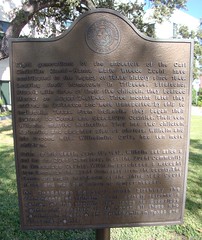
Texas Historical Marker #03128
Los Nogales. This structure was built in 1849 for German immigrant Justus Gombert. The one-room adobe structure, later stuccoed and enlarged, was owned from 1849 to 1859 by Joseph Zorn. After the Civil War, the property was used as a campground for members of the Freemen's Bureau. Ben McCulloch owned the property briefly in 1870. Demolition of the house was prevented as the first project of the Seguin Conservation Society in 1952. Los Nogales (Spanish for walnuts), as it is now known, was designated a Recorded Texas Historic Landmark in 1962. (1989) #3128
415 S River St, Seguin, TX, United States
Subjects

Texas Historical Marker #03129
Los Portales. Local farmer, rancher, and landowner Gregorio Nacenseno Garcia constructed this building as his family's residence about 1855. Built in the territorial style, it features milled wood detailing. Because of its distinctive inset gallery (portal), it became known as Los Portales. In the 1870s, the structure was converted to use as a schoolhouse. The first teacher was Octaviano Larrazola, who later became governor of New Mexico and a U.S. Senator. Recorded Texas Historic Landmark - 1962 #3129
1587 Church St., San Elizario, TX, United States
Texas Historical Marker #03130
Lost Battalion. To the memory of those honored members of the Lost Battalion, native sons, members of the 2nd Battalion, 131st Field Artillery, 36th Infantry Division. On March 3, 1942, these gallant men were taken prisoner by the Japanese on Java, held captive for three and one half years. The living members were released September 2, 1945. To these valiant men living and dead we offer our humble gratitude, August 1951. #3130
?, Wichita Falls, TX, United States