

Texas Historical Marker #07977
Green-Batte House. Now enclosed, original cabin on site was built of logs and bricks both made nearby, 1847. Owner was George Green (1813-1885), prominent early surveyor and soldier in Battle of San Jacinto. Home was among Cameron's first. Boards were added in 1850s. About 1900, R. L. Batte, Sr., an oil mill owner, law officer, and capitalist, purchased home. Over years, both owners added rooms. Batte reared his children and many orphans in this house. Recorded Texas Historic Landmark - 1969 #7977
?, Cameron, TX, United States
Texas Historical Marker #07978
Hope Lutheran Church. Founded in 1890, this congregation began with twelve charter members led by German missionary Julius Schroeder. Early worship services were held in homes and in a local school building. The Rev. H. F. Daude was called to serve the church in 1891, and in 1901 the first sanctuary was erected. It was replaced by a second structure in 1925. Some worship services were conducted in the German language until 1949. A new sanctuary was erected in 1975. The oldest church in Buckholts, Hope Lutheran serves a predominantly German and Czech membership. #7978
?, Buckholts, TX, United States

Texas Historical Marker #07979
Lilac. Primarily a farming and stockraising settlement, Lilac was originally known as Oak Point. Dr. John H. Graves, a dentist and planter, brought his family to Milam County in 1858. The community which developed around his farm was named Lilac in 1883 when a U. S. post office was established. The Graves family continued to reside in the area for generations, donating land for a school, Baptist church, and Methodist encampment. At its height Lilac included two stores, a cotton gin, blacksmith shop, and homes. It declined after a 1921 flood and the Great Depression. (1990) #7979
?, Davilla vicinity, TX, United States
Texas Historical Marker #07980
Little River Baptist Church and Cemetery. Organized in 1849 with eight members. Met in local homes for worship. First building was a small log cabin. Church grew as settlers entered area. In 1855 70 members joined congregation following a three-day revival. Church was center of social life here, as throughout rural Texas. Important members sat in front, in "Amen Pews." Had separate sides for men, women. Present building was finished in 1873 by church together with Masonic Lodge. Cemetery started in early days. The structure was enlarged to present size in 1909. (1970) #7980
FM 485, Maysfield, TX, United States

Texas Historical Marker #07982
Locklin Cemetery. Abigale McLennan Fokes acquired a Mexican land grant here in 1835. Peter M. Mercer established a blacksmith shop in this area in the early 1840s. His burial in 1844 is the first recorded in this cemetery. Fokes later set aside this site for cemetery purposes. The cemetery is believed to be named for the extended family of early area settler William Lawson Locklin. It presently contains about 400 burials including many of this area's frontier settlers and their descendants and veterans of the Texas revolution and Republic of Texas Army. It continues to serve the area. (1994) #7982
FM 486, San Gabriel, TX, United States
Texas Historical Marker #07983
Maysfield United Methodist Church. Though area Methodists met as early as 1847, this church was not formally organized until 1854. Itinerant preachers of the Cameron-Port Sullivan-Maysfield circuit served the congregation, which met in a school building. In 1885, a separate Maysfield circuit was organized, and the Rev. William G. Nelms was appointed pastor. A sanctuary was built in 1897 and stood at this site until destroyed by fire in 1933. The congregation met in the Presbyterian Church until 1952, when the present structure was donated and moved here from Ben Arnold, Texas. Texas Sesquicentennial 1836 - 1986 #7983
FM 485 N / CR 254, Maysfield, TX, United States
Texas Historical Marker #07984
Ben Milam. Benjamin Rush Milam, born in Kentucky 1788. Soldier in the War of 1812. Trader with the Texas Comanche Indians, 1818. Colonel in the Long Expedition in 1820. Empresario from 1826 to 1835. Benjamin Rush Milam participated in the capture of Goliad, October 9, 1835; was killed in San Antonio December 7, 1835 while commanding the Texas forces which later captured the town. Who will follow Old Ben Milam into San Antonio? Erected by the State of Texas 1936 with funds appropriated by the Federal government to commemorate one hundred years of Texas Independence. #7984
Courthouse lawn, Cameron, TX, United States
Texas Historical Marker #07985
Milam County. A part of Robertson's colony in 1834. A part of the municipality of Viesca, 1835. Named changed to Milam, December 27, 1835 in honor of Benjamin Rush Milam, 1788-1835, who fell at San Antonio. After Burleson and Robertson counties were cut off Nashville became the county seat in 1837. The later creation of Williamson, Bell, McLennan and Falls, reduced Milam County to its present size. Cameron, the county seat since 1846. #7985
?, Cameron, TX, United States
Texas Historical Marker #07987
Bristol School. The community's first school was housed in a multi-purpose building erected here in 1870. The Bristol School district was established in 1877. Youth from throughout the area attended Bristol schoolhouse built in 1886 and 1913. A new brick school containing five classrooms and an impressive auditorium and stage was completed here by the U.S. Works Progress Administration (WPA) in 1940. 130 pupils attended the 9-grade, 6-teacher school in 1940-41. The school served the area until 1955. In 1957 its facilities and grounds were deeded to the Bristol Cemetery Association. #7987
?, Bristol, TX, United States
Texas Historical Marker #07988
Site of the Mission Nuestra Senora de la Candelaria. Established by Franciscan missionaries in 1749 with the hope of civilizing and christianizing the Coco, Mayeye, Orcoquiza, Karankawa, and other tribes of Indians. The martyrdom of Padre Jose Ganzabal and the circumstances connected therewith caused the departure of the Indians and the friars and the removal of this mission to the San Marcos River in 1755. Reestablished in 1762 on the Sabinal River for the conversion of the Lipan Apaches with the same name of Nuestra Senora de la Candelaria. #7988
?, San Gabriel, TX, United States

Texas Historical Marker #07989
210 feet north 36 east of this point is the exact site of a Confederate Powder Mill. Erected in 1862 by William Rowen. On April 29, 1863 it was destroyed by an explosion and its owner killed. Also killed was Joshua G. Phillips. #7989
300 Block of N. Rogers St., Waxahachie, TX, United States
Texas Historical Marker #07990
Site of the Mission San Ildefonso. Established by Franciscan missionaries in 1749 with the hope of civilizing and christianizing the Coco, Mayeye, Orcoquiza, Karankawa, and other tribes of Indians. The martyrdom of Padre Jose Ganzabal and the circumstances connected therewith caused the departure of the Indians and the friars and the removal of this mission to the San Marcos River in 1755. Reestablished in 1762 on the Nueces River for the conversion of the Lipan Apaches with the new name of Mission San Lorenzo de la Santa Cruz. #7990
?, San Gabriel, TX, United States
Texas Historical Marker #07991
Mount Zion Baptist Church. Pleasant Grove Baptist Church, organized in 1872 (4.5 mi. W), and Fellowship Baptist Church, formed about 1877 in Minerva (2 mi. N), merged in 1895 to form Mount Zion Baptist Church. The Rev. N. J. Dyer served as first pastor. Services were held in a building relocated to two acres here in 1895. In 1941 membership expanded, a Women's Missionary Union was formed, and the church joined the Milam County Association. Over the years new facilities have been built, including a new sanctuary in 1982. The church continues to be active in missionary outreach and community educational programs. Sesquicentennial of Texas Statehood 1845 - 1995 #7991
?, Rockdale, TX, United States
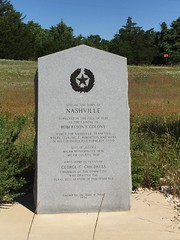
Texas Historical Marker #07992
Site of the Town of Nashville. Surveyed in the fall of 1835 as the capital of Robertson's colony. Named for Nashville, Tennessee where Sterling C. Robertson and many of his colonists had formerly lived. Seat of justice Milam municipality, 1836; Milam County, 1837. First home in Texas of George C. Childress, chairman of the committee who drafted the Texas Declaration of Independence. #7992
?, Gause, TX, United States
Subjects


Texas Historical Marker #07993
George Sessions Perry. The son of Andrew and Laura Perry, George Sessions Perry was born May 5, 1910, in Rockdale. In 1933, he married Claire Hodges of Beaumont. Four years later, he published the first in a long line of fiction and non-fiction stories and novels, many of which were based on people and events from his growing-up years in Rockdale. As a World War II correspondent, he brought first-hand accounts of the war to readers of "The New Yorker" and "The Saturday Evening Post." Perry won several major awards, including the 1941 National Book Award, before his death in 1956-57. #7993
?, Rockdale, TX, United States
Texas Historical Marker #07994
William Persky. (Nov. 21, 1844 - Feb. 9, 1945) A native of Germany, William Persky migrated to the United States with his family at the age of eight. He enlisted in the Confederate army during the Civil War and served time as a prisoner of war. A farmer, Persky lived in Austin and Bell counties before moving to this area in 1925. He lived to be 100, and at the time of his death in 1945 was the oldest resident and the last Confederate veteran of Milam County. #7994
?, Sharp, TX, United States

Texas Historical Marker #07995
S. S. Cyril and Methodius Catholic Church. Through the efforts of fellow immigrant Joseph Russek, many Czech families came to this area of Milam County in the 1880s. The first Catholic Mass in the Maraksville settlement was conducted by a visiting priest in the Kaspar Kubecka home in 1883, and later services were held in other homes. In 1889 the Kubecka family donated land for a Catholic school and church, and the community began raising funds to erect a building. A wooden church structure was completed in 1904 and dedicated in 1905. Named for the patron saints of the Moravian immigrants, the congregation was served by the Rev. K. Kacer. Worship services were conducted in Latin, German, and Czech for many years. The congregation has been associated with parishes in Cyclone and Cameron over the years, and additional church facilities have been built and adapted for various purposes, including a school, rectory, and parish hall. Two burial grounds, known as the Old Marak Catholic Cemetery and the New Catholic Cemetery, were established on land donated by church members. The church has been the social center of the community since its founding, and the annual parish picnic has become a popular event in Milam County. #7995
?, Cameron, TX, United States
Texas Historical Marker #07996
St. John Lutheran Church Cemetery. The small agricultural community of Detmold was settled near the turn of the century by German immigrants. In 1900, local residents Carl Fick, August Boening, and Ernst Richter deeded land at this site for the establishment of a Lutheran church and cemetery. The oldest recorded grave, that of Gottfried Eschberger, dates to 1903. Over 175 graves are located here, many with tombstones bearing German surnames and inscriptions. In 1963, the church congregation relocated to Thorndale, but the cemetery remains as a tangible reminder of the small community. #7996
?, Thorndale, TX, United States

Texas Historical Marker #07997
Saint Michael's Catholic Church. Irish Catholic settlers first came to this area in 1875. The community, first called Irish Settlement, was served by visiting priests beginning in 1879. Eight families joined together in 1885 to build a church, which they dedicated to St. Michael. The predominantly Irish membership was eventually joined by a number of German-American Catholics. A parochial school opened in 1891 and was operated by nuns of various orders until it closed in 1956. St. Michael's Cemetery (.7 mi. E) contains burials dating to 1878 and is maintained by the church. #7997
?, Burlington, TX, United States
Texas Historical Marker #07998
St. Monica's Catholic Church. Founded in 1883, the congregation erected this structure in 1927-28 after a fire had destroyed their previous place of worship. The building exhibits influences of both Palladian and Italian Romanesque architectural styles, an unusual combination for a Roman Catholic church in Texas. Outstanding features include the Doric portico and the Lombard Romanesque style bell tower. Recorded Texas Historic Landmark - 1983 #7998
306 S. Nolan St., Cameron, TX, United States