

Texas Historical Marker #08039
First Methodist Church. Founded on this site, 1844. Rev. Jas. Baldridge, first pastor. Log church was replaced 1860 by most imposing brick one west of Mississippi River. Its bell, minted of 1500 Mexican silver dollars, now is in this building erected 1884. Recorded Texas Historic Landmark - 1965 #8039
Henderson and Market St., Jefferson, TX, United States
.jpg?width=250)
Texas Historical Marker #08040
First National Bank of Jefferson. Thomas J. Rogers (1832-1918), a native of Mississippi, came to Jefferson in 1856. After serving in the Civil War, where he attained the rank of captain, he returned here and in 1868 established a mercantile business in this block. In partnership with his son Ben F. Rogers, he opened private banking facilities in the store in 1896. Eight years later the private bank received a Federal charter, as the Rogers National Bank. Following the death of his father, Ben opened the Rogers State Bank and Trust at another site in this block. It closed in 1928 and was succeeded by the Jefferson Bank and Trust. Later incorporated as the Jefferson State Bank, it remained in operation until 1932. The Commercial National Bank, started in 1907, was also located here until 1920. During the economic depression of the 1930s, the Rogers National Bank remained sound. It was one of the first institutions to reopen without a special examination after President Franklin D. Roosevelt's 1933 closing of the nation's banks. A reorganization in 1950 resulted in the formation of the First National Bank of Jefferson. The present facility, constructed on the site of the original bank, is modeled after T. J. Rogers' building. #8040
Jefferson Square (Polk and Lafayette St.), Jefferson, TX, United States

Texas Historical Marker #08041
Freeman Plantation. This Greek revival plantation home was built about 1850 by Williamson M. (1807-66) and Drucilla (1812-65) Freeman for their children. A cotton and sugar cane planter, Freeman also operated a river freighting business. Materials use din construction of the house include hand-hewn timbers and brick made on the site. In the 1870s the residence was sold to R. E. Rowell (1826-1900), a former Confederate doctor, who later served as county treasurer. A rear wing was added to the home during the ownership of oilman L. S. Flannery (d. 1961), who purchased the property in 1937. Recorded Texas Historic Landmark - 1965 #8041
?, Jefferson, TX, United States
.jpg?width=250)
Texas Historical Marker #08043
Jay Gould Railroad Car. Built in 1888 by the American Car & Foundry Company of St. Charles, Missouri, this was the private railway car of Jay Gould (1836-1892). A native of New York, Gould was a noted financier and the owner of numerous railroad companies, including the Union Pacific, The Missouri Pacific, the International & Great Northern, and The Texas Pacific. This car, named "Atlanta," remained in Gould family ownership until the 1930s. Elaborately designed and elegantly furnished, the Atlanta features two observation rooms, four staterooms, two baths, a butler's pantry, kitchen, dining room, and office. Interior materials include mahogany and curly maple woodwork, silver bathroom accessories, and crystal light fixtures. Following Jay Gould's death in 1892, the car was used by his son, George Jay Gould (president of the Texas and Pacific Railroad), and his wife, actress Edith Kingston. The car later was brought to Texas from St. Louis and used as a family residence during the 1930s East Texas oil boom. Purchased in 1953 by the Jessie Allen Wise Garden Club, it was moved to this site in 1954. It remains a focal point in Jefferson's heritage tourism industry. #8043
200 block W. Austin St., Jefferson, TX, United States
Texas Historical Marker #08044
Home of Capt. Charles G. Graham. Born in Tennessee, Charles Gibbs Graham (1833-1896) came to Texas in 1843 with his parents. He settled in Jefferson about 1850. During the Civil War (1861-1865), Graham served in the Confederate army, earning the rank of captain, and in 1864 was wounded at the Battle of Mansfield. Married in 1868 to Texanah Harris (1848-1927), he had three sons and one daughter. He became a prominent local merchant and cotton broker and in 1885 built this Victorian residence. In 1977 the structure had been continuously owned and occupied by three generations of the Graham family. Incise in base: Restored in 1973 by Mr. and Mrs. Kenneth Craver #8044
409 E. Delta, Jefferson, TX, United States

Texas Historical Marker #08045
Guarding Oak. -- #8045
301 E. Friou St., Jefferson, TX, United States
Texas Historical Marker #08046
19th Century Business House. Fine structure with fanlight transoms. Housed Kahan Saloon in city's river port era. Recorded Texas Historic Landmark - 1966 #8046
123 W. Austin, Jefferson, TX, United States
Texas Historical Marker #08047
Capt. Wm. Perry House. Built in 1850s by Capt. Wm. Perry, officer on one of riverboats when city was largest inland port in Texas. Recorded Texas Historic Landmark - 1966 #8047
Clarksville and Walnut St., Jefferson, TX, United States
Texas Historical Marker #08048
The Homestead. Built in 1851 by slave labor, square nails, broadax-hewn boards. Center society life of city. #8048
410 E. Delta, Jefferson, TX, United States

Texas Historical Marker #08049
The House of the Seasons. Built in 1872 for Benjamin H. Epperson, the House of the Seasons derives its name from the cupola with its stained glass windows that create an illusion of the seasons of the year. The home is a fine example of the transition period between Greek revival and Victorian styles of architecture. In plan and overall form, it is Greek revival. However, the detailing is Victorian with certain Italianate characteristics, such as the tall arched windows, the bracketed cornices, the gallery, the cupola, and the projecting bay windows. The circular opening in the first floor ceiling allows a view of the frescoes in the dome. Benjamin Epperson (1826-1878), a confidant of Sam Houston, was a distinguished lawyer, political leader, and entrepreneur. He served many terms in the Texas Legislature and was elected to the U. s. Congress in 1866, but did not serve because the southern delegations were not seated. When he built the house, Epperson was listed as one of the wealthiest men in the state and was respected as a major influence in Texas politics. Throughout most of its history, the House of the Seasons has served as a residence. It has also been used as a boarding house and as the main building of Jefferson College, a World War II veterans' college. Recorded Texas Historic Landmark - 1965 #8049
409 S. Alley, Jefferson, TX, United States

Texas Historical Marker #08050
Historic Houston Street Victorian Cottage. Situated near ferry that brought riches to early Jefferson. First known owners (1851): John M. and Nancy Dollehite. A distinguished occupant: Mrs. Ernestine Sterne, 1872-1875 Jefferson postmaster. Restored by Mrs. Katherine R. Wise, owner since 1946. Recorded Texas Historic Landmark - 1970 #8050
312 Houston St., Jefferson, TX, United States

Texas Historical Marker #08051
Hudgins-Blake House. Residence with fine door and window styling; large rooms; 13' ceilings; wide board floors. Built during 1855-67 era, by William P. Hudgins, ;the house had a series of short-term owners before W. L. and Mattie A. Blake, prominent Jefferson Central (Negro) School teachers, bought it in 1897; their family owned it for 60 years. Restored by 1957 purchasers, Bill R. and Ella McDonald, house has been preserved since 1961 by Mrs. W. L. (Nellie) Jackson. Recorded Texas Historic Landmark - 1973 #8051
1109 Line St., Jefferson, TX, United States
Texas Historical Marker #08052
Immaculate Conception Church. Church of oldest parish (organized 1866, by Father Jean M. Giraud, French priest) in Dallas Diocese. Among its charities have been three schools and first hospital in the Diocese. This edifice was built in 1867 of hand-finished wood, with tiered steeple, lancet windows. Recorded Texas Historic Landmark - 1964 #8052
Lafayette and Vale, Jefferson, TX, United States
.jpg?width=250)
Texas Historical Marker #08053
Jefferson. Home to the Caddo Indians for centuries, this area of Texas attracted Anglo-American colonists to settle here in the early 1800s. Founded in 1839, Jefferson developed along a double-grid pattern. Daniel Nelson Alley platted the townsite in a true north-south and east-west pattern, while Allen Urquhart drew a plan with streets leading diagonally to and from Big Cypress Bayou. Jefferson was a center of commerce and an important shipping point on the Red River system. Riverboats arrived at the wharves daily, making it a major inland port of entry for Texas pioneers. It was the seat of Cass County from 1846 to 1852, and was named seat of the new county of Marion in 1860. During the Civil War Jefferson served as a major supply center for the Confederacy. The late 1860s saw the imposition of martial law by Federal reconstruction troops, and a devastating fire in 1868 destroyed much of the central business district. Destruction of a massive logjam on the Red River in November 1873 diverted the river's flow and lowered the water in Big Cypress Bayou. The decline of Jefferson's economy due to the loss of its port continued until 20th-century tourism began to revive the town. (1990) #8053
US 59, Jefferson, TX, United States
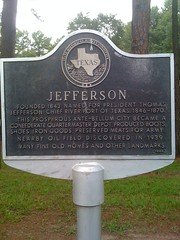
Texas Historical Marker #08054
Jefferson. Founded 1836. Named for President Thomas Jefferson. Chief river port of Texas, 1846-1870. This prosperous ante-bellum city became a Confederate Quartermaster Depot; produced boots, shoes, iron goods, preserved meats for army. Nearby oil field discovered in 1939. Many fine old homes and other landmarks. #8054
?, Jefferson, TX, United States
Subjects
.jpg?width=250)
.jpg)
.jpg)
.jpg)
.jpg)

Texas Historical Marker #08055
Jefferson C. S. A.. (Star and Wreath) Metropolis of commerce and culture for East Texas, Jefferson became important center for Confederate activity. Major quartermaster depot for northern Texas established 1862 supplied clothing and camp equipment. Cotton Bureau Station set up to buy cotton, "life blood of the Confederacy." Two iron works in county made plows, kettles, skillets and cannon balls. Thousands of cattle and sheep were driven to slaughter house for processing and shipment. Boot and shoe factory helped outfit army. Debarkation center for troops leaving Texas. A memorial to Texans who served the Confederacy. Erected by the state of Texas 1963. #8055
200 block of W. Austin, Jefferson, TX, United States

Texas Historical Marker #08056
The Jefferson "Jimplecute". Initials of words "join industry, manufacturing, planting, labor, energy, capital (in) unity together everlasting" headed 1848 paper of E.C. Beazley. Ward Taylor (1832-1894) founded present "Jimplecute", published 1865-1926 by his family. Later owners: Mrs. H. P. Winsborough, Tom Foster, Arthur M. Bower, Mr. and Mrs. Tom Hicks, Mr. and Mrs. Dwaine Dennis.
205 W. Austin St., Jefferson, TX, United States
.jpg?width=250)
Texas Historical Marker #08057
Early Jefferson Lodge Building. Built in the late 1850s, this building first housed the Jefferson Masonic Lodge. A number of businesses were located here during the Civil War, and later it was used by the Knights and Ladies of Honor of Myrtle and the Knights of Honor of Jefferson. Exhibiting elements of the Italianate style, this is the last remaining example of the commercial-row structures which served Jefferson's Dallas Street wharf front during its heydey as an inland port. Recorded Texas Historic Landmark - 1990 #8057
61 Dallas St., Jefferson, TX, United States
Texas Historical Marker #08058
Jefferson Playhouse. Built about 1860 by Robert W. Nesmith, a contractor of stage lines. After several changes in ownership, house was purchased 1869 for Sisters of Charity and used as their convent, hospital and school (called St. Mary's). In 1875, property was bought by Sinai Hebrew Congregation of Jefferson. An auditorium was added, and served as the local synagogue until about 1900. Owned and restored by the Jessie Allen Wise Garden Club. Recorded Texas Historic Landmark - 1965 #8058
Henderson and Market St., Jefferson, TX, United States