

Texas Historical Marker #08434
Samuel Calhoun Cemetery. Established by Samuel Calhoun (1788-1871), native of Abbeville, S.C.; Captain of Cavalry, State of Georgia, during War of 1812. He came to Texas 1845. Bought land in Gordiana Badillo and Jose Ortega grants, in this area. Lived near Calhoun Ferry. Children by his first wife Elizabeth Finney (who died 1836): Martha Ann, Mary, Antonette, John H., Catherine, William. By second wife Catherine O'Brien: Ella and Louis. Had sons in Mexican War and Civil War. Generations of descendants are buried here. Calhoun's tomb was brought (1872) to Cincinnati by steamer "Wren". #8434
?, Huntsville, TX, United States
Texas Historical Marker #08435
Chalk Cemetery. Founded in the 1870s on land owned by Lacy Harrington, this cemetery takes its name from the geologic features of the area. The earliest documented burial is that of Civil War veteran Barney Carroll (1835-1880), although local oral tradition suggests the existence of older, unmarked graves. For more than 100 years, the cemetery has served the Kittrell community, which once boasted a post office, school, church, blacksmith shop, general store, cotton gin, and grist mill. A cemetery association, formed in 1971, maintains the historic graveyard. (1988) Marker is property of the state of Texas #8435
Chalk Cemetery Rd, Riverside, TX, United States
Texas Historical Marker #08436
Site of Cincinnati. Site of Cincinnati, important shipping point in Trinity River navigation. Founded in 1838 by James C. De Witt. Abandoned after yellow fever scourge in 1853 #8436
?, , TX, United States
Texas Historical Marker #08437
Clapp Cemetery. According to local tradition this cemetery was established by deed in 1853 to prevent people of mixed Native American and pioneer American heritage from being buried in other area cemeteries. The first person known to be buried here was Martha Johnston Andrews in 1860. The cemetery is closely associated with the nearby Pleasant Grove Baptist Church. Among the more than 500 burials are many early area settlers (mostly of Scots-Irish ancestry), and veterans of wars ranging from the Civil War to the Vietnam Conflict. Historic Clapp Cemetery continues to serve the local community. #8437
?, Trinity, TX, United States
Texas Historical Marker #08438
Elijah Collard. Born in Virginia, Elijah Collard later settled on the frontier in Kentucky and in Missouri, where he fought in the War of 1812. Collard migrated to Texas in 1833. He was elected to the Consultation at San Felipe in 1835 and served on the General Council. In 1837, when Montgomery County was created, he was named one of the first commissioners. In 1840 he moved to Walker County, where he died. Collard married Mary Stark in Kentucky. They had 11 children. #8438
?, New Waverly, TX, United States
Texas Historical Marker #08439
Cook Springs Baptist Church. Baptists organized here in 1901 and held services at the Guinea Glade School (about 2 mi. NW). Brother Elisha E. Day (1848-1936), pastor of the Woodville Church (about 10 mi. SW), helped establish the congregation and conducted its first services. Charter members included Mr. and Mrs. Jim Cauthen, Mr. and Mrs. W. H. Hill, Mr. and Mrs. Jesse Petree, Mr. and Mrs. John L. Petree, Mrs. Mary Petree, Mr. and Mrs. Peter Petree, Mr. and Mrs. E. H. Tharp, and Miss Ruth Tharp. Mrs. Sarah Brown Gaines, wife of Toliver L. Gaines, organized the Sunday School. In 1903 Mrs. Scisely Wells Cook Rose (1830-1912), also a charter member, gave this spring-fed site for a church building. She asked that the church be named for her late husband, John William Cook, who died in 1864 in the Civil War. Records date from 1907, when Deacon Edwin Harris Tharp (1849-1922) was church clerk and C. W. Matthews was the first called pastor listed. By 1912 a wooden sanctuary was completed. Services were held one weekend per month, Saturday night and Sunday morning. A new building was dedicated in 1945, assembled and furnished largely by the labors of the congregation. Many additions indicate the growth of the church, yet the original spring survives, occupying a revered site. #8439
?, Huntsville, TX, United States
Texas Historical Marker #08440
Hillary Mercer Crabb. Georgia native Hillary Mercer Crabb, a veteran of the militia in his home state, moved his family to the Mexican state of Texas in 1830. While awaiting a land grant they settled in the Sabine District. From there Crabb joined the Texas militia and served in such action as the 1832 Battle of Nacogdoches. In 1835 he was granted property at this site. The rural community that developed around his homesite (400 yds. W) became known as Crabb's Prairie. Crabb was instrumental in the early development of Huntsville and Walker County. A leader in civic and social activities, he became the first probate judge when the county was created in 1846. He also served as a justice of the peace and chief justice (county judge). In 1852 he was elected to serve the unexpired term of State Representative F. L. Hatch. Among Crabb's accomplishments as a legislator was the introduction of a bill to create Madison County. Opposed to secession, Crabb moved to Lavaca County at the outbreak of the Civil War. He later moved to Madison County, where he served as sheriff. His influence as a prominent landowner, church leader, Mason and public servant had a dramatic impact on the early growth of this area. #8440
?, Huntsville, TX, United States
Texas Historical Marker #08441
Cunningham, Minnie Fisher. (March 19, 1882-December 9, 1964) A native of Walker County, Minnie Fisher earned a pharmacy degree at the University of Texas Medical Branch in Galveston in 1901. She worked in a Huntsville drugstore and married attorney B. J. Cunningham in 1902. They moved to Galveston in 1907, and she later lived in Austin and Washington, D.C. A leader in woman suffrage organizations, she was president of the Texas Equal Suffrage Association and helped found the National League of Women Voters. In 1928 she became the first Texas woman to run for the U.S. Senate. Her campaign was unsuccessful, and the year also was marred by the death of her husband. Her career turned toward public relations for government agencies, including the Texas Agricultural Extension Service and the U.S. Department of Agriculture. An activist in the National Democratic Party, she counted President Franklin D. Roosevelt among the many friends who fondly called her by her nickname, "Minnie Fish". In 1944 she ran for Governor of Texas against Coke Stevenson, placing second among nine candidates in the primary. She built a home near this site in 1946 and continued to work in Democratic Party politics until her death at age 82. #8441
?, New Waverly, TX, United States
Subjects
Texas Historical Marker #08442
Dodge. The town of Dodge was established in 1872, when the Houston and Great Northern Railroad built a line through this area. W. J. Johnson gave land for the railroad right-of-way with the stipulation that a station be built at the new settlement. The town was platted along the tracks, with streets named for early pioneers. Dodge soon had a school, two churches, a Masonic lodge, a bank, a cotton gin, and several stores. After 1900 a rail line from an Oakhurst sawmill was built to transport lumber to the main line at Dodge for shipment. #8442
?, Dodge, TX, United States
Texas Historical Marker #08443
Eastham-Thomason House. Constructed between 1859 and 1862 by James H. Thomason, this is one of the oldest homes in Walker County. Byrd Eastham acquired the house in 1869, and his descendants, one of whom married into the Thomason Family, have retained ownership. The Georgian plan home exhibits simple classical revival features in its balustrade, porte cochere, and central hall entrance with sidelights. The triple two-story columns were added in 1912. #8443
906 Ave. M, Huntsville, TX, United States
Texas Historical Marker #08444
Ebenezer Baptist Church. This congregation was organized in 1854 by The Rev. J. W. D. Creath, pastor of the Huntsville Baptist Church, and The Rev. Richard Pace, the pioneer Baptist leader and preacher who served as the first minister at this church. Early worship services were conducted in the homes of members. The first church building was a two-story structure shared with an early Masonic lodge. It was located at the site of Ebenezer Cemetery (6 mi. NE) on land conveyed in 1854 by Jonathan A. and Sarah McGary. The building served until 1880, when the church moved to the West Sandy community. Here services were first held in the sanctuary of Farris Chapel Methodist Church. A separate building, completed in the 1890s, was used until 1916, when the congregation relocated at this site. Throughout its history, Ebenezer Baptist Church has been led by many prominent pastors. It has also been active in the ordination of ministers, including J. S. McGraw, a Civil War chaplain, and Baptist preacher and missionary J. R. Walker, the son of early church leader J. N. Walker. An instrumental force in the development of the community, the church continues to reflect the ideals of its pioneer founders. #8444
?, Huntsville, TX, United States

Texas Historical Marker #08445
Christopher C. Edinburg. Came to Texas 1824. Fought at San Jacinto. Died in 1864 #8445
?, Huntsville, TX, United States

Texas Historical Marker #08446
Emancipation Park. Celebrations of "Juneteenth"--the anniversary of the June 19, 1865 emancipation of Texas slaves--were first held in homes and churches. Later, festivities took place outdoors. By 1915, Huntsville blacks, led by former slave Jane Ward (d. 1933), had moved the annual observance to this site, known as Emancipation Park. Dave Williams, another former slave, organized the Band and Park Association to raise the down payment on the property. In 1933, R. A. Josey, a white businessman, completed purchase of the land for use by the black community. The 9.04 acre site became a city park in 1963. #8446
302 Ave. F, Huntsville, TX, United States
Texas Historical Marker #08447
Hezekiah Faris. A soldier who participated in Texans' victory at San Jacinto. Born in Virginia, brought up in Tennessee, Faris came to Texas to fight for colony's freedom, 1835. Locating bounty land for army service and his headright in this vicinity, he became a local leader and named Faris Chapel for his home church in Tennessee. He married Mrs. Matilda Stevens Roberts; children were Susan (Mrs. James Gillespie) and James Morgan. Family name later became Farris. #8447
?, Richards, TX, United States
Texas Historical Marker #08448
Farris Chapel Methodist Church. Farris Chapel Methodist Church, built 1880 for congregation founded by Hezekiah Farris in 1841. Used by other faiths. First area schoolhouse. #8448
?, Huntsville, TX, United States
Texas Historical Marker #08449
First Christian Church of Huntsville. Joseph Addison Clark, who with his brother, Randolph Clark, later founded Texas Christian University, started this congregation in January 1854. The church originally had a dozen members who met in private homes. For a time, worship services were held in the Walker County Courthouse. First resident pastor was The Rev. Benton Sweeney, who began his ministry here on January 1, 1863. The congregation moved into an existing church structure in 1871 at the corner of 11th Street and Avenue J. In 1901 it was replaced by a new structure at the site. A red brick church was dedicated in 1931 and served until the congregation moved to 19th Street and Avenue R in 1963. The longest pastorate in the church's history was held by The Rev. Edwin Curtis Boynton, who served here on three different occasions, beginning in 1899 and ending in 1949. Membership of First Christian Church has included a number of prominent lay leaders, such as Dr. Joseph Baldwin, who became president in 1881 of what was then Sam Houston Normal Institute. The congregation continues to provide significant service and leadership to the community. #8449
?, Huntsville, TX, United States
Texas Historical Marker #08450
First Baptist Church of Huntsville. One of the earliest Baptist congregations in Texas, this church was organized in 1844 by The Rev. Z. N. Morrell, who served as first pastor. The Rev. J. W. D. Creath, a missionary from Virginia, was the second, and The Rev. G. W. Baines, known now as an ancestor of U.S. President Lyndon Baines Johnson, was the third. General Sam Houston, ex-president of the Republic of Texas, was a member. The congregation dedicated its first church building in 1851; it was on this site. A bell added in the 1850s became a pride of the city. This church hosted the Baptist State Convention five times in the 1850s and 60s. One of the first regular Sunday schools in Texas functioned here by 1864. Blacks in the membership requested and received letters of dismission in 1868, to organize a church of their own. After Sam Houston Normal Institute (now Sam Houston State University) was established in 1879, many of its people came to augment the leadership in this church. The congregation has erected houses of worship in 1891, 1924, and 1954. Throughout its history, it has promoted and financed mission work, and has helped to organize and encourage other congregations. #8450
1229 Avenue J, Huntsville, TX, United States
Subjects

Texas Historical Marker #08451
First Presbyterian Church of Huntsville. Organized by the Presbytery of the Brazos in June 1848, the First Presbyterian Church of Huntsville began with one elder and ten members. Early worship services were held in the county courthouse, the Cumberland Presbyterian Church, and the chapel of Austin College. Property at the corner of Thirteenth Street and Avenue K was purchased in 1855, and the congregation's first sanctuary was erected that year under the leadership of The Rev. Daniel Baker. It continued to serve the congregation until a larger structure was built in 1898-1899. The growth of this church has paralleled the growth and development of Huntsville. Many of the city's civic leaders have been active in the congregation, which has also ministered to area college students through the years. Land at this site was purchased in 1955, and a sanctuary was completed the following year. An educational wing was soon added to fill the needs of the growing Sunday School, and a new sanctuary was built in 1974-75. Throughout its history, the First Presbyterian Church of Huntsville has maintained an active outreach program to its community. #8451
1801 19th Street, Huntsville, TX, United States
Texas Historical Marker #08452
First United Methodist Church of Huntsville. Before 1842 Methodists in Huntsville were probably served by itinerant preachers on the Montgomery County circuit. The Texas Methodist Conference appointed The Rev. Henderson B. Palmer as first pastor of the Huntsville church in that year. Records from 1854 indicate 120 members on the roll, but no permanent church was constructed until 1857. The church purchased the land at this site in 1854, with the deed made out to trustees of the church D. J. Ransom, Thomas Gibbs, Robert Wynne, Williamson Wynne, Thomas Bowdre, and their successors. The first sanctuary was erected under the pastorate of The Rev. A. Davis. By 1888 a new building was needed, so the original was torn down and replaced with a larger one. A wooden structure was later added to the rear to provide room for Sunday School classes. In 1910 fire destroyed the church. Under the leadership of The Rev. E. W. Solomon a new building was begun, and was completed in 1913 during the pastorate of The Rev. R. W. Adams. Fire again damaged the church in 1918, and it was rebuilt the following year. Throughout its history, the First Methodist Church of Huntsville has provided significant service and leadership to the community. #8452
1016 Sam Houston Avenue, Huntsville, TX, United States
Subjects
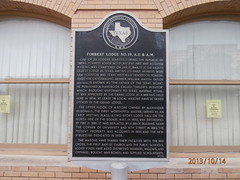
Texas Historical Marker #08453
Forrest Lodge No. 19, A.F.&A.M.. One of 25 lodges started during the Republic of Texas, Forrest Lodge No. 19, Ancient Free and Accepted Masons, was chartered on Jan. 11, 1844. It is the eighth oldest lodge in Texas. Among its early members were Sam Houston and Texas historian Henderson Yoakum. Another outstanding member, William Martin Taylor (1817-1871), is known as "The Father of the Texas Work". He published a handbook called "Taylor's Monitor" which brought uniformity to Texas Masonic ritual. It was approved by the Grand Lodge at a meeting held here in 1858. At least 28 local Masons have attained offices in the Grand Lodge. The upper floor of a store owned by Alexander McDonald, the first worshipful master, served as an early meeting place. A two-story lodge hall on the north side of the square, built in 1850, was destroyed by fire in 1881. It was replaced by a brick building near the corner of University and 11th Street in 1883. The present property was acquired in 1896 and the new structure dedicated in 1909. The Masons have shared their facilities with the Red Cross, the First Baptist Church, and the public schools. Lodge funds have aided distressed members, widows, and orphans; bought war bonds; and supplied scholarships. #8453
1030 12th Street, Huntsville, TX, United States