

Texas Historical Marker #08526
Hillcrest Cemetery. The grave of M. Elizabeth Collins (1813-1867), the earliest marked in this burial ground, predates the settlement of Forney. In 1880 the site was platted and formally set aside as a public cemetery for the growing railroad town. It was later enlarged through additions of adjoining land. Early efforts to provide maintenance for the cemetery included a brief experiment which allowed sheep to graze on the grounds. Burials in Hillcrest Cemetery include those of pioneer area settlers, prominent community leaders, and five known veterans of the Civil War. #8526
?, Forney, TX, United States

Texas Historical Marker #08527
Huff-Park House. Built 1889 by W. L. Huff; bought 1892 by Dr. J. W. Park (1855-1941). Born in Texas, Park studied at Louisville (Ky.) Medical College. As doctors were scarce, he was licensed in 1877, and practiced two years in Egypt (Tex.), then returned to take his degree in 1880. Locating in Kaufman, he engaged in active practice until the day before his death. He married Sallie Wiggins, 1883. After her death, wed Lida Matilda Thompson. Reared six children. Recorded Texas Historic Landmark - 1971 #8527
?, Kaufman, TX, United States
Texas Historical Marker #08528
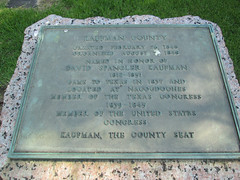
Kaufman County. Created February 26, 1848; organized August 7, 1848; named in honor of David Spangler Kaufman 1812-1851; came to Texas in 1837 and located at Nacogdoches; member of the Texas Congress 1839-1845; Member of the United States Congress. Kaufman, the County Seat
?, Kaufman, TX, United States
Subjects

Texas Historical Marker #08529
Mrs. William P. King. (Frances A. King) (Donor, Land for County seat, Kaufman County) Wife of founder of King's Fort (in 1840), Frances A. King pioneered with great courage and enthusiasm in Republic of Texas. After King's death in 1846, she later (as Mrs. Tabor) entered and won election of Kingsborough for county seat of newly organized Kaufman County. In April 1851 she deeded 75 acres for townsite and a 75-acre timber tract to the county commissioners, James W. Love, J. Larkin Austin and John W. Terrell. King's Fort had grown into village of Kingsborough, later given same name as county. INCISE ON BACK: Erected by Clover Club and Cameo Club #8529
?, Kaufman, TX, United States
Texas Historical Marker #08530
Birthplace of City of Kaufman; Site of King's Fort. (Founded 1840) Established by Wm. P. King and 40 pioneers he led from Holly Springs, Miss.; this was then in Nacogdoches County, Republic of Texas. Caddo, Cherokee, Delaware and Kickapoo Indians roamed the area. Settlers built log cabins inside the fort. When the Indian menace lessened, Kingsboro (or early Kaufman) began to grow. Supplies came from San Antonio, in arduous yearly trips there. Hearing the Texas Republic was joining the United States, King in 1846 got patent to lands at the fort. Although he soon died, his widow carried on his plans for the colony. (1970) Incise on back: Kaufman County Historical Survey Committee #8530
?, Kaufman, TX, United States

Texas Historical Marker #08531
Lawrence Cemetery. In 1873, soon after the Texas and Pacific Railroad built a line through this area, a group of investors formed the Texas Colony Association with the goal of promoting a town. Named for one of the company directors, the town of Lawrence was established and soon boasted numerous homes and businesses. This community cemetery began that same year with the burial of seven-month-old Katie D. Hibbler. Now containing more than 400 graves, including those of many pioneers, the Lawrence Cemetery stands as a reminder of the area's early history. #8531
?, Terrell, TX, United States

Texas Historical Marker #08532
Lone Oak Cemetery. In 1858 passing strangers lost a son by sudden death. Befriending them, Weaver A. Cotton (1822-96) provided gravesite at a tree near log school - church building. Later he gave community burial ground; deed was recorded 1883. Cotton and family and many other pioneers rest here. Incise on back: Marker sponsor: Lone Oak Cemetery Association #8532
?, Kemp, TX, United States
Texas Historical Marker #08533
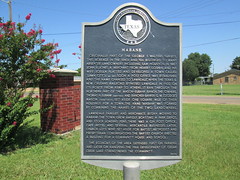
Mabank. Originally part of the George T. Walters Survey, this acreage in the 1840s and '50s belonged to many absentee landowners including Sam Houston. In 1887 John R. Jones, a merchant from nearby Goshen, and his wife Joella platted and developed a town called "Lawn City" (1 mi. NE). Soon a post office was established and the name changed to "Lawndale". When the Texas & New Orleans Railroad bypassed Lawndale in 1900 on its route from Kemp to Athens, it ran through the northern part of the Mason-Eubank Ranch. The owners, Thomas H. Eubank (1859-1952) and rancher-banker G. W. ("Dodge") Mason (1858-1917), set aside one square mile of their holdings for a town. The name "Mabank" was formed by combining the names of the two landowners. Lawndale families and merchants began moving to Mabank. The town grew rapidly, boasting a park, depot, and stock loading pens. There was a gin, post office, cafe, hotel, and several mercantile businesses. Later, church lots were set aside for Baptist, Methodist and Presbyterian congregations. The Baptist church erected a building for a community house and school. The economy of the area depended first on farming and later on ranching. The 1966 development of Cedar Creek Lake strengthened the community. #8533
?, Mabank, TX, United States
Subjects


Texas Historical Marker #08534
McKellar House. Originally built in 1873 by landowner and merchant John Alexander McKellar (1813-1875), this house was remodeled to its current appearance by his son, B. Yancy McKellar (1859-1916) about 1902. Features of the colonial revival structure include two-story giant order columns with modified Ionic capitals on the north and west facades, stained glass windows, and a wraparound porch. The home remained in the McKellar family until 1977. Recorded Texas Historic Landmark - 1989 #8534
303 S Center St, Forney, TX, United States

Texas Historical Marker #08535
Methodist Church, 1844. In 1844 A. J. Beck, Henry Beck, Wilson Fogleman, A. H. Henry, W. T. Patton, Ed. King settled in this vicinity. A Methodist church was organized in 1845 with Rev. J. W. Fields as pastor; A. H. Henry, Ed. King, stewards; A. H. Henry, Sunday School Superintendent. In 1865 a frame building replaced the log church. In 1897 the present building was constructed; the land for the church was donated by W.T. Patton #8535
?, College Mound, TX, United States

Texas Historical Marker #08536
Dick P. Moore House. Built in 1910, this home dates from a period of economic boom enjoyed by the town of Forney from 1873 until 1929. It was constructed for Georgia native Dick Parmenas Moore (1869-1943), a merchant who owned a large amount of cotton acreage in the area. His wife, Nancy (Pinkard), resided here until her death in 1958. The American four-square style house features Classical Revival influences in the porch details. Recorded Texas Historic Landmark - 1985 #8536
306 S Bois d'Arc St, Forney, TX, United States

Texas Historical Marker #08537
Morrow Chapel Cemetery. This burial ground originally served members of the Morrow family, early area settlers. It was first used in 1853 for the interment of Alexander Morrow, an infant. In 1892 his mother Mary Elizabeth Morrow (1812-94) gave the site and adjoining land to the Methodist Episcopal Church, South, who built a sanctuary here named in her honor. The church disbanded in the early 1920s and the chapel later housed classes of the Ola School District. In the 1930s a cemetery association was formed under the leadership of Mrs. Henry LaRoe and Mr. and Mrs. Basil Barton. #8537
?, Kaufman, TX, United States
Texas Historical Marker #08538
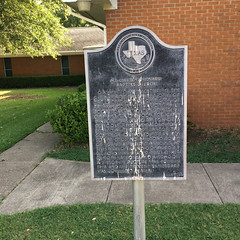
Mount Olive Missionary Baptist Church. Organized in 1860 during the Civil War era, this is one of the oldest active churches of Kaufman County. It was originally located at Mt. Olive Cemetery (1.5 mi. W) in a one-room log cabin which was also used for a school. The Rev. E. S. Colthorp served as the first pastor. The congregation moved here in 1896 to the growing railroad town of Scurry. The first building at this site, on land donated by D. L. Ford, was shared with other denominations and a school. A 2-story structure was built in 1918 and the present sanctuary was completed in 1968. #8538
8975 SH 148 W, Scurry, TX, United States
Texas Historical Marker #08539
Oakland Memorial Park. After Terrell was established as a railroad town in 1873, its citizens saw the need for a community burial ground. In 1878 John R. Terrell sold 7 acres of land for use as a cemetery, and the first burials were those of Peter Meinenger and Dr. G. W. Ridgell. In 1925 the Oakland Cemetery Association was founded to provide perpetual care for the gravesites. The name Oakland Memorial Park was adopted in 1931. Among those buried here are professional artist Frank Reaugh and 20 members of the British Royal Air Force who were killed while in training at Terrell during World War II. #8539
1001 Moore Ave, Terrell, TX, United States

Texas Historical Marker #08540
Poetry Baptist Church. The oldest Baptist church in Kaufman County, organized in 1855 by The Rev. J. J. Butler and The Rev. J. R. Briscoe. Original name was Salem Baptist Church, when the community was called Turner's Point. In 1870, the congregation helped organize the 11-church East Fork Baptist Association, and hosted annual conferences on three occasions. The first structure on this site was built in the mid-1880s. In 1899, the name "Poetry Baptist Church" began to be used, and by 1909, "Salem" had disappeared. The present church sanctuary was built in 1912. #8540
?, Terrell, TX, United States

Texas Historical Marker #08541
Poetry Methodist Church. Originally called Turners Point, this community was founded in 1845 by Elisha Turner. In 1855 the Methodist congregation paid Zachariah Turner and his wife Martha $20 for the original church site. The Rev. J. W. Fields, a Methodist circuit rider living in Kaufman County, witnessed the deed and may have been the organizer and first minister. After the name of the town changed to Poetry, this site was donated in 1886 by J. H. Tate and his wife Nancy. The circuit rider preached only once a month, yet the membership grew to 119 in those early days. #8541
?, Terrell, TX, United States

Texas Historical Marker #08542
Porter Farms. Birthplace of agricultural (cooperative) extension, under lead of Dr. Seaman A. Knapp, U.S. Department of Agriculture. On Feb. 26, 1903, from places offered, a special committee of citizens selected farm of Mr. and Mrs. Walter C. Porter for first "farm demonstration". The project was highly successful in demonstrating methods of farming. Extension is now part of each state land-grant university and adapted in many foreign nations. Porter sons still operate this pioneer farm, "Where science and farmers first joined hands". #8542
?, Terrell, TX, United States
Texas Historical Marker #08543
Public Education in Terrell. On July 3, 1883, the citizens of Terrell voted overwhelmingly to establish and support a system of public schools. The first classes were held in September of that year in buildings that had previously been occupied by various private schools. In 1885, Terrell's first public school building, a three-story brick structure, was completed at the corner of Moore and Ann streets. It burned in 1913, and classes were held at the site of the former Wesley College until a replacement was completed in 1914. Over the years additional facilities have been built as the student population increased. The Terrell School System has been served by able leaders throughout its history. D. A. Paulas served the first superintendent. From 1893 to 1918 the district was headed by S. M. N. Marrs, who went on to become state superintendent of public instruction in 1922. Since its beginning in 1883 and its first graduating class in 1886, the Terrell schools have produced fine community citizens and leaders. Public education in Terrell has had a significant impact on the development and growth of the town and the surrounding area. #8543
?, Terrell, TX, United States

Texas Historical Marker #08544
Prairieville. (site within Mercer Colony land grant) Established by colonizer Johan Reinert Reiersen (1810-64). The 1845 founder of Brownboro (Normandy) in present Henderson County, who settled here in 1847. Elise Tvede Waerenskjold, Reiersen's aide on his magazine "Norway and Texas", spurred migration by continuing to write for Norwegian journals. In 1848 colonists organized a church, Erick Bache in 1853 built a hotel which served as post office and station on two stage lines. By 1857 Prairieville had about 80 Norwegians living as neighbors to Anglo-Americans, Danes, Frenchmen, Germans, Swedes, and other early settlers. #8544
?, Prairieville, TX, United States

Texas Historical Marker #08545
Pyle Prairie Cemetery. John Pyle, a veteran of the Republic of Texas Army, arrived in this area with his family in the 1850s. According to family tradition, this cemetery was begun in 1854 with the death of Pyle's son-in-law J. P. McFarland. The community which grew up in this area was known as Pyle Prairie, and the family graveyard eventually became a community cemetery as friends and neighbors were interred here. Family names on the tombstones reflect the pioneer heritage of the area. Descendants of those pioneer families maintain the cemetery. #8545
?, Pyle Prairie Cemetery, TX, United States