

Texas Historical Marker #08454
Gibbs-Powell House. Built in 1862, this Greek revival house was originally the home of the Thomas Gibbs Family. Used briefly as a rent house and for student housing in the 1880s and 1890s, it was purchased by Judge Ben Powell, II, in 1897. Although altered over the years, the house retains its original character and exhibits stylistic features such as square porch columns and a central entry with transom and sidelights. It became a local history museum in 1984. #8454
1228 11th Street, Huntsville, TX, United States
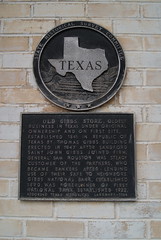
Texas Historical Marker #08455
Old Gibbs Store. Old Gibbs Store, oldest business in Texas under original ownership and on first site. Established 1841 in Republic of Texas by Thomas Gibbs. Building erected in 1847 after Sandford Saint John Gibbs joined firm. General Sam Houston was steady customer of the partners, who became bankers after lending use of their safe to neighbors. Gibbs National Bank, established 1890, was forerunner of First National Bank, established 1922. #8455
1116 Cedar Stree, Huntsville, TX, United States
Subjects


Texas Historical Marker #08456
Henry Opera House. Built in 1880 as lodge hall. First floor soon became a dry goods and grocery store, and second was made into a fine theater by owner, John Henry (1828-97). Here traveling troupes played Shakespeare and dramas of the times. Famous magician Hermann the Great made Texas debut here; and Blind Tom, self-taught Negro piano virtuoso, once performed on this stage. After period as skating rink, opera house showed first motion picture in the city, about 1909. But with building of new theater, it closed and came again to be used for offices and stores. #8456
?, Huntsville, TX, United States

Texas Historical Marker #08457
Sam Houston. Born March 2, 1793, in Rockbridge County, Va.; son of Samuel and Elizabeth Houston. Moved to Tennessee in 1807 with widowed mother and her family. In 1813 joined U.S. Army under Gen. Andrew Jackson, with whom he formed lifetime friendship and political ties. In Tennessee, taught school, kept a store, served in U.S. Congress, was state governor. In 1829, after his young bride left him, resigned as governor and went westward. Settling in 1833 in Nacogdoches, became a leader in cause of Texas independence from Mexico. Elected March 4, 1836, to command the Army of the Republic, engineered retrograde movement that led to victory of San Jacinto, which won Texas independence. President of the Republic, 1836-1838 and 1841-1844, he was senator after annexation. In 1859 he was elected governor, and served until secession. In 1861 he declined to take oath of office in Confederacy, retiring instead after a quarter-century of service to his state. However, he did not oppose Confederate army enlistment of his young son, Sam Houston, Jr. While the Civil War continued, he died on July 26, 1863, at his home, "Steamboat House," Huntsville. With him was his family, to hear his last words to his wife: "Texas--, Margaret, Texas--". #8457
?, Huntsville, TX, United States
Subjects
Texas Historical Marker #08458
Founding of Huntsville and of Historic Indian Post. Located here about 1830, this Indian post was established by Pleasant Gray, adventurer and pioneer from Alabama. Friendly Indians of East Texas had long used the nearby springs and they came to exchange agricultural products and pottery for hides, ponies, and cured meat brought by the western Indians. Soon settlers began to move into the region and by 1836, during the Republic of Texas, the future town of Huntsville had started to spring up here. Gray sold his post in 1846, as he could no longer tend it. He died in 1848. He had one son. #8458
?, Huntsville, TX, United States
Texas Historical Marker #08459
Huntsville Springs. Kentucky native Pleasant Gray and his wife Hannah (Holshouser) left Tennessee with their two children in 1834 and in 1835 settled here on land granted to them as part of Mexico's colonization effort. At that time natural springs located nearby served as a campsite for the area's native Bedias Indians and for immigrants passing through the region. After establishing a trading post near the springs with his brother Ephraim, Pleasant Gray subdivided his land into home and business lots and advertised the property in Alabama, Tennessee, New Orleans, and various steamboat offices. Settlers soon arrived and a town developed which Gray named after Huntsville, Alabama, a former family home. The area's bountiful springs were observed in the Texas chronicles written by British scientist/adventurer William Bollaert in 1843-44. Huntsville was incorporated in 1845. For many years townspeople were accustomed to using spring water captured in a trough near the springs. In 1893-1894 the city dug an artesian well within a few feet of the springs to provide water for municipal distribution and an ice factory. Shortly thereafter the watering trough at the spring fell into disuse, and the spring itself was boarded over. #8459
?, Huntsville, TX, United States
Texas Historical Marker #08460
Jardine-Brown House. Robert and Jane Jardine Browne built east cabin of hewn pine logs on walnut posts, 1849. Site was part of James Jardine (or Jordan) League--1835 land grant surveyed 1838 by Republic of Texas for Jane's uncle. The west cabin of sawed pine logs was added for growing family. James F. Browne, a son born and reared here, added the lean-to bedroom, dining room and detached kitchen. Bought 1940 from the heirs and restored 1966 by Ben H. Powell, Jr. #8460
?, Huntsville, TX, United States

Texas Historical Marker #08461
Old Main Building. First permanent structure built by state of Texas for teacher training--when Joseph Baldwin was president of Sam Houston Normal Institute, L. S. Ross was governor, and A. T. McKinney was chairman of the S.H.N.I. local board. Cornerstone was laid Sept. 23, 1889, with main address by The Hon. O. M. Roberts, Governor when S.H.N.I. was chartered in 1879. Also present was state school superintendent Oscar H. Cooper, a member of the first faculty. Completed in 1891, Main gave institute its first library, 8 large classrooms, a distinctive chapel. Architect: Alfred Mueller. #8461
?, Huntsville, TX, United States
Texas Historical Marker #08462
Mark Manning. Served in American Revolution from Halifax District of North Carolina, his native state. Later lived in South Carolina and in Conecuh County, Ala., coming to Texas at 97 to live with sons who had large land grants and helped to settle Walker County. Some 20 or 30 veterans of the American Revolution followed the nation's westward movement to Texas, perpetuating here their devotion to freedom and liberty. Manning's sons fought in the Texas Revolution before he came to the New Republic. Manning is buried in family cemetery (2 mi. NE). #8462
From the intersection of SH 30 and IH-45 take IH-45 N approximately ? miles to IH-45 and FM 1696, Huntsville, TX, United States
Texas Historical Marker #08463
Martha's Chapel. Robinson's settlement became a stronghold for Methodist activity in Southeast Texas in the early 1830s. By 1839 a campground, church, and school were established here on land given by William and Elizabeth Robinson to The Rev. Littleton Fowler, Superintendent of Methodism in the Republic of Texas. Early clergy who visited and served here included Isaac Strickland, Jesse Hord, Joseph P. Sneed, and Bishop Thomas A. Morris. The Fourth Texas Methodist Conference met here in 1843, with Bishop James O. Andrew presiding. The church and the area became known as Martha's Chapel in 1854 after Martha Palmer, wife of a church trustee, died and was buried behind the church building. During the pastorate of The Rev. James G. Johnson (1812-1887), it was also referred to as Johnson's Chapel. At his death, Johnson bequeathed funds to complete the construction of the third and last place of worship at this site. It was dedicated on October 18, 1887, by Bishop W. W. Duncan. Although the congregation disbanded in the 1930s, ending a century of Methodism in this area, the Martha's Chapel Cemetery remains as a reminder of the area's pioneer heritage. #8463
?, Huntsville, TX, United States
Subjects
Texas Historical Marker #08464
McAdams Cemetery. John McAdams (1815-1892), a veteran of the Texas Revolution, came to what is now Walker County with his wife, Hester (White), about 1840. McAdams became a rancher, planter, and land speculator and later owned and operated a family cotton gin and sawmill. The community that grew up around his landholdings was named McAdams. The cemetery at this site was established in 1849 with the burial of Hester McAdams. The second burial, which took place soon thereafter, was that of John McAdams' sister, Polly McAdams Price. Others interred here include John McAdams; his second wife, Mary Frances (Bankhead) (d. 1905); and many friends, relatives, and neighbors of the family. In addition, McAdams set aside a special section for the burial of his slaves. Upon McAdams' death in 1892, five acres of his estate were reserved for the cemetery. Additional gifts of land have increased the acreage to nearly thirteen acres. Since 1937, the graves have been maintained by the McAdams Cemetery Association. This historic cemetery stands as a reminder of the contributions of an early Walker County family. #8464
?, Huntsville, TX, United States
Texas Historical Marker #08465
McAdams Homeplace. John McAdams, III (1815-92), a veteran of the Texas Revolution and the Republic of Texas Army, moved to present Walker County from the Sabine District. He and his first wife Hester White (1818-49) built this home in the 1840s. He later wed Mary Frances Bankhead (1834-1905). A land speculator, planter, and rancher, he also ran a cotton gin and sawmill. The area around his land became known as McAdams community. A post office was located there from 1888 to 1917. The family cemetery is now a public burial ground. In 1968 the house was moved here from the original site (1 mi. E). #8465
?, Huntsville, TX, United States
Texas Historical Marker #08466
Newport. Founded in 1846 by Joseph Werner, a German emigrant. Abandoned with the decline of Trinity River navigation #8466
?, Riverside, TX, United States
Subjects
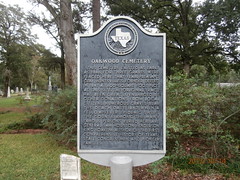
Texas Historical Marker #08467
Oakwood Cemetery. This cemetery existed as early as 1846. For three graves were placed here that year. Pleasant Gray, Huntsville's founder, deeded in 1847 a 1,600-square foot plot at this site. The original tract has been greatly enlarged by other donations from local citizens. Numerous graves bear the death date 1867, when a yellow-fever epidemic swept the county. Among the many famous persons buried here are General Sam Houston; Henderson King Yoakum, author of the first comprehensive history of Texas; state congressmen; and pioneer families. #8467
?, Huntsville, TX, United States
Subjects
Texas Historical Marker #08468
Jesse Parker. In 1822 Jesse Parker moved to the Mexican state of Texas. A veteran of the War of 1812, he represented the Sabine District at the Convention of 1832 in San Felipe de Austin. Three years later he received a land grant in the Washington municipality, now Walker County. A farmer, Parker also served as the Deputy Land Commissioner for Montgomery County. He died in 1849 and was buried on his land. In 1979 he was reinterred here. #8468
?, Huntsville, TX, United States

Texas Historical Marker #08469
Peabody Library Building. The first campus structure to be used exclusively for library purposes, this building was erected in 1902. Built with assistance from the Peabody Education Fund (a philanthropic program created by northern banker George Peabody soon after the Civil War), the library exhibits classical revival and Romanesque revival style influences. Designed by J. L. O'Connor, it served as a library until 1929 and has had other academic uses since that time. #8469
1700 Sam Houston, Huntsville, TX, United States
Subjects


Texas Historical Marker #08470
Town of Riverside. Founded 1872 when Houston & Great Northern Railroad (later, International & Great Northern) was being built into the area. Walker County landowners gave earth, timber, and rock to the road in order to gain shipping facilities. Post office was moved here Feb. 23, 1872, from Newport (6 mi. SE), where wharves were idle when Trinity River was low. Riverside developed churches, a 4-teacher school, and two blocks of businesses, including stores, blacksmith shop, livery stable, saloon, barber shop, 2-story hotel, cotton gin. In the 1920s, Fuller's earth refining plants were built. #8470
?, Riverside, TX, United States

Texas Historical Marker #08471
St. James United Methodist Church of Huntsville. This congregation was organized shortly after the Civil War to serve the newly freed slaves of the Huntsville area. The earliest worship services were conducted in 1868 in the Union Church building at this site. The sanctuary, located on land donatd by local French merchant John Courtade, was shared with a Baptist fellowship. Straughter Hume, Joshua Houston, William Baines, W. Fayle, and William Sinclair, the first trustees of the Methodist Episcopal Church, purchased the Union Church building in the 1870s. Also known as the Freedmen's Church, the original membership included Solomon Jones, Jeff Lockhart, John Clark, Mary Baines, Sarah Smithers, Harriet Hendricks, Eliza Jones, Kizziah Lacy, and others. For many years the structure also served as a schoolhouse. Some of the teachers were Lizzie Stone, Texana Snow, Jacob Cozier, O. A. Todd, and Mollie Flood. A new wooden sanctuary with a belfry was constructed at this site in 1894. Under the leadership of The Rev. Lee of Navasota, the first black presiding elder, the church experienced a period of considerable growth. Since 1868 St. James United Methodist Church has played a significant role in the development of Huntsville. #8471
?, Huntsville, TX, United States

Texas Historical Marker #08472
St. Joseph's Catholic Church. The Rev. Felix Orzechowski, who came to Texas in 1866 to answer an appeal for Polish missionaries, organized St. Joseph's Parish in 1869. The first Catholic church in Walker County, it served the many Polish families who settled this area in the 1870s. Church tradition often sustained the immigrants until they adjusted to life in a new country. Services were held outdoors or in private homes during Father Orzechowski's pastorate. Soon after leaving this parish in 1876, he returned to Poland and was imprisoned by ruling Russian officials for advocating democratic ideals. A frame church building was erected in 1877 under the direction of the Rev. Victor Justiana Linicki, who was a Polish baron before he became a priest. A larger edifice, designed by Tom Lavandoski, was built in 1897, and the original structure was used as a school. The present church was begun in 1905 and dedicated on the feast of St. Joseph, March 19, 1908, during the pastorate of the Rev. Thomas Aloysius Bily (1859-1921). The stately Gothic-style structure, designed by L.S. Green, reflects the European heritage of the parishioners. The parish school was operated until 1951. St. Joseph's Catholic Church continues to minister to descendants of New Waverly's historic Polish community. Recorded Texas Historic Landmark - 1975 #8472
101 Elmore St, New Waverly, TX, United States
Texas Historical Marker #08473
State Penitentiary C.S.A. and Texas Civil War Manufacturing. Inmates, slaves, free men worked in the penitentiary textile factory, main source of cloth goods for Confederate Southwest. Here "king cotton" and wool became millions of yards of cloth and yarn, osnaburgs, uniforms for state troops, Confederate army, needy families of soldiers, cloth sales supported 300 inmates and Union prisoners of war briefly kept there. As Union blockade tightened, army requests flooded in and family cloth distribution rationed. Later financial difficulties and worn machinery caused production lag. A memorial to the Texans who served the Confederacy; erected by the State of Texas 1963 (back side.) TEXAS CIVIL WAR MANUFACTURING, 1861-65 Heavy military demands-90,000 Texas troops, a 2000 mile coastline-frontier to guard-plus reduced imports, caused a fast expansion of Texas industry. Arms and munitions plants were built, and land grants were used to encourage production. Private industry met the need and produced vital supplies for military and civilians. The Confederate quartermaster formed depots and shops for military goods. Production of salt and "king cotton" was hiked to trade for scarce items. Ladies and societies spun and sewed to outfit soldiers. #8473
12th Street, Huntsville, TX, United States