

Texas Historical Marker #08505
City of Crandall. Named for The Rev. C. F. Crandall (1827-1906), Methodist minister who came here from Indiana, 1877, and bought 1800 acres of land. When Texas Trunk Line Railroad built east from Dallas in 1880, he gave bonus for rail service and was first postmaster when post office was created in 1881. Baptists, Disciples of Christ, and Methodists built churches. Townsite plat was recorded in 1889. The city school system was established in 1901. By the early 1900s, town had a lumber yard, several stores, 3 physicians, 3 banks. It remains a center for agriculture and recreation. (1971) #8505
?, Crandall, TX, United States

Texas Historical Marker #08506
Dry Creek Cemetery. Named for a nearby ravine, this burial ground originally served the community of Turner's Point. Located on the stage road between Shreveport, Louisiana, and Dallas, the settlement was established by Elisha Turner in 1845. In the 1870s the town was moved to a new location (1.5 miles southeast) and renamed Poetry. The earliest marked grave at this site is that of Samuel Key (1840-1871). Now closed for burials, the cemetery has 279 marked graves bearing names of the English, Scottish, Irish, and Welsh pioneer settlers of the area. #8506
?, Terrell, TX, United States

Texas Historical Marker #08507
First Baptist Church of Kaufman. Organized Nov. 5, 1871, by Elder J. B. Daniel, assisted by The Rev. A. D. Manion, missionary of East Fork Baptist Association. Nine charter members met in homes or other places until 1883, when the first small white frame church with steeple was erected. Ladies formed a Benevolent Society, 1885. Second church was a classic brick structure, razed by fire on Dec. 18, 1937. The present building was dedicated March 24, 1944. From the original nine, the congregation has grown to such size as to use a staff of four, including a bilingual pastor for its Latin-American mission. #8507
?, Kaufman, TX, United States

Texas Historical Marker #08508
First Baptist Church of Mabank. In 1898 or 1899 nine charter members under The Rev. E. J. Thompson, a missionary for the East Fork Baptist Association, organized Lawndale Baptist Church (1 mi. NE). After the railroad arrived in 1900, the fellowship moved here and became Mabank Baptist Church. Area residents helped erect a meetinghouse at this location which served Baptist, Methodist, and Presbyterian congregations, and housed the public school. As the membership grew a new frame meetinghouse was constructed in 1929. It was replaced in 1973 by a larger brick sanctuary. #8508
?, Mabank, TX, United States

Texas Historical Marker #08509
First Baptist Church of Terrell. The Rev. J. B. Daniel (d. 1884) organized this church in 1876 and served as its first pastor. The congregation started with 13 members, who met once a month for services. The first church building was a small frame structure erected on this block in 1879. The Women's Missionary Society, established the same year, continues to serve this fellowship today. In 1905 a new brick sanctuary was built. The stained glass windows from it were transferred to the present church building, completed in 1956. Membership in this congregation has steadily grown to its current (1975) total of about 850. #8509
?, Terrell, TX, United States

Texas Historical Marker #08511
First Christian Church of Terrell. Organized in 1876 with 18 to 20 charter members, this church met in borrowed quarters until its first sanctuary was built on this site in 1881. That building had become inadequate by 1895, as the membership had grown tenfold, so a new structure was erected, complete with stained glass windows and steeple. Land for the parsonage was acquired in 1913. In 1923 the present brick sanctuary was dedicated, along with its spacious educational facilities. The fine pipe organ with echo and chimes greatly enhances this edifice. #8511
?, Terrell, TX, United States

Texas Historical Marker #08512
First Presbyterian Church of Forney. This church was created by the merger of two congregations. Before the town of Brooklyn was renamed Forney, the Brooklyn Church of the Presbytery of Bacon of the Cumberland Presbyterian Church was organized in 1872. A second congregation, the Forney Presbyterian Church U.S. (Southern), began in 1883, and built a sanctuary on this site. Following the merger in 1919, the name was changed to First Presbyterian Church of Forney. A new red brick structure was dedicated in October, 1925, and the church continues to be a vital part of the Forney community. #8512
?, Forney, TX, United States

Texas Historical Marker #08513
First Presbyterian Church of Mabank. Organized on September 11, 1896, this church began as a small Cumberland Presbyterian congregation in the town of Lawndale (about 2 mi. E of the original Mabank townsite; now within its city limits). Worship services were held in the Lawndale Schoolhouse. In 1900, when the Texas and New Orleans Railroad was built through this area, the town of Mabank was created on the rail line. The citizens of Lawndale relocated to the new townsite. Baptists constructed the first church building in Mabank, which the Presbyterian congregation also used until 1903, when a frame sanctuary was completed under the leadership of The Rev. Newton P. Patterson. The name was changed to First Presbyterian Church, USA, of Mabank in 1904. During the depression of the 1930s the church experienced a period of inactivity. By the 1940s, however, the congregation was reorganized. The construction of a nearby lake in the 1960s brought economic revitalization and increased population to the area. The membership of First Presbyterian Church grew as a result, and the congregation called its first full-time pastor in 1977. It continues to serve the community with a variety of programs. #8513
?, Mabank, TX, United States

Texas Historical Marker #08514
First Presbyterian Church of Terrell. This congregation traces its history to two Presbyterian churches formed in the 1870s. A Cumberland Presbyterian Church, formerly located in the town of Lawrence, and the First Presbyterian Church in Terrell, also called the Old School Presbyterian Church, joined in 1904 to form a united congregation. A sanctuary was built at Rockwall and High streets in 1907-08 and was replaced in 1958 by a new structure at this site. Throughout its history, the First Presbyterian Church of Terrell has been an integral part of the life of the city. #8514
?, Terrell, TX, United States

Texas Historical Marker #08515
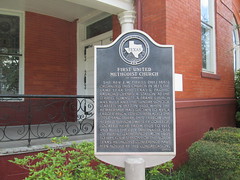
First United Methodist Church. Organized in February of 1845 as the Kingsborough Methodist Episcopal Church, South. The Rev. Wm. K. Wilson was first pastor. In 1850 Kingsborough (county seat) was renamed Kaufman. Present site was purchased and first building erected 1857, with The Rev. J. A. Scruggs as pastor. The second building, a traditional steepled, white frame structure, was built 1876 at cost of $400, with The Rev. O. P. Thomas as pastor. Present brick building was erected 1909 at a cost of $13,000. The Rev. A. R. Nash was pastor. It was redecorated 1968, with The Rev. E. H. Cole, pastor. #8515
?, Kaufman, TX, United States
Texas Historical Marker #08516
First United Methodist Church of Terrell. The Rev. J. W. Fields (1817-1886) organized this church in 1873, the same year the Texas & Pacific Railroad opened a station at the Terrell townsite. A frame church was built and the Sunday School started in 1877. In 1900, when the membership had grown to 495, a larger brick edifice replaced the first sanctuary. This fellowship helped support Wesley College, located here from 1905 to 1911, and built the City Tabernacle, site of public gatherings from 1905 to 1915. Four sessions of the North Texas Methodist Conference have been hosted by this congregation. #8516
?, Terrell, TX, United States

Texas Historical Marker #08517
Forney. A Native American trail, sometimes referred to as the Kickapoo Trace, and early Anglo-American roads traversed this area prior to the settlement of the pioneer families of Isaac Briscoe and Jacob Sheltman in the mid-1840s. By 1871 a village called Brooklyn, which included a combined school, church, and lodge building, general store, saloon, and blacksmith shop, was established about one mile south of here. Brooklyn's business and housing activity shifted here after the Texas & Pacific Railroad extended its line through this area in 1873. A post office opened in 1873 and the town was renamed Forney for noted railroad official John W. Forney. By 1891 Forney had become a bustling town with more than 50 business establishments including a bank, opera house, and two hotels. Ranch and farm produce, including cotton, Bois d'Arc wood products, and the area's nationally recognized blackland prairie hay were shipped by rail at Forney and the town prospered. In the 1920s U.S. Highway 80 (The Dixie Highway) and an interurban railroad came through the town. Beginning with the Great Depression Forney's agricultural economy declined for several decades. Eventually Forney experienced a revival of growth as a bedroom community of Dallas, Texas. #8517
?, Forney, TX, United States

Texas Historical Marker #08518
Forney High School Building. Forney's first schoolhouse was built here about 1868, and its first general store was built nearby by pioneer settler John C. McKellar in 1871. This building was erected by the Works Progress Administration (WPA) in 1938-39. Designed by WPA architect Hoke Smith, the Spanish Colonial revival style structure features a tile roof, multi-light windows, buff brick, and wrought iron and cast stone details. A high school was housed here until 1974 and a middle school until 1993. #8518
?, Forney, TX, United States

Texas Historical Marker #08519
Forney Independent School District. Public education began in Forney (then named Brooklyn) about 1868 when a 16' x 16' room was built, serving as both a schoolhouse and Union church. Forney School District No. 9, formed in 1876, was part of a county-wide school system. In 1889 the first structure was replaced by a 2-story wooden school building. In 1899 the Forney Independent School District was formed. An imposing brick and stone building superseded the wooden structure in 1903. The present edifice was erected in 1938 by a WPA grant. Recent activities included the restoration of the 1938 Forney High School building. #8519
?, Forney, TX, United States

Texas Historical Marker #08520
The Forney Messenger. The Forney Messenger is the oldest newspaper in continuous operation in Forney. Founded in 1896 by M. J. Cox, the first issue was printed on April 16 and contained a personal column, school news, a local church directory, and news from surrounding communities. In 1919 the Messenger was merged with the Forney News and was known as the Forney News and Messenger until 1921, when it again became the Forney Messenger. For many years the Messenger has provided residents of Forney and the surrounding area with news of local interest. Texas Sesquicentennial, 1836 - 1986 #8520
?, Forney, TX, United States

Texas Historical Marker #08521
Fox Cemetery. Set aside as a burial ground by Joseph Fox. His daughter Sarah K. first person buried here, Aug. 24, 1852. Grounds are cared for by descendants, friends. Jos. Fox was born 1800 in London. Died in Prospect, Texas, 1872. Was physician. Many prominent early settlers interred here. #8521
?, Kaufman, TX, United States

Texas Historical Marker #08522
The Old Graveyard (Pioneer Cemetery). This small historic cemetery, also called the "Irvine Family Cemetery," predates the establishment of Terrell by more than 20 years. The first burial was that of Robert Alexander, nephew of W. D. Irvine, in 1851. Now located within the city limits, the cemetery began on land owned by the pioneer Irvine family. It contains the graves of Irvine family members, their neighbors, and descendants, many of whom were responsible for founding this community. The cemetery also contains several unmarked graves. The last known burial to take place here was in 1956. #8522
?, Terrell, TX, United States

Texas Historical Marker #08523
Greenslade Drug Store. Built 1891 by R. C. Dansby; of iron, masonry, wood. Sold to Smith E. Greenslade, 1919; still in Greenslade family. Exposed iron beams support the roof. Windows have upper and side panels that fold for ventilation. Modified Spanish architecture. Recorded Texas Historic Landmark - 1968 #8523
?, Kaufman, TX, United States


Texas Historical Marker #08525
W. E. Henderson Home. Built 1898 by William Ebenezer Henderson (1847-1944), who moved from Louisiana to Texas (1862) in an ox-drawn barouche. Going to work at 19 for a cattleman, he became in time a prosperous commission dealer-- shipping cattle to St. Louis, where he bought the fine mantels and tile for this house. Structure is of select heart pine from the big timber of the Beaumont area. Rooms are large and lofty, with 12-foot ceilings. Recorded Texas Historic Landmark - 1970 #8525
?, Terrell, TX, United States