

Texas Historical Marker #16938
Old Gray Mare Band. The 142nd Infantry Band of the 36th division of the U. S. Army began during the first World War. Band leader R. Wright Armstrong reformed the group in Brownwood in Nov. 1921. They played at such notable events as American Legion Conventions in New Orleans and San Francisco and the 1923 inauguration of Gov. Pat Neff, who proclaimed them the official band of texas. The band marched behind an actual mare and rider into hotels, state capitol buildings and democratic party national conventions in Houston (1928) and Chicago (1932). Wearing distinctive red silk shirts, yellow bandanas, patent leather boots and sombreros, the Old Gray Mare Band spread the spirit of texas across the state and nation. #16938
?, Brownwood, TX, United States
Texas Historical Marker #16939
Van Zandt County Poor Farm. In the early days of Van Zandt County, families, churches and charitable organizations took care of people in need. After the civil war, the high number of indigents forced an addendum to the state constitution making care for the poor the responsibility of each county. In 1877, the Van Zandt County commissioners court authorized a search for an appropriate site for a county poor farm. After seven years, in August 1884, County Judge John S. Spinks appointed several men to find and purchase land near canton to establish a poor farm. The site chosen contained 339 acres about four miles south of canton. M. V. Burns was the first appointed superintendent paid by the county to oversee the farm, clean up the land and complete improvements to the site. Mr. Burns resigned in 1885 and Hugh Guinn took over to complete his term. The first known residents of the poor farm were two ladies declared paupers in march 1886 by the commissioners court. Other residents included the elderly, widows with children who had no means of support and those convicted of petty crimes who would work at the farm to pay off their fines. In 1901, County Judge John W. Davidson authorized the sale of the poor farm and bought a larger site in the same area. A 14 by 16 feet calaboose was built on the new site in 1901 for the safekeeping of convicts at night. The structure is still standing. After the poor farm was established, paupers were buried in the poor farm cemetery. The farm was operational until October 1928. The Van Zandt County poor farm provided poverty-stricken citizens with shelter, food and a ready means of subsistence for 42 years.
17018 State Highway 19, Canton, TX, United States
Texas Historical Marker #16941
Southside School. #16941
211 West Lee Street, San Marcos, TX, United States
Subjects
Texas Historical Marker #16942
First United Methodist Church. #16942
800 West 5th, Fort Worth, TX, United States
Texas Historical Marker #16947
Holy Rosary Catholic Parish. #16947
1416 George Street, Rosenberg, TX, United States
Texas Historical Marker #16948
St. John's United Church of Christ Cemetery. #16948
?, Burton, TX, United States
Subjects
Texas Historical Marker #16949
First Baptist Church. In 1940, 28 charter members organized a Baptist church to meet the spiritual needs of the local community. Though worshippers had met for services in the area since 1877, the community, then known as Prairie View, had lacked an organized church for a number of years. Interest in forming a church was renewed when Central Baptist Church of Port Arthur led a vacation bible school for the community and local residents organized and began attending Sunday School. The Rev. J.B. Perry was the first pastor for the congregation, which was first known as Blandale Baptist Church. Other nearby Baptist congregations supported the new church through donations and service. After Prairie View changed names to Bridge City, following completion of the Rainbow and Cow Bayou swing bridges, the institution became known as Bridge City Baptist Church, before taking its current name in 1948. In 1953, a new sanctuary was constructed at this location. The congregation has historically been active in the community, serving families in financial need and offering use of its facilities for public education and as a staging area and shelter following hurricanes. The church also established a school, which began operating in 1958. Additionally, members have focused on missions, establishing Harmony Baptist (later Second Baptist) and Liberty Baptist Churches. Today, First Baptist Church continues to serve as a spiritual and social leader for Bridge City, a community with which it is inextricably connected. #16949
200 West Roundbunch Road, Bridge City, TX, United States
Texas Historical Marker #16950
Simonton School. #16950
34935 FM 1093, Simonton, TX, United States
Subjects
Texas Historical Marker #16951
Center Point School. #16951
215 China Street, Center Point, TX, United States
Subjects
Texas Historical Marker #16957
Lufkin Daily News. #16957
300 Ellis St., Lufkin, TX, United States
Subjects

Texas Historical Marker #16963
Bankhead Highway Through Arlington. #16963 [full inscription unknown]
?, Arlington, TX, United States
Texas Historical Marker #16964
St. Matthew Catholic Parish. Following the establishment of Jourdanton in 1909, many catholic families of hispanic, Irish, Polish, and German descent expressed interest in building a church. Bishop J.W. Shaw traveled from San Antonio to assist in preparing a new church building. In 1912, the church held dedication ceremonies for the mission-style brick building on land donated by the Central Townsite Company. For the next decade, the parish grew rapidly and received guidance from Rev. Manuel Moreno and other priests in the area. One leader, Father Kasper, assisted the Czech parishioners by helping to establish K.J.T and K.J.Z.T. Organizations for Czech men and women. In 1925, Rev. Smith became the first resident pastor and the first church rectory and Parish Hall was built in 1926. Father Smith contributed much to the parish, including organizing the first 4th of July picnic and founding the group, Children of Mary. Under Father Benz’s leadership, a second parish hall was built in 1934, and a catholic school opened in September 1937, but was forced to close in 1940. In May 1961, under Father Lieb’s direction, a new church was built utilizing the original cast iron bell. A new parish hall was built in 1979. The St. Matthew Catholic Parish contributed to many aspects of the community, including participating in fraternal, cultural, and religious groups such as a Czech Sokol gymnastics group in the early 1940s, the Sociedades Guadalupanas for Catholic Women, Knights of Columbus, Ladies’ Altar Society, Catholic Daughters of Americans, and youth organizations. The church continues to serve their neighbors with a soup kitchen and thrift store, and remains a beacon of light in the community. (2011) (Marker No. 16964)
, Jourdanton, TX, United Kingdom
Texas Historical Marker #16965
Summerfield Methodist Church. #16965
7078 Tryon Rd, Longview, TX, United States
Subjects
Texas Historical Marker #16967
Longview Womack High School. #16967
?, Longview, TX, United States
Subjects
Texas Historical Marker #16968
Post Oak Christian Methodist Episcopal Church. DURING RECONSTRUCTION, AFRICAN AMERICANS LIVING IN THE AREA FORMED COMMUNITIES AND CHURCHES. MANY OF THESE CHURCHES SERVED AS A HOUSE OF WORSHIP AND AS THE POLITICAL AND SOCIAL CENTER OF THE COMMUNITY. IN 1878, NEAR THE TOWN OF EASTON, A GROUP OF AFRICAN AMERICAN CHRISTIANS JOINED IN FELLOWSHIP TO FORM THE POST OAK COLORED METHODIST EPISCOPAL CHURCH. ORIGINAL FOUNDERS INCLUDED BROS. JEFF PORTLEY, JESSIE DANIELS, SR., AND DANIEL BRADFORD. THE FIRST MEMBER ON THE MEMBERSHIP ROLL WAS CHARLIE LUCAS FROM 1880. THE CONGREGATION FIRST ORGANIZED UNDER THE PASTORATE OF REVEREND M. BUTLER. OVER THE YEARS, THE CHURCH WAS GUIDED BY REVEREND ELI JOHNSON, REVEREND T. H. RANDALL AND REVEREND V. McCALISTER. A LOG CABIN SERVED AS THE FIRST PLACE OF WORSHIP UNTIL THE GROWTH IN MEMBERSHIP LED TO THE CONSTRUCTION OF A BUILDING BETWEEN 1896 AND 1899 MEASURING 14 BY 28 FEET. SEVERAL ACRES WERE PURCHASED FROM COUNTY JUDGE E. M. BRAMLETTE IN 1912. IN THE LATE 1930s AND EARLY 1940s, A NEWER FRAMED BUILDING WAS CONSTRUCTED. IN THE 1970s, COMMUNITY GROWTH ENABLED THE CHURCH TO BUILD A LARGER, MODERN BRICK STRUCTURE. THE CHURCH CHANGED ITS NAME IN MAY 1954 TO POST OAK CHRISTIAN METHODIST EPISCOPAL CHURCH. FROM ITS INCEPTION, CHURCH SERVICES WERE ONLY HELD ONCE A MONTH. BY THE 1960s, MEMBERS DESIRED TO MEET EVERY SUNDAY. THE POST OAK CHRISTIAN METHODIST EPISCOPAL CHURCH SERVES AS A REMINDER OF THE HISTORY AND HERITAGE OF A COMMUNITY AND CHURCH CREATED BY AFRICAN AMERICAN LANDOWNERS AND RESIDENTS OF EASTON AND GREGG COUNTY. #16968
2675 FM 2906, Easton, TX, United States
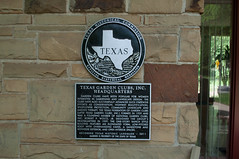
Texas Historical Marker #16969
Texas Garden Clubs, Inc., Headquarters. #16969 [full inscription unknown]
3111 Old Garden Road, Fort Worth, TX, United States
Subjects
Texas Historical Marker #16975
St. James Lutheran Church. #16975
23932 US 290, Harper, TX, United States
Subjects
Texas Historical Marker #16987
La Mota de Olmos Cemetery. #16987
1631 E. FM 2295, Benavides, TX, United States
Subjects
Texas Historical Marker #16994
First Baptist Church. #16994
306 Palo Pinto St., Weatherford, TX, United States
Texas Historical Marker #16996
H. P. Luckett House. #16996
1402 Church St., Bastrop, TX, United States