

Texas Historical Marker #16997
Gustav Blersch House. #16997
213 Washington Street, San Antonio, TX, United States
Subjects

Texas Historical Marker #17001
Goodrich School. #17001
234 Katie Simpson, Goodrich, TX, United States
Subjects
Texas Historical Marker #17004
Cementerio del Rio. #17004
2801 FM 621, San Marcos, TX, United States
Subjects
Texas Historical Marker #17005
Rice University. William Marsh Rice (1816-1900) came to Texas in 1838 and through extensive entrepreneurship became one of the state's wealthiest men. Rice envisioned a polytechnic school as his philanthropic legacy. The State of Texas chartered the William M. Rice Institute for the Advancement of Literature, Science and Art on May 19, 1891. Rice delayed the project by stipulating that it open after his death. When he died under suspicious circumstances, investigations and legal struggles jeopardized the school's future. After his estate was settled, development began for the first university in Houston. Trustees had a multi-million dollar endowment but little experience in education. The first president, Dr. Edgar Odell Lovett of Princeton University, spent months visiting experts around the world. His experiences helped him broaden Rice's vision to a university uniting teaching and research. In 1909, the Boston firm of Cram, Goodhue and Ferguson developed the campus plan, combining classically-inspired architecture with Mediterranean influences. On Sep. 23, 1912, classes opened with 59 young men and women and four buildings. Rice was a charter athletic member of the Southwest Conference (1914) and quickly achieved academic accreditation, with the first class graduating in 1916. Two world wars and the Great Depression slowed growth. In 1945, trustees broadened the curriculum and initiated a substantial building program. Renamed Rice University in 1960, the school has hosted presidential visits, including John F. Kennedy's in 1962 when he urged the nation's space program to explore the moon by the end of the decade. Rice boasts many distinguished alumni and faculty, including Nobel and Pulitzer Prize recipients. In 2012 Rice University embarked on its second century of producing "leaders across the spectrum of human endeavor." 175 Years of Texas Independence * 1836-2011 #17005
?, Houston, TX, United States
Subjects


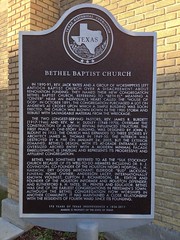
Texas Historical Marker #17014
Bethel Baptist Church. #17014
801 Andrews Street, Houston, TX, United States
Subjects
Texas Historical Marker #17015
New Zion Temple Church - Worldwide Fellowship, Inc.. #17015
1601 Ruthven Street, Houston, TX, United States

Texas Historical Marker #17017
Jourdanton I.S.D. JOURDANTON INDEPENDENT SCHOOL DISTRICT FROM A TINY SCHOOL TO AN OFFICIAL, RECOGNIZED SINGLE-CAMPUS CONCEPT, THE JOURDANTON INDEPENDENT SCHOOL DISTRICT HAS REMAINED DEDICATED TO EDUCATION AND COMMUNITY. IN THE EARLY 20TH CENTURY, COUNTY SCHOOLS SUCH AS THE HILBURN SCHOOL NORTHWEST OF JOURDANTON SERVED THE AREA. SOON THE GROWING ENROLLMENT AND NEED FOR TEACHERS PROMPTED THE COMMUNITY TO APPEAL TO THE LEGISLATURE. IN 1911, THE STATE LEGISLATURE AUTHORIZED THE CREATION OF THE JOURDANTON INDEPENDENT SCHOOL DISTRICT, THE FIRST IN ATASCOSA COUNTY. RESIDENTS QUICKLY PASSED A BOND ELECTION TO BUILD A SCHOOL AND PARK SYSTEM. A THREE-STORY BRICK BUILDING WAS ERECTED IN THE CENTER OF JOURDANTON. A FOOTBALL FIELD AND HIGH SCHOOL BUILDING WERE ADDED ON ADJOINING LOTS. IN 1938, A GYMNASIUM WAS COMPLETED WITH ASSISTANCE FROM THE WORKS PROGRESS ADMINISTRATION. TO ACCOMMODATE A GROWING DISTRICT, A NEW CAMPUS WAS CONSTRUCTED ON THE SOUTHERN EDGE OF TOWN IN 1953 WHERE IT REMAINS TODAY. OVER THE DECADES, JOURDANTON INDEPENDENT SCHOOL DISTRICT OVERCAME MANY OBSTACLES. WITH THE OUTBREAK OF WORLD WAR I AND II, THE SCHOOL LOST EDUCATORS AND ADMINISTRATORS TO MILITARY SERVICE AND ASSISTED THE WAR EFFORT BY HOLDING WAR BOND DRIVES ON CAMPUS. MANY STUDENTS FROM THE DISTRICT ATTENDED COLLEGES AND THEN RETURNED TO TEACH THE NEXT GENERATION OF STUDENTS. OTHER GRADUATES HAVE GONE ON TO BECOME CHEFS, LAWYERS, RESEARCHERS, WRITERS, AND ATHLETES. THROUGH COMMITMENT TO EDUCATION AND ACHIEVEMENT, JOURDANTON INDEPENDENT SCHOOL DISTRICT HAS CEMENTED ITS REPUTATION FOR EXCELLENCE FOR A VIBRANT AND GROWING COMMUNITY. 175 YEARS OF TEXAS INDEPENDENCE * 1836-2011 #17017
200 Zanderson Ave., Jourdanton, TX, United States
Texas Historical Marker #17020
Eldorado Ballroom. #17020
2310 Elgin Street, Houston, TX, United States
Subjects
Texas Historical Marker #17024
Mineral Springs Primitive Baptist Church. On Sunday, May 30, 1886, Elder Wilson Hufner and W. L. Rogers founded this church in nearby Post Oak. Charter members were J. O. Soap, his wife, Rebecca, and Mrs. Fannie May. The church first joined the Village Creek Association, but in 1899 joined 15 other area churches to form the Duffau Association, the largest Primitive Baptist Church Association in Texas. A church house built in Post Oak in 1906 was moved to this site ca. 1920. In 1948, the Roden family donated eight acres to the Duffau Association. Beginning in 1955, Elder Berley Welch and his wife, Treasure, of Wichita Falls founded the Texas Youth Camp and held summer camps here. The present sanctuary was moved here in 1960. #17024
1104 Hereford St., Glen Rose, TX, United States
Subjects
Texas Historical Marker #17025
Pleasant Grove Cemetery. Malissa (Dodson) Sides became the first person to be buried on this site in March 1891. Believed to have been half Native American, Mrs. Sides and her Cherokee half sister Ellen Murphy survived the U. S. government relocation of the tribe during their youth. The pair came to Collin County from Indian Territory with Malissa's husband Henry L. Sides. In October 1891, charter Methodist church members Franklin J. and Nancy (Van Hues) Rominger donated an acre of land including Mrs. Sides' gravesite to the trustees of the Pleasant Grove Methodist Episcopal Church, South, to be used as a public burial ground. The Romingers, Henry Sides and Ellen Murphy are all interred in the cemetery, as are descendants of these and other pioneer families. For many years cemetery trustees raised funds and maintained the grounds through stew suppers and annual decoration days. A 1996 count revealed more than 1,000 graves, most with markers of some kind. The graves of 141 infants in the old north section bear witness to the harsh conditions of pioneer life; 7 Confederate and 52 other veterans of U. S. and international conflicts are interred here. Pleasant Grove Cemetery continues to serve the area. (1998) #17025
?, Princeton, TX, United States
Subjects
Texas Historical Marker #17027
Calloway Cemetery. #17027
12600 Calloway Cemetery Rd., Euless, TX, United States
Subjects
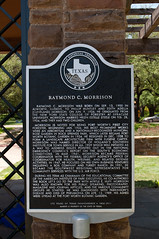
Texas Historical Marker #17028
Raymond C. Morrison. #17028
3220 Rock Springs Road, Fort Worth, TX, United States
Subjects
Texas Historical Marker #17038
Grace Episcopal Church. #17038
811 S. Main St., Georgetown, TX, United States
Subjects
Texas Historical Marker #17042
Alexander Dobkins Family Cemetery. Pioneer area settlers Alexander Dobkins (1815-1869) and his wife Mary (1818-1880) migrated to Texas from Tennessee in 1852. Ordained as a minister in the nearby Bear Creek Baptist Church, Alexander also served as postmaster for the local community of Estill's Station during the Civil War. His grave is the earliest marked at this site, originally part of his 200-acre farm. Also buried here is his son William C. Dobkins (1841-1928), who served the area as a physician, businessman, and civic leader. Other graves include those of family members and friends. (1981) #17042
?, Euless, TX, United States
Subjects
Texas Historical Marker #17050
Thurber Cemetery (REPLACEMENT). Encompassing slightly more than nine acres, the Thurber Cemetery documents the multi-ethnic Thurber community. The graveyard was divided into three sections with separate entrances: Catholic, Protestant, and African American. There are more than 1,000 graves here, including almost 700 unmarked burials. The oldest tombstone is that of Eva Chapman, an infant who died in 1890. More than half the total graves are those of infants and children, a reflection of such epidemic diseases as scarlet fever, typhoid fever, diphtheria, and whooping cough. #17050
?, Thurber, TX, United States
Subjects
Texas Historical Marker #17057
Thomas Edison Dixon, M.D.. (1890-1958) Thomas Edison Dixon, M.D., was an African-American physician committed to serving God and his community in a time dominated by white men. Dixon, or "Tommy" to friends and family, was born in August 1890 in Hearne, Texas. He first attended Bishop College in Marshall and then Meharry Medical College in Nashville in 1912. After graduating in 1916, he was granted a medical license in the State of Texas and began practicing medicine in Mart, Texas. Around 1927, Dixon relocated his practice to downtown Temple during a time when there were minimal health care services for African-Americans. It was here that he gave special attention to pediatrics and obstetrics. In addition to his professional work, Dixon played a prominent role in the community's churches and organizations. He was chairman of the board of trustees and deacon of Mt. Zion Missionary Baptist Church, a regular contributor to many of Temple's black churches, and was also involved with the Boy Scouts, the Negro Civic League and the Progressive Voters League. Specific instances of his influence on the community include his sizable contribution with other physicians to the NAACP's "Fighting Fund for Freedom" in 1954, which aimed to eliminate racial discrimination in the U.S., and his sale of building sites to the city at reasonable costs for the purpose of constructing schools. At the time of his death, Dixon was the only African-American physician practicing in Bell County. Dr. Dixon dedicated his life to the people of Temple for almost 30 years and is remembered for being driven by love and a profound sense of duty. 175 Years of Texas Independence * 1836-2011 #17057
1717 East Avenue J, Temple, TX, United States
Subjects

Texas Historical Marker #17064
Union Missionary Baptist Church. #17064
520 Houston Street, Jefferson, TX, United States