
41 out of 78 (52%) plaques have been curated
55 subjects all or unphotographedGender Diversity
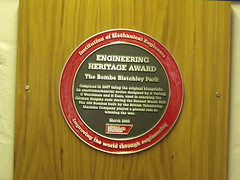
Engineering Heritage Award The Bombe Bletchley Park Completed in 2007 using the original blueprints. An electromechanical device designed by A Turing, G Welchman and H Keen, used in cracking the German Enigma code during the Second World War. The 200 Bombes built by the British Tabulating Machine Company played a pivotal role in winning the war.
Block B - Bletchley Park , Bletchley, United Kingdom
Subjects


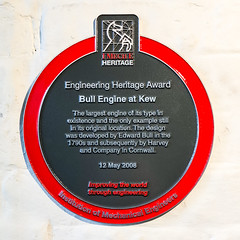
The Bull Engine The largest engine of its type in existence and the only example still in its original location. The design was developed by Edward Bull in the 1790s and subsequently by Harvey and Company in Cornwall.
Kew Bridge Steam Museum, Green Dragon Lane, Brentford TW8, London, United Kingdom
Subjects

Tower Bridge opened 1894. Built to the design of Sir John Wolfe Barry the whole mechanical construction is unique in the world and the acme of steam and hydraulic power in the Victorian era.
Tower Bridge, London, United Kingdom
Subjects



Kirkaldy Materials Testing Machine Built in 1865 to David Kirkaldy's design. This machine established the present-day system of materials testing and specifications of mechanical properties for engineering materials.
99 Southwark Street, SE1, London, United Kingdom
Boulton and Watt Engine The world's oldest steam engine still able to perform its original function. Presented to mark the year of the 250th anniversary of the birth of James Watt (Engineer) 1736-1819.
Crofton Pumping Station, Crofton, Marlborough, United Kingdom
Subjects

Bramah Hydraulic Press Presented in recognition of the outstanding contribution to mechanical engineering made by Joseph Bramah in laying the foundations of fluid power engineering, as embodied in this last remaining example of a Bramah Hydraulic Press.
Kelham Island Industrial Museum, Alma Street, Sheffield, United Kingdom
River Don Engine A three-cylinder 12,000hp engine with Joy Valve Gear, one of the most powerful surviving steam engines in the world. Built in 1905 by Davy Brothers of Sheffield, and installed at Cammell's Grimesthorpe Works to drive an armour plate rolling mill, this engine was transferred to the River Don Works of English Steel Corporation where it remained until Easter 1978.
Kelham Island Industrial Museum, Alma Street, Sheffield, United Kingdom
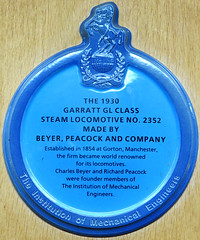
1930 Garratt Class Steam Locomotive No 2352 Made by Beyer, Peacock and Company. Established in 1854 at Gorton, Manchester, the firm became world-renowned for its locomotives. Charles Beyer and Richard Peacock were founder members of the Institution of Mechanical Engineers.
Museum of Science and Industry, Liverpool Road, Castlefield, Manchester, United Kingdom
Subjects

Cragside The House of Lord Armstrong (1810-1900) investor, engineer and armaments manufacturer. His hydraulic and hydroelectric inventions were applied throughout his estate. The house was the first in the world to be lit by electricity derived from water power.
Cragside, Rothbury, Morpeth, United Kingdom
Subjects

The Bessemer Converter In recognition of the outstanding contribution to the steel industry by Sir Henry Bessemer through his invention of the Bessemer Process for steelmaking as embodied in this last remaining example of the Bessemer Converter.
Kelham Island Industrial Museum, Alma Street, Sheffield, United Kingdom
Subjects
Jubilee Line Extension In recognition of the numerous features contributing to passenger safety and access on the Jubilee Line Extension, exemplifying the continuous innovation in London's Underground system from its inception in 1863.
Canary Wharf Underground Station, Canary Wharf, London, United Kingdom
Subjects


Fluent CFD Software Awarded in recognition of the significant impact of the Fluent CFD software (Releases 1-5, 1983 to 1998) on knowledge, excellence and innovation in mechanical engineering, and for its resultant contribution to the health and well-being of society, the economy and the environment.
ANSYS UK, Sheffield Business Park, 6 Europa View, Sheffield, United Kingdom
World's First Prototype Cast Steel Node The world's first cast steel node made in 1978 at the nearby foundry of River Don Castings, now part of Sheffield Forgemasters. Used to join the tubulars of offshore oil platforms, the design in cast steel represented a significant milestone for both the development of casting technology and offshore structures.
Sheffield Forgemasters (roundabout outside works), Brightside Lane, Sheffield, United Kingdom
Priestman Oil Engine William Dent Priestman (1847-1926) patented in 1885 an internal combustion engine to burn fuels heavier than petrol. Introduced in 1886, it was the first successful engine of its type in the United Kingdom. The quality of his mechanical engineering has lasted.
Streetlife Museum, High Street, Hull, United Kingdom
Transport Heritage Site 'Red Wheel' #36
SS Great Britain An outstanding example of I. K. Brunel's innovative design that made a significant contribution to society and mechanical engineering. It was the first iron-hulled, screw-propelled vessel to cross any ocean. It was conceived as a key element in the integrated transport system from London to the New World.
Great western Dock, Gasferry Road, Bristol, United Kingdom
Subjects


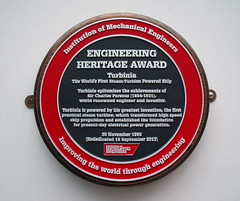
Turbinia The World's First Steam-Turbine Powered Ship. Turbinia epitomises the achievements of Sir Charles Parsons (1854-1931), world-renowned engineer and inventor. Turbinia is powered by his greatest invention, the first practical steam turbine, which transformed high speed ship propulsion and established the foundation for present-day electrical power generation.
Discovery Museum, Blandford Square, Newcastle upon Tyne, United Kingdom
Subjects

Maudslay Rope-forming Machine Designed and manufactured in 1811 by Henry Maudslay (1771-1831). It was used to re-rope HMS Victory and is still in use today.
Chatham Historical Dockyard, The Old Surgery, The Historic Dockyard, Chatham, United Kingdom
Subjects


Eling Tide Mill Restored in 1980 as a working tide mill museum. The only surviving mill in the world harnessing the power of the tide for the regular production of wholemeal flour.
Eling Tide Mill, The Tollbridge, Totton, Southampton, United Kingdom
Subjects

Awarded to the Claymills Pumping Engines Trust for their restoration of Britain's most complete example of a Victorian sewage pumping station. From 1885 to 1971 this site dealt with the effluent from Burton-upon-Trent's brewing industry. Among its many treasures is the oldest steam-driven dynamo in the country.
Meadow Lane, Burton-upon-Trent, United Kingdom
The Bluebell Railway The first preserved standard-gauge passenger railway in Great Britain, running its first train in August 1960. The Bluebell Railway has impressive workshop facilities and is committed to preserving and developing the rolling stock, infrastructure, skills and atmosphere of a working steam railway.
Sheffield Park Station, Sheffield Park, United Kingdom
Sir Harry Ricardo's first engine This four-stroke stratified charge engine, designed by Sir Harry at the age of 17, was built in 1903 and used for pumping water at his family home. Its success encouraged Sir Harry to a lifetime of engine design and development. President of IMechE in 1944, his thoughts and inventions still contribute to the success of Ricardo today.
Ricardo Visitors Centre, Shoreham Technical Centre, Shoreham-by-sea, United Kingdom
Kempton Great Engines Designed by the Metropolitan Water Board under the direction of Henry Stilgoe. these two triple expansion engines were manufactured by Worthington-Simpson at Newark-on-Trent and commissioned in 1928. They provided clean water to the people of London for 50 years. Engine No. 6 (known as The Sir William Prescott) is the largest working steam engine in the world.
Kempton Park Water Treatment Works, Snakey Lane, Hanworth TW13, London, United Kingdom
Battle of Britain Memorial Flight The Avro Lancaster, Hawker Hurricanes and Supermarine Spitfires of this Flight are a tribute to the airmen who lost their lives in the service of this country and an inspiration to all.
RAF Coningsby, Coningsby, United Kingdom
Old Bess Engine. Power for the Industrial Revolution. In recognition of James Watt's improvements to the steam engine. 'Old Bess' was built by Boulton and Watt in 1777 and used to power their Soho Manufactory until 1848. this engine was the precursor of much of the power-generating plant on show in the Museum and is the oldest surviving of Watt's engines.
Science Museum, Exhibition Road, South Kensington, SW7, London, United Kingdom
Subjects
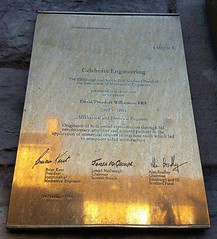
Theo Williamson's House In this house lived David Theodore Nelson Williamson 1920-1992. Mechanical and Electrical Engineer. Originator of high-quality sound reproduction through his amplifier. World pioneer in the application of Numerical Control to Machine Tools which led to Computer-Aided Manufacture.
65 Gilmore Place, Edinburgh, United Kingdom
Subjects
The Nottingham CHP Community Heating Scheme The Nottingham Combined Heating and Power Scheme is the first in the UK to produce commercial electricity and hot water for community heating by the efficient incineration of refuse. Reducing refuse to sterile, inert residue and extending the life of landfill sites are additional environmental and economic benefits of the scheme.
?, Nottingham, United Kingdom
Otto Langen Engine This engine (No 379) is one of about 1,300 built by Crossley Brothers, Manchester to a Nikolaus August Otto design patented in 1866. It is an example of the first commercially successful internal combustion engine which was introduced at the 1867 Paris Exhibition.
University of Nottingham, University Park, Nottingham, United Kingdom
Channel Tunnel and Eurostar The Channel Tunnel is one of the most advanced and largest engineering projects of its type. It carries both conventional trains and vehicle shuttles and has reduced the time to cross the Channel to minutes rather than hours.
was at Waterloo Station, London, United Kingdom
Bryan Donkin's Rose Lathe The intricate patterns engraved by this geometric lather were used for over a century to protect bank notes and documents from forgery. In tandem with Bryan Donkin's unique pantograph milling machine, the lathe produced high-precision compound metal dies for printing simultaneously in two colours.
Possibly Science Museum, Exhibition Road, South Kensington, SW7, London, United Kingdom
Thames Water Ring Main This is a unique water distribution system with a pressurised closed tunnel ring of drinking water, gravity fed from several treatment works.
Thames Water, Islington, London, United Kingdom
Wortley Top Forge The world's oldest surviving heavy-iron forge, operated from 1620 to 1908. It earned a worldwide reputation for the quality of the railway axles produced in the 19th century. It was a pioneering example of integrated engineering, combining research, design, and manufacture and testing.
Wortley Top Forge Industrial Museum, Forge Lane, Thurgoland, United Kingdom
Ffestiniog Railway In 1863 the company pioneered the use of narrow-gauge steam locomotive haulage. The Fairlie patent design of articulated bogie locomotive and Britain's first bogie coaches were successfully introduced in the 1870s. These innovations led to worldwide exports for British technology.
Ffestiniog Railway, Harbour Station, Porthmadog, United Kingdom
Subjects

Claverton Pump Designed by John Rennie (1761-1821). Built 1810-1813. Restored by Kennet and Avon Canal Trust 1969-1976.
Claverton Pumping Station, Ferry Lane, Claverton, Bath, United Kingdom
Subjects
.jpg?width=250)
'Peace' Powering the last Steam Driven Weaving Mill in the World. This Horizontal Tandem Compound Condensing engine was built by W Roberts and Sons of Nelson in 1894 and powered the mill until the Queen Street Manufacturing Company closed down in 1982. Now Peace is preserved and can be seen working in her original location.
Queen Street Mill Textile Museum, Queen Street, Harle Syke, Burnley, United Kingdom
The Pocket Power Station Powered by the Bristol Siddeley Proteus engine and conceived by A N Irens, this 3MW unit was commissioned in 1959. It pioneered the concept of unmanned power stations and the use of lightweight gas turbines for power generation. This is the only operational set on public display in the world.
Internal Fire Museum of Power, Castell Pridd, Tanygroes, United Kingdom

The Crossness Engines The restored 1865 Prince Consort Engine was a key part of Joseph Bazalgette's sewage system and is one of four James Watt Rotative Beam Engines still in its original setting. Representing the change from cast iron to steel and the more effective use of steam, it played a key part in freeing London from Cholera and Typhoid.
The Crossness Engines Trust, The Old Works, Crossness Sewage Treament Works, Belvedere Road, Abbey Wood, SE2, London, United Kingdom
Subjects

The English Electric Lightning The first and only all-British fully supersonic fighter aircraft type. In frontline service with the RAF 1960-1988, a record for a fighter jet.
BAE Systems, Warton Aerodrome, Preston, United Kingdom
Class A1 Steam Locomotive (Tornado: 60163) Tornado - A1 Pacific Locomotive. Designer: A H Peppercorn. Completed in 2008 using a blend of traditional and modern engineering skills, Tornado is the first mainline steam locomotive to be built in this country since 1960. The A1 Pacifics were the last LNER express passenger design, able to run 118,000 miles between repairs. None were preserved at the end of steam.
, ,
CA Parsons No5 Generator This was one of the first commercial machines based on the 1884 patent by Charles A Parsons for a steam turbine and used a dynamo as load. Output 65 amps, 100 volts at a speed on 12,000rpm. Presented to Trinity College, Dublin by Gerald Stone, BAI, 1911.
Parsons Building, Trinity College Dublin, College Green, Dublin, Ireland
Subjects
Perkins Wolf Engine Perkins Wolf. Designer CW Chapman. The first high-speed diesel engine. The Wolf with its patented Perkins Aeroflow combustion system could run at 3,000rpm and was available for light truck and passenger car conversions from 1933. The success of Perkins Engines was founded upon this engine.
Perkins Heritage Centre, Perkins Engines, Frank Perkins Way, Peterborough, United Kingdom
HMS Belfast Launched in 1938 at Harland & Wolff, the only surviving major Royal Navy warship from WWII. Four 20,000 hp steam turbines, a speed of 32 knots, 12 6-inch guns and displacing 11,500 tons; HMS Belfast's success in battle is a tribute to her sound design and the skill and courage of her crew.
Morgans Lane, Tooley St, SE1, London, United Kingdom
Hawker Siddeley Harrier The world's first operational V/STOL aircraft which entered service in 1969. Developed from the P1127, a concept by the Hawker Aircraft and Bristol Siddeley Engines design teams under the leadership of Sir Sydney Camm and Sir Stanley Hooker.
Kingston upon Thames, London, United Kingdom
Subjects

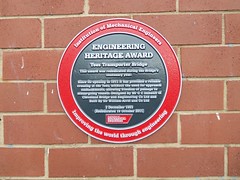
Tees Transporter Bridge This is the world's longest operational transporter bridge. Since its opening in 1911 it has provided a reliable crossing of the Tees, without the need for approach embankments, allowing freedom of passage to ocean-going vessels. Designed by Mr GC Imbault of Cleveland Bridge and Engineering Co Ltd and built by Sir William Arrol and Co Ltd.
Ferry Road, Middlesbrough, United Kingdom
Subjects
Thames Barrier Officially opened in 1984, it is the world's largest navigable flood barrier and incorporated novel and unique engineering design and operation of equipment. It is vital and effective in London's flood defences as well as being one of the capital's aesthetically pleasing major structures. Project sponsored by the Greater London Council Consulting engineers Rendel Palmer and Tritton. Operated by the National Rivers Authority.
Thames Barrier Learning Centre, 1 Unity Way, Woolwich SE18, London, United Kingdom
Princess of Wales Conservatory Designed by PSA Projects and opened on 28 July 1987 as the world's most advanced energy-efficient conservatory. It incorporates ten different climatic zones, created and maintained by a fully integrated computer-controlled system.
Royal Botanic Gardens, Kew, Richmond TW9, London, United Kingdom
Subjects
Huntsman Crucible Furnace and Tilt Hammers The furnace (1829) is the world's oldest surviving example of the type developed by Benjamin Huntsman. In its day it represented a great metallurgical achievement. The tilt hammers (1785) are probably the oldest set on their original site. They exemplify engineering technology in the heyday of water power. Together they symbolise the achievement of steel-makers and engineers which provided the foundations of the Industrial Revolution.
Abbeydale Industrial Hamlet, Abbeydale South Road, Sheffield, United Kingdom
Subjects
Locomotion No 1 Locomotion was built to a design originated by George Stephenson, the first President of the Institution of Mechanical Engineers. On the opening day of the Stockton and Darlington Railway, 27 September 1825, he drove this engine, hauling the inaugural train, on the world's first steam-worked public railway.
Darlington Railway Museum, North Road Station, Darlington, United Kingdom
Subjects

Bellerophon Built in 1874 to Josiah Evans' design at his family's Haydock foundry. The earliest surviving example of piston valves in a steam locomotive. Restored to full working order by the Vintage Carriages Trust in 1985.
Museum of Rail Travel, Ingrow, Keighley, United Kingdom
Post Office Underground Railway Opened 5 December 1927. The first automatic electric railway and the only postal railway in the world, providing a unique solution to the problem of transporting large volumes of mail across a capital city.
Mount Pleasant Post Office, 151 Mount Pleasant Road, N17, London, United Kingdom
Beyer Peacock Garratt K1 Locomotive Built in 1909 to HW Garratt's patent, the first of over 1,000 Garratt-type articulated locomotives exported from Manchester to all corner of the world. They gave reliable service in some of the most remote places on Earth.
Ffestiniog Railway, Harbour Station, Porthmadog, United Kingdom
The Great Western Society For its work in preserving and recreating the heritage of the Great Western Railway, allowing future generations to enjoy the work of Brunel, Gooch and Churchward, to participate and to learn engineering skills.
Didcot Railway Centre, Didcot Parkway Station, Didcot, United Kingdom
Subjects
Robert Stephenson's Works The Stephenson Works on South Street in Newcastle housed the world's first purpose-built locomotive works. These building were the birth of the steam locomotive, which revolutionised the railway industry worldwide.
The Stephenson Works, 20 South Street, Newcastle upon Tyne, United Kingdom
Subjects

Rolls Royce RB211 Engine The RB211 is the first, and at present the only, three-shaft, high bypass ratio aero engine in the world to go into production. 25 years on, it is still setting new standards of reliability and durability.
Rolls Royce Heritage Centre, Derby, United Kingdom
Subjects
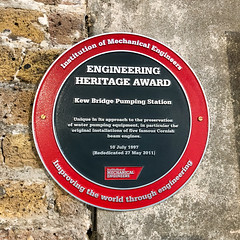
Kew Bridge Pumping Station Unique in its approach to the preservation of water pumping equipment, in particular the original installations of five famous Cornish beam engines.
Kew Bridge Steam Museum, Green Dragon Lane, Brentford, TW8 0EN, London, United Kingdom
Subjects
Float Glass Process Invented by Sir Alastair Pilkington and his team of engineers, scientists and production workers in 1953 at Pilkington Brothers, St Helens. This process has revolutionised window and automotive glass production throughout the world since the 1960s.
Pilkington Group Limited, Prescott Road, St Helens, Merseyside, United Kingdom
Subjects
Quarry Bank Mill A unique collection of working textile and power machinery enabling visitors to experience the whole process from spinning raw cotton to weaving finished cloth. Quarry Bank Mill is a site of educational importance, providing a link for the children of today with children of a bygone era.
Quarry Bank Mill and Styal Estate, Styal, Wilmslow, United Kingdom

Bursledon Brickworks The steam driven extrusion plant was installed in 1897 and operated for over 70 years. Restored by the Hampshire Buildings Preservation Trust, this is thought to be the only working example in the country. Brick making machinery such as this was key to the expansion of our towns and cities.
Bursledon Brickworks Industrial Museum, Swanwick Lane, Swanwick, United Kingdom

Holland 1 Designer: John Philip Holland Built by Vickers Maxim at Barrow-in-Furness and launched in 1901, this pioneer submarine was powered by a 160hp petrol engine and had a surface speed of 8 knots. A 70hp electric motor gave a submerged speed of 7 knots. Holland 1 was the Royal Navy's first operational submarine.
Royal Navy Submarine Museum, Haslar Jetty Road, Gosport, United Kingdom
Subjects

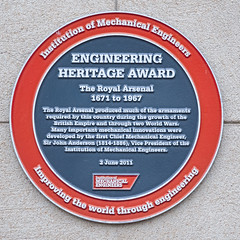
The Royal Arsenal 1671 to 1967 The Royal Arsenal produced much of the armaments required by this country during the growth of the British Empire and through two World Wars. Many important mechanical innovations were developed by the first Chief Mechanical Engineer, Sir John Anderson (1814-1886), Vice President of the Institution of Mechanical Engineers.
The Royal Arsenal, Woolwich, London, United Kingdom
Subjects
PS Waverley A & J Inglis Ltd - Glasgow Built in 1946 for the London & North Eastern Railway, Waverley is the last seagoing paddle steamer in the world. She has a displacement of 693 tons and Rankin & Blackmore triple expansion steam engine producing 2100 ihp at 58 rpm. In acceptance trials she achieved a speed of 18 knots.
, ,
Avro Vulcan XH558 Designed by Roy Chadwick and Stuart Davies The last airworthy representative of the RAF's V-bomber fleet, the British strategic deterrent from 1955 to 1969, the Vulcan is a stirring example of British leadership in aviation. XH558 was in service until 1993 and is powered by four Rolls-Royce Olympus engines.
Vulcan to the Sky, Robin Hood Airport, Doncaster, United Kingdom
Talyllyn Railway Opened in 1866, the Talyllyn Railway is the oldest continuously operated narrow gauge railway in Britain. In 1951 it became the world's first volunteer operated preserved railway. At 7.25 miles long and with a gauge of 2 feet and 3 inches, the Talyllyn Railway is an important part of Welsh industrial heritage.
Talyllyn Railway, Wharf Station, Tywyn, United Kingdom
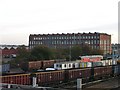
Central Valve Steam Engine Willans & Robinson Built in 1901 at Rugby, this 140hp three crank compound engine was in service for 57 years. Willans engines ran at 350 to 500rpm and could be direct-coupled to generators. In 1892 they accounted for 68% of all electricity generated in Britain, dominating this market until the advent of steam turbines.
Alstom Power, Willans Works, Newbold Road, Rugby, United Kingdom
Subjects
Jaguar E-type Designed by Malcolm Sayer under the direction of Sir William Lyons (HonFIMechE) the Jaguar E-type is a direct descendant of the cars which won five Le Mans 24 hour races during the 1950s. It introduced breakthrough motor engineering technology such as the combined monocoque-spaceframe which in later years was adopted by Formula one.
Jaguar Heritage, Browns Lane, Allesley, Coventry, United Kingdom
Boulton and Watt Engine The oldest rotative steam engine in the world. Built in 1785, it powered Whitbread's London Brewary until 1887. James Watt demonstrated this engine to King George III when he visited the brewary in 1787. This engine marks the start of mass industrialisation and the exponential increase in our use of fossil fuel.
Powerhouse Museum, 500 Harris Street, Ultimo, Sydney, New South Wales, Australia
Subjects

The Humphrey Pump H A Humphrey MIMechE A four-stroke engine with no pistons or crankshaft, Humphrey's ingenious invention patented in 1906 acts directly upon the water it pumps. This gas fuelled example, built by William Beardmore & Co., served Cobdogla from 1927 to 1965. Restored in 1985, it is the only working Humphrey Pump in the world.
Cobdogla Irrigation Museum, Cobdogla, SA, Australia
Locomotive No.1 The oldest surviving steam locomotive in Australia Built by Robert Stephenson & Co. in 1854, this is the only locomotive designed by James McConnell, one of the founders of the Institution of Mechanical Engineers, to have been preserved. Locomotive No.1 symbolises the transformation of social, industrial and commercial life in New South Wales through British railway technology.
Powerhouse Museum, 500 Harris Street, Ultimo, Sydney, New South Wales, Australia
MS Yavari The world's oldest iron kit-built ship. Designed by James Watt & Co and built in 1862 by the Thames Ironworks & Shipbuilding Co, she was assembled on the shores of Lake Titicaca, Peru and launched in 1870. Now powered by a 1914 4-cylinder Bolinder hot bulb semi-diesel engine producing 320bhp at 225rpm, MS Yavari is an enduring symbol of the ingenuity and global reach of British engineering.
Yavari, Puno Bay, Lake Titicaca, Peru
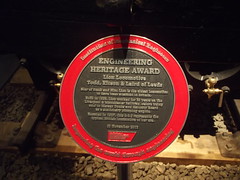
Engineering Heritage Award Lion Locomotive Todd, Kitson & Laird of Leeds Star of track and film, Lion is the oldest locomotive to have been steamed in Britain. Built in 1838, Lion worked for 20 years on the Liverpool & Manchester Railway, before being sold to Mersey Docks and Harbour Board as a stationary pumping engine. Rescued in 1927, this 0-4-2 represents the typical British locomotive of her era
The Great Port, Museum of Liverpool, Pier Head, Liverpool Waterfront, Liverpool, United Kingdom
Subjects
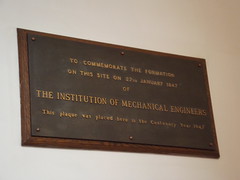
To commemorate the formation on this site on 27th January 1847 of The Institution of Mechanical Engineers This plaque was placed here in the Centenary Year 1947
Curzon Street Station, New Canal Street, Birmingham, United Kingdom
Subjects

Volk's Electric Railway, Brighton. The world's oldest electric railway opened on 4 August 1883. Constructed by pioneering electrical engineer Magnus Volk, the line still follows much of the original route. The continued operation of this railway is a tribute to his life and work
Seafront, Brighton, United Kingdom
Subjects

Engineering Heritage Award. Anderton Boat Lift. The worlds oldest operational boat lift. Designed by Edwin Clark and opened in 1875 to raise boats 50 feet from the River Weaver to the Trent & Mersey Canal using hydraulic power. Later converted to electric drive, it was restored to hydraulic operation in 2002 and continues to provide a navigable link between the two waterways. 21 March 2014
Lift Lane, Northwich, United Kingdom
Subjects
.JPG?width=250)
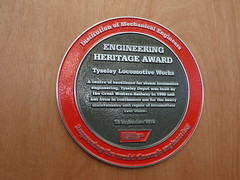
Engineering Heritage Award Tyseley Locomotive Works A centre of excellence for steam locomotive engineering. Tyseley Depot was built by the Great Western Railway in 1908 and has been in continuous use for the heavy maintenance and repair of locomotives ever since.
Tyseley Locomotive Works, Birmingham, United Kingdom
Subjects


Engineering Heritage Award SR.N5 Hovercraft. A new way of travelling. Built in 1963 and powered by a 900 horsepower Bristol Siddeley Gnome gas turbine, Saunders Row Nautical 5 was the first production hovercraft in the world. This particular hovercraft was used to demonstrate SR.N5 worldwide and train all the pilots for the Inter-Service Hovercraft Trials Unit based at Lee-on-Solent. This is the last example in the world 13 Sept 2013
, Lee-on-the-Solent, United Kingdom
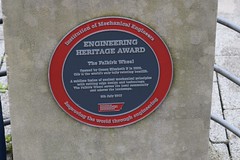
Engineering Heritage Award. The Falkirk Wheel. Opened by Queen Elizabeth II in 2002, this is the world's only fully rotating boatlift. A sublime fusion of ancient mechanical principles with cutting edge design and technology, The Falkirk Wheel serves the local community and adorns the landscape
Lime Road, Falkirk, United Kingdom
Subjects

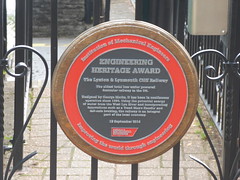
Engineering Heritage Award The Lynton & Lynmouth Cliff Railway The oldest total loss water powered funicular railway in the UK. Designed by George Marks, it has been in continuous operation since 1890. Using the potential energy of water from the West Lyn River and incorporating innovation such as a 'Dead Man's Handle' and fail-safe braking, the railway is an integral part of the local company.
Lynton Village Station - Lynton & Lynmouth Cliff Railway, Lynton, United Kingdom
Subjects


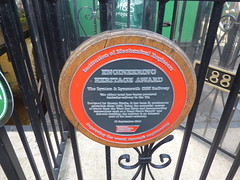
Engineering Heritage Award The Lynton & Lynmouth Cliff Railway The oldest total loss water powered funicular railway in the UK. Designed by George Marks, it has been in continuous operation since 1890. Using the potential energy of water from the West Lyn River and incorporating innovation such as a 'Dead Man's Handle' and fail-safe braking, the railway is an integral part of the local company.
Lynmouth Bay Station - Lynton & Lynmouth Cliff Railway, Lynmouth, United Kingdom
Subjects
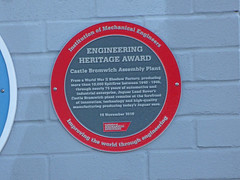
Engineering Heritage Award Castle Bromwich Assembly Plant From a World War II Shadow Factory, producing more than 10,000 Spitfires between 1940 - 1945, through nearly 75 years of automotive and industrial enterprise, Jaguar Land Rover's Castle Bromwich plant remains at the forefront of innovation, technology and high-quality manufacturing producing today's Jaguar cars.
Jaguar Land Rover Castle Bromwich - Chester Road, Birmingham, United Kingdom