
The Mechanics' Institutes of Victoria (MIV) was formed in 1998 following a State Conference of Mechanics' Institutes (MIs) held in Kilmore in April of that year. It aims to foster the preservation and restoration of the social, cultural and physical heritage of active MIs throughout the state as well as to encourage and facilitate recognition and preservation of MI buildings and the revival of inactive MIs.The purpose of the MIV Historical Plaques Program is to inform the public of the history of Mechanics' Institutes in Victoria and also give a snippet of history about the individual Institute.
59 out of 68 (86%) plaques have been curated
62 subjects all or unphotographedGender Diversity
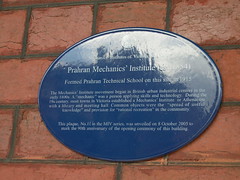
MIV Historical Plaques Program #0011
Prahran Mechanics' Institute (est. 1854) Formed Prahran Technical School of this site in 1915. The Mechanics' Institute movement began in British urban industrial centres in the early 1800s. A "mechanic" was a person applying skills and technology. During the 19th century, most towns in Victoria established a Mechanics' Institute or Athenaeum with a library and meeting hall. Common objects were the "spread of useful knowledge" and provision for "rational recreation" in the community. This plaque, No. 11 in the MIV series, was unveiled on 8 October 2005 to mark the 90th anniversary of the opening ceremony of this building.
140 High Street, Prahran, VI, Australia
Subjects

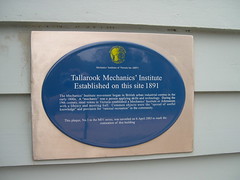
MIV Historical Plaques Program #0003
Tallarook Mechanics' Institute. Established on this site 1891. The Mechanics' Institute movement began in British urban industrial centres in the early 1800s. A "mechanic" was a person applying skills and technology. During the 19th century, most towns in Victoria established a Mechanics' Institute or Athenaeum with a library and meeting hall. Common objects were the "spread of useful knowledge" and provision for "rational recreation" in the community. This plaque, No. 3 in the MIV series, was unveiled on 6 April 2003 to mark the restoration of this building.
Main Road, Tallarook, Victoria, Australia
Subjects


MIV Historical Plaques Program #0001
Maldon Athenaeum Library 1863. The Mechanics' Institute movement began in British urban industrial centres in the early 1800s. A "mechanic" was a person applying skills and technology. During the 19th century, most towns in Victoria established a Mechanics' Institute or Athenaeum with a library and meeting hall. Common objects were the "spread of useful knowledge" and provision for "rational recreation" in the community. This plaque, No. 1 in the MIV series, was unveiled on 21 April 2003 during celebrations of the 150th anniversary of the discovery of gold at Maldon.
97 High Street, Maldon, Victoria, Australia
Subjects

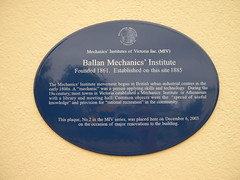
MIV Historical Plaques Program #0002
Ballan Mechanics' Institute. Founded 1861. Established on this site 1885. The Mechanics' Institute movement began in British urban industrial centres in the early 1800s. A "mechanic" was a person applying skills and technology. During the 19th century, most towns in Victoria established a Mechanics' Institute or Athenaeum with a library and meeting hall. Common objects were the "spread of useful knowledge" and provision for "rational recreation" in the community. This plaque, No. 2 in the MIV series, was placed here on December 6, 2003 on the occasion of major renovations to the building.
143 Inglis Street, Ballan, VI, Australia
Subjects

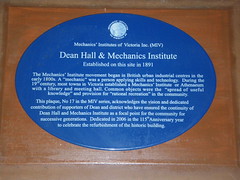
MIV Historical Plaques Program #0017
Dean Hall & Mechanics Institute. Established on this site in 1891. The Mechanics' Institute movement began in British urban industrial centres in the early 1800s. A "mechanic" was a person applying skills and technology. During the 19th century, most towns in Victoria established a Mechanics' Institute or Athenaeum with a library and meeting hall. Common objects were the "spread of useful knowledge" and provision for "rational recreation" in the community. This plaque, No 17 in the MIV series, acknowledges the vision and dedicated contribution of supporters of Dean and district who have ensured the continuity of Dean Hall and Mechanics Institute as a focal point for the community for successive generations. Dedicated in 2006 in the 115th Anniversary year to celebrate the refurbishment of the historic building.
Daylesford-Ballarat Road, Dean, VI, Australia
Subjects


MIV Historical Plaques Program #0026
Elmore Athenaeum Hall. Established on this site 1869-1924. The Mechanics' Institute movement began in British urban industrial centres in the early 1800s. A "mechanic" was a person applying skills and technology. During the 19th century, most towns in Victoria established a Mechanics' Institute or Athenaeum with a library and meeting hall. Common objects were the "spread of useful knowledge" and provision for "rational recreation" in the community. The Elmore Athenaeum Hall complex comprises the original 1869 building, the 1885 Athenaeum, the 1912 Supper Room and the 1924 Memorial Hall. It was the centre of the social activities and community gatherings by Elmore Residents. After falling into disuse, it faced demolition in 1992. But the community rallied and through individual effort, council assistance and government grants, the building has been restored and is once again a significant social and cultural centre for the Elmore community. This plaque, No. 26 in the MIV series, is dedicated to the local citizens who worked so diligently to achieve this result.
62 Michie Street, Elmore, VI, Australia
Subjects

MIV Historical Plaques Program #0004
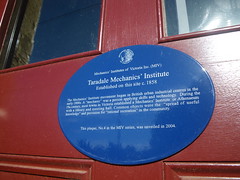
Taradale Mechanics' Institute. Established on this site c. 1858. The Mechanics' Institute movement began in British urban industrial centres in the early 1800s. A "mechanic" was a person applying skills and technology. During the 19th century, most towns in Victoria established a Mechanics' Institute or Athenaeum with a library and meeting hall. Common objects were the "spread of useful knowledge" and provision for "rational recreation" in the community. This plaque, No. 4 in the MIV series, was unveiled in 2004.
Calder Highway, Taradale, VI, Australia
Subjects
MIV Historical Plaques Program #0014
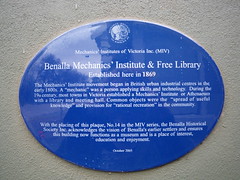
Benalla Mechanics' Institute & Free Library. Established here in 1869. The Mechanics' Institute movement began in British urban industrial centres in the early 1800s. A "mechanic" was a person applying skills and technology. During the 19th century, most towns in Victoria established a Mechanics' Institute or Athenaeum with a library and meeting hall. Common objects were the "spread of useful knowledge" and provision for "rational recreation" in the community. With the placing of this plaque, No. 14 in the MIV series, the Benalla Historical Society Inc. acknowledges the vision of Benalla’s earlier settlers and ensures this building now functions as a museum and is a place of interest, education and enjoyment. October 2005
14 Mair Street, Benalla, VI, Australia
Subjects

MIV Historical Plaques Program #0005
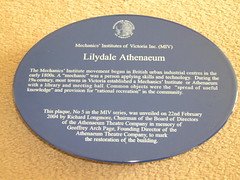
Lilydale Athenaeum. The Mechanics' Institute movement began in British urban industrial centres in the early 1800s. A "mechanic" was a person applying skills and technology. During the 19th century, most towns in Victoria established a Mechanics' Institute or Athenaeum with a library and meeting hall. Common objects were the "spread of useful knowledge" and provision for "rational recreation" in the community. This plaque, No. 5 in the MIV series, was unveiled on 22nd February 2004 by Richard Longmore, Chairman of the Board of Directors of the Athenaeum Theatre Company in memory of Geoffrey Arch Page, Founding Director of the Athenaeum Theatre Company, to mark the restoration of the building.
35 Castella Street, Lilydale, VI, Australia
Subjects

MIV Historical Plaques Program #0008
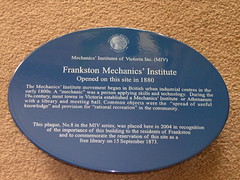
Frankston Mechanics' Institute. Opened on this site 1880. The Mechanics' Institute movement began in British urban industrial centres in the early 1800s. A "mechanic" was a person applying skills and technology. During the 19th century, most towns in Victoria established a Mechanics' Institute or Athenaeum with a library and meeting hall. Common objects were the "spread of useful knowledge" and provision for "rational recreation" in the community. This plaque, No. 8 in the MIV series, was placed here in 2004 in recognition of the importance of this building to the residents of Frankston and to commemorate the reservation of this site as a free library on 15 September 1873.
1N Plowman Place, Frankston, VI, Australia
Subjects

MIV Historical Plaques Program #0007
Minyip Mechanics' Institute. Established on this site in 1891. The Mechanics' Institute movement began in British urban industrial centres in the early 1800s. A "mechanic" was a person applying skills and technology. During the 19th century, most towns in Victoria established a Mechanics' Institute or Athenaeum with a library and meeting hall. Common objects were the "spread of useful knowledge" and provision for "rational recreation" in the community. This plaque, No. 7 in the MIV series, was unveiled on the 12th June 2004 to commemorate the centenary of the main hall.
Main Street, Minyip, Victoria, Australia
Subjects

MIV Historical Plaques Program #0009
Mount Eccles Mechanics' Institute. [full inscription unknown]
Hall Road, Mount Eccles, Victoria, Australia
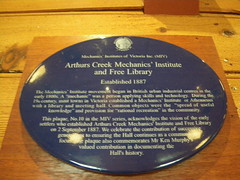
MIV Historical Plaques Program #0010
Arthurs Creek Mechanics' Institute and Free Library. Established 1887. The Mechanics' Institute movement began in British urban industrial centres in the early 1800s. A "mechanic" was a person applying skills and technology. During the 19th century, most towns in Victoria established a Mechanics' Institute or Athenaeum with a library and meeting hall. Common objects were the "spread of useful knowledge" and provision for "rational recreation" in the community. This plaque, No. 10 in the MIV series acknowledges the vision of the settlers who established Arthurs Creek Mechanics’ Institute and Free Library on 2 September 1887. We celebrate the contribution of successive generations to ensuring the Hall continues as a community focus. The plaque also commemorates Mr Ken Murphy’s valued contribution in documenting the Hall’s history.
Arthurs Creek Road, Arthurs Creek, VI, Australia
Subjects
MIV Historical Plaques Program #0012
Digby Mechanics' Institute. Established 1870. The Mechanics' Institute movement began in British urban industrial centres in the early 1800s. A "mechanic" was a person applying skills and technology. During the 19th century, most towns in Victoria established a Mechanics' Institute or Athenaeum with a library and meeting hall. Common objects were the "spread of useful knowledge" and provision for "rational recreation" in the community. This plaque, No. 12 in the MIV series, was unveiled to commemorate restoration by the Digby community in 2005
49 Buckingham Street, Digby, VI, Australia
Subjects

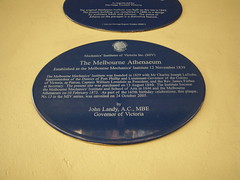
MIV Historical Plaques Program #0013
The Melbourne Athenaeum. Established as the Melbourne Mechanics' Institute 12 November 1839. The Melbourne Mechanics' Institute was founded in 1839 with Mr Charles Joseph LaTrobe, Superintendent of the District of Port Phillip and Lieutenant-Governor of the Colony of Victoria, as Patron. Captain William Lonsdale as President, and the Rev. James Forbes as Secretary. The present site was purchased on 13 August 1840. The Institute became the Melbourne Mechanics' Institute and School of Arts in 1846 and the Melbourne Athenaeum on 10 February 1873. As part of the 165th birthday celebrations, this plaque, No. 13 in the MIV series, was unveiled on 24 October 2005 by John Landy, A.C., MBE Governor of Victoria
188 Collins Street, Melbourne, Victoria, Australia
Subjects

MIV Historical Plaques Program #0015
Jindivick Mechanics' Institute. [full inscription unknown]
1290 Jacksons Track, Jindivick, VI, Australia
Subjects
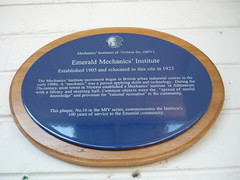
MIV Historical Plaques Program #0016
Emerald Mechanics' Institute. Established 1905 and relocated to this site in 1923.The Mechanics’ Institute movement began in British urban industrial centres in the early 1800s. A “mechanic” was a person applying skills and technology. During the 19th century, most towns in Victoria established a Mechanics’ Institute or Athenaeum with a library and meeting hall. Common objects were the “spread of useful knowledge” and provision for “rational recreation” in the community. This plaque, No. 16 in the MIV series, commemorates the Institute's 100 years of service to the Emerald community.
400a Belgrave-Gembrook Rd, Emerald, VI, Australia
Subjects
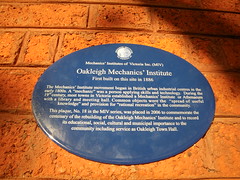
MIV Historical Plaques Program #0018
Oakleigh Mechanics’ Institute. First Built on this site in 1886. The Mechanics' Institute movement began in British urban industrial centres in the early 1800s. A "mechanic" was a person applying skills and technology. During the 19th century, most towns in Victoria established a Mechanics' Institute or Athenaeum with a library and meeting hall. Common objects were the "spread of useful knowledge" and provision for "rational recreation" in the community.This plaque, No. 18 in the MIV series, was placed in 2006 to commemorate the centenary of the rebuilding of the Oakleigh Mechanics’ Institute and to record its educational, social, cultural and municipal importance to the community including service as Oakleigh Town Hall.
142-144 Drummond Street, Oakleigh, VI, Australia
Subjects
MIV Historical Plaques Program #0019
Newham Mechanics’ Institute. Established 1903. The Mechanics' Institute movement began in British urban industrial centres in the early 1800s. A "mechanic" was a person applying skills and technology. During the 19th century, most towns in Victoria established a Mechanics' Institute or Athenaeum with a library and meeting hall. Common objects were the "spread of useful knowledge" and provision for "rational recreation" in the community. This plaque, No. 19 in the MIV series, celebrates the Newham community 2007.
1292 Rochford Road, Newham, Victoria, Australia
Subjects

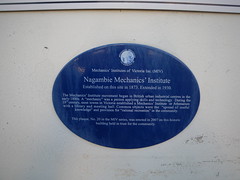
MIV Historical Plaques Program #0020
Nagambie Mechanics' Institute. Established on this site in 1873. Extended in 1930. The Mechanics' Institute movement began in British urban industrial centres in the early 1800s. A "mechanic" was a person applying skills and technology. During the 19th century, most towns in Victoria established a Mechanics' Institute or Athenaeum with a library and meeting hall. Common objects were the "spread of useful knowledge" and provision for "rational recreation" in the community. This plaque, No. 20 in the MIV series, was erected in 2007 on this historic building held in trust for the community.
286 High Street, Nagambie, Victoria, Australia
Subjects


MIV Historical Plaques Program #0021
Mia Mia Mechanics' Institute. Established on this site in 1907. Extended and renovated in 1983. The Mechanics' Institute movement began in British urban industrial centres in the early 1800s. A "mechanic" was a person applying skills and technology. During the 19th century, most towns in Victoria established a Mechanics' Institute or Athenaeum with a library and meeting hall. Common objects were the "spread of useful knowledge" and provision for "rational recreation" in the community. This plaque, No. 21 in the MIV series, was erected on this historic building in 2007 to mark the centenary celebrations of this hall.
Mia Mia Hall, Valley Road, Mia Mia, Victoria, Australia
Subjects

MIV Historical Plaques Program #0023
Kinglake West Mechanics' Institute. [Missing] [full inscription unknown]
1055 Whittlesea-Kinglake Road, Kinglake West, VI, Australia
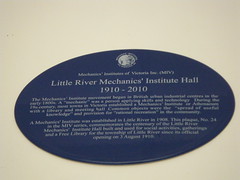
MIV Historical Plaques Program #0024
Little River Mechanics' Institute Hall. 1910-2010. The Mechanics' Institute movement began in British urban industrial centres in the early 1800s. A "mechanic" was a person applying skills and technology. During the 19th century, most towns in Victoria established a Mechanics' Institute or Athenaeum with a library and meeting hall. Common objects were the "spread of useful knowledge" and provision for "rational recreation" in the community. A Mechanics’ Institute was established in Little River in 1908. This plaque, No. 24 in the MIV series, commemorates the centenary of the Little River Mechanics’ Institute Hall built and used for social activities, gatherings and a Free Library for the township of Little River since its official opening on 3 August 1910.
8 Rothwell Road, Little River, Victoria, Australia
Subjects

MIV Historical Plaques Program #0025
EV’s Youth Centre. Croydon Mechanics' Institute. 1909-2009. The Mechanics' Institute movement began in British urban industrial centres in the early 1800s. A "mechanic" was a person applying skills and technology. During the 19th century, most towns in Victoria established a Mechanics' Institute or Athenaeum with a library and meeting hall. Common objects were the "spread of useful knowledge" and provision for "rational recreation" in the community. A Mechanics’ Institute was established in Croydon in 1908. This Plaque, No. 25 in the MIV series, commemorates the centenary of the Croydon Mechanics’ Institute Hall, built and used for social activities and has been utilised over the years as a Library, Cinema, Town Hall, and is currently used as Maroondah City Council’s Youth Centre.
212 Mount Dandenong Road, Croydon, VI, Australia
Subjects
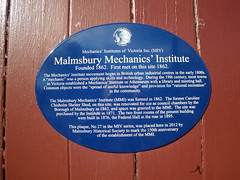
MIV Historical Plaques Program #0027
Malmsbury Mechanics' Institute. Founded 1862. First met on this site 1862. The Mechanics' Institute movement began in British urban industrial centres in the early 1800s. A "mechanic" was a person applying skills and technology. During the 19th century, most towns in Victoria established a Mechanics' Institute or Athenaeum with a library and meeting hall. Common objects were the "spread of useful knowledge" and provision for "rational recreation" in the community.The Malmsbury Mechanics’ Institute (MMI) was formed in 1862. The former Caroline Chisholm Shelter Shed, on this site, was renovated for use as council chambers by the Borough of Malmsbury in 1862, and space was granted to the MMI. The site was purchased by the Institute in 1871. The two front rooms of the present building were built in 1876, the Fedral Hall at the rear in 1895. This plaque, No. 27 in the MIV series, was placed here in 2012 by Malmsbury Historical Society to mark the 150th anniversary of the establishment of MMI.
Mollison Street, Malmsbury, Victoria, Australia
Subjects

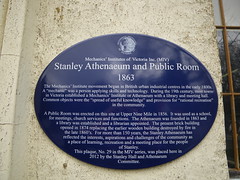
MIV Historical Plaques Program #0029
Stanley Athenaeum and Public Room. 1863. The Mechanics' Institute movement began in British urban industrial centres in the early 1800s. A "mechanic" was a person applying skills and technology. During the 19th century, most towns in Victoria established a Mechanics' Institute or Athenaeum with a library and meeting hall. Common objects were the "spread of useful knowledge" and provision for "rational recreation" in the community. The Public Room was erected on this site in Upper Nine Mile in 1856. It was used as a school, for meetings, church services and functions. The Athenaeum was founded in 1863 and a library was established and a librarian appointed. The present brick building opened in 1874 replacing the earlier wooden building destroyed by fire in the late 1860’s. For more than 150 years, the Stanley Athenaeum has reflected the interests, aspirations and challenges of the community as a place of learning, recreation and a meeting place for the people of Stanley. This plaque, No. 29 in the MIV series, was placed here in 2012 by the Stanley Hall and Athenaeum Committee.
Main Street, Stanley, Victoria, Australia
Subjects
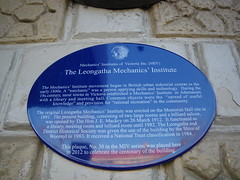
MIV Historical Plaques Program #0030
Leongatha Mechanics' Institute. The Mechanics' Institute movement began in British urban industrial centres in the early 1800s. A "mechanic" was a person applying skills and technology. During the 19th century, most towns in Victoria established a Mechanics' Institute or Athenaeum with a library and meeting hall. Common objects were the "spread of useful knowledge" and provision for "rational recreation" in the community. The original Leongatha Mechanics’ Institute was erected on the Memorial Hall site in 1891. The present building, consisting of two large rooms and a billiard saloon, was opened by The Hon. J. E. Mackey on 26 March 1912. It functioned as a library, meeting room and billiard room until 1982. The Leongatha and District Historical Society was given the use fo the building by the Shire of Woorayl in 1983. It received a National Trust classification in 1984. This plaque, No. 30 in the MIV series, was placed here in 2012 to celebrate the centenary of the building.
McCartin Street, Leongatha, Victoria, Australia
Subjects

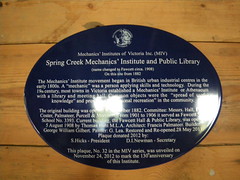
MIV Historical Plaques Program #0032
Spring Creek Mechanics' Institute and Public Library (name changed to Fawcett circa. 1908). On this site from 1882. The Mechanics' Institute movement began in British urban industrial centres in the early 1800s. A "mechanic" was a person applying skills and technology. During the 19th century, most towns in Victoria established a Mechanics' Institute or Athenaeum with a library and meeting hall. Common objects were the "spread of useful knowledge" and provision for "rational recreation" in the community. The original building was opened 8 September 1882. Committee: Messrs. Hall, Long, Coster, Palmateer, Purcell & Morrison. From 1901 to 1906 it served as Fawcett State School No. 3393. Current building, the Fawcett Hall & Public Library, was opened 5 August 1908 by Thomas Hunt M.L.A. Architect: Francis Palmateer. Builder: George William Gilbert. Painter: G. Lea. Restores and Re-opened 28 May 2011. Plaque donated 2012 by: S. Hicks - President; D. I. Newman - Secretary. This plaque, No. 32 in the MIV series, was unveiled on November 24, 2012 to mark the 130th anniversary of this Institute.
655 Spring Creek Road, Fawcett, VI, Australia
Subjects
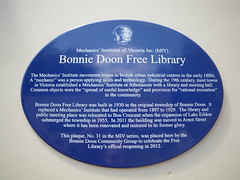
MIV Historical Plaques Program #0031
Bonnie Doon Free Library. The Mechanics' Institute movement began in British urban industrial centres in the early 1800s. A "mechanic" was a person applying skills and technology. During the 19th century, most towns in Victoria established a Mechanics' Institute or Athenaeum with a library and meeting hall. Common objects were the "spread of useful knowledge" and provision for "rational recreation" in the community. Bonnie Doon Free Library was built in 1930 in the original township of Bonnie Doon. It replaced a Mechanics’ Institute that had operated from 1897 to 1929. The library and public meeting place was relocated to Bon Crescent when the expansion of Lake Eildon Submerged the township in 1955. In 2011 the building was moved to Arnot Street where it has been renovated and restored to its former glory. This plaque, No. 31 in the MIV series, was placed here by the Bonnie Doon Community Group to celebrate the Free Library’s official reopening in 2012.
Arnot Street, Bonnie Doon, VI, Australia
Subjects
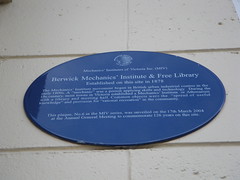
MIV Historical Plaques Program #0006
Berwick Mechanics' Institute & Free Library. Established on this site in 1878. The Mechanics' Institute movement began in British urban industrial centres in the early 1800s. A "mechanic" was a person applying skills and technology. During the 19th century, most towns in Victoria established a Mechanics' Institute or Athenaeum with a library and meeting hall. Common objects were the "spread of useful knowledge" and provision for "rational recreation" in the community. This plaque, No. 6 in the MIV series, was unveiled on the 17th March 2004 at the Annual General Meeting to commemorate 126 years on this site.
15 High Street, Berwick, VI, Australia
Subjects
MIV Historical Plaques Program #0022
Mortlake Mechanics' Institute. Established on this site 1869. The Mechanics' Institute movement began in British urban industrial centres in the early 1800s. A "mechanic" was a person applying skills and technology. During the 19th century, most towns in Victoria established a Mechanics' Institute or Athenaeum with a library and meeting hall. Common objects were the "spread of useful knowledge" and provision for "rational recreation" in the community. This plaque, No. 22 in the MIV series, was erected in 2008 to honour the memory of the people of Mortlake and district who have built and maintained our hall for the benefit of our community.
Mortlake Mechanics Institute, Mortlake, Victoria, Australia
Subjects
MIV Historical Plaques Program #0028
Laen Mechanics' Institute. On this site 1886-1955. The Mechanics' Institute movement began in British urban industrial centres in the early 1800s. A "mechanic" was a person applying skills and technology. During the 19th century, most towns in Victoria established a Mechanics' Institute or Athenaeum with a library and meeting hall. Common objects were the "spread of useful knowledge" and provision for "rational recreation" in the community. The Laen Mechanics' Institute was built in 1186. It was a large (50ft x 20ft) galvanised iron hall, later lined with timber. The opening was celebrated with a concert and ball attended by 250 people. It was the lifeblood of a thriving rural community. There were dances, balls, school concerts, luncheons on picnic days, church services, and a library. It continued as a centre for community activities until the late 1940's. One of the last recorded events was a concert in 1951. In 1955 the building was sold and removed from the site. This plaque, No. 28 in the MIV series, is dedicated to Jack and Ron Della Vedova in recognition of their lifetime of service to the local community.
Donald-Laen Road, Laen, Victoria, Australia
Subjects
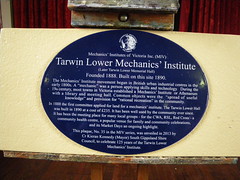
MIV Historical Plaques Program #0035
Tarwin Lower Mechanics' Institute (Later Tarwin Lower Memorial Hall). Founded 1888. Built on this site 1890. The Mechanics' Institute movement began in British urban industrial centres in the early 1800s. A "mechanic" was a person applying skills and technology. During the 19th century, most towns in Victoria established a Mechanics' Institute or Athenaeum with a library and meeting hall. Common objects were the "spread of useful knowledge" and provision for "rational recreation" in the community. In 1888 the first committee applied for land for a mechanics' Institute. The Tarwin Lower Hall was built in 1890 at a cost of £235. It has been well used by the community ever since. It has been the meeting place for many local groups - for the CWA, RSL, Red Cross - a community health centre, a popular venue for family and community celebrations, and its Market Days an ongoing highlight. This plaque, No. 35 in the MIV series, was unveiled in 2013 by Cr Kieran Kennedy (Mayor) South Gippsland Shire Council, to celebrate 125 years of the Tarwin Lower Mechanics' Institute.
Riverside Drive, Tarwin Lower, Victoria, Australia
Subjects

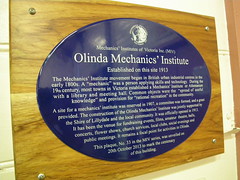
MIV Historical Plaques Program #0033
Olinda Mechanics' Institute. Established on this site 1913. The Mechanics' Institute movement began in British urban industrial centres in the early 1800s. A "mechanic" was a person applying skills and technology. During the 19th century, most towns in Victoria established a Mechanics' Institute or Athenaeum with a library and meeting hall. Common objects were the "spread of useful knowledge" and provision for "rational recreation" in the community. A site for a Mechanics' Institute was reserved in 1907, a committee was formed, and a grant provided. The construction of the Olinda Mechanics' Institute was jointly supported by the Shire of Lillydale and the local community. It was officially opened in 1913. It has been the venue for fundraising events, films, amateur theatre, balls, concerts, flower shows, church services, local clubs, social evenings and public meetings. It remains a focal point for activities in Olinda. This plaque, No. 33 in the MIV series, was unveiled on the 10th October 2013 to mark the centenary of this building.
Cnr The Georgian & Olinda-Monbulk Rds, Olinda, VI, Australia
Subjects

MIV Historical Plaques Program #0036
Footscray Mechanics’ Institute. Founded 1857. This building constructed 1913. The Mechanics' Institute movement began in British urban industrial centres in the early 1800s. A "mechanic" was a person applying skills and technology. During the 19th century, most towns in Victoria established a Mechanics' Institute or Athenaeum with a library and meeting hall. Common objects were the "spread of useful knowledge" and provision for "rational recreation" in the community. The Footscray Mechanics’ Institute first began in Pilgrim Street in 1857. It then moved to Austin Street, and later in 1870 to the corner of Napier and Nicholson Streets, where the old post office stands. The present building was constructed on this site in 1913, to replace the old wooden building. We are proud to celebrate our 100th year at this site. The Footscray Mechanics’ Institute is truly a part of the living history of the Western Suburbs of Melbourne.
209 Nicholson Street, Footscray, VI, Australia
Subjects
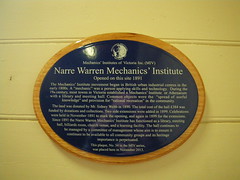
MIV Historical Plaques Program #0034
Narre Warren Mechanics' Institute. Opened on this site 1891. The Mechanics' Institute movement began in British urban industrial centres in the early 1800s. A "mechanic" was a person applying skills and technology. During the 19th century, most towns in Victoria established a Mechanics' Institute or Athenaeum with a library and meeting hall. Common objects were the "spread of useful knowledge" and provision for "rational recreation" in the community. The land was donated by Mr. Sidney Webb in 1890. The total cost of the hall £384 was funded by donations and collections. Two side extensions were added in 1899. Celebrations were held in November 1891 to mark the opening, and again in 1899 for the extensions. Since 1891 the Narre Warren Mechanics' Institute has functioned as a library, meeting hall, billiards room, church venue, and a learning facility. The hall continues to be managed by a committee of management whose aim is to ensure it continues to be available to all community groups and its heritage importance is perpetuated. This plaque, No. 34 in the MIV series, was placed here in November 2013.
59 Webb Street, Narre Warren, Victoria, Australia
Subjects

MIV Historical Plaques Program #0039
Alexandra Mechanics' Institute. A library service for Alexandra since 1877. The Mechanics' Institute movement began in British urban industrial centres in the early 1800s. A "mechanic" was a person applying skills and technology. During the 19th century, most towns in Victoria established a Mechanics' Institute or Athenaeum with a library and meeting hall. Common objects were the "spread of useful knowledge" and provision for "rational recreation" in the community. In 1877 residents of Alexandra formed a library committee and established a Mechanics' Institute and Free Library in the Protestant Hall. Despite those "who looked upon the venture as altogether too advanced for an outside township" the Alexandra Library and Mechanics Hall was built by Thomas Carrison at a cost of £467 and opened on 6 June 1883. This building was duplicated in 1891 for a Billiard Room, and in 1962 the library expanded into both buildings. in 2005 a new extension was opened. This plaque, No. 39 in the MIV series, was placed here in 2013 to mark the 130th anniversary of the building.
Grant Street, Alexandra, VI, Australia
Subjects

MIV Historical Plaques Program #0040
Lardner Mechanics' Institute [full inscription unknown]
255 Burnt Store Road, Lardner, VI, Australia
Subjects
MIV Historical Plaques Program #0037
Kallista Mechanics’ Institute. Opened 20th December 1913. The Mechanics' Institute movement began in British urban industrial centres in the early 1800s. A "mechanic" was a person applying skills and technology. During the 19th century, most towns in Victoria established a Mechanics' Institute or Athenaeum with a library and meeting hall. Common objects were the "spread of useful knowledge" and provision for "rational recreation" in the community. This plaque, No. 37 in the MIV series, was unveiled on 21st December 2013 to commemorate the centenary of the building of the South Sassafras Mechanics’ Institute and Free Library (name changed to Kallista in 1925). It is dedicated to the pioneers who built this hall and to record its educational, social and cultural importance to the community.
6 Tom Roberts Road, Kallista, VI, Australia
Subjects
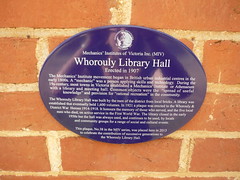
MIV Historical Plaques Program #0038
Whorouly Library Hall. Erected in 1907. The Mechanics' Institute movement began in British urban industrial centres in the early 1800s. A "mechanic" was a person applying skills and technology. During the 19th century, most towns in Victoria established a Mechanics' Institute or Athenaeum with a library and meeting hall. Common objects were the "spread of useful knowledge" and provision for "rational recreation" in the community. The Whorouly Library Hall was built by the men of the district from local bricks. A library was established that eventually held 1,600 volumes. In 1921 a plaque was erected to the Whorouly & District War Heroes 1914-1918. It honours the memory of those who served, the five local men who died on active service in the First World War. The library closed in the early 1950s but the hall was always used, and continues to be used, by locals and community groups for a range of social and cultural events.
12 Church Street, Whorouly, VI, Australia
Subjects
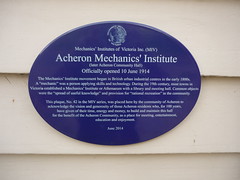
MIV Historical Plaques Program #0042
Acheron Mechanics' Institute (later Acheron Community Hall) Officially opened 10 June 1914. The Mechanics' Institute movement began in British urban industrial centres in the early 1800s. A "mechanic" was a person applying skills and technology. During the 19th century, most towns in Victoria established a Mechanics' Institute or Athenaeum with a library and meeting hall. Common objects were the "spread of useful knowledge" and provision for "rational recreation" in the community. This plaque, No. 42 in the MIV series, was placed here by the community of Acheron to acknowledge the vision and generosity of those Acheron residents who, for 100 years, have given of their time, energy and money, to build and maintain this hall for the benefit of the Acheron Community, as a place for meeting, entertainment, education and enjoyment. June 2014
McColl Lane, Acheron, VI, Australia
Subjects
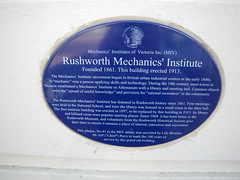
MIV Historical Plaques Program #0041
Rushworth Mechanics' Institute. Founded 1861. This building erected 1913. The Mechanics' Institute movement began in British urban industrial centres in the early 1800s. A "mechanic" was a person applying skills and technology. During the 19th century, most towns in Victoria established a Mechanics' Institute or Athenaeum with a library and meeting hall. Common objects were the "spread of useful knowledge" and provision for "rational recreation" in the community. The Rushworth Mechanics' Institute has featured in Rushworth history since 1861. First meetings were held in the National School, and later the library was housed in a small room in the shire hall. The first Institute building was erected in 1897, to be replaced by this building in 1913. Its library and billiard room were popular meeting places. Since 1969 it has been home to the Rushworth Museum, and volunteers from the Rushworth Historical Society give their time to ensure it remains a place of interest, education and enjoyment. This plaque, No. 41 in the MIV series, was unveiled by Life Member Mr Jeff ("Chief") Perry to mark the 100 years of service by this grand old building.
Cnr High and Parker Street, Rushworth, Victoria, Australia
Subjects


MIV Historical Plaques Program #0044
Christmas Hills Mechanics' Institute. Founded 1877. This building erected 2013. The Mechanics' Institute movement began in British urban industrial centres in the early 1800s. A "mechanic" was a person applying skills and technology. During the 19th century, most towns in Victoria established a Mechanics' Institute or Athenaeum with a library and meeting hall. Common objects were the "spread of useful knowledge" and provision for "rational recreation" in the community. Built in 1877 on what is now the sailing club, the original Hall, with library and records, was burnt down in 1893. It was rebuilt on its current site in 1895 on land donated by Thomas Young. Almost a century later, in 1984, a larger hall was added, built by the community, Box Hill TAFE, and the Healesville Shire. Following the bush fires of 2009, the Victorian Bushfire Appeals Fund financed the demolition of the then unfortunately derelict hall, and the building of the current hall. It was re-opened in 2013. This plaque, No. 44 in the MIV series, was unveiled in 2014 to mark its completion.
787 Ridge Road, Christmas Hills, VI, Australia
Subjects
MIV Historical Plaques Program #0043
Barfold Mechanics' Institute. Established 1897. Moved to this site in 1906. The Mechanics' Institute movement began in British urban industrial centres in the early 1800s. A "mechanic" was a person applying skills and technology. During the 19th century, most towns in Victoria established a Mechanics' Institute or Athenaeum with a library and meeting hall. Common objects were the "spread of useful knowledge" and provision for "rational recreation" in the community. This building, originally sited at Emberton, was the Emberton State School from 1874 to 1886. It was used by Redesdale railway construction workers till 1891. The site was gazetted for a Mechanics' Institute in 1895, and in 1897 a library was established with a donation of books by Miss Mitchell of Barfold Estate. In 1906 the building was relocated to this site in Dargan's paddock, beside the Barfold Railway Station, on the Kyneton-Redesdale Road. This plaque, No. 43 in the MIV series, commemorates the Victorian launch of "Home is Where the Hall Is" on 27 October 2013 by Ms Amanda Millar MLC representing the Minister for the Arts. The occasion included a book launch, artwork by students of Langley and Redesdale-Mia Mia schools and unveiling of a replica 'Mechanics' Free Library' sign.
Heathcote-Kyneton Road, Barfold, VI, Australia
Subjects

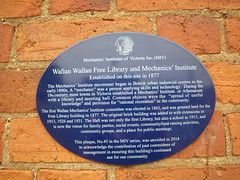
MIV Historical Plaques Program #0045
Wallan Wallan Free Library and Mechanics' Institute. Established on this site 1877. The Mechanics' Institute movement began in British urban industrial centres in the early 1800s. A "mechanic" was a person applying skills and technology. During the 19th century, most towns in Victoria established a Mechanics' Institute or Athenaeum with a library and meeting hall. Common objects were the "spread of useful knowledge" and provision for "rational recreation" in the community. The first Wallan Mechanics' Institute committee was elected in 1865, and was granted land for the Free Library building in 1877. The original brick building was added to with extensions in 1913, 1926 and 1931. The Hall was not only the first Library, but also a school in 1915, and is now the venue for family parties, social events, community fund-raising activities, community groups, and a place for public meetings. This plaque, No. 45 in the MIV series, was unveiled in 2014 to acknowledge the contribution of past committees of management in ensuring this building's continued use for our community.
Northern Highway, Wallan, VI, Australia
Subjects

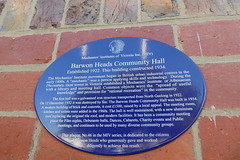
MIV Historical Plaques Program #0046
Barwon Heads Community Hall. Established 1922. This building constructed 1934. The Mechanics' Institute movement began in British urban industrial centres in the early 1800s. A "mechanic" was a person applying skills and technology. During the 19th century, most towns in Victoria established a Mechanics' Institute or Athenaeum with a library and meeting hall. Common objects were the "spread of useful knowledge" and provision for "rational recreation" in the community. The first hall was a galvanised iron structure transported from North Geelong in 1922. On 12 December 1932 it was destroyed by fire. The Barwon Heads Community Hall was built in 1934. A modern building of brick and concrete, it cost 1500 pounds, raised by a local appeal. The meeting room, kitchen and toilets were added in the 1960s. The hall is well maintained, with a new aluminium roof replacing the original tile roof, and modern facilities. It has been a community meeting place for Film nights, Debutante balls, Dances, Cabarets, Charity events and Public meetings, and continues to be used by many diverse community groups. This plaque, No. 46 in the MIV series, is dedicated to this citizens of Barwon Heads who generously gave and worked diligently to achieve this result.
79 Hitchcock Avenue, Barwon Heads, VI, Australia
Subjects
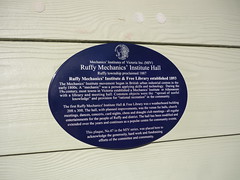
MIV Historical Plaques Program #0047
Ruffy Mechanics' Institute Hall. Ruffy township proclaimed 1878. Ruffy Mechanics' Institute and Free Library established 1893. The Mechanics' Institute movement began in British urban industrial centres in the early 1800s. A "mechanic" was a person applying skills and technology. During the 19th century, most towns in Victoria established a Mechanics' Institute or Athenaeum with a library and meeting hall. Common objects were the "spread of useful knowledge" and provision for "rational recreation" in the community. The first Ruffy Mechanics' Institute & Free Library was a weatherboard building 20ft x 30ft. The hall, with planned improvements, was the venue for balls, church meetings, dances, concerts, card nights, chess and draught club meetings - all regular entertainments for the people of Ruffy and district. The hall has been modified and extended over the years and continues as a popular centre for community events. This plaque, No. 47 in the MIV series, was placed here to acknowledge the generosity, hard work and fundraising efforts of the committee and community.
Nolans Road, Ruffy, Victoria, Australia
Subjects

MIV Historical Plaques Program #0048
Jeffcott North Mechanics' Institute and Free Library. On this site 1891-1900. The Mechanics' Institute movement began in British urban industrial centres in the early 1800s. A "mechanic" was a person applying skills and technology. During the 19th century, most towns in Victoria established a Mechanics' Institute or Athenaeum with a library and meeting hall. Common objects were the "spread of useful knowledge" and provision for "rational recreation" in the community. The opening of the Jeffcott North Mechanics' Institute and Free Library was celebrated with a Concert and Ball on 19th November 1891. It was a pine weatherboard building, 50ft x 20ft, built by Mr. J. R. Hornsby of Donald. It consisded of a main hall, library and reading room. It was a place for the district people to meet, learn and socialise. The Jeffcott Orchestra played at the Annual Race Concerts, Balls and other social functions. On 3rd January 1900 a fierce storm destroyed the building, a a clearing sale was held. A public hall was later built on a different site. This plaque, No. 48 in the MIV series, was placed on the site in November 2015 by the Jeffcott History Research Committee.
, Jeffcott North, VI, Australia
Subjects
MIV Historical Plaques Program #0049
Kyneton Mechanics' Institute. Opened 19 October 1858. The Mechanics' Institute movement began in British urban industrial centres in the early 1800s. A "mechanic" was a person applying skills and technology. During the 19th century, most towns in Victoria established a Mechanics' Institute or Athenaeum with a library and meeting hall. Common objects were the "spread of useful knowledge" and provision for "rational recreation" in the community. In 1855 a committee was formed to establish the Kyneton Mechanics' Institute. The first building opened in 1858, had meeting rooms and a library. Serious fires in 1867 and 1876 destroyed large sections of the building and its valuable library. In 1897 fire damaged the room of the main hall. The building was rebuilt after each of these fires. The original hall had a mural in a Grecian theme that was later replaced with an Art Deco design. The restoration and refurbishment in recent years has returned a grand building to the community where people can meet and socialise in the heart of the town. This plaque, No. 49 in the MIV series, was placed here in 2015. It is dedicated to the pioneers who established the reserve and built the hall.
Mollison Street, Kyneton, VI, Australia
Subjects

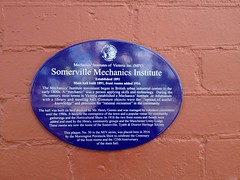
MIV Historical Plaques Program #0050
Somerville Mechanics' Institute. Established 1891. Main hall built 1891, front rooms added 1916. The Mechanics' Institute movement began in British urban industrial centres in the early 1800s. A "mechanic" was a person applying skills and technology. During the 19th century, most towns in Victoria established a Mechanics' Institute or Athenaeum with a library and meeting hall. Common objects were the "spread of useful knowledge" and provision for "rational recreation" in the community. The hall was built on land donated by Mr. Henry Gomm and was managed by volunteer committees until the 1980s. It became the centrepiece of the town and a popular venue for community gatherings and the Horticultural Show. In 1916 the two front rooms and facade were added and used by the library, community groups and the Manchester Unity Lodge. These rooms are now the home of the Somerville, Tyabb & District Heritage Society. This plaque, No. 50 in the MIV series, was placed here in 2016 by the Mornington Peninsula Shire to celebrate the Centenary of the front rooms and the 125th Anniversary of the main hall.
66 Station Street, Somerville, Victoria, Australia
Subjects
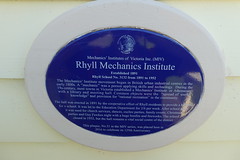
MIV Historical Plaques Program #0051
Rhyll Mechanics' Institute. Established 1891. Rhyll School No. 3132 from 1891 to 1952. The Mechanics' Institute movement began in British urban industrial centres in the early 1800s. A "mechanic" was a person applying skills and technology. During the 19th century, most towns in Victoria established a Mechanics' Institute or Athenaeum with a library and meeting hall. Common objects were the "spread of useful knowledge" and provision for "rational recreation" in the community. The hall was erected in 1891 by the cooperative effort of Rhyll residents to provide a building for a school. It was let to the Education department for 2/6 per week. After school hours it was used for church services, dances, euchre parties, family events, Christmas parties and Guy Fawkes night with a huge bonfire and fireworks. The school closed in 1952, but the hall remains a vital social centre of the district. This plaque, No. 51 in the MIV series, was placed here in 2016 to celebrate its 125th Anniversary.
Lock Road, Rhyll, Victoria, Australia
Subjects
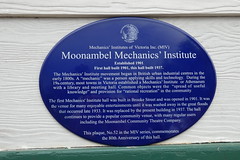
MIV Historical Plaques Program #0052
Moonambel Mechanics' Institute. Established 1901. First hall built 1901, this hall built 1937. The Mechanics' Institute movement began in British urban industrial centres in the early 1800s. A "mechanic" was a person applying skills and technology. During the 19th century, most towns in Victoria established a Mechanics' Institute or Athenaeum with a library and meeting hall. Common objects were the "spread of useful knowledge" and provision for "rational recreation" in the community. The first Mechanics' Institute hall was built in Brooke Street and was opened in 1901. It was the venue for many enjoyable entertainments until it was washed away in the great floods that occurred late 1933. It was replaced by the present building in 1937. The hall continues to provide a popular community venue, with many regular users including the Moonambel Community Theatre Company. This plaque, No. 52 in the MIV series, commemorates the 80th Anniversary of this hall.
14 Woods Street, Moonambel, Victoria, Australia
Subjects


MIV Historical Plaques Program #0053
Merton Mechanics' Institute (later Merton Memorial Hall). Established 1910. Building opened 1923. The Mechanics' Institute movement began in British urban industrial centres in the early 1800s. A "mechanic" was a person applying skills and technology. During the 19th century, most towns in Victoria established a Mechanics' Institute or Athenaeum with a library and meeting hall. Common objects were the "spread of useful knowledge" and provision for "rational recreation" in the community. In 1910, the Merton community met to discuss building a public hall and Mechanics' Institute. The Mechanics' Institute hall finally opened on 20th June 1923 at a cost of 550 pounds. It had a main hall for social events, and a smaller room for a library. In 1944 the Merton community supported changing the hall's official name to Merton Memorial Hall to honour residents who served in both wars. In 1952 the hall was upgraded with a kitchen and toilets, and major renovations have taken place over recent years. This plaque, No. 53 in the MIV series, was placed here in 2016 to celebrate this historic hall's restoration and its continuing role in the community.
17 Shaws Road, Merton, Victoria, Australia
Subjects

MIV Historical Plaques Program #0054
Amphitheatre Mechanics' Institute. Established here in 1901. The Mechanics' Institute movement began in British urban industrial centres in the early 1800s. A "mechanic" was a person applying skills and technology. During the 19th century, most towns in Victoria established a Mechanics' Institute or Athenaeum with a library and meeting hall. Common objects were the "spread of useful knowledge" and provision for "rational recreation" in the community. The Amphitheatre Mechanics' Institute was first instigated by Headmaster, Albert M. Barry. It was constructed by a local builder, Mr. William Whitley, at a cost of 179 pounds. The official opening was on 19th November 1901. The Free Library was established soon after. Many original books remain, including the 1900 edition of the Encyclopaedia Brittanica. In 2011 the library was renamed the 'Glenlogie Room' and is used for meetings and displays of historic memorabilia. The Mechanics' Institute continues to be well utilised by many groups and prides itself on its community support and spirit. This plaque, No.54 in the MIV series, was placed here in 2016.
, Amphitheatre, VI, Australia
Subjects

MIV Historical Plaques Program #0055
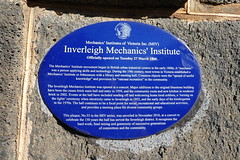
Inverleigh Mechanics' Institute. Officially opened on Tuesday 27 March 1866. The Mechanics' Institute movement began in British urban industrial centres in the early 1800s. A "mechanic" was a person applying skills and technology. During the 19th century, most towns in Victoria established a Mechanics' Institute or Athenaeum with a library and meeting hall. Common objects were the "spread of useful knowledge" and provision for "rational recreation" in the community. The Inverleigh Mechanics' Institute was opened at a concert. Major additions to the original bluestone building have been the cream brick main hall and entry in 1959, the community room and new kitchen in rendered brick in 2002. Events at the hall have included sending off and welcoming home local soldiers, a 'turning on the lights' ceremony when electricity came to Inverleigh in 1952, and the early days of the kindergarten in the 1970s. The hall continues to be a focal point for social, recreational and educational activities, and provides a meeting place for diverse community groups. This plaque, No. 55 in the MIV series, was unveiled in November 2016, at a concert to celebrate the 150 years the hall has served the Inverleigh district. It recognises the hard work, fund raising and generosity of successive generations of committees and the community.
, Inverleigh, VI, Australia
Subjects

MIV Historical Plaques Program #0056
Ararat Mechanics' Institute. Established in 1859, first built on the Barkly Street site in 1869. The Mechanics’ Institute movement began in British urban industrial centres in the early 1800s. A “mechanic” was a person applying skills and technology. During the 19th century, most towns in Victoria established a Mechanics’ Institute or Athenaeum with a library and meeting hall. Common objects were the “spread of useful knowledge” and provision for “rational recreation” in the community. The 1869 building was rebuilt in 1889, and again in 1908. The Federation style building with its corrugated iron roof, red brick walls, timber windows and doors, and finely decorated parapet, is a feature of the streetscape. In its early years it had an extensive library, and held music classes, lectures and penny readings. In the 1980s the top floor became the venue for the Rosengreen School of Dance with dance teacher Stella Rosengreen. Stella died in 1997, but a Dancing School continues with about 200 students, and a Hairdressing Salon operates downstairs. David Rosengreen joined the Committee in the 1980s. Now Secretary/Treasurer, and with Alan Wetton, President, he has continued to work tirelessly to keep the Institute functioning. This plaque, No.56 in the MIV series, is dedicated to David Rosengreen in recognition of his lifetime of service to the local community. December 2016.
Barkly Street, Ararat, VI, Australia
Subjects
MIV Historical Plaques Program #0057
Sea View Mechanics' Institute. (now Seaview Mechanics’ Institute Inc.) Built on this site in 1905. The Mechanics’ Institute movement began in British urban industrial centres in the early 1800s. A “mechanic” was a person applying skills and technology. During the 19th century, most towns in Victoria established a Mechanics’ Institute or Athenaeum with a library and meeting hall. Common objects were the “spread of useful knowledge” and provision for “rational recreation” in the community. The early pioneers held meetings, concerts, church services, balls and euchre parties in the Sea View School. As the number of settlers grew they agitated for a hall. Money was raised by local subscription and the Sea View Mechanics Institute and Library was built on land donated by Mr Bernard Kennedy, with plans provided gratis by architect Mr Lacey of Sale. The building was completed by Mr R. Games of Yannathan at a cost of £300. The grand opening by the Hon. J.E.Mackey,M.L.A. on Wednesday 14th June 1905 was attended by more than 200 people. This plaque, No.57 in the MIV series, was placed here in February 2017 in recognition of the building's significance in the history of the district.
, Seaview, Victoria, Australia
Subjects
MIV Historical Plaques Program #0058
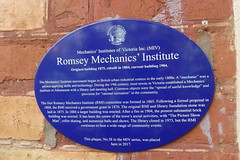
Romsey Mechanics' Institute. Original building 1875, rebuilt in 1884, current building 1904. The Mechanics’ Institute movement began in British urban industrial centres in the early 1800s. A “mechanic” was a person applying skills and technology. During the 19th century, most towns in Victoria established a Mechanics’ Institute or Athenaeum with a library and meeting hall. Common objects were the “spread of useful knowledge” and provision for “rational recreation” in the community. The first Romsey Mechanics Institute (RMI) committee was formed in 1865. Following a formal proposal in 1868, the RMI received a government grant in 1870. The original RMI and library foundation stone was laid in 1875. In 1884 a larger building was erected. After a fire in 1904, the present substantial brick building was erected. It has been the centre of the town’s social activities, with “The Picture Show Man”, roller skating, and numerous balls and shows. The library closed in 1975, but the RMI continues to host a wide range of community events. This plaque, No.58 in the MIV series, was placed here in 2017.
122 Main St, Romsey, VI, Australia
Subjects

MIV Historical Plaques Program #0059
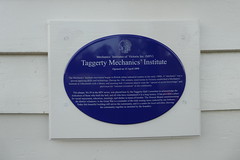
Taggerty Mechanics' Institute. Opened on 15 April 1898. The Mechanics' Institute movement began in British urban industrial centres in the early 1800s. A "mechanic" was a person applying skills and technology. During the 19th century, most towns in Victoria established a Mechanics' Institute or Athenaeum with a library and meeting hall. Common objects were the "spread of useful knowledge" and provision for "rational recreation" in the community. This plaque, No. 59 in the MIV series, was placed here by the Taggerty Hall Committee to acknowledge the dedication of those who built the hall, and all who have maintained it in a long history. It has provided a place for social enjoyment, education, meetings, and shelter in times of trouble. The Honour Board commemorating the district volunteers in the Great War is a reminder of the truly testing times endured by our forbears. Today this beautiful building still serves the community, and is a centre for local activities, drawing the community together as intended by the founders.
5 Taggerty-Thornton Rd, Taggerty, Australia
Subjects

MIV Historical Plaques Program #0061
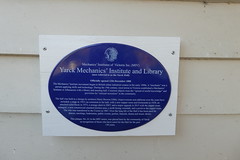
Yarck Mechanics' Institute and Library (now referred to as the Yarck Hall). Officially opened 12th December 1888. The Mechanics' Institute movement began in British urban industrial centres in the early 1800s. A "mechanic" was a person applying skills and technology. During the 19th century, most towns in Victoria established a Mechanics' Institute or Athenaeum with a library and meeting hall. Common objects were the "spread of useful knowledge" and provision for "rational recreation" in the community. The hall was built to a design by architect Harry Browse Gibbs. Improvements and additions over the years have included: a stage in 1923; an extension to the hall, with a new supper room and kitchenette in 1938; an attached toilet block in 1973; a storage shed in 2007; and a major upgrade in 2015 with the supper room enlarged, a new commercial standard kitchen area, a north facing verandah, and a porch to the supper room. The title was transferred to the Crown in 1967. Over the long life of the Hall it has been used for dances, meetings, badminton, public events, parties, funerals, drama and music shows. This plaque, No. 61 in the MIV series, was placed here by the community of Yarck in recognition of those who have cared for the Hall for the past 130 years.
Maroondah Highway, Yarck, VI, Australia
Subjects

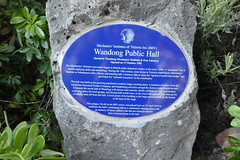
MIV Historical Plaques Program #0060
Wandong Public Hall (formerly Wandong Mechanics' Institute & Free Library) Opened on 17 October 1902. The Mechanics' Institute movement began in British urban industrial centres in the early 1800s. A "mechanic" was a person applying skills and technology. During the 19th century, most towns in Victoria established a Mechanics' Institute or Athenaeum with a library and meeting hall. Common objects were the "spread of useful knowledge" and provision for "rational recreation" in the community. The hall was built as the growing population needed a larger meeting place. A donation of timber from the Australian Seasoned Timber Company, and fundraising activities around the district, helped build the hall. It became the social hub of Wandong with dances and concerts, family celebration, fairs, and bazaars, a meeting place for the local groups, and during both world wars, as the local men enlisted, they were given rousing send-off from the hall. A focal point of the building is the large mural painted on the boards at the back of the stage. This plaque, No. 60 in the MIV series, was placed here on 25th April 2018 to celebrate the hall's continuing role as a community meeting place, and in memory of those soldiers who did not return to receive their welcome home at the hall.
19 Rail Street, Wandong, Victoria, Australia
Subjects


MIV Historical Plaques Program #0064
Ballaarat Mechanics' Institute. Established on this site in 1860. The Mechanics' Institute movement began in British urban industrial centres in the early 1800s. A "mechanic" was a person applying skills and technology. During the 19th century, most towns in Victoria established a Mechanics' Institute or Athenaeum with a library and meeting hall. Common objects were the "spread of useful knowledge" and provision for "rational recreation" in the community. Ballaarat Mechanics' Institute was founded in 1859. The main building was constructed in 1860 and the front four-story section added in 1869. Since its inception, the Institute has been a significant centre of cultural activity and social life in Ballarat. During 2004-2013 the building was fully refurbished to return to its 19th century glory. This plaque, No. 64 in the MIV series, was unveiled on 17 November 2018 by Dr Frank Hurley OAM, MIV founding President, on the occasion of the 20th anniversary of the formation of the Mechanics' Institutes of Victoria.
Sturt Street, Ballarat, VI, Australia
MIV Historical Plaques Program #0063
Neerim Junction Hall (originally the Neerim Mechanics' Institute and Free Library. Built on this site in 1873. The Mechanics' Institute movement began in British urban industrial centres in the early 1800s. A "mechanic" was a person applying skills and technology. During the 19th century, most towns in Victoria established a Mechanics' Institute or Athenaeum with a library and meeting hall. Common objects were the "spread of useful knowledge" and provision for "rational recreation" in the community. In 1873 the original building was built for the Neerim Mechanics' Institute and Free Library. It was burned down in the fires of Black Friday in 1898, but built again in the same year. The name Neerim Junction began to be used about 1911. In December 1972 the hall burned down again. It was rebuilt, with community support, and officially opened in November 1978 as the Neerim Junction Hall. This plaque, No.63 in the MIV series, was placed here on 11 November 2018 to celebrate the 40 Year Anniversary. "By the Community for the Community"
2957 Main Neerim Rd, Neerim Junction, VI, Australia
MIV Historical Plaques Program #0062
Tatura Mechanics' Institute [full inscription unknown]
, Tatura, Victoria, Australia
MIV Historical Plaques Program #0065
Mt Egerton Mechanics' Hall [full inscription unknown]
, Mount Egerton, Australia
MIV Historical Plaques Program #0066
Pyramid Hill Mechanics' Institute and Free Library [full inscription unknown]
, Pyramid Hill, VI, Australia
MIV Historical Plaques Program #0067
Horsham Mechanics' Institute [full inscription unknown]
, Horsham, VI, Australia
MIV Historical Plaques Program #0068
Lancefield Mechanics' Institute [full inscription unknown]
, Lancefield, Victoria, Australia