
Fort Worth, TX
Gender Diversity
The top 10



Texas Historical Marker #15259
Ponton, Dr. Arvel and Faye, House. At the time of this home's c. 1920 construction, the Mistletoe Heights neighborhood was emerging as a desirable subdivision for merchants and professionals. Designed by noted local architect Joseph R. Pelich, the Spanish Eclectic style home features a clay tile roof, large arched windows and doorways, stucco walls, embellished door surrounds, chimney belvedere and wrought iron detailing. Dr. Arvel and Faye Ponton were the first occupants. Dr. Ponton helped establish Fort Worth's Protestant Hospital and later his own clinic in a building also designed by Pelich. Recorded Texas Historic Landmark - 2008 #15259
1208 Mistletoe Drive, Fort Worth, TX, United States
Texas Historical Marker #15262
1869 Independence Day Raid. On July 4, 1869, after gathering a herd of horses from the Fort Worth area, a group of eleven Indians rode north and west from the city. They were followed by a posse of Tarrant County men, who trailed them into Parker County. Along the way, the Indians raided the homes of several settlers and shot and scalped two travelers. Other posses began following the Indians, who slipped away on the night of July 5th, leaving behind most of the stock they had taken. Raids such as this were common on the North Texas frontier between the late 1850s and 1875. (1984) #15262
8001 Malaga, Fort Worth, TX, United States
Texas Historical Marker #15420
Ray-Manship Cemetery, Site of. #15420
?, Fort Worth, TX, United States
Texas Historical Marker #15871
Polytechnic Cemetery. #15871
1000 Bishop, Fort Worth, TX, United States
Subjects
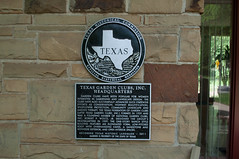
Texas Historical Marker #16969
Texas Garden Clubs, Inc., Headquarters. #16969 [full inscription unknown]
3111 Old Garden Road, Fort Worth, TX, United States
Subjects

Texas Historical Marker #04709
Sinclair Building. Pioneer oilman Richard O. Dulaney hired noted Fort Worth architect Wiley G. Clarkson to design this building. It acquired its name from the Sinclair Oil Company which leased offices here soon after the building's completion in 1930. The billion-dollar Sinclair-Prairie Oil Company moved its headquarters here in 1932. Built during the city's oil and gas-inspired golden era, this High-Rise Art Deco building features zig-zag motif, Mayan accents and terra cotta detailing. #4709
512 Main St., Fort Worth, TX, United States
Subjects
Texas Historical Marker #12202
Alice E. Carlson Elementary School. Designed by Fort Worth architect Wiley G. Clarkson and built in 1927, this building was enlarged twice, once in 1935 with Works Progress Administration funds and again in 1953 with designs by noted area architect Joseph R. Pelich, Sr. The original classrooms, principal's office and cafeteria were supplemented by additional wings. Named for a teacher who was the first woman to serve on the Fort Worth School Board, the institution shaped the growth of the neighborhood and its children. Architectural features include multilight frame windows and Spanish colonial revival details, including the tile roof and wrought iron lamps. State Archeological Landmark - 1983 Recorded Texas Historic Landmark - 2000 #12202
3320 W. Cantey St., Fort Worth, TX, United States
Subjects
Texas Historical Marker #05636
Van Zandt, Khleber Miller. N/A #5636
?, Fort Worth, TX, United States
Texas Historical Marker #00762
Cattle Brands. Proof of ownership since 600 B.C.; in Texas since 1821. Registered in counties and burned on hides of cattle. Every owner has individual brand. In Texas these aggregate several thousand. History of Texas is displayed here in brands of leaders: patriots, soldiers, bankers, rangers, industrialists. (1966) #762
East Exchange St., Fort Worth, TX, United States
Texas Historical Marker #00413
Birdville Cemetery. The oldest marked grave in this pioneer community cemetery is that of Wiley Wilda Potts (Dec. 20, 1822 - Dec. 15, 1852). The one-acre tract, then part of the George Akers Grant, was legally set aside for burial purposes before 1860. More land was later donated, and by 1910 the site included 3.27 acres. Birdville Cemetery Association, organized under a 50-year charter in 1917, was rechartered in 1967. The cemetery contained 552 known graves in 1965. Several families have four generations buried here in the same plot. The site now encompasses seven acres and is still used for burials. (1975) #413
6100 block of E. Bellknap, Fort Worth, TX, United States
Texas Historical Marker #00514
Broadway Baptist Church of Ft. Worth. On December 31, 1882, six men and three women met to organize this congregation. They called the Rev. John Smith Gillispie as their first Pastor. The name South Side Baptist Church was adopted January 14, 1883, at worship services held in a rented hall at 15th and Houston Street. In 1886 the fellowship erected a frame church building on the southwest corner of Broadway and St. Louis Avenue. Four years later the congregational name was changed to Broadway Baptist Church. As the church grew, larger facilities were needed. In 1906 a brick structure replaced the original building. On April 3, 1909, a devastating fire swept Fort Worth's South Side, destroying over 200 structures, including the church building, parsonage, and the homes of 22 member families. Rebuilding started immediately, and a new church structure was completed in 1910. The church complex expanded with the addition of educational facilities. A new sanctuary was begun in 1949 and completed by Easter Sunday in 1952. The membership of Broadway Baptist Church has grown to over 2,500 in its centennial year. At least seven other Baptist churches have been established through the efforts of this congregation. (1982) #514
305 W. Broadway, Fort Worth, TX, United States

Texas Historical Marker #01910
Flatiron Building. Known in early 1900s as the tallest building in North Texas. Erected 1907 for the renowned Dr. Bacon Saunders, Dean of City Medical College; Chief Surgeon, nine railroads; acclaimed as a pioneer of medicine in Texas. Designed by firm of Sanguinet and Staats, distinguished Fort Worth architects of reinforced concrete over steel frame, this Renaissance Revival structure was inspired by the wedge-shaped Flatiron Building in New York. Recorded Texas Historic Landmark-1970. #1910
1000 Houston St., Fort Worth, TX, United States
Texas Historical Marker #01355
Early Site of Southwestern Exposition and Livestock Show. Fort Worth became an important trading and supply depot in the 1870s for Texas cattlemen driving herds to Northern markets. With the convergence of several railroads here in the 1870s and 1880s stockyard facilities began to appear along the railroad lines. In 1893 Boston investors purchased the Stockyards and organized the Fort Worth Stock Yards Company. The Company held the first livestock show at nearby Marine Creek in March 1896. The show's initial sucess was due mainly to the participation of members of the Texas Cattle Raisers Association (TCRA) whose Annual Meeting in Fort Worth coincided with the Show. The Fort Worth Stock Yards Company built an impressive livestock exchange building in 1903. In 1908, with the help of Armour & Co., Swift & Co., and TCRA members, the National Feeders and Breeders Show opened here in new Coliseum facilities. The show offered a variety of events including a cutting horse competition and a horse show. A Wild West show was added in 1916. The show, renamed Southwestern Exposition and Fat Stock Show in 1918, developed into a premier rodeo, livestock, and exhibition event. In 1943 the facilities were converted for U.S. military purposes and in 1944 the Show relocated to a site in west Fort Worth. Sesquicentennial of Texas Statehood 1845-1995. #1355
Stockyards Blvd & Rodeo Plaza, Fort Worth, TX, United States

Texas Historical Marker #01556
Fairview, William J. Bryce House. A native of Scotland, William J. Bryce (1861-1944) moved to Fort Worth in 1883 and developed a successful brick contracting business. In 1893 he constructed this house, which was designed by the prominent architectural firm of Sanguinet & Messer. The Mayor of Fort Worth from 1927 to 1933, Bryce lived here until his death. One of the rare examples of a Chateauesque dwelling in Texas, Fairview features Richardsonian arches and gabled dormers. Recorded Texas Historic Landmark-1983. #1556
4900 Bryce St., Fort Worth, TX, United States
Texas Historical Marker #01470
Emanuel Hebrew Rest Cemetery. Fort Worth civic leader John Peter Smith donated land at this site in 1879 for use as a cemetery to serve the early Jewish residents of the City. Maintenance of the grounds was first provided by the Emanuel Hebrew Association, which was started by local families. The earliest marked grave is that of a child, Leah Kaiser, who died in 1879. Under the control of Congregation Beth-el since 1962, Emanuel Hebrew Rest Cemetery is the burial site of many prominent business, professional, and civic leaders of Fort Worth's Jewish community. (1981) #1470
1414 S. Main St., Fort Worth, TX, United States
Texas Historical Marker #01710
First Christian Church of Fort Worth. City's pioneer congregation, organized by the Rev. A.M. Dean, who with hymn book and revolver came in 1855 to the riotous six-year-old hamlet on the Trinity. He held services (at present Belknap and Houston streets) in a log house built for Post Surgeon, 2nd Dragoons, U.S. Army, stationed at fort that gave the city its name. Charter members were: Mr. and Mrs. James K. Allen, Mr. and Mrs. Benjamin P. Ayers, Mrs. Francis M. Durrett, Mrs. Alfred D. Johnson, Mrs. Florence Peak, Mr. and Mrs. William A. Sanderson, and Stephen Terry. First regular meeting place, a one-story concrete house at present Belknap and Lamar, was used on weekdays by Col. John Peter Smith (member of congregation) for sessions of the first public school established in Fort Worth. Rev. Mr. Dean, a frontier farmer, was followed as pastor by Dr. B.F. Hall, a dentist, and by Dr. Mansell Mathews, physician and judge of Red River County, and head of a large family grazing cattle in this area. Confederate General R.M Gano of Grapevine after the Civil War preached regularly at this church. In later 1860s came the Rev. Joseph Clark and sons Addison and Randolph, who in 1873 founded Add-Ran College, forerunner of Texas Christian University. First Christian is the oldest church in Fort Worth. #1710
612 throckmorton St., Fort Worth, TX, United States
Texas Historical Marker #01836
First Presbyterian Church of Fort Worth. The Fort Worth Presbyterian Church was organized in 1873 with ten charter members. Affiliated with the Presbyterian Church, U. S. ("Southern"), the congregation built a frame sanctuary at the corner of 4th and Calhoun Streets. In 1886 the name was changed to First Presbyterian Church of Fort Worth, and a new stone structure was built in 1890. A Fort Worth congregation of the Cumberland Presbyterian Church was formed in 1878. When the Cumberland Presbyterian Church affiliated with the Presbyterian Church, U.S.A. ("Northern") in 1906, the word Cumberland was dropped from the local church's name. Desiring to work together to serve the community with worship and missionary programs, the two Fort Worth congregations united in 1916 to form a federation, the first such union in Texas. The members met together and shared one pastor, but maintained separate national affiliations. The congregation erected a new edifice at this site, opening it on December 23, 1956. The "Southern" and "Northern" denominations united in 1983 to form the Presbyterian Church (U.S.A.). (1992) #1836
1000 Penn St., Fort Worth, TX, United States
Texas Historical Marker #02142
General Thomas N. Waul, C.S.A.. A native of South Carolina, Thomas Neville Waul (1813?-1903) practiced law in Mississippi before moving to Texas in 1850. After serving the Provisional Confederate Congress and signing the 1861 Confederate constitution, he organized Waul's Texas Legion, C.S.A. Waul led the Texans in Mississippi during 1862 and 1863, participating in the defense of Vickburg. He led a brigade in the Red River campaign of 1864 at Mansfield, La., and Jenkins' Ferry, Ark. Waul returned to Texas in 1865 and resumed the practice of law. He died near Greenville and was buried at this site #2142
?, Fort Worth, TX, United States
Texas Historical Marker #02233
Governor Charles A. Culberson. A native of Alabama, Charles A. Culberson grew up in Jefferson, Texas. He married Sallie Harrison (1861-1926) in 1882 after earning his law degree at the University of Virginia. During two terms as Attorney General of Texas, Culberson enforced the reform policies of Gov. James S. Hogg. He succeeded Hogg as Governor, 1895-99. Culberson served four terms in the United States Senate, winning the post of Democratic Minority Leader in 1907. Renowned for his knowledge of the law, he chaired the Senate Judiciary Committee from 1913-1919. (1979) #2233
Oakwood Cemetery, 700 Grand Ave., Fort Worth, TX, United States
Texas Historical Marker #02936
Khleber Miller Van Zandt (1836-1930). Tennessee native Khleber Miller Van Zandt moved to East Texas as a child. After serving as a Major in the 7th Texas Infantry Regiment, C.S.A., he came to Fort Worth in 1865. A merchant, banker, and rancher, he was instrumental in making the city a major rail center and helped establish early newspaper, the public schools, public transportation, and the First Christian Church. He served in the 13th Texas Legislature of 1875. A member of the United Confederate Veterans, he held the office of National Commander-in-Chief (1918-1921). Texas Sesquicentennial 1836-1986 #2936
700 Grand Ave., Fort Worth, TX, United States
Texas Historical Marker #04877
Site of Randol Mill. In 1856 Archibald F. Leonard (1816-1876) built a dam and grain mill at this site. Hiram Crowley became a partner. The mill became a community center and county voting place. During widespread abolition violence in 1860, Leonard's Mill was burned. It reopened by 1862 and operated during the Civil War. Owners after 1867 were H.B. Alverson and J.H. Wheeler. In 1876 R.A. (Bob) Randol (1850-1922) acquired Wheeler's Mill. A water-driven turbine powered the mill, a circular saw,and a cotton gin. Randol Mill played an important role in the area economy and closed after Randol's death. #4877
Precinct Line Rd. at Trinity River, Fort Worth, TX, United States
Texas Historical Marker #03659
Oakwood Cemetery. Founded 1879 by John Peter Smith, one of Fort Worth's first settlers, who became a civic leader, Mayor, philanthropist. He gave 20 acres to City; cemetery since enlarged to 100. The area contains three cemeteries: Oakwood, Calvary, Trinity. Many Fort Worth and Tarrant County men and women of destiny are buried here. Plots are owned by lodges, unions, Catholic, Protestant, Negro, and White. Tracts are dedicated to Union and Confederate soldiers. The Chapel was built in 1914. Oakwood, Calvary Associations, and City provide care. Recorded Texas Historic Landmark, 1966 #3659
Oakwood Cemetery at Grand and Gould Ave., Fort Worth, TX, United States
Texas Historical Marker #04453
Saint John's Evangelical and Reform Church. A United Church of Christ, this congregation was chartered October 1882 under the direction of the Rev. F. Werning, a pioneer missionary from Waco. It grew from early worship services in the home of Mr. and Mrs. H. Raab, conducted for twelve families of German descent. The Church's original sancturary was built on Calhoun Street, but was moved to the corner of Texas and Taylor streets before being relocated here in 1915. For over a century St. John's Evangelical and Reformed Church has played in an important role in the area's development. #4453
908 Pennsylvania Ave., Fort Worth, TX, United States
Texas Historical Marker #05244
Texas & Southwestern Cattle Raisers Association. On February 15, 1877, a large number of stock raisers from northwest Texas assembled in the Young County Courthouse in Graham to address the problem of cattle rustling. Their solution was the creation of the "Stock-Raisers' Association of North-West Texas." The organization worked to promote the interests of stock raisers and initiated a system of tracking stray or stolen cattle. Names, marks, brands, locations of ranches, and addresses of individual stock raisers were made available to each member. C.L. (Kit) Carter of Palo Pinto County served as the association's first president. Other prominent cattlemen involved in the group's formative years were C.C. Slaughter, Samuel Burk Burnett, and James C. Loving. During the 1893 Annual Convention, membership in the organization was opened to the entire state, and its name was changed to the "Cattle Raisers Association of Texas." In the same year, Fort Worth became the location of its permanent headquarters. The current name was adopted in 1921, when the Panhandle and Southwestern Stockmen's Association joined the Texas organization. Throughout its history, the association has provided significant service and leadership to the cattle industry of Texas. #5244
1301 W. 7th St., Fort Worth, TX, United States
Texas Historical Marker #05263
Texas Log Cabins. These authentic log cabins, built by pioneers 100 years ago, recall a way of life in early Texas when great courage was required to meet the hardships of frontier existence. Constant threats from Indians, poor crops, adverse weather, primitive living conditions did not stop these ingenious people from developing a wilderness into a land of opportunity. The log cabin, a familiar sight in Cross Timbers country of North Texas, was most readily available type of construction to the pioneer and his family. He was too far from a mill to obtain "box lumber." Skill, stamina were needed when preparing logs with such tools as the axe, broad and adze. Styles of fitting corners included "quarter notch" and "dovetail." Oak, cedar and heart pine woods were used. The cabin was a welcome sight to neighbors and saddle-sore travelers. Each told a personal story of frontier life and the family that lived within. The Tomkins cabin was a landmark on Ft. Worth-Belknap Road; visitors were welcome. Isaac Parker cabin was the last home of Cynthia Ann Parker after she was taken from her Comanche family in 1860. This Log Cabin Village was created so that part of the spirit of the Texas frontier would survive. #5263
University & Colonial Parkway, Fort Worth, TX, United States
Texas Historical Marker #05423
The Sanctuary - Gustavaus Adolphus Church. The Swedish Evangelical Lutheran Church of Gustavus Adolphus Synod was organized in 1905 to serve Swedish settlers in the City of Fort Worth. In 1912 the congregation, which later became known as Grace Lutheran, constructed this sanctuary and held worship services here until it moved to another site in 1957. The Lombard Romanesque style building features fine brickwork in the tower and over the arches. #5423
400 Hemphill, Fort Worth, TX, United States
Texas Historical Marker #05680
WBAP-TV - Channel 5, First Television Station in Texas. Founded by Amon G. Carter, noted publisher of the "Fort Worth Star-Telegram", the first progam--a public appearance, Sept. 27, 1948, by President Harry Truman--made Texas the sixteenth state in the nation to open a commercial station. Among other "Firsts" of WBAP-TV are the first live entertainment in Texas ("Flying X Ranchboys"), and first Texas colorcast via NBC-TV, 1954. Today Channel 5 serves aproximately 60 counties in Texas and Oklahoma. Since its birth, television has made many advances. In Washington, D.C., 1927, Herbert Hoover (at that time Secretary of Commerce) appeared on the first major telecast in the nation. In 1931, H. & W. Corset Company in New York conducted the first experimental use of closed-circuit television to display its models to a buyer and sold $5,000 worth of merchandise. Modern commercial telecasting did not begin, however, until 10 years later, when New York opened the first station in the country. After a slow start, major strides were made in 1947 and 1948. As of July 1, 1967, the U.S. had 628 commercial and 128 educational stations, with 224 under construction. Of these, Texas had 49 commercial and 5 educational. #5680
3900 Barnett St., Fort Worth, TX, United States

Fairmount-Southside Historic District The Fairmount-Southside Historic District is a predominately residential area in the center of Fort Worth's Historic Southside. Located approximately two miles south of present-day downtown, the district is comprised of 22 separate additions containing more than 1,200 contributing residences, commercial buildings and other structures. It emcompasses nearly 375 acres in about 100 square blocks. Most residences were built as wood-framed single-family cottages, bungalows and two-story foursquare homes. Fort Worth was incorporated in 1873 in anticipation of the first railroad, which came through in 1876. Speculators bought and sold land they believed would turn the most profit if Fort Worth's economy was bolstered by the railroad. During the post-railroad boom, the city began to quickly expand south. Developers planned the additions that now comprise the Fairmount-Southside Historic District during the years 1883-1907. The largest was the Fairmount Addition, platted in 1890, which encompasses much of the western half of the district. When developed, the land on which the Fairmount-Southside Historic District now rests was on the southernmost edge of the city. The district grew rapidly in its formative years, as many middle-income workers moved to Fort Worth for various employment opportunities. Within the first two decades of the 20th Century, streetcar lines ran down major district thoroughfares, including College and Fairmount Avenues, carrying railroad employees, doctors, lawyers, salesmen and merchants to and from their homes built on the Southside to their areas of employment. Beginning with Queen Anne and ending in the Craftsman style, the homes built by the original residents now showcase the evolution of domestic architecture of early 20th Century suburban America. (2016) Marker is property of the State of Texas
Allen Street, Fort Worth, TX, United States
Texas Historical Marker #12201
Blackstone Hotel. The first art deco skyscraper in Fort Worth, the Blackstone Hotel was erected in 1929 for wealthy cattleman C. A. "Gus" O'Keefe, who named it after a visit to the Blackstone Hotel in Chicago. The St. Louis architectural firm of Mauran, Russell, and Crowell designed the structure. The city's first radio station, WBAP, once occupied the 22nd floor. A five-story annex was added in the 1950s by the Hilton Hotel chain, which occupied the building from 1952 to 1962. Featuring original sash windows, irregular setbacks, and ornamental terra cotta detailing, the Blackstone Hotel remains the city's tallest pre-World War II structure. Recorded Texas Historic Landmark - 1998 #12201
601-615 Main St., Fort Worth, TX, United States
Texas Historical Marker #04828
Site of Majestic Theatre. At the turn of the century Ft. Worth's live entertainment consisted chiefly of saloon, dance hall, church, and school presentations. Matters changed in 1905 when Karl Hoblitzelle founded the Interstate Amusement Company and chose Ft. Worth for its Southwest Vaudeville Theater Circuit. One of Interstate's famous "Atmospheric" Majestic Theaters was built at Tenth and Commerce streets (one block south) in 1910-11. The Majestic's lavish interior included Turkish rugs, French doors and mirrors, plush Spanish leather upholstery and a lobby with marble floors, hand-painted walls ,and 18 karat gold leaf ceilings. The 1,356-seat theater reportedly contained the country's first indirect stage lighting system and the country's largest concrete arch, an 80-foot balcony support beam. Performers on Ft. Worth's Majestic stage included Will Rogers, Walter Huston, Tallulah Bankhead, and Fred Allen. The Theater added feature movies to its Vaudeville program in 1922 and in 1932 discontinued its Vaudeville presentations. Thereafter strictly a motion picture theater the Majestic fell on hard times and closed in 1953. Despite efforts to restore it, the Majestic was razed in 1970 to make room for the new Tarrant County Convention Center. (1993) #4828
9th & Commerce St., Fort Worth, TX, United States
Texas Historical Marker #05280
The 1865 Indian Creek Raid. During the late 1850s Indians on the north Texas frontier became increasingly restive about continued white settlement on their lands. As a result, numerous attacks on Anglos occurred during the years form 1859 to 1875. One such incident took place in Sept. 1865 near this site when 15 mounted Indians attacked two Denton County residents by the names of Smith and Wright. Wright was killed, and Smith, wounded by an arrow, rode to Denton for help. Within a short time, Smith died from blood poisoning caused by his wound. (1983) #5280
On Morris - Dido - Newark Rd., Fort Worth, TX, United States
Texas Historical Marker #05845
William Reeves House. Prominent businessman and philanthropist William Reeves built this home for himself and his wife, Mattie Hosea, in 1907-08. He served as President of Reeves Investments and was President and founder of the First Fort Worth Bank and Trust. The Reeves house exhibits characteristics of the Neo-Classical Revival and Queen Anne styles of architecture. Prominent features include the round pavilion at the entrance and the wrap-around porches with Doric columns. #5845
2200 Hemphill, Fort Worth, TX, United States
Texas Historical Marker #05771
Westover Manor. Built in 1929-30 as the flagship for development of Westover Hills, this Norman-Jacobethan revival mansion was selected as the Fort Worth Star-Telegram newspaper's "Home Beautiful". John E. Farrell (1891-1946), first Mayor of Westover Hills and co-discover of the vast east Texas oil field in 1931, lived here from 1930 until his death. Designed by architect Victor Marr Curtis, the house exhibits picturesque blend of materials, including brick and rough-cut limestone, and features a bell-cast tower roof, Tudor chimneys, half-timbered gables, and vari-shaded roof tile. Recorded Texas Historic Landmark-1988 #5771
8 Westover Rd., Fort Worth, TX, United States
Texas Historical Marker #05815
Willburn Cemetery. Many of the individuals buried in this pioneer cemetery are descendants of Edward Willburn (1805-82) and his wife Nancy (Overton) (ca. 1811-87), immigrants from the upper south who settled here in the 1850s. The earliest marked grave, dated 1867, is for the infant child of William and Cassandra (Williams) Willburn. Also interred here: Rachael M. (Wilburn) Snyder, donor of property for a church, school, and cemetery in Benbrook; Church Willburn, a cowboy on several cattle drives in the 1860s; Civil War veterans; and other pioneers of southwestern Tarrant County. Texas Sesquicentennial 1836-1986 #5815
3720 Streamwood Rd., Fort Worth, TX, United States
Texas Historical Marker #05883
Witten Cemetery. This cemetery was established for the family of Samuel Cecil Holiday Witten (1819-91), who came to Texas in 1854. A successful landowner, he also served as a Justice of the Peace and Deputy County Surveyor. Witten first used this burial site in 1857 for the interment of his son, William. Also buried here is another son, George (1841-68), who drowned while on a cattle drive, and a son-in-law, Ryan Harrington (1829-84), a participant in the 1849 California Gold Rush. Samuel Witten and his wife moved to Corpus Christi in 1890 and the cemetery was later used by family descendants. #5883
Colleyville Cr. at Jackson Court, Fort Worth, TX, United States

Grammer-Pierce House This California style Craftsman bungalow was built in 1915 by A.H. Richter and his wife, Violet (Murdock) Richter, in what is now the Fairmount Historic District. It was purchased in 1917 by Mrs. N.E. Grammer, widow of Nathaniel Grammer. Nathaniel was a prominent Fort Worth businessman, owning the largest and oldest drug store in the city. Mrs. Grammer sold the house in 1940. In 1948, Alice (Lewis) Pierce, who was part Choctaw Indian, purchased the house after she and her husband, Mark, moved to Fort Worth to reestablish themselves following the Stock Market Crash of 1929, they sold the house in 1970. Recorded Texas Historic Landmark - 2015 Marker is Property of the State of Texas
2232 College Ave., Fort Worth, TX, United States
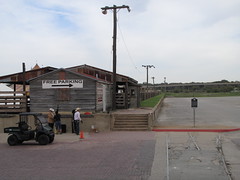
Fort Worth Belt Railway Beginning in 1904, the Belt Railway serviced the Fort Worth Stock Yards. The arrival of the railroad in Fort Worth in 1876 moved the cow town from a regional economic player to a national force. The Stockyards Corporation, chartered in 1895, created a belt railway system to handle the movement of livestock and supplies into the yards and finished products out to the national market. As road traffic grew in the mid-1920s, the Belt's role began to diminish. By 1978, the Texas & Pacific and the Missouri Pacific railroads gained full control of the Belt. In 1988, the Fort Worth and Western Railroad purchased what was left of the Belt. The remaining two miles of line are not used as an access route by an excursion train to the National Historic District. Marker is property of the State of Texas (2014)
Exchange Avenue, Fort Worth, TX, United States