
Fort Worth, TX
Gender Diversity
The top 10


Texas Historical Marker #02032
Fort Worth Stock Yards Company. The Fort Worth Stock Yards Company was created in 1893, when Boston capitalist Greenlief W. Simpson led a group of investors in purchasing the Fort Worth Union Stock Yards. Under Simpson's leadership, the Company earned the support of the Texas Cattle Raisers Association and lured the prominent meatpacking companies of Armour and Swift to open plants here. Publicity through the Company's market newspaper and annual Fat Stock Show, both begun in 1896, resulted in a significant increase in the number of animals brought to market. The Stock Yards Co. built the area's livestock-related facilities and had controlling interest in many North Fort Worth businesses and properties. The first five decades of the 20th Century were the most successful for the Fort Worth Stock Yards Co. During World War I, foreign governments purchased draft animals, making Fort Worth the largest horse and mule market in the world. In 1917, overall livestock market receipts reached 3,500,000 and in 1944, sales exceeded 5,000,000 head of livestock. However, by the 1950s, local auctions were drawing sellers away from this central market. Today the Fort Worth Stock Yards Co. continues as a significant part of the city's unique heritage. Texas Sesquicentennial 1836-1986. #2032
131 E. Exchange St., Fort Worth, TX, United States

Texas Historical Marker #04964
Smith-Burnett Home. This area of Fort Worth became a fashionable subdivision during the early part of the twentieth century and attracted many prominent residents. In 1906 Fort Worth banker Ben O. Smith (1867-1932) purchased land at this site. He built a home here for his wife, Frances, who hosted many Fort Worth social gatherings. In 1916, the home was purchased by Tom Burnett, a prominent cattleman and the son of rancher S. Burk Burnett. The site retains historical significance for its association with these two prominent Fort Worth families. #4964
4910 Crestline Rd., Fort Worth, TX, United States

Texas Historical Marker #01369
Eastern Cattle Trail. This native stone, dug from the Trinity River Valley, marks the route of the Eastern Cattle Trail, where cattle were driven north on Rusk Street, now Commerce Street, through the City of Fort Worth, Texas, to the bluff and then across the Trinity River to the broad valley below, where they rested before continuing their long drive north. From the end of the Civil War to the bringing of the railroad in 1876, great herds of cattle passed this way to Abilene, Kansas. The Eastern Trail, also called the McCoy Trail, became the Chisholm Trail when it reached the Red River. Fort Worth, the last place for provisions before Indian Country, received its name, 'Cow Town', and it first major industry, from this period. #1369
Heritage Park, 100 N. Commerce, Fort Worth, TX, United States

Texas Historical Marker #03877
Ormer Leslie Locklear. A native of Greenville, Texas, Ormer Leslie Locklear moved to Fort Worth with his family in 1906. He worked for his father's construction company until 1914, when he and his brother opened an automobile repair shop. Locklear enlisted in the U.S. Army Air Service in 1917, soon after the U.S. enter World War I. He trained in San Antonio and Austin before being assigned to Barron Field near Fort Worth as a flight instructor. He soon became known for his daring feats of precision flying and performed in barnstorming air shows to recruit pilots for military service. Locklear resigned his Army commission in 1919 to fly in the commercial air show circuit. Hired by the Universal Film Company as a stunt pilot for motion pictures, he moved to Hollywood and in 1920 was killed flying a stunt pilot for his second feature, "The Skywayman". The accident, believed to have been caused when the bright lights illuminating the night sky for filming blinded the pilot, was recorded on film and used in the movie's final scene. Thousands of mourners attended Locklear's Fort Worth funeral, which the Fox Film Corporation filmed and released later as a newsreel. (1992) #3877
3400 White Settlement Rd., Fort Worth, TX, United States

Texas Historical Marker #04881
Site of Saint Stanislaus Kostka Catholic Church. Catholics in Fort Worth began meeting together for regular worship services by 1875. They met in private homes, and were served by traveling priests. In 1876 Bishop Claude Dubuis of the Diocese of Galveston assigned a young Irish priest, Father Thomas Loughrey, to establish a parish in Fort Worth. In July 1876 the Diocese purchased two lots at this site for a church to be named for Polish Jesuit Saint Stanislaus Kostka. Within three months, on October 29, 1876, Father Laughry said the first High Mass in the frame structure. He continued to serve the church until 1884, when Father Jean Marie Guyot was assigned as Pastor. The church opened a Catholic School in the parish. Classes initially were taught by Father Loughrey and the Sisters of Mercy. After 1885 the school was operated by the Sisters of St. Mary. By 1885 plans were underway for a new church structure. Completed in 1892, it was named for Saint Patrick. The original Saint Stanislaus building became part of the school. After serving the parish for over three decades, it was removed between 1908 and 1909 to make way for a new parish rectory. #4881
1206 Throckmorton, Fort Worth, TX, United States

Texas Historical Marker #02030
Fort Worth Main Post Office Buiding. The Fort Worth Post Office was established in 1856 with pioneer settler Julian Field serving as Postmaster. The central offices were moved here in 1933 when this building was completed. Designed by the Fort Worth firm of Wyatt C. Hedrick, it features interior detailing of marble, bronze, and gold leaf. Exterior ornamentation reflects the significance of the cattle industry in the development of the area. Recorded Texas Historic Landmark-1980. #2030
300 block W Lancaster, Fort Worth, TX, United States
Texas Historical Marker #02028
Fort Worth Library. Seeking funds for a public library, local woman asked the philanthropist, Andrew Carnegie, to donate "The price of a good cigar". He gave $50,000. With that and substantial local gifts, including land donated by Mrs. Sarah J. Jennings, the first City Library opened on this site, 1901. First Librarian, Mrs. Charles Schevber, was active in parks movement and local art circles. She was Vice President, 1911-1917, American Federation of Art. The old library was razed in 1938. This building in modern Classic style is four times as large as the original Library. (1968) #2028
Houston & 9th St., Fort Worth, TX, United States
Subjects


.jpg)


Texas Historical Marker #05465
Thomas B. Saunders Family. A native of North Carolina, Thomas Bailey Saunders (1816-1902) migrated to Texas in 1850 and started a cattle ranch near Gonzales. After the Civil War he completed cattle drives to markets in New Orleans and Kansas before settling in Bexar County. Two of Saunders' twelve children were also involved in the cattle industry. William David Harris Saunders (1845-1922) helped supply beef for Confederate forces during the Civil War and later became a successful Goliad merchant and rancher. Another son, George Washington Saunders (1854-1933), became a noted trail driver of the 1870s. He later opened a livestock commission in San Antonio. Thomas B. Saunders, II (1872-1929), the son of William, owned a livestock firm in Houston. He later moved here and in 1902 became the first cattle dealer on the Fort Worth Stockyards. He was a pioneer in the transporting of cattle by truck. His son Thomas B. Saunders, III (1906-1974), was involved in extensive ranching operations throughout the Southwest. During the 1930s economic depression, he started a cattle clearinghouse for traders, order buyers, and commission companies. Since the 1850s, Saunders family members have been actively involved in the Texas cattle industry. #5465
100 block of E. Exchange St., Fort Worth, TX, United States
Texas Historical Marker #03495
Mount Olivet Cemetery. Encompassing almost 130 acres, the Mount Olivet Cemetery was founded in 1907 by Flavious G. McPeak (1858-1933) and his wife, Johnnie Clara Lester McPeak (1858-1936), who arrived in Fort Worth in 1894 from Tennessee. The land on which the cemetery is located was purchased by Mrs. McPeak in 1895, and the family built a two-story home in 1896. The parents of ten children, the McPeaks moved to a home on Lake Street when they founded this cemetery. Flavious McPeak, a respected Fort Worth businessman, had visited the Mount Olivet Cemetery in Nashville, Tennessee, and was so impressed with its design that many of its features were incorporated here. A mausoleum was completed in 1909, but only served as a temporary receiving vault. It was torn down when a new mausoleum was built in 1983. A variety of free-standing and relief sculpture can be seen throughout the grounds. Containing over 47,000 burials, this was the first perpetual care cemetery in the county. The oldest marked grave is that of Zenas Ewin Kerr, buried April 11, 1907. Also interred here are 594 victims of the flu epidemic of 1918, the McPeaks and members of their family, and many Tarrant County pioneers. Texas Sesquicentennial 1836-1986. #3495
2205 N. Sylvania, Fort Worth, TX, United States
Texas Historical Marker #04377
Royal Flying Corps. In 1917, during World War I, the U.S., British, and Canadian Governments entered into a reciprocal agreement to train military pilots for combat duty. Foreign troops trained in Texas during the winter and in Canada in the summer. Camp Taliaferro in Tarrant County, consisting of three air fields, provided training facilities for members of the Royal Flying Corp and U.S. forces from October 1917 to November 1918. Each field accommodated an average of 2,000 men. Royal Flying Corps expertise and skilled instructors enabled large numbers of Americans to receive excellent flight training in a short time. During the months British and Canadian troops were stationed in Fort Worth, 39 officers and cadets were killed during flight training. Eleven of the men were buried at the three Air Fields; in 1924 the Imperial War Graves Commission purchased a plot at Greenwood Cemetery for reinterment. A monument was later erected at the site, which now has twelve graves since a veteran who died in 1975 requested burial here with his friends. The Royal Flying Corps, although in Texas for only a short time, had a beneficial and lasting influence on aviation in this country. #4377
3400 White Settlement Rd., Fort Worth, TX, United States
Texas Historical Marker #04464
Saint Mary of the Assumption Roman Catholic Church. The first Mass for this Roman Catholic parish was held in 1909 in a small wooden church which burned in 1922. This Romanesque Revival structure was designed by the well-known firm of Sanguinet, Staats and Hedrick. It was dedicated July 20, 1924, by the most Rev. Joseph P. Lynch, Bishop of Dallas. The bells were installed in 1956. This parish has been guided by the Vincentian, Benedictine, and Salvatorian religious orders. #4464
509 W. Magnolia Ave., Fort Worth, TX, United States
Texas Historical Marker #04479
Saint Paul Lutheran Church. In 1892 the Rev. Johann Christian Schulenburg (1840-1922), a Lutheran Church-Missouri Synod missionary, conducted services in German at the Knights of Honor Hall in downtown Fort Worth. In 1896 the Mission was chartered as the Evangelisch Lutherische St. Paulus Gemeinde, and a chapel was erected on Hemphill and Railroad (now Vickery) avenues. In 1919 the congregation erected a new church building on May Street. With continued growth of membership a larger facility became necessary, and the church relocated on the West Freeway in 1954. #4479
1800 West Freeway, Fort Worth, TX, United States
.jpg?width=250)
Texas Historical Marker #02035
Fort Worth Stockyards Horse and Mule Barns. The Fort Worth Stock Yard Company's wooden horse and mule barns on this site were destroyed by fire on March 14, 1911, opening day of the Feeders and Breeders show (later Southwestern Exposition & Fat Stock Show). The show opened as planned, with former President Theodore Roosevelt giving the opening address. The company announced plans to replace the destroyed barns immediately with new concrete and steel fireproof buildings. Construction was completed in March 1912, and the new barns measuring 540'x350' had a capacity for 3000 animals. With a price tag of $300,000, the buildings were described as among the finest stables in the world. Activity here increased considerably in 1914, at the outbreak of World War I. Horses and mules were needed in great supply by European armies, and agents were sent in droves to Fort Worth to buy stock, spending an estimated $11 million. During that time, Fort Worth was designated the largest horse and mule market in the world. The wide space between the buildings has over the years spawned the nickname "Mule Alley". In recent years the barns have been used for various cultural activities and annual events. Texas Sesquicentennial 1836-1986. #2035
120 E. Exchange St., Fort Worth, TX, United States
Subjects
Texas Historical Marker #04800
Site of Fort Worth's First Telephone Exchange. #4800
W. 2nd & Houston, Fort Worth, TX, United States
Texas Historical Marker #05463
Thistle Hill, The Cattle Baron's Mansion. Designed by Sanguinet & Staats, this Georgian Revival structure was built in 1903 for A.B. Wharton (1878-1963) and his bride Electra (1882-1925), daughter of rancher W.T. Waggoner (1852-1934). Electra named the mansion "Thistle Hill". Cattlemen-investor Winfield Scott (1849-1911) bought the home in 1910 but died before he moved in. His wife Elizabeth (1861-1935) lived here until her death. Occupied by the Girls' Service League, 1940-1968, the house was purchased in 1976 by "Save the Scott Home!" Inc. #5463
1509 Pennsylvania Ave., Fort Worth, TX, United States
Texas Historical Marker #05839
William Madison McDonald (June 22, 1866-July 4, 1950). Born in Kaufman County, William "Gooseneck Bill" McDonald became active in politics in 1890. His ability to unite black and white voters led to his prominence as a leader of the "Black and Tan" faction of the Republican Party. He remained influential, serving as a delegate to many state and national conventions, until the decline of the Republican Party in Texas in the early 1900s. Also active in black Masonic societies, he served as State Secretary for 47 years. He moved to Fort Worth in 1906, founded the Fraternal Bank and Trust Company, and was a prominent civic leader. (1982) #5839
700 Grand Ave., Fort Worth, TX, United States
Texas Historical Marker #04456
Saint Joseph Hospital. In the 1880s Fort Worth was a thriving railroad town. The Missouri Pacific Railroad Company established an infirmary near its headquarters to care for its employees. In 1885 the Congregation of Sisters of Charity of Incarnate Word, based in San Antonio, was asked to take over operation of the infirmary. Ten nuns traveled to Fort Worth to begin work at the Infirmary. When the work of the railroad was completed in 1889, the Congregation purchased the facility and it was renamed St. Joseph's Infirmary. St. Joseph's was Fort Worth's first general hospital, and from the outset ministered to charity patients. A new three-story brick structure was built in 1898, and over the years additional facilities were built to house the hospital's expanding services. The name was changed in 1930 to St. Joseph's Hospital, and again in 1966 to Saint Joseph Hospital. In addition to direct medical care, the hospital's programs have grown to include training for health care professionals as well as educational and counseling services for patients and their families. The county's first hospice program for terminally ill patients was inaugurated here in 1980. For over 100 years this hospital has served the community. #4456
1401 S. Main St., Fort Worth, TX, United States
Texas Historical Marker #04462
Saint Mark United Methodist Church. This congregation was formed in 1940 by the merger of several historic Fort Worth Methodist Churches. The Swedish Methodist Episcopal Church was organized in 1883 with twenty charter members under the leadership of the Rev. P.S. Juhline. Use of the Swedish language during worship services continued until 1920. In 1924 the name of the congregation was changed to Broadway Methodist Episcopal Church. Six years later, St. Paul Methodist Episcopal Church merged with the Broadway Congregation. St. Paul's had been organized in 1877 with thirty charter members under the leadership of the Rev. Harvey Webb. Mulkey Memorial Methodist Episcopal Church began in the late 1880s as a mission of the First Methodist Episcopal Church of Fort Worth. The church was named for the Rev. and Mrs. William Mulkey, parents of George Mulkey, who was a charter member of the new church. The Rev. John M. Barcus served as first pastor. At the 1940 Annual Conference these historic congregations merged to become the Broadway-Mulkey Methodist Episcopal Church, South. The name St. Mark was adopted in 1945. The congregation has worshiped at this site since 1960. [Now renamed Christ-Life Church] #4462
1200 Wesleyan St., Fort Worth, TX, United States
Texas Historical Marker #00094
Ahavath Sholom Hebrew Cemetery. Wishing to have their own cemetery, congregation Ahavath Sholom, the first Jewish congregation in Fort Worth, purchased a six-acre tract from the Greenwood Cemetery Association at this location and dedicated Ahavath Sholom Hebrew Cemetery in 1909. A Ladies Cemetery Society was formed in that year to oversee the upkeep of the graveyard; Rebecca Goldstein served as its initial president. The first person buried here was Charles Hurwitz in 1910. In 1929 an agreement between the congregation and the Greenwood Cemetery Association resulted in the enlargement of this Jewish cemetary. Three soldiers who perished during World War II are buried side by side in the north section of the cemetery. A large monument memorializing the millions of Jewish victims of the German Nazi Regime in World War II Europe (1939-1945) was erected by members of the congregation who lost relatives in the Holocaust. The Kornbleet Chapel, which contains seating for one hundred persons, was dedicated in 1988. The chapel is used for funeral services as well as other religious services pertaining to the cemetery. The congregation established a trust fund for the long-term maintenance of the cemetery. (1993) (1992) #94
415 N. University, Fort Worth, TX, United States
Texas Historical Marker #00154
Amon G. Carter. Born in Wise County, Texas, on December 11, 1879, Amon Giles Carter left home at an early age and worked at a variety of odd jobs around the country before his arrival in Fort Worth in 1905. Carter became the advertising manager of the "Fort Worth Star", which published its first issue on February 1, 1906. Thus began a career in journalism that by 1925 had taken him to the position of president and publisher of the "Fort Worth Star-Telegram," the newspaper with the largest circulation in Texas for many years. Carter's involvement in a wide variety of interests left its mark on many Texas institutions. In 1921, he authorized the purchase of equipment that resulted in the establishment of WBAP Radio in Fort Worth. An aviation enthusiast, Carter brought numerous early aviators to Fort Worth to demonstrate their skills and helped attract aviation industry to the area. His promotion of Fort Worth and the entire West Texas region attracted widespread attention. Much of the fortune he earned in oil was spent on philanthropic interests, including establishment of the Amon Carter Museum as a gift to Fort Worth. Amon G. Carter died in Fort Worth on June 23, 1955, and is buried in Greenwood Cemetery. (1985) #154
400 W. 7th, Fort Worth, TX, United States
Texas Historical Marker #00387
Beth-el Congregation. The beginnings of a Reform Jewish Community in Fort Worth date to 1879, when the Hebrew Benevolent Society opened a Sabbath School, and early services were held in homes. About 1900, under the leadership of Henry Gernsbacher (1858-1936), enthusiasm began to grow,and in 1902 a call was issued in the area for the organization of a formal congregation. Forty-three people gathered to found the Beth-el Congregation, and Sam Levy (1856-1927) was elected president. The Fort Worth section of the National Counsel of Jewish Women donated funds to bring a Rabbi to conduct High Holy Days services. The early days of the congregation were difficult ones, with services being held sporadically. For a time, student Rabbis from Hebrew Union College in Cincinnati conducted services for High Holy Days. In 1904 a Rabbi was hired, and the congregation met in rented quarters. A lot was bought on the corner of Fifth and Taylor streets in 1907, and a Temple was built in 1908. By 1919 the congregation had outgrown the buildings and a new Temple was built on this site. Soon after a 25th Anniversary Celebration, the temple was destroyed by fire on August 29, 1946. Beth-El Temple was rebuilt, and dedicated on January 7, 1949. Texas Sesquicentennial 1836-1986. #387
207 W. Broadway, Fort Worth, TX, United States
Texas Historical Marker #00651
Camp Bowie in World War I. Headquarters, 36th Division, United States Army, 1917-1919. Established to train Texas National Guard and Oklahoma National Guard, after the U.S. entered World War I April 1917. Named for James Bowie (1795-1836), one of the commanders who died at the Alamo in Texas War for Independence, Camp Bowie was occupied in July 1917. First troops to arrive slept in deep Johnson grass that covered the site, an undeveloped suburb. By Nov. 1917, the 36th Division had 25,000 men here, and on July 8, 1918, they were shipped to France, to form reserve for French Armies of the Center. After nightfall, Oct. 6, the 36th occupied a segment of the fighting front; on Oct. 8 joined by elements of the U.S. 2nd Division, it captured St. Etienne-A-Arnes. It fought Oct. 10-28 in the Meuse-Argonne operation that shattered the German Army and assured victory to the Allies, bringing Armistice on Nov. 11, 1918. The 36th Division, embarking for home the next May, had all its men on U.S. soil by June 11, 1919. Soon demobilized, it saw its "Home" at Camp Bowie revert to civilian uses between July 1919 and Aug. 1920. When the Texas National Guard entered World War II its new camp at Brownwood was also named Bowie. (1973) #651
4100 block Camp Bowie Blvd., Fort Worth, TX, United States
Texas Historical Marker #01035
Congregation Ahavath Sholom. Recognized as Fort Worth's first Jewish congregation, Congregation Ahavath Sholom, meaning "Love of Peace", was organized in 1892. William Goldstein served as its first president. The first synagogue, a wooden structure built in 1893 and located at the corner of Hemphill and Jarvis Streets, was relocated to downtown Fort Worth (819 Taylor Street) in 1901. Subsequent growth in the congregation's membership led to the construction of a brick structure at the Taylor site in 1906. An adjoining building, which housed the congregation's Hebrew Institute, was built in 1914. The Institute's Ladies Auxiliary, organized in 1915, sponsored a Sunday school and assisted charity organizations. Mrs. Sam Rosen was its first president. The Institute served as a community center for military personnel during World Wars I and II. The Men's Club, organized in 1944 with Maurice Rabinowtz as president, develops cultural, social, and athletic interests. A new synagogue, erected at the corner of 8th and Myrtle Streets, was dedicated in 1952. A synagogue was constructed at this site in 1980. Although the location of the synagogue has changed, it continues to be the focal point for the religious observances of the congregation. (1993) #1035
4050 S Hulen St, Fort Worth, TX, United States
Texas Historical Marker #01490
Ephraim Merrill Daggett. Canadian born Ephraim Merrill Daggett was reared on a farm in Indiana. He traded with the Indians at Fort Dearborn (Chicago) in the early 1830s then moved to Shelby County, Republic of Texas, in 1838. There he and his family became involved in the East Texas Regulator-Moderator feud (1839-1844). He later served as a Captain in the Mexican War of 1846. While serving as State Legislator from Shelby County (1851-53), he established a mercantile business and a hotel in the frontier town of Fort Worth. In 1854 he moved his family here and soon thereafter began purchasing large tracts of Tarrant County real estate. Daggett used his influence as a former legislator to help secure Fort Worth's selection as County Seat in 1860. After serving as Brigadier General during the Civil War, he engaged in the mercantile and cattle business in Fort Worth. In 1873 Daggett's likeness was chosen to adorn the City's first seal. His role in bringing the Texas & Pacific Railroad here in 1876, developing a downtown district, and in helping transform Fort Worth from an abandoned military post to a center of commerce earned Daggett reknown as "The Father of Fort Worth". He is buried in the City's Pioneer's Cemetery. (1993) #1490
9th and Houston St., Fort Worth, TX, United States
Texas Historical Marker #02038
Fort Worth-Yuma Mail (Star Post Route No. 31454). By the 1870s remote areas of the frontier not served by the railroads needed mail delivery routes. In response the U.S. Post Office Department, in 1873, began establishing Star Post Routes. On Aug. 15, 1878, Star Route No. 31454 was opened between Fort Worth and Yuma, Arizona Terr., under contract to J.T. Chidester. Stagecoaches carried the mail along much the same route used by the Butterfield Overland Mail in the late 1850s. Fort Worth to Yuma mail was discontinued after completion of the southern transcontinental railroad in 1881. (1976) #2038
Spur 520 & IH 820, Fort Worth, TX, United States
Texas Historical Marker #02057
Freese & Nichols, Inc.. Engineer John B. Hawley, designer and builder of Fort Worth's first city water system in 1892, was joined by Simon W. Freese in 1927 and Marvin C. Nichols in 1930 to form Hawley, Freese, and Nichols. The firm designed the nation's first dual-purpose reservoirs and pioneered the use of environmental engineering concepts in water treatment. One of Texas' oldest engineering firms, Freese and Nichols, Inc. is noted for developing water for West Texas by designing regional supplies to serve several cities and industries. It continues to play a vital role in the development of Texas. (1994) #2057
4055 International Plaza, Fort Worth, TX, United States
Texas Historical Marker #02036
Fort Worth Zoological Park. The oldest continuous Zoo site in Texas, the Fort Worth Zoological Park has provided its visitors with many recreational and educational opportunities since 1909. The first Zoo in Fort Worth was a small menagerie then located in an old City Park and operated by the newly established Park Board. After a 1909 flood destroyed the animal collection, George Vinnedge, the city's first Park Superintendent, chose this site for a new Zoo. Over the years, the Zoo has experience a steady growth in facilities and additions to its collection, largely due to community support and concern. (1983) #2036
2727 Zoological Park Dr., Fort Worth, TX, United States
Texas Historical Marker #02117
General William Jenkins Worth (1794-1849). During the War of 1812, William Jenkins Worth, a native of Hudson, New York, was aide-de-camp to Generals Morgan Lewis and Winfield Scott. Severely wounded at Lundy's Lane, Worth remained in the Army after the war and later served as Commandant of Cadets at West Point, 1820-28. In 1832 he fought in Illinois against the Sac and Fox Indians, led by Black Hawk. Involved in defenses along the Canadian border in the 1830s, Worth also participated in the removal of Cherokee Indians from the Southeastern United States. In 1842 Worth led an expedition against Florida Seminole Indians, defeating the last hostile band at Palaklakha Hammock. During the Mexican War, 1846-48, he fought with Zachary Taylor's forces at the Battle of Monterrey and received a Sword of Honor from Congress and a promotion to Major General. He was also a leader in the 1847 conquest of Mexico City. Worth died of cholera at San Antonio while serving as Commander of the Texas and New Mexico Military Districts. Although he never visited this area, a frontier post named in his honor, Fort Worth, was established here after his death. His grave in New York City is marked by a granite monument, fifty feet tall, at Broadway and Fifth Avenue. #2117
800 Main St., Fort Worth, TX, United States
Texas Historical Marker #02799
John Peter Smith. A native of Kentucky, John Peter Smith migrated to Fort Worth in 1853. He worked as a teacher, clerk, and surveyor before his appointment as Deputy Surveyor of the Denton Land Department in 1855, for which he received payment in property. Also a student of law, he was later admitted to the bar. Although opposed to the secession of Texas during the Civil War, Smith raised a company of Tarrant County men for the Confederacy and joined Sibley's Brigade in 1861. While in the war he served in the unsuccessful invasion of New Mexico, the recapture of Galveston in 1863, and was severely wounded at Donaldsville, Louisiana, later that year. After the war Smith returned to Fort Worth, where he became involved in the development of the City. He helped organize a bank, gas light company, and street railway. He also donated land for parks, cemeteries,and a hospital, later named John Peter Smith Hospital. In 1882 he became Mayor and directed the establishment of many public services, including the school system and the water department. In 1901 Smith died in St. Louis, Missouri, while on a promotional trip for Fort Worth. He is buried in Oakwood Cemetery, a site he donated to the city. #2799
1100 Throckmorton, Fort Worth, TX, United States
Texas Historical Marker #02800
John Peter Smith, Founder of Oakwood Cemetery. Pioneer area settler John Peter Smith (1831-1901), who donated twenty acres for the establishment of this cemetery, came to Fort Worth from Kentucky in 1853. He served the community as a teacher, clerk, surveyor, and attorney, and became a noted civic leader. Although opposed to the secession of Texas during the Civil War, Smith raised a company of Tarrant County men for the Confederacy and joined Sibley's Brigade in 1861. While in the war he served in the unsuccessful invasion of New Mexico, the recapture of Galveston in 1863, and was severely wounded at Donaldsville, Louisiana, later that year. After the war Smith returned to Fort Worth, where be became involved in the development of the city. He helped organize a bank, gas light company,and street railway. He also gave land for city parks, cemeteries, including this site in 1879, and a hospital, later named in his honor. In 1882 he became Mayor and directed the establishment of many public services, such as the school system and the water department. In 1901 Smith died in St. Louis, Missouri, while on a promotional trip for Fort Worth. He is buried in a section of Oakwood Cemetery that is part of the original acreage he donated to the city. #2800
700 Grand Ave., Fort Worth, TX, United States
Texas Historical Marker #03569
Neil P. Anderson Building. Neil P. Anderson (1847-1912) lived in Fort Worth by 1882. A talented broker, he helped this city set the pace for cotton trading in the inland markets of the Southwest. His firm had Sanguinet & Staats design this "Cotton Exchange" with seven skylights over top floor showrooms. Completed in 1921, it housed some of the city's leading businesses. The Exchange closed in 1939, but the Anderson interests owned the building until 1963. Recorded Texas Historic Landmark- 1978. #3569
411 West 7th, Fort Worth, TX, United States
Texas Historical Marker #01731
First Hundred Years of Texas Christian University. Founded during 19th century Christian Restoration Movement, by Joseph Addison Clark (1815-1901) and sons Addison (1842-1911) and Randolph (1844-1935). Joseph A. Clark, born in Illinois, came to Republic of Texas in 1839. A teacher, preacher, lawyer, surveyor, editor and publisher, he also was Fort Worth Postmaster in noisy cattle-trail and early railroad era. His sons, home from the Civil War, established a school in this city in 1869, on site which proved unsuitable. The family moved the school to Thorp Springs (33 MI. SW), where they founded Add-Ran Male and Female College in 1873. Church-related from its origin, the college was given in 1889 to the Christian Church Convention of Texas, and renamed Addran Christian University. Moved to Waco on Christmas Day, 1895, the school was renamed Texas Christian University (1902), and stayed there until the main building was destroyed by fire in 1910. When Fort Worth offered 52 acres of land for a campus and funds of $200,000 for building, Texas Christian University returned (1910) to the city first chosen as its location. By 1973, TCU had grown to 243 acres, 60 buildings, seven schools and colleges, and an average fall enrollment of 6500 students. Erected during Centennial Observance - 1973. #1731
2800 S. University, Fort Worth, TX, United States
Texas Historical Marker #02105
Garvey-Veihl House. Early landowner Baldwin L. Samuel deeded land in this area to his daughter Mary and her husband Isaac Foster in 1876. The Fosters and their daughter Lucy (Lula) and her husband William B. Garvey moved here from Kentucky in 1882 and built a home overlooking the Trinity River on a lot adjacent to this home site. At that time many of the city's wealthiest families were building impressive homes along Samuels Avenue and the bluff of the Trinity River. The Garveys bought this lot from the Fosters in 1883 and in 1884 built a small 1-story frame residence. By the late 1890s they had enlarged the house to its current 2-story Queen Anne style appearance. The house exhibits hallmark features of the style, including asymmetrical massing, porches, dormers, and beehive turrets. The house was bequeathed to Baptist Church Charities following the Garvey's deaths in 1915. Merchant Robert C. Veihl and his wife, Lena B., bought the home in 1918. It was maintained by the Veihl family until 1959, but was subsequently abandoned and in 1972 faced condemnation. The house is representative of the grand homes that lined Samuels Avenue at the turn of the century. Recorded Texas Historic Landmark- 1993. #2105
769 Samuels Ave., Fort Worth, TX, United States
Texas Historical Marker #02524
Home Town of Texas Confederate Major K.M. Van Zandt (1836-1930). Born in Tennessee. Came to Texas 1839. Was son of Republic of Texas Minister to the United States. K.M. Van Zandt was admitted to the Bar in 1858. Raised Co. D, 7th Tex. Inf., 1861. Fought in snows at Fort Donelson, Tenn., Feb. 1862. Captured in surrender there. During imprisonment at Camps Douglas, Chase, Johnson Island, Ill., 5 Co. D men died. The rest were exchanged at Vicksburg in Sept. 1862. In the campaign to prevent the split of the Confederacy along the Mississippi River, Van Zandt and Co. D Fought many Battles to the east of Vicksburg. (Back of Monument) Van Zandt was promoted to Major in 1863 in Granbury's Brigade. Granbury led 306 men into battle at Raymond, Miss., came out with only 148. Van Zandt led 7th Tex. After Granbury was wounded at the Battle of Chickamauga. Went farthest of any Confederate unit into enemy lines. At Missionary Ridge, saved the heavy guns of his unit by pushing them by hand when horses wavered under fire. Van Zandt was in retreat to Atlanta, May 1864, and in the Nov. 1864 carnage at Franklin, Tenn. Late 1864 and 1865 he was in Trans-Mississippi department in Tax services for Gen. Kirby Smith. After the war he moved from Marshall to Fort Worth and became a Merchant. When big Eastern bankers failed to put railroad into Fort Worth, he founded a firm for railroad construction. Was president of Fort Worth National Bank for 56 years, and city benefactor to such an extent that he was called "Mr. Fort Worth." Erected by the State of Texas 1963. #2524
2900 Crestline Rd., Fort Worth, TX, United States
Texas Historical Marker #03310
Meadowbrook Methodist Church. This congregation traces its original to the establishment in 1911 of the Sycamore Heights Methodist Episcopal Church, South, and the Sagamore Hill Methodist Episcopal Church, South. These two small mission congregations, initially led by theology student Alonzo Monk, Jr., were located in the Meadowbrook section of the former Polytechnic Community of eastern Fort Worth. Having outgrown their respective facilities by 1925, the two churches, located within the same residential district, merged in 1928 to form the Meadowbrook Methodist Episcopal Church, South. That year, 475 charter members held their first church services in a newly built two-story frame sanctuary located in the 3900 block of Meadowbrook Drive. The Rev. Jesse Herman Baldridge was the congregation's First Pastor. In 1939 the Meadowbrook Methodist Episcopal Church, South, became the Meadowbrook Methodist Episcopal Church. The frame building was converted to a Sunday school and a new Gothic-style stone sanctuary was completed in 1949. Subsequent building programs over the next two decade resulted in the improvement of classroom facilities and the construction of a fellowship hall. Meadowbrook United Methodist Church continues to serve the community with a variety of programs. (1993) #3310
3900 Meadowbrook Dr., Fort Worth, TX, United States
Texas Historical Marker #05326
The Edna Gladney Home. The Rev. Issac Z.T. Morris and his wife began in 1887 to care for orphans and abandoned children in Fort Worth, keeping them in their family home. Their work led to chartering (1904) of the Texas Children's Home & Aid Society, with J.B. Baker, J.N. Brown, William Bryce, E.R. Conner, J.C. Conner, J.V. Dealey, Irby Dunklin, H.B.Francis, H.H. Halsell, J. Lee Johnson, E.H. McCuistion, Mr. Morris, G. H. Mulkey, J.W. Robbins, L. A. Suggs, and R.M. Wynne as directors. The Society engaged primarily in placing children in well-chosen adoptive homes. Mrs Edna Gladney (1889-1961) became a director in 1910. A crusader in behalf of waifs, foundlings and unwed mothers, she joined the staff as superintendent in 1927. By her efforts, permanent housing was acquired and services enlarged. Her influence extended beyond her own office, into securing legislation and social reform. Her work received wide public notice; it was dramatized (1941) in the motion picture "Blossoms in the Dust". The home was renamed (1950) in her honor. Progress continued. A hospital unit was added (1954) and named for veteran Board Chairman A. J. Duncan. In 1962, the Gladney home was accredited by the Child Welfare League of America, Inc. Auxiliaries have been formed and facilities added to promote the work. (1974) #5326
2110 Hemphill, Fort Worth, TX, United States
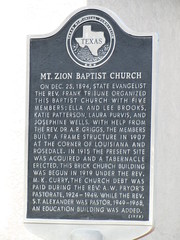
Texas Historical Marker #03499
Mount Zion Baptist Church. On Dec. 25, 1894, State Evangelist the Rev. Frank Tribune organized this Baptist church with five members: Ella and Lee Brooks, Katie Patterson, Laura Purvis, and Josephine Wells. With help from the Rev. Dr. A. R. Griggs, the members built a frame structure in 1907 at the corner of Louisiana and Rosedale. In 1915 the present site was acquired and a tabernacle erected. This brick church building was begun in 1919 under the Rev. M. K. Curry. The church debt was paid during the Rev. A. W. Pryor's pastorate, 1924-1949. While the Rev. S. T. Alexander was Pastor, 1949-1968, an education building was added.
1101 Evans St., Fort Worth, TX, United States
Subjects

Texas Historical Marker #03596
Niles City. Incorporated in 1911, the City of Niles was called the "Richest Little Town in the World" because of its size and the number of large businesses located here. Included in the townsite, which eventually covered 1.5 square miles, were major meat packing firms, the Fort Worth Stockyards, two grain elevators, a cotton seed oil company, and a petroleum refinery and pipeline plant. By the early 1920s the town's taxable property was valued at $30,000,000. Niles was named for Louville Veranus Niles (1839-1928), a successful Boston businessman who first visited Fort Worth in 1893. His reorganization of the Fort Worth Packing Company in 1899 led the firms of Swift and Armour to locate their plants in this area in 1902, rapidly increasing nearby business development. Substantial muncipal tax revenues helped make the city of Niles a progressive community. Under the supervision of a Mayor and five Aldermen, funds were used for improvements in roads, utilities,and city services. The two school districts which served the town also benefited from the large tax base. Despite legal efforts beginning in 1921 to remain incorporated and avoid annexation, the City of Niles became part of Fort Worth in 1923. (1981) #3596
500 block of E. Exchange St., Fort Worth, TX, United States

Texas Historical Marker #02610
I. M. Terrell High School. In 1882, the Fort Worth school system opened its first free public school for black students, called "East Ninth Street Colored School." It was moved to the corner of East Twelfth Street and Steadman in a property trade with the Fort Worth and Denver Railroad in 1906, and renamed "North Side Colored School No. 11." Isaiah Milligan Terrell was named principal and served until 1915. A 1909 bond election provided funds for a new building, which opened in May 1910. In honor of its former principal, the school was named "I.M. Terrell High School" in 1921. The school at twelfth and Steadman became a Junior High and Elementary in 1938, when Terrell High School was moved to its present location at 1411 E. 18th Street, site of a former white elementary school. Isaiah Milligan Terrell was born in Grimes County in 1859. Named one of the first four black teachers in Fort Worth in 1882, he served as principal and supervisor of black schools. He was married in 1883 to Marcelite Landry, a respected music teacher. Terrell became President of Prairie View State Normal and Industrial College (now Prairie View A&M University) in 1915, and later became an active leader in Houston's black community. He died in 1931. #2610
1411 E. 18th Street, Fort Worth, TX, United States