
Fort Worth, TX
Gender Diversity
The top 10


Texas Historical Marker #04801
Site of Fort Worth-Dallas Interurban. In 1901 the Texas Legislature authorized the Northern Texas Traction Company of Fort Worth to extend rail service to Dallas. The interurban system, powered by overhead electrical lines, was completed one year later. The thirty-five mile trip took just over an hour. Passengers could flag the train and board at any point on the route. Each car held up to forty travelers. Rail traffic began to decline in the 1930s when paved roads were constructed between the two cities, and the last train made the interurban run on Christmas Eve, 1934. (1980) #4801
6604 E. Rosedale,, Fort Worth, TX, United States

Texas Historical Marker #04066
Pollock-Capps House. Built in 1898 for Dr. Joseph R. Pollock (1856-1941), this mansion was sold to William Capps (1858-1925) and wife Sallie (1864-1946), whose family lived here 1909 to 1971. On the grounds were a golf course, tennis court, and a 3-car garage with a ballroom above. This was in a neighborhood lined with Victorian homes of bankers, businessmen, cattlemen, lawyers, physicians,and publishers, and was nicknamed "Quality Hill". #4066
1120 Penn St., Fort Worth, TX, United States
Texas Historical Marker #04441
Saint Ignatius Academy Building. The first Catholic School in Fort Worth, St. Ignatius Academy was organized by the Sisters of St. Mary of Namur in 1885. The first classes were held in a house purchased from Jacob Smith. This four-story limestone structure, used for classrooms and chapel, was completed in 1889. J.J. Kane designed the building, a good example of the Victorian Institutional style. School classes were conducted here until 1962. #4441
1206-12 Throckmorton, Fort Worth, TX, United States
Texas Historical Marker #04565
Sandidge-Walker House. Cattleman George Sandidge (1873-1965) had this house built about 1921 and sold it four years later to Webb and Gussie Walker. Dr. Walker (1886-1962), was appointed city health officer in 1913 and served in that position for seven years. In 1954, Walker sold the house to St. John's Episcopal Church to serve as its rectory. The Sandidge-Walker house features influences of Prairie School style architecture in its horizontal lines and wide eaves. #4565
2420 College Ave., Fort Worth, TX, United States
Subjects
Texas Historical Marker #04630
Second Site of the Old Wayside School. Founded 1883 on site in Dozier community, given by W.E. Boswell. Situated 1898-1948 in 2 successive buildings on land given by A.W. Moore. Now in Eagle Mountain-Saginaw District, which includes W.E. Boswell High School, named in honor of donor of first site. #4630
?, Fort Worth, TX, United States
Texas Historical Marker #04670
Shelton Building. This building was constructed in 1900 for Robert G. Johnson, who was acting on behalf of his wards, the children of Albert D. Evans. It was first leased to G.Y. Smith, who opened the "Daylight Store", a general merchandise establishment. In 1910, after the property was purchased by John M. Shelton, a third floor was added to the original two-story structure. From that same year until 1936 the building was leased to S.H. Kress and Company. Following major architectural remodeling in 1937, the structure was occupied by another variety store, McCrorys. #4670
901 Shelton St., Fort Worth, TX, United States
Texas Historical Marker #14057
Consolidated Vultee Aircraft Corporation Plant No. 4. Prior to WWII, the U.S. aircraft industry focused primarily on producing aircraft for civilian airlines; few manufacturers specialized in military airplane construction. In the fall of 1940, the War Department determined that expected future demand for military aircraft required new defense plants, not just expansion of existing sites. This form of home front industry and the application of its product toward strategic aerial bombing grew grew exponentially as a primary weapon toward defeating an enemy's ability to wage war. Although involved in pilot training, Texas had no large-scale role in aircraft manufacturing at this time. As America recovered from the Great Depression while moving closer to war, the Fort Worth Chamber of Commerce aggressively campaigned Consolidated Vultee Aircraft Corporation (Convair) for a new plant. Their efforts proved successful and groundbreaking ceremonies took place here on April 18, 1941. The Austin Company of Cleveland, Ohio, built Convair Plant No. 4 in less than a year and the first B-24 (Liberator) bomber rolled off the assembly line on April 17, 1942 - 100 days ahead of schedule. More than 3,000 heavy bombers were produced here with a peak wartime employment of 32,000. The site also converted B-24 airframes into C-87 cargo/transports (Liberator Express), and later in the war, produced a limited number of the new B-32 heavy bombers (Dominator). Wartime mobilization was an important factor in the eventual Allied victory during World War II. This and other home front industries had a major impact on the local economy. Industrial growth brought new employers and workers to the community and added a modern industrial aspect to Fort Worth's existing Texas frontier reputation. Texas in World War II - 2008 #14057
?, Fort Worth, TX, United States
Texas Historical Marker #05196
Tarrant County Criminal Courts Building. Built in 1917-18, this structure is located on land upon which old Camp Worth was constructed in 1849. The noted Fort Worth architectural firm of Sanguinet and Staats designed the building, incorporating elements of the Beaux Arts and Classical Revival styles. In addition to a criminal courtroom, it originally housed the jail and gallows, a jail hospital, mental wards, and offices for the Sheriff, District Attorney, and District Clerk. #5196
200 W. Belknap, Fort Worth, TX, United States
Texas Historical Marker #05193
Tannahill Homestead. In 1853 Scottish-born Robert Watt Tannahill (1821-1885) and his wife Mary Catherine (Smallwood) came here from Mississippi. In 1856 Tannahill patented this 320-acre tract on the Fort Worth-Azle Road. He used rocks from a nearby creek bank to construct this house in 1874. He served as a Tarrant County Judge and used the front room of this home for a Post Office from 1878 to 1885. This was also a stagecoach station for the first stop west of Fort Worth. The house was sold in 1894 to early pioneer William Thomas Tinsley (1858-1909) and in 1945 to Mrs. Verna Burns Stubbs. #5193
9741 Verna Drive, Fort Worth, TX, United States
Texas Historical Marker #05469
Thomas G. & Marjorie Shaw House. This Monterrey style house was built in 1927 by prominent Fort Worth contractor Bert B. Adams. One of the first houses built in the fashionable Park Hill Addition, it was purchased upon completion by Thomas and Marjorie Shaw. A highly successful independent oil producer, Shaw was associated with the Standard Oil Company and founded the T.G. Shaw Oil Corporation in 1924. Hallmark features of the house include its stucco wall finish and tile roof. #5469
2404 Medford Ct. East, Fort Worth, TX, United States
Texas Historical Marker #05552
Travis Avenue Baptist Church. A Sunday school was started in 1908 in this development outside the city limits. The group became a Mission of the College Avenue Baptist Church, established in 1905 (about 3 Mi. N). By 1910 72 Mission participants were meeting in the Prairie Chapel School. In 1911 18 members formed the Southside Baptist Church and moved a building here in 1913. By 1915 the membership had grown to 231. The Church name changed to Travis Avenue Baptist in 1920 and a new sanctuary was completed in 1925. The church now serves a large area of Fort Worth, and sponsors several outreach ministries. Texas Sesquicentennial 1836-1986. #5552
700 block of W. Berry, Fort Worth, TX, United States

Texas Historical Marker #05635
Van Zandt Cottage. Built in 1860s on stage road to Weatherford, and for generations a haven to travelers during Trinity River Floods, this was the country home of Khleber Miller Van Zandt (1836-1930), who was know as "Mr. Fort Worth." A Confederate veteran, Major Van Zandt was a merchant, lawyer, banker, railroad builder, State Legislator (1873), opener of frontier lands to settlement, and leader in many civic activities. Structure was restored by the State during Texas Centennial, 1936. #5635
2900 Crestline Rd., Fort Worth, TX, United States
Texas Historical Marker #05819
William Alfred Sanderson. A native of England, William Sanderson came to Texas in 1841. He obtained a Republic of Texas land grant and in 1847 settled in Tarrant County with his wife, Isabella Francis (Ayres). Sanderson soon established himself as a farmer and stock raiser. A charter member of the First Christian Church of Fort Worth, he also was appointed Justice of the Peace and was involved in the relocation of the county seat from Birdville to Fort Worth. #5819
2500 block of Scott St., Fort Worth, TX, United States
Texas Historical Marker #05986
Administration Building. Erected by old Polytechnic College, a coeducational school organized 1890 by Bishop J. S. Key, on site given by A. S. and W. D. Hall and George Tandy. This hall, of Texas limestone, was built 1902 in presidential term of Bishop Hiram A. Boaz. Has continued in use while institution was Texas Woman's College, 1914-1934, and since it became Texas Wesleyan College. Modernized in 1963. Owned by Texas Methodist Conferences. #5986
1200 block Wesleyan St., Fort Worth, TX, United States
Texas Historical Marker #02457
Herbert M. Hinckley. Engineering innovator who designed this dome for 1936 Texas Centennial. Staked reputation on plan (which uses a unique way of connecting radial arches at peak) despite doubts of many experts. Also designed nearby tower, buildings in major cities, and many bridges. (1971) #2457
3300 block W. Lancaster, Fort Worth, TX, United States

Meacham Field On July 3, 1925, the Fort Worth city council approved a lease on 100 acres of property on Decatur Road for the city’s new municipal airport. It was built to replace the city’s first municipal airport at Barron Field, a World War I-era flying training field near Everman. After passage of the Air Mail Act (Kelly Act) in 1925, airlines began flying the mail over Contract Air Mail (CAM) routes. As headquarters of the 11th district of the U.S. Post Office Railway Mail Service, Fort Worth offered an ideal location to tie together ground and air distribution. On May 12, 1926, National Air Transport Co. (later United Airlines) flew the field’s first air mail flight to Chicago. On July 16, 1927, the airport’s name changed to Meacham Field, in honor of former Mayor H. C. Meacham. Soon several airlines began to offer passenger service on the CAM routes. By 1931, the airport had expanded to 280 acres. On April 4, 1937, Meacham Field’s new Art Moderne Terminal (the first air-conditioned passenger terminal in the U.S.) and control tower were dedicated. During World War II, in April 1943, American Airlines was awarded a contract to train U. S. Navy pilots at the airport on the Douglas R4D (DC-3) transport. In May 1943, the navy commissioned the airport as a naval auxiliary air facility and established a ferry service unit to coordinate cross-country fighter and torpedo bomber deliveries to the pacific and seaplane ferrying services at nearby Lake Worth. When Fort Worth International Airport opened in April 1953, commercial airline operations moved there. Afterward, Meacham Field Developed into one of the world's leading airports for general and corporate aviation, flight training and aircraft repair. (2015) Marker is Property of the State of Texas
3300 Ross Avenue, Fort Worth, TX, United States
Texas Historical Marker #17336
Fairfield Gates Apartments. #17336
3200 Fairfield Avenue, Fort Worth, TX, United States
Texas Historical Marker #00650
Camp Bowie Boulevard. In 1917-18, this roadway was the main artery through Camp Bowie, a World War I training center. Narrow strips of asphalt paving flanked streetcar tracks that ran the length of the avenue, then called Arlington Heights Boulevard. After the war, business and residential development spread into this area. In 1919 the street was renamed Camp Bowie Boulevard. In 1927-28, like many of the major thoroughfares in Ft. Worth, it was paved with durable Thurber bricks. Today this street is a reminder of Ft. Worth's heritage and a source of pride to area residents. (1979) #650
4100 Camp Bowie Blvd., Fort Worth, TX, United States

Texas Historical Marker #15766
Westbrook Estate. #15766
2232 Winton Terrace West, Fort Worth, TX, United States
Texas Historical Marker #01385
Eddleman-McFarland House. Designed by Howard Messer, this Victorian house was built in 1899 for Sarah C. Ball (1825-1904), widow of Galveston banker George Ball. William H. Eddelman (1850-1932), a local banker, bought the home in 1904 and in 1921 gave it to his daughter Carrie (1877-1978), wife of cattleman Frank H. McFarland (1869-1948). She lived here 75 years. The finely crafted interior retains most of the original woodwork and fixtures. The exterior features marble, sandstone, brick, and copper. Recorded Texas Historic Landmark- 1980. #1385
1110 Penn St., Fort Worth, TX, United States
Texas Historical Marker #01506
Euday Lewis Bowman. Fort Worth native Euday Bowman was a ragtime composer. His best-known song was the classic "12th Street Rag," which he wrote about his experiences in Kansas City, Kansas. Copyrighted in 1914, it did not become popular until 1948 when it was recorded by Walter "Pee Wee" Hunt. Other songs written by Bowman, including "Fort Worth Blues," were never published. He died of pneumonia while on a business trip to New York City in 1949. (1988). #1506
701 Grand Ave., Oakwood Cemetery, Fort Worth, TX, United States
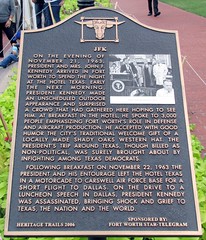
JFK On the evening of November 21, 1963, President and Mrs. John F. Kennedy arrived in Fort Worth to spend the night at the Hotel Texas. Early the next morning, President Kennedy made an unscheduled outdoor appearance and surprised a crowd that had gathered here hoping to see him. At breakfast in the hotel, he spoke to 3,000 people emphasizing Fort Worth’s role in defense and aircraft production. He accepted with good humor the city’s traditional welcome gift of a locally made Shady Oaks Western Hat. The president’s trip around Texas, though billed as non-political, was surely brought about by infighting among Texas democrats. Following breakfast on November 22, 1963 the president and his entourage left the Hotel Texas in a motorcade to Carswell Air Force Base for a short flight to Dallas. On the drive to a luncheon speech in Dallas, President Kennedy was assassinated, bringing shock and grief to Texas, the nation and the world.
999 Main St, Fort Worth, TX, United States
Subjects

Texas Historical Marker #02027
Fort Worth Elks Lodge 124. Designed by Fort Worth architect Wyatt C. Hedrick (1888-1964) and built in 1927-28, this was the headquarters of the Fort Worth Elks Lodge and served as a residence for visiting Elks members until purchased by the Fort Worth Y.W.C.A. in January 1955. Featuring Georgian Revival style elements, the five-story structure on a raised basement is of steel construction with brick and cast stone veneer, metal balustrades, and shallow-relief detail. Recorded Texas Historic Landmark -1986. #2027
512 W. 4th St., Fort Worth, TX, United States
Texas Historical Marker #02305
Gunhild Weber House. This was the first home built in a 1907 subdivision opened by D.T. Bomar and John W. Broad. It shows influences from the West Coast, where Broad lived from 1896 to 1906. Charles K. Lee, later a State Bar Association, President, bought the house in 1914. He added a room and porte cochere. The Lees lived here 15 years. Mrs. Gunhild Weber, a native of Norway and a Fort Worth business executive, has owned the house since buying it from the Lucie C. Lee estate, 1944. Recorded Texas Historical Landmark-1978. #2305
1404 S. Adams, Fort Worth, TX, United States

Robert David Law Specialist Four, United States Army Robert David Law was born on September 15, 1944, to Robert M. and Martha E. (Morris) Law in Fort Worth. He attended Fort Worth Technical High School, graduating in 1964, and was a member of Southcliff Baptist Church. Law enlisted in the U.S. Army at Dallas on October 17, 1967. He completed his basic combat training and infantry advanced individual training at Fort Polk, Louisiana, and was advanced in rank to Private First Class. He graduated from Airborne School at Fort Benning, Georgia, in summer 1968, and received orders to join F Company (Ranger), 52nd Infantry Regiment, 1st Infantry Division in combat in the Republic of (South) Vietnam. From 1968-69, Law served as a Scout Observer and was promoted in rank to E-4 as a Specialist Four (SP4). Under a February 1969 reorganization, his unit became I Company (Ranger), 75th Infantry Regiment, 1st Infantry Division. SP4 Law had been in Vietnam for eight months when he volunteered for a mission to gather intelligence near the Cambodian border, northeast of the 1st Infantry Division base camp at Lai Khe. Law paced a patrol of six Rangers beginning on February 20, 1969. Within an hour of their insertion by helicopter, the patrol was in a gunfight. Law sprayed rifle fire into the woods to cover the patrol's retreat for the night. The next day, the Rangers monitored enemy troops near a log bridge over a stream. On the morning of February 22, three Viet Cong soldiers spotted the Rangers and opened fire. During the exchange, a grenade rolled close to three of the Rangers. Law threw himself on the grenade to save his comrades and was killed instantly. When notified about her son's death, his mother remarked that his letters home indicated that "He knew what he was fighting for." In August 1970 at the White House in Washington, D.C., President Richard M. Nixon presented SP4 Law's family with a posthumous Medal of Honor for his selfless and decisive actions. (2020) Marker is Property of the State of Texas
2301 N. Sylvania Ave., Fort Worth, TX, United States

Texas Historical Marker #02658
Isham Cemetery. The Rev. W. Marion Isham (1831-1904) and his family came to Tarrant County from Georgia about 1870. Soon after arriving in the area Isham donated a one-acre plot of land to be used for a community cemetery. The oldest remaining legible grave marker here is that of N.L. Sweet (1824-1870), although earlier burials are documented by plain sandstone markers. Approximately five acres were added to the graveyard in 1941. Still in operation as a community burial ground, the historic graveyard is maintained by the Isham Cemetery Association. Texas Sesquicentennial 1836-1986. #2658
7100 block of John T. White Boulevard, Fort Worth, TX, United States
Texas Historical Marker #02720
James E. Guinn School. After Fort Worth public schools were organized in the fall of 1882, black students continued to be taught in black churches for more than a year. The city completed a schoolhouse for blacks on E. 9th Street at Elm in December 1883. The son of a former slave, James Elvis Guinn was born in Fort Worth. Though neither of them could read nor write, his parents placed a great value on education, and James attended Fort Worth's early schools for blacks. He later pursued a college degree and became a professor of chemistry at Prairie View College, now Prairie View A&M University. Guinn returned to Fort Worth as principal of South Side Colored School in 1900. Construction of a new three-story brick school building, designed by the prominent architectural firm of Sanguinet and Staats, began at the corner of Louisiana and Rosedale Avenues in April 1917. Shortly before its completion, Guinn died on July 11, 1917. Six days later the school board voted to name the new school building James E. Guinn School in his honor. It was the largest black school in Fort Worth in 1930. After sixty-three years of service it, it was closed in 1980. Texas Sesquicentennial 1836-1986. #2720
1100 Louisiana St., Fort Worth, TX, United States
Texas Historical Marker #02967
Knights of Pythias. Erected in 1881; rebuilt in 1901, following fire, by noted local architects Sanguinet and Staats. Style similar to North European city hall or medieval guild hall. This is first Pythian Castle Hall built in the United States. In third-floor niche is 7-foot suit of armor that stood above 1881 building. Fort Worth Pythian Lodge No. 101 (a fraternal group) occupies 2 floors. Became first local building named to National Register of Historic Places, 1970. Recorded Texas Historic Landmark--1962 #2967
110 East Third St., Fort Worth, TX, United States
Texas Historical Marker #03053
Lawrence Clifton Elliott. Aviation pioneer Lawrence C. Elliot was born in Greenville, Texas. During high school, Elliott exhibited early aviation talent when he built an experimental airplane. He attended Texas A&M University, participating in the Reserve Officers Training Corps. After graduating in 1924, Elliott was commissioned a 2nd Lieutenant in the Army Air Corps and trained at Brooks Field and Kelly Field in San Antonio. He earned awards in air races and became a U.S. Army flight Instructor. In 1928, Elliot began a 35-year career with the Aeronautics Branch of the U.S. Department of Commerce (Later the Civil Aeronautics Administration). Stationed at Southwest Regional Headquarters in Fort Worth for 25 years, he was instrumental in marking domestic flight routes, developing weather communication broadcast techniques, establishing standards for airplane maintenance and inspection, and recommending air facility safety modifications. During World War II, Elliott was regional manager of the U.S. Civil Aviation System. He received awards for exceptional service and impact on international aviation in 1953. Elliott was married to Mildred Leonhart Reiter (d. 1963). Their former home at 3 Chase Court was designated a Recorded Texas Historic Landmark in 1983. (1991) #3053
3400 White Settlement Rd., Fort Worth, TX, United States
Texas Historical Marker #03246
Masonic Temple Association of Fort Worth. The Masonic Temple Association was founded as the result of dramatic growth in Fort Worth's Masonic membership during the early part of the twentieth century. It was chartered in 1929 with ten member bodies for the purpose of building and maintaining a central meeting place for those organizations. Funds were raised and the new temple was completed in 1932. Since its founding, The Masonic Temple Association of Fort Worth has helped to create a common bond among its members. (1984) #3246
1100 Henderson, Fort Worth, TX, United States
Texas Historical Marker #11963
Site of Confederate Park. Local businessman Khleber M. Van Zandt organized the Robert E. Lee camp of the United Confederate Veterans in 1889. By 1900 it boasted more than 700 members. The camp received a 25-year charter to create the Confederate Park Association in 1901, then purchased 373 acres near this site for the "recreation, refuge and relief of Confederate soldiers" and their families. Opening events included a picnic for veterans and families on June 20, 1902, and a statewide reunion September 8-12, 1903, with 3,500 attendees. The park thrived as a center for the civic and social activities of Texas Confederate organizations. By 1924 the numbers of surviving veterans had greatly diminished, and the Confederate Park Association voluntarily dissolved when its charter expired in 1926. (2000) #11963
?, Fort Worth, TX, United States
Texas Historical Marker #12476
Billy Muth. William McKinley (Billy) Muth (1902-1949) made significant contributions to Texas' cultural history. Born in Allentown, Pennsylvania, Muth was a church organist at the age of nine. Nationally known as "the master of the keyboard," Muth was organist at Casa Manana during the 1936 Texas Centennial, the Worth Theatre, multi-instrument Fort Worth symphony musician and church organist. A Paramount/Publix Theatres' pipe organist, Muth opened theatres across the United States. Settling in Texas in 1926, Muth performed concerts, benefits, and taught statewide organ and music seminars. Recorded - 2001 #12476
3100 White Settlement Rd., Fort Worth, TX, United States
Texas Historical Marker #03905
Paddock Viaduct. Low-water crossing and ferries originally provided the only access across the Trinity River at this location, connecting the downtown area of Fort Worth with northern sections of the city. A two-lane suspension bridge, constructed near this site in the 1890s, proved inadequate for the growing population. This span, designed by the St. Louis firm of Brenneke and Fay, was built in 1914. It was the first reinforced concrete arch in the nation to use self-supporting, reinforcing steel. The bridge is named in honor of B.B. Paddock, former State Legislator and Mayor of the City. #3905
Main St. Bridge at Heritage Park, Fort Worth, TX, United States
Texas Historical Marker #12576
Mary Daggett Lake. (Nov. 11, 1880-Mar. 1, 1955) A botanist, musician, author and clubwoman, Fort Worth native Mary Daggett Lake played a prominent role in the civic life of her hometown throughout the first half of the 20th century. She chronicled the lives of pioneer Fort Worth families in a series of articles for the Star-Telegram in the 1920s and 1930s. Through her active involvement and leadership with the Fort Worth Garden Club, the Texas Federation of Garden Clubs, the Fort Worth Park Board and the National Council of State Garden Clubs, Mary gained widespread recognition for her efforts in landscape conservation and beautification. Her labors on behalf of the Fort Worth Garden Center led to a national award for its work. (2001) #12576
3220 Rock Springs, Fort Worth, TX, United States
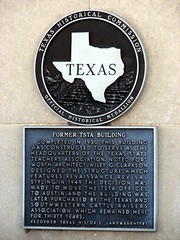
Texas Historical Marker #01956
Former TSTA Building. Completed in 1930, this building was constructed to serve as the headquarters of the Texas State Teachers Association. Noted Fort Worth architect Wiley G. Clarkson design the structure, which features Renaissance Revival styling. In 1949 the decision was made to move the TSTA offices to Austin, and the building was later purchased by the Texas and Southwestern Cattle Raisers Association which remained here for thirty years. Recorded Texas Historic Landmark- 1981. #1956
410 E. Weatherford, Fort Worth, TX, United States
Subjects
Texas Historical Marker #13228
Handley Church of Christ. Originally known as Turkey Knob, an early community in this area changed its name after 1876, when the T&P Railroad built a depot and section house nearby and named it Handley. Beginning in 1882, local Protestant denominations worshiped in a union church building. In 1905, J. Dan Thomas invited approximately 22 men and women into his home to organize the Handley Church of Christ. The congregation soon moved to a larger space and has constructed several buildings over the years, remaining at this location since 1919. Throughout the church's history, members have maintained a significant presence in the community through worship, Bible study, mission work and outreach. (2005) #13228
3029 Handley Dr, Fort Worth, TX, United States
Texas Historical Marker #14938
Texas & Pacific Railroad Passenger Terminal. #14938
?, Fort Worth, TX, United States
Texas Historical Marker #13913
Hagar Tucker. (1842-1892) Hagar Tucker was the first African American policeman in Fort Worth, notable in 1870s Texas. Born into slavery, he came here from Kentucky in 1857 and was emancipated in 1865. One of the first African Americans in the county registered to vote, he was appointed a "special policeman" in 1873, partly through influence of former master Wm. B. Tucker, then alderman. Hagar was the only black on the force, one of few until the 1950s. Paid separately from other police, he could only patrol black neighborhoods. He served a short time, later working other jobs and eventually returning to the Wm. B. Tucker household with his wife Amy and three daughters. (2007) #13913
701 Grand Ave, Fort Worth, TX, United States