
Fort Worth, TX
Gender Diversity
The top 10


Tim Cole Timothy Brian Cole, born in Brenham in 1960, served in the U.S. Army and attended Texas Tech University in Lubbock. While there, Cole was accused of assaulting a fellow student in September 1986. A jury convicted him and sentenced him to 25 years in prison. Prior to the trial, he was offered probation in exchange for a guilty plea, and while in prison, he was offered parole if he would admit guilt. He refused to take blame for a crime he did not commit. In December 1999, he died in prison at age 39 from complications from asthma. In 2007, the Innocence Project of Texas received a letter from an inmate confessing to the crime for which Cole was convicted. Physical evidence confirmed that this man was guilty and Cole was innocent. The crime victim joined Cole's family in the effort to clear his name. In district court in Travis County, Cole's advocates successfully used a court of inquiry to obtain a hearing on his innocence. In April 2009, the court declared that Cole was innocent of the crime "to a 100% moral, legal and factual certainty." Following this opinion and order of the court, the other two branches of state government also cleared Cole's name and record. In 2009, the 81st Texas Legislature enacted the Tim Cole Act, to compensate wrongly convicted individuals, and created the Timothy Cole Advisory Panel on wrongful convictions to reverse other wrongful imprisonments and prevent future miscarriages of justice. In March 2010, the Texas Governor's Office issued the first posthumous pardon in state history. This promise of fairness for all Texans is the legacy of a man who once wrote from prison that "I still believe in the justice system, even though it doesn't believe in me." 175 Years of Texas Independence * 1836 - 2011 Marker is property of the State of Texas
2301 N. Sylvania Avenue, Fort Worth, TX, United States

Texas Historical Marker #04990
Southside Church of Christ. This congregation, initially led by Dr. I.L. Van Zandt and other elders, was established in a fast growing southern area of Fort Worth in 1892. Named Southside Church of Christ, the new congregation experienced several decades of steady growth before purchasing a church building and merging with another congregation known as the Central Church of Christ in 1916. The congregation incorporated in 1917 under the name Southside Central Church Christ. The congregation relocated to this site in 1959. The church sponsors community outreach and missionary programs. #4990
2101 Hemphill, Fort Worth, TX, United States

Texas Historical Marker #04339
Rogers-O'Daniel House. William Joseph Rogers built this residence after purchasing a 137-acre farm here in 1901. Originally a three-story, Queen Anne style frame structure, it was remodeled by W. Lee "Pappy" O'Daniel (1890-1969) in 1925, after the farm was subdivided. O'Daniel had moved to Fort Worth as sales manager for Burrus Mills. He sponsored the Light Crust Doughboys, won election as Governor of Texas, 1939-1941, and sold this property in 1945 while serving as U.S. Senator, 1941-1949. #4339
2230 Warner Rd., Fort Worth, TX, United States

Texas Historical Marker #02266
Greater Saint James Baptist Church. Founded in 1895 by the Rev. J. Francis Robinson and members of Mt. Gilead Baptist Church, St. James Baptist Church, first met in the local Y.M.C.A. building. Construction of this building began in 1913, and services were held in the basement until the sanctuary was completed in 1918. The red brick building, featuring elements of the Gothic Revival style, is simply detailed with shallow brick reliefs and patters, cast stone, and art glass windows. Recorded Texas Historic Landmark-1986. #2266
210 Harding St., Fort Worth, TX, United States

Racial Terrorism: The Abduction of Mr. Fred Rouse On Tuesday, December 6, 1921, Mr. Fred Rouse, an African-American husband, father of three, and non-union butcher for Swift & Co., was attacked by white union strikers and agitators in the Niles City Stockyards (now part of Fort Worth). Mr. Rouse sustained stab wounds and broken bones. His skull was fractured in two places. He was then brought here to the basement Negro Ward of the former city & county hospital. At 11pm on Sunday, December 11, 1921, a mob of ~30 white men arrived at the hospital, forced their way past the superintendent, surgeon, and night nurse, entered the Negro Ward, and tore Mr. Rouse from his corner cot. When the nurse called their attention to the fact that he had no clothes, they jokingly replied that "He would not need any." The mob abducted Mr. Rouse from the hospital "almost in a run." They forced him into a car and drove north on Samuels Ave. to meet another group of white men at the corner of NE 12th St. There Mr. Rouse was hanged from a hackberry tree. His body was riddled with bullets. A bloody pistol was left under his feet. Three white men were charged in the murder of Mr. Rouse, including the acting Niles City police chief and another officer. No one was ever convicted. Our community memorializes Mr. Fred Rouse as a call to remain vigilant in the pursuit of racial justice. Sponsored by: The Rouse Family Tarrant County Coalition for Peace and Justice Performing Arts Fort Worth, Inc. Hertiage Trails 2021
Intersection of East 4th Street and Jones Street, Fort Worth, TX, United States

Texas Historical Marker #04001
Peterson Family Cemetery. Swedish native John Peterson (1840-1925) came to the United States in 1868. His wife, Thilda (Mossberg) (1848-1912), joined him two years later. They lived in Nebraska before coming to Texas in 1872. Peterson acquired several hundred acres in this part of Tarrant County and made his living by farming the land. His granddaughter Grace (1902-1903) was the first to be buried in this cemetery plot set aside for the family. A reminder of Tarrant County's early Swedish settlements, the Peterson Family Cemetery contains a total of ten graves. Texas Sesquicentennial 1836-1986. #4001
Off IH-35 and Old Denton Road, Fort Worth, TX, United States

Woody-Kutch Livestock Commission Company In 1920, brothers-in-law Joseph Casner Woody (1880-1950) and Jefferson Davis Kutch, Jr. (1890-1990) were both active in the Fort Worth Stock Yards Company, a central buying location for regional cattle and sheep ranchers and hog farmers. They incorporated the Woody-Kutch Livestock Commission Company of North Fort Worth in 1923, with Woody as president and Kutch as vice president. Their office in the Livestock Exchange Building was a clearinghouse to process receipts of sales. For all its activity and volume of business, the building which housed 48 livestock commission companies was known as the "Wall Street of the West." After Woody's death, Kutch and J.D. Farmer started Farmer-Kutch Livestock Commission Company, which operated until 1981. (2019) Marker is property of the State of Texas
131 East Exchange Avenue, Fort Worth, TX, United States

Daggett's Crossing Among the early settlers of Fort Worth, Charles Biggers (C.B.) Daggett (1812-1888) was born in Canada and moved to Indiana when he was eight years old. Around 1839–40, His family moved to Shelby County, Texas, where they participated in the Regulator–Moderator War. C.B. Daggett then fought in the U.S.-Mexico War. For his military service, he received a 320-acre land grant in Tarrant County which became the C.B. Daggett Survey. On his land situated north of the West Fork of the Trinity, Daggett farmed with his sons and maintained a small herd of cattle. Daggett and his sons also operated a ferry across the West Fork, near present-day Samuels Avenue and Cold Springs Road. It was one of only two across the river at the time, with the other being Eagle Ford Ferry in Dallas County. Local boosters claimed that Daggett's Ferry was superior, causing hundreds of immigrants and trail drivers in the late 1860s and early 1870s to bypass Dallas in favor of the Fort Worth crossing. C.B. Daggett reported that more than 40,000 cattle passed through annually during the 1870s. The operation of the ferry was carefully choreographed with teams of mules positioned on opposite riverbanks. Once the cargo or passengers were loaded on the ferry raft, ropes were thrown across the river to the mule skinner on the other side to then pull the ferry across, an entertaining sight according to reports. The ferry operated until 1877, when a bridge was built nearby to serve the community and region. Daggett's Crossing is remembered for its significance and heritage in the area's settlement, transportation and commerce. (2019)
Trinity Trails near Northside Dr., Fort Worth, TX, United States

Texas Historical Marker #14114
Newby, W.G., Memorial Building. #14114
?, Fort Worth, TX, United States

Texas Historical Marker #02614
Ida Saunders Hall. Old home of Wm. Edrington Scott (1899-1961), who gave to Fort Worth the unique Scott Theater for all the performing arts. Built in 1903 and bought by Woman's Club in 1929. Named for a leader in the Fort Worth Woman's Club. #2614
1300 block Pennsylvania Ave., Fort Worth, TX, United States

Texas Historical Marker #03210
Margaret Meacham Hall. Named in honor of Mrs. H.C. Meacham, charter member and many years a Director of Fort Worth Woman's Club. House built, 1905, by J.F. Moore; sold, 1920, to Baptist Hospital as Nurses Residence. Bought by Woman's Club, 1949, giving club entire block. Recorded Texas Historic Landmark, 1967. #3210
1326 Pennsylvania Ave., Fort Worth, TX, United States

Texas Historical Marker #05889
Woman's Club of Fort Worth. Women from eleven social and study groups, some formed before 1900, joined in 1923 to create the Woman's Club of Fort Worth. Miss Anna Shelton, who led the unification drive, served as the first President of the club. The charter members first met in a house donated by Etta O. (Mrs. William G.) Newby. As the club grew, it acquired other buildings. The organization performs many civic, charitable, and educational activities and maintains a Texana library collection. Membership in 1975 totaled about 3000. #5889
1316 Pennsylvania Ave., Fort Worth, TX, United States

Texas Historical Marker #01921
Florence Shuman Hall. Named for charter member of Fort Worth Woman's Club. Early cottage, built here, 1905, was rebuilt by pioneer civic leader, W.R. Edrington, in 1910. Woman's Club, formed in 1923, bought house year later as a center for its groups devoted to civic projects. #1921
1300 Pennsylvania Ave., Fort Worth, TX, United States
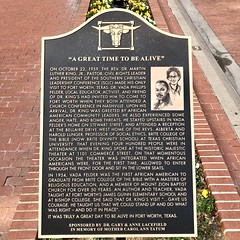
"A Great Time to Be Alive" On October 22, 1959, The Rev. Dr. Martin Luther King, Jr., pastor, civil rights leader and president of the Southern Christian Leadership Conference (SCLC) made his only visit to Fort Worth, Texas. Dr. Vada Phillips Felder, local educator, activist, and friend of Dr. King’s had invited him to Fort Worth when they both attended a church conference in Nashville. Upon his arrival, Dr. King was greeted by African American community leaders. He also experienced some anger, hate and bomb threats. He stayed upstairs in Vada Felder’s home on Stewart Street, and attended a reception at the Bellaire Drive West home of the Revs. Alberta and Harold Lunger, Professor of Social Ethics, Brite College of the Bible (now Brite Divinity School) at Texas Christian University. That evening four hundred people were in attendance when Dr. King spoke at the historic Majestic Theater at 1101 Commerce Street. On that occasion the theater was integrated when African Americans were, for the first time, allowed to enter through the front door and sit in the lower seats. In 1954 Vada Felder was the first African American to graduate from Brite College of the Bible with a Masters of Religious Education. She was a member of Mount Zion Baptist Church for over 50 years, authored Christian Education materials, founded and operated United Christian Leadership School, and taught in Fort Worth’s James Guinn Elementary School and at Bishop College. She said that Dr. King’s visit “…gave us courage. He taught us that we could stand up and do what was right – and do it in peace”. It was truly a great day to be alive in Fort Worth, Texas Sponsored by Dr. Gary & Anne Lacefield in memory of mother Carol Ann Tatum
Main Street, Fort Worth, TX, United States
