
Fort Worth, TX
Gender Diversity
The top 10


Founding Fort Worth Major General William J. Worth was the commanding officer of the eighth military district including Texas and Mexico. His responsibility was to maintain peace between settlers and the plains Indians. His plan was to establish a new post on the Trinity River to extend the line of defense. Worth died suddenly of cholera and did not get to see his plan come to light. Major Ripley Arnold was given the duty of establishing a fort by the acting commander, General Harney. This site would close the gap between the Brazos and Red Rivers. Arnold’s dragoons met with Col. Middleton Tate Johnson, a citizen with great influence, at the ranger’s station on Marrow Bone Springs. Along with Johnson were Joseph R. Parker, Dr. William B. Echols, Charles Turner and Simon Farrar. Along with his five guides, Arnold and his men set out to locate the ideal site for the new fort. The barracks of the fort were first located at the present-day site of the Tarrant County Courthouse. The land was described by Simon Farrar as “the most beautiful and grand country the sun had ever shone on…in view of all advantages of a natural point of defense.” After learning that Major General Worth, a hero in the recent Mexican War, had passed away, it was relatively easy for Arnold to name the new post after him even though he never saw the place named in his honor. Remembering his part in the founding of Fort Worth, Farrar stated in 1893, “it is the prayer and wish of your humble correspondent that Fort Worth may be the capital of northwest Texas, for i have at all times entertained great confidence in the people of Fort Worth.” (2012) Marker is Property of the State of Texas
360-398 North Taylor Street, Fort Worth, TX, United States

This stone marks the site of Camp Worth, a United States Military Post, named in honor of General William J. Worth, and Commanded by Major Ripley A. Arnold, 1849-1853. The camp protected the frontier against Indians, and was the beginning of the City of Fort Worth. Erected by Mary Isham Keith Chapter Daughters of the American Revolution, 1921
200 West Belknap, Fort Worth, TX, United States

In 1901, local business leaders G. W. Simpson and L. V. Niles began negotiating with Armour & Co. one of the nation' four largest meatpacking firms, to encourage establishment of a branch plant in Fort Worth. The Fort Worth Stock Yards Co. offered land and other incentives and by 1902, construction of a plant just north of this site was underway. The new operation was instrumental in the city's development as the livestock center of the Southwest, creating a number of support businesses. It remained in operation for over 50 years, closing in 1962. Texas Sesquicentennial 1836-1986
500 block E. Exchange Ave., Fort Worth, TX, United States

Texas Historical Marker #05278
Thannisch Block Building. The eastern portion of this structure was built in 1906-07 by Col. Thomas Marion Thannisch (1853-1935), one of north Fort Worth's early developers. Designed for use as a hotel and office space to serve the Stockyards community and trade, the building was expanded in 1913. The three-story commercial structure features decorative brickwork, chevron designs in the upper story, and a corbeled parapet. #5278
109 E. Exchange Ave., Fort Worth, TX, United States

Texas Historical Marker #05198
Tarrant, General Edward H.. N/A #5198
?, Fort Worth, TX, United States

Texas Historical Marker #17360
Fort Worth's First Flight. #17360
Carroll and Mercedes Streets, Fort Worth, TX, United States
Texas Historical Marker #12697
Texas in the Civil War: Confederate Veterans. From 1865 until World War I, Civil War veterans were leaders in economic and public life in Texas. Every locality had its United Confederate Veterans Camp, with yearly reunions. Texas railroads gave free passes to veterans and widows. but while the U.S. Treasury gave ample pensions to Federals, the Confederates depended on state bounties. Texas in 1881-1883 gave 1280-acre land grants to widows of men who died in service and to disabled veterans and their servants. Pensions were approved in 1899; 91% of Texas pensioners had served in the war from other states, but met residential requirements here. Confederate homes for veterans, their wives and widows were located in Austin. John B. Hood Camp, U.C.V., founded the men's home in 1886, gave it to the state in 1891. Daughters of the Confederacy built the woman's home in 1907 and gave it to the state in 1911. The men's home lost its last veteran in 1954 with the death of Thomas Riddle. in 1965 at least 47 Confederate widows survived. Last Civil War soldier of either army, the Texas Confederate Walter Williams, died in Houston in 1959, aged 117. By 1965, Texas had spent $71,106,648 to maintain homes and pension benefits. #12697
?, Fort Worth, TX, United States

Texas Historical Marker #17337
Curzon Place. #17337
3108 Winthrop Ave., Fort Worth, TX, United States
Texas Historical Marker #04577
Santa Fe Depot. Built 1899. Beaux Arts design features native stone banding. When intact, north windows of painted glass depicted travel from Pony Express to steam locomotives. Visitors here have included such world figures as Presidents Franklin D. Roosevelt, Dwight D. Eisenhower and Lyndon B. Johnson. Depot was used by six railroad companies. As of 1970, Santa Fe served Texas with greater trackage than any other railroad, 5102 miles. #4577
1501 Jones, Fort Worth, TX, United States
Subjects


Texas Historical Marker #15744
Douglass and McGar Parks. From the late 1800's, through the 1920's, during a time of Jim Crow segregation, Douglass and McGar parks served as recreational grounds for African Americans in Fort Worth. In 1895 Thomas Mason, an African-American entrepreneur, with J.D. Johnson and A. Sumlin, purchased land in the Trinity River Bottoms. The property soon became known as Douglass Park (about 300 yards south), named for abolitionist Frederick Douglass. That same year, the Park hosted a Juneteenth Celebration; this became an annual event that thousands attended. The city commissioned a special officer to patrol Douglass Park. Many noted black churches used the property, as did the Prince Hall Masons, who built a lodge on it. In 1918, Fort Worth's Park Board purchased Douglass park; despite an attempt to revitalize the park, it fell into disrepair and in 1925, the Texas Electric Service Company purchased the property and oficially closed it. Douglass Park led directly to the creation of another African-American Park. Crowds who gathered at Douglass Park to watch Negro baseball teams play became so large that the games moved to the Texas & Pacific Ballpark, which sat on a railroad right of way across) North Main Street. The ballpark was upgraded between 1907 and 1909 and changed names to McGar Park (McGar's Field), after businessman Hiram McGar. Both black and white fans came to watch McGar's Wonders (later the Black Panthers) play. Industrial development, the 1922 flood and other factors led up to the demise of the Park during the 1920's. Today, no remnant remains of the Parks, though they continue to be remembered as vital community institutions for Fort Worth African American Americans in the early 20th Century.
7th and Jones, Fort Worth, TX, United States

Texas Historical Marker #14515
Grace Lutheran Church. This congregation was organized formally in 1905 to serve the Swedish-American Lutheran community in Fort Worth. The Rev. Theo Seashore served as first pastor. In 1912, during the pastorate of Dr. Martin Noyd, the congregation built a sanctuary at the corner of Hemphill and Broadway. Services were conducted in Swedish until 1918, when the members agreed to suspend use of the language for the duration of World War I. They continued this practice after the close of the war. Known until 1928 as the Swedish Evangelical Lutheran Church, the congregation relocated to this site in 1957. (1984) supplemental: Congregation relocated to this site November 29, 1998 and dedicated to another 100 years of grace to the glory of God on November 6, 2005. #14515
7900 McCart Ave., Fort Worth, TX, United States

Texas Historical Marker #04991
Southwest Baptist Theological Seminary. Chartered March 14, 1908, for graduate education in Christian ministries. Moved here in 1910 from Waco, Texas. Original 200-acre campus tract and first building, Fort Worth Hall, were gifts of people of Fort Worth. Control passed from Baptist General Convention of Texas to Southern Baptist Convention in 1925. First president (1908-14) was B.H. Carroll. Successors: L.R. Scarborough, 1914-42; E.D. Head, 1942-53; J. Howard Williams, 1953-58; Robert E. Naylor, 1958-. #4991
Jame & W. Seminary St., Fort Worth, TX, United States

Texas Historical Marker #05195
Tarrant County Courthouse. Designed by firm of Gunn & Curtis and built by the Probst Construction Company of Chicago, 1893-1895. This red Texas granite building, in Renaissance Revival style, closely resembles the Texas State Capital with the exception of the clock tower. The cost was $408,840 and citizens considered it such a public extravagance that a new County Commissioners' Court was elected in 1894. #5195
Main & Weatherford Streets, Fort Worth, TX, United States

Texas Historical Marker #02029
Fort Worth Livestock Exchange. Headquarters, one of greatest cattle markets in the world. In late 1860s Fort Worth was stop on cattle trails. Market for West Texas organized 1870s. First trader, T. B. Saunders, Sr., soon was joined by others. First small packing houses were followed (early 1900s) by multi-million dollar plants. By 1910 trading almost doubled. This structure was erected in 1902-03 to house the Stockyards Company, Livestock Commission, and buyers officers, surrounded by lawns (now parking lots). In 1944, was purchased by United Stockyards Corporation. #2029
201 E. Exchange St., Fort Worth, TX, United States

Texas Historical Marker #05984
Tarrant County Criminal Courts Building. N/A #5984
200 W. Belknap, Fort Worth, TX, United States

Texas Historical Marker #13486
Site of the First Masonic Hall in Fort Worth. After many years of debate, Fort Worth researchers identified this site in 1957 as the location of the city's first Masonic lodge. For more than twenty years, lodge members met in a two-story hall at this location. The group organized in 1854 and received its charter the following year as Fort Worth Masonic Lodge No. 148, A.F. & A.M. Members initially rented space for meetings and began construction on their own lodge hall in 1857. The new building offered space for lodge functions on the second floor, which was a single room, and the Masonic group operated a school on the ground level. The first floor space was divided into two rooms and was available for public meetings and church services. Donated to the lodge by Middleton T. Johnson, the site of the lodge once lay outside the city's populated area. The hall sat well beyond the old fort grounds, and even at about four blocks east of the public square it was built on unplatted land outside the city's business district. Although plain in appearance, the red-brick building signified progress and civilization. Its two stories faced west with a bell tower over the main entrance. In 1871, Lawrence Steel, a member, sold the lodge an English-made bell (c. 1782) that became known as the Masonic bell. It rang to announce stagecoach arrivals, fires and the start of the school day. By 1878, the Masons had outgrown their lodge hall at this site, and they moved to a new building at Second and Main. Lodge No. 148 has continued to be a strong presence in the community, spawning an additional fifteen lodges in Fort Worth. (2006) #13486
315 E Belknap, Fort Worth, TX, United States

Texas Historical Marker #03265
Maxwell-Liston House. This late Queen Anne style residence was built in 1904 by Charles W. Maxwell (1850-1912). A contractor and carpenter by trade, Maxwell lived here with his wife, Katie, until 1907. The home then was sold to James Liston (d. 1917), and it remained in the Liston Family until 1941. Elements of the Queen Anne style represented in the Maxwell-Liston House include the corner turret, the wraparound porch, and the wreath and scroll decorative work in the front gables. Recorded Texas Historic Landmark-1985. #3265
712 May St., Fort Worth, TX, United States

Texas Historical Marker #13585
Zion Missionary Baptist Church. Founded in 1919, this church has played an important role in the African American community of Lake Como in Fort Worth. The congregation erected this building in 1923, and that same year, the Rev. G. W. Burton began his long pastorate through 1966, years in which the church grew as a leader in the community. He was followed by the Rev. J. W. Briscoe, Sr., who served until 1992. Over the years, the congregation deeply affected the city through social, civic and public involvement. Members also contributed to the economy through Lake Como entrepreneurship. A spiritual leader in the Civil Rights era, the church today continues to play a vital spiritual role in the community. (2006) #13585
4100 Horne St, Fort Worth, TX, United States
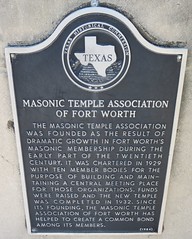
Texas Historical Marker #03247
Masonic Temple of Fort Worth. This building was constructed for the Masonic Temple Association of Fort Worth provide a single meeting place for all member bodies. Completed in 1932, it was designed by the Fort Worth architectural firm of Wiley G. Clarkson & Co. The Temple exhibits Neo-Classical styling with Art Moderne influences and features upper-story ionic columns and Monel bas-relief doors. Recorded Texas Historic Landmark-1984. #3247
1100 Henderson, Fort Worth, TX, United States
Subjects
_plaque_01.jpg?width=250)
Texas Historical Marker #03030
Land Title Building. Pioneer architects Haggart and Sanguinet designed this brick, sandstone and cast iron building with rounded arched windows and other ornate details. It featured the first known stone carving in Fort Worth, the figure of an owl, and displayed the initials of the lawyers Ross, Head and Ross, who occupied the second floor, above the title firm. The structure is architecturally important because its style was rare in this region when it was built in 1889. Recorded Texas Historic Landmark-1977. #3030
111 W. 4th St., Fort Worth, TX, United States

Texas Historical Marker #05349
The Handley Power Plant & Lake Erie. The Northern Texas Traction Company built the original plant at this location to generate electrical power for the Fort Worth-Dallas Interurban. Lake Erie provided water for plant operations. The area developed as a park and became popular for local outings and social events. A two-story auditorium extended over the edge of the lake. When interurban traffic declined the park was closed. The power plant was expanded to meet increased electrical demands. In 1956 Lake Arlington became the new source of water for the Handley Plant, and Lake Erie was drained. (1980) #5349
6604 E. Rosedale, Fort Worth, TX, United States

Texas Historical Marker #04992
Southwestern Exposition and Livestock Show. Fort Worth Stock Yards Company publicist Charles C. French and local cattleman Charles C. McFarland oranized the first livestock show in north Fort Worth in 1896. Members of the Texas Cattle Raisers Association (TCRA) participated in the initial show. The Fort Worth Stock Yards Company built a new coliseum in north Fort Worth in 1908 with the help of TCRA members. That year the National Feeders and Breeders Show opened with various events including a cutting horse competition and a horse show. The event, renamed the Southwestern Exposition and Fat Stock Show in 1918, included an indoor rodeo competition, youth activities, and a debutante social pagent popularized by the City's more prominent citizens. In 1943 the show's facilities were converted for U.S. military purposes and the show was canceled. In 1944 the show relocated to this site which included a coliseum, auditorium,and a memorial Tower erected in 1936 as part of the Texas Centennial celebration. The show was renamed the Southwestern Exposition and Livestock Show in 1988. By 1995 the Show had become a 17-day multimillion-dollar premier rodeo, equine, livestock, and exhibition event with an annual draw of about 800,000 people. Sesquicentennial of Texas Statehood 1845-1995. #4992
3300 Crestline Rd., Fort Worth, TX, United States
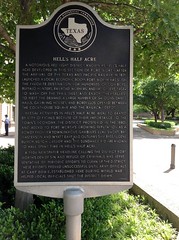
Texas Historical Marker #02431
Hell's Half Acre. A notorious red light district known as Hell's Half Acre developed in this section of Fort Worth after the arrival of the Texas and Pacific Railway in 1876 launched a local economic boom. Fort Worth was soon the favorite destination for hundreds of cowboys, buffalo hunters, railroad workers, and freighters eager to wash off the trail dust and enjoy themselves. To meet the demand, a large number of saloons, dance halls, gambling houses, and bordellos opened between the Courthouse Square and the railroad depot. Illegal activities in Hell's Half Acre were tolerated by city officials because of their importance to the town's economy. The district prospered in the 1880s and added to Fort Worth's growing reputation as a rowdy frontier town. Famous gamblers Luke Short, Bat Masterson and Wyatt Earp and outlaws Sam Bass, Eugene Bunch, Butch Cassidy and the Sundance Kid are known to have spent time in Hell's Half Acre. A 1906 newspaper headline calling the district Fort Worth's den of sin and refuge of criminals was representative of periodic efforts to clean up the district. These efforts proved unsuccessful until Army officials at Camp Bowie, established here during World War I, helped local officials shut the district down. (1993) #2431
12th & Houston, Fort Worth, TX, United States
Subjects


_plaque_01.jpg)


Comanche chief Quanah Parker was a son of two cultures. He was born about 1845 along Elk Creek, Indian Territory (Oklahoma). His Anglo mother was Cynthia Ann Parker, taken captive in a May 1836 raid and adopted by Qua-Ha-Di (Antelope) Comanches, and his father was Comanche chief Peta Nocona. Texas Rangers reclaimed Cynthia Ann in an 1860 fight at the Pease River. Nocona died soon after, and Cynthia Ann lived with relatives near Birdville in Tarrant County before dying with no further contact with her Comanche family. Becoming chief upon his father's death, Quanah refused to sign the 1867 Medicine Lodge Treaty that sent many Plains Indians to reservations. Instead, he led raids in texas and Mexico for another seven years, likely including the last foray into Tarrant County in June 1871. That winter, Quanah's band eluded Col. Ranald MacKenzie's Fourth U.S. Cavalry across the Texas panhandle. Comanche losses during the 1874 Panhandle Battle of Adobe Walls, in which Quanah was wounded, followed by a harsh winter, finally brought him and fewer than 100 remaining Qua-Ha-Di to the reservation at Fort Sill, Indian Territory in May 1875. Quanah served as liaison between his people and the Bureau of Indian Affairs. He proved to be a pragmatic leader, encouraging the Comanches to take up ranching and farming, and to educate their children in government schools. Quanah prospered through his investments and built his spacious Star House near Cache, OK. He traveled widely, giving speeches and interviews and participating in wild west shows, the Texas State Fair, Texas Cattle Raisers Association gathering and the Fort Worth Fat Stock Show. Quanah visited Fort Worth and the Stockyards on many occasions. He died in 1911 and is buried at Fort Sill. (2007)
131 E. Exchange St, Fort Worth, TX, United States

Texas Historical Marker #05243
Texas & Pacific Terminal Building. A line of the Texas & Pacific Railroad was extended to Fort Worth in 1876 and proved vital to the economic growth of the City. Company officials, led by the President John L. Lancaster, had this Passenger Terminal Building constructed in 1931. Designed by Wyatt C. Hedrick (1888-1964), it is a good example of the Art Deco style. Rail traffic began to decline during the 1950s and the last T&P passenger train to the city stopped here on March 22, 1967. #5243
Lancaster & Throckmorton St., Fort Worth, TX, United States
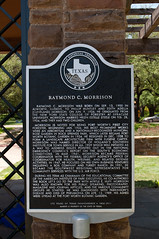
Texas Historical Marker #17028
Raymond C. Morrison. #17028
3220 Rock Springs Road, Fort Worth, TX, United States
Subjects

Texas Historical Marker #00804
Chapel Cemetery. This cemetery traces its origin to the settlement here in the mid 1850s of the pioneer families of John A. and Rhoda Raibourn Fanning, Mitchell and Eliny Jane Raibourn, and Thomas Raibourn. According to Fanning family tradition the cemetery began with the burial of Eliny Raibourn at this site in 1856 and the subsequent donation of the land for cemetery purposes by her brother-in-law, John Fanning. Afterwards the site became known as the Fanning burying grounds. A one-room school house known as Horse Creek School or Lone Star School, located about a mile south of here, was the sole communal structure in this area until a chapel was built next to the burying ground. In 1893 T.A. and Catherine Sweet transferred ownership of the chapel and surrounding land to the Sweet Chapel Methodist Church, and the burying grounds became known as Sweet Chapel Cemetery. By 1938 the Sweet family had moved to Fort Worth, the chapel had disappeared, and the cemetery was known simply as Chapel Cemetery. Burials continued on an informal basis and for many years the graveyard was cared for by members of the Francisco family. The Cemetery was acquired by the Mount Olivet Cemetery Association in 1985. (1993) #804
On Old Denton Highway, 20 mi. N of Fort Worth, Fort Worth, TX, United States

Texas Historical Marker #01266
Dr. Clay Johnson House. Completed in 1912 for Dr. Clay Johnson, this house was designed by the Fort Worth architectural firm of Waller and Field. The Prairie School influence is visible in the home's horizontal roof line and broad cornices, while more Classical detailing appears in the semi-circular windows and the balustrade around the roof. Dr. Johnson, Chief Surgeon for the Fort Worth and Denver City Railroad's Wichita Valley Line, lived here until his death in 1948. Recorded Texas Historic Landmark-1983. #1266
#3 Chase Ct., Fort Worth, TX, United States

Texas Historical Marker #05272
Texas Spring Palace. Following a suggestion by General R.A. Cameron, an officer of the Fort Worth & Denver Railway, city promoters developed the idea of an annual exhibition for the display of Texas agricultural products. In 1889 they constructed the Texas Spring Palace near this site to house the exhibits. Designed by the Fort Worth firm of Armstrong and Messer, it was a two-story wooden structure featuring influences of Oriental and Moorish styles. Women's groups added ornamentation using flowers, seeds, and grasses. On the evening of May 30, 1890, during the second season of the exhibition, a fire swept through the Spring Palace, completely destroying the structure. A number of people who crowded the building at the time had to leap from the second floor to escape the flames. Alfred S. Hayne (b. 1849), a native of England, returned to the burning Palace to help others who were still trapped inside. The only fatality of the fire, he died the next day of burns suffered in the rescue effort. In 1893 the Women's Humane Association dedicated a monument near this site in memory of his heroism and courage. Efforts to rebuild the Texas Spring Palace failed because of economic problems in the Panic of 1893. #5272
100 Block of W. Lancaster, Fort Worth, TX, United States

Texas Historical Marker #02435
Hemphill Presbyterian Church. This Neo-Classical auditorium was built in 1925 to serve the increasing membership of Hemphill Presbyterian Church. Dedicated the following year, the building features a brick parapet and a bay window on the north corner. The imposing entrance consists of three open oval brick arches flanked by large pilasters. The neighborhood landmark continues to serve a large congregation. Recorded Texas Historic Landmark - 1984. #2435
1701 Hemphill St., Fort Worth, TX, United States
Texas Historical Marker #00286
Baldridge House. This property was part of the original Chamerlain-Arlington Heights development of the 1890s. Earl and Florence Baldridge built this elegant residence in 1910-13. Designed by the architectural firm of Sanguinet & Staats, it was a showplace of the time. Massive limestone columns line of the line facade. Carved oak woodwork decorates the interior. The home was occupied for many years by W.C. Stonestreet, a prominent Fort Worth clothier. Recorded Texas Historic Landmark - 1978. #286
5100 Crestline Rd., Fort Worth, TX, United States

Texas Historical Marker #04038
Pioneer's Rest Cemetery. This burial ground was started in the summer of 1850 upon the deaths of Sophie and Willis Arnold, children of Major Ripley A. Arnold (1817-1853), commander of the troops at Fort Worth. Arnold's friend, Doctor Adolphus Gouhenant, set aside a three-acre burial site at that time. In 1871, after a cemetery association was begun, Baldwin Samuels gave three adjoining acres. Many early Fort Worth settlers, including 75 Civil War veterans, are buried here. This site also contains the graves of Major Arnold and General Edward H.Tarrant (1799-1858), for whom Tarrant County was named. #4038
600 block Samuels Ave., Pioneer's Rest Cemetery, Fort Worth, TX, United States

Texas Historical Marker #02033
Fort Worth Stock Yards Entrance. Spanning Exchange Avenue, this gateway to the Fort Worth Stock Yard was completed in 1910. Constructed by the Topeka Bridge & Land Co. for the Fort Worth Stock Yards Co., it was a significant feat of concrete work for that era. The columns are 22 feet high and 13 feet in circumference. The sign is 36 feet long and 4 feet high. The entrance is a significant landmark in this historic area of Fort Worth. Recorded Texas Historic Landmark-1985. #2033
100 block E. Exchange St., Fort Worth, TX, United States

Texas Historical Marker #02126
General Edward H. Tarrant. South Carolina native Edward H. Tarrant enlisted in the Kentucky Militia in 1814 and served under Gen. Andrew Jackson in the Battle of New Orleans. Moving to Tennessee after 1816, he was elected Colonel of the Henry County Militia and served as County Sheriff. Tarrant arrived in Texas in November 1835, settling in Red River County. He served in the Republic of Texas Congress and became a Brigadier General in the Texas Militia in 1839. He commanded the Texas Rangers at the Battle of Village Creek in present Tarrant County in 1841 and, with George W. Terrell, negotiated treaties with many of the Texas Indian tribes at Bird's Fort in 1843. Tarrant represented Bowie County at the Annexation Convention of 1845. By February 1846, he had moved to Navarro County, where he became Chief Justice and was elected to the 3rd and 4th Texas Legislatures. In the 1850s, Tarrant commanded a force of Texas Rangers defending the frontier at Fort Belknap. He died in Parker County in 1858 and was buried there. The next year, his remains were moved to his farm in Ellis County. In 1928, his body was reinterred here by the Daughters of the Republic of Texas. Tarrant County, created in 1849, was named in his honor. #2126
626 Samuels Ave., Fort Worth, TX, United States
Texas Historical Marker #04475
Saint Patrick's Cathedral. Erected 1888-1892 under the direction of the parish priest, the Rev. Jean M. Guyot, a native of France. Stone for walls was quarried locally. Improvised, horse-powered lathes were used to turn and polish the eighteen interior pillars. Ceilings and window frames are wood grained. Stained glass windows were imported from Munich, Germany. Bell, cast in Troy, New York, has been in use since 1888. #4475
1206 Throckmorton, Fort Worth, TX, United States

Texas Historical Marker #00945
Coliseum. Until 1908, The Annual Fort Worth Fat Stock Show was held in a variety of locations. As interest increased in the event and its educational and promotional values were realized, livestock exhibitors sought a permanent home for the show. The coliseum was constructed in 1907-08 to provide such an exhibition hall. Construction costs were borne by the Swift and Armour Packing Companies, and by the Fort Worth Stock Yards Company, which owned the property. The stock show was held here annually for 34 years. This site has been within three separate cities: North Fort Worth until 1909; Niles City, 1911-23; and in Fort Worth since 1923. It is the birthplace of the indoor rodeo, and the first live radio broadcast of a rodeo was transmitted here on WBAP Radio in 1923. The Coliseum also has served as a place for cultural, educational, religious, social, and civic events. In 1911, former President Theodore Roosevelt spoke here. Numerous Texas Governors, performing artists, grand operas, entertainers and evangelists have appeared here. The great Italian tenor, Enrico Caruso, performed here in 1920. In 1936, the Stock Yards Company sold the coliseum to the City of Fort Worth. Historically it has been an important part of the city and the livestock industry. (1984) #945
123 E. Exchange Ave., Fort Worth, TX, United States
Subjects

Texas Historical Marker #00125
Allen Chapel African Methodist Episcopal Church. The oldest and largest African Methodist Episcopal Church in Fort Worth. This church organization was organized about 1870 by the Rev. Moody, pioneer circuit rider, and five area settlers. Members met in homes until facilities were built at this site soon after it was purchased in 1878. The name Allen was adopted as part of the congregational title in 1879 to honor Richard Allen, a former slave who became the first Bishop of the A.M.E. faith. Led by 29 pastors in over a century of service, Allen Chapel has played a significant role in Fort Worth's development. (1982) #125
116 Elm Street, Fort Worth, TX, United States

Texas Historical Marker #02131
General H.P. Mabry. A Georgian. Came to Texas 1851. Admitted to bar. Texas Legislator 1856-60. With Confederate expedition capturing Forts Washita and Arbuckle, Indian Territory, April-May 1861. June 1861 joined 3rd Tex. Cav. Helped win Wilson's Creek battle, in campaign to keep Missouri in Confederate fold. Late 1861 scouted U.S. Gen. Fremont's Army, Springfield, Mo. Had arm shattered in Bowie knife fray with 7 out to take him as spy. Led regiment at Pea Ridge, Ark., March 1862. At Luka, Miss., Sept. 1862, lost a third of unit, was shot 3 times and was taken captive. Back of Marker: Exchanged at Vicksburg late 1862, Mabry refused to sign parole until slur on Confederacy was removed. In command of Mississippi Cavalry, led patrols repulsing Federals from rich Yazoo Valley breadbasket 1863-64. Guarded food, forage for supplying Confederacy. Commanded Calvary that took, dismantled, burned U.S. Gunboat "Petrel" on Yazoo River. Attached to Gen. Forrest's Division, helped bottle enemy in Memphis, formed rear guard for offensives, destroyed Sherman communications, fought pitched battles. Spies would report Mabry's horsemen in 3 different spots hundreds of miles apart on same day. Assigned to move Texas cattle, men, supplies across tightly guarded Mississippi River. 1866 was elected District Judge, but removed by Radical Reconstruction authorities. 1879-1885 practiced law Fort Worth. Buried in Oakwood Cemetery, Jefferson. #2131
2900 Crestline Rd., Fort Worth, TX, United States

Texas Historical Marker #02026
Fort Worth "Where the West Begins". Founded June 6, 1849, as frontier post of Co. F., 2nd Dragoons, 8th Dept., U.S. Army. The commander, Maj. Ripley Arnold, named camp for his former superior officer, Maj. Gen William Jenkins Worth. In 4 years of operations, the post had but one serious Indian encounter. A town grew up alongside the fort, as center for supply stores and stagecoach routes. In 1856 Fort Worth became county seat of Tarrant County. A boom started after 1867 when millions of longhorns were driven through town en route to Red River Crossing and Chisholm Traill. Herds forded the Trinity below Courthouse Bluff, one block north of this site. Cowboys got supplies for the long uptrail drive and caroused in taverns and dance halls. After railroad arrived in 1876, increased cattle traffic won city the nickname of "Cowtown". By 1900, Fort Worth was one of world's largest cattle markets. Population tripled between 1900 and 1910. Growth continued, based on varied multimillion-dollar industries of meat packing, flour milling, grain storage, oil, aircraft plants and military bases. Fort Worth also has developed as a center of culture, with universities, museums, art galleries, theatres and a botanic garden. #2026
200 W. Belknap, Fort Worth, TX, United States

Texas Historical Marker #02034
Fort Worth Stockyards Hog and Sheep Markets. Early attempts by the Fort Worth Union Stock Yards Corporation, established in 1887, to persuade Texans to produce more hogs proved unsuccessful. In 1903 the Fort Worth Stockyards constructed new hog and sheep pens and launched a promotional campaign, which included cash and livestock prizes and a youth Pig Club program, to persuade ranchers to raise more hogs. The number of hogs processed at the stockyards increased from 150,527 in 1903 to 1,062,021 in 1917. The number of sheep processed at the stockyards ranged from about 100,000 to 400,00 per year from 1903 through the 1920s . By 1936 Texas had become the largest producing state for both cattle and sheep. For one week in the spring of 1937 Fort Worth received more sheep than any other principal U.S. market. During World War II cattle, sheep, and hog numbers at the Fort Worth Stockyards increased dramatically. Hog totals topped 1 million in both 1943 and 1944 and from 1943 through 1946 more than 2 million sheep were processed annually at Fort Worth's Stockyards. The Sheep and Hog Markets were a significant factor in Fort Worth's development into one of the nation's largest livestock centers during the 1940s and 1950s. Sesquicentennial of Texas Statehood 1845-1995. #2034
140 E. Exchange St., Fort Worth, TX, United States