
Series 'Texas Historical Marker'

Texas Historical Marker #02815
John Valentine Pliska. Mechanical genius who made and flew first locally-owned aircraft. Born in Austria, Pliska came with parents to Texas, and after 1903 followed blacksmith trade in Midland. He built (1912) and flew at intervals up to 15 minutes an aeroplane of his own invention. (plane now in museum at Midland-Odessa air terminal.) Pliska was a master Smith. Gen. John J. Pershing had U. S. Army horses shod here during border trouble prior to World War I. Branding irons for a large west Texas area were also made here. Pliska married Louis Hundle. They had seven children. #2815
Texas & Baird St., Midland, TX, United States
Texas Historical Marker #02817
Site of the Home of John White Bower. Early Texas Statesman. Born in Georgia in 1808. Came to Texas in 1826. Delegate to the Convention at Old Washington March 1, 1836. Signer of the Texas Declaration of Independence. Member of Sixth and Seventh Congress of the Republic. Died January 13, 1850. #2817
Off US 77, W along private road from Vidauri, Vidaurri, TX, United States
Subjects
Texas Historical Marker #02818
John W. Bull Stone House. One of earliest masonry homes in area; built in view of indian caucus site, Comanche Peak. John W. Bull (1818-98), born in Tennessee, came to Texas in 1853; preempted land here, 1861; in Jan. 1865 participated in the famed Dove Creek Indian Battle. After land grant was approved (1871), Bull hired crew under Mason Pat Gannon to build this house of stone quarried from nearby hill. Chiseled in chimney is the date "March 17, 1872". #2818
?, Granbury vicinity, TX, United States
Texas Historical Marker #02820
Hardin, John Wesley. Champion gunfighter in personal combat, Hardin was brought to justice for first time for murder of Deputy Sheriff Charles Webb here in Comanche in 1874. Served 15 years in prison. On release, opened law office in El Paso, 1894. Killed at age of 42 when shot in back, 1895. (1966) #2820
?, Comanche, TX, United States
Subjects

Texas Historical Marker #02821
John Wesley Malone Home. Pioneer ranchers Modie J. and Samuel R. Coggin began this house after 1874. They sold it in 1888 to John Wesley Malone (1858-1932), who added the second floor in 1904. Malone ran a hardware store in partnership with his longtime friend Will H. Mayes, who became Texas' lieutenant governor, 1913-14. Also located here is Brownwood's first public swimming pool, built by Malone's father-in-law, John W. Lambeth. T. W. and Helen Waddill bought the residence in 1970. Recorded Texas Historic Landmark - 1976 #2821
606 Coggin Ave., Brownwood, TX, United States
Texas Historical Marker #02822
John Wilkins Whitfield. Star and Wreath Brigadier General, C.S.A. Battle of Pea Ridge, commanded "Whitfield's Legion" at Iuka, Brigade commander Vicksburg Campaign, Texas legislator. Erected by the State of Texas 1963 #2822
?, Hallettsville, TX, United States
Texas Historical Marker #02823
John Williams (February 6, 1804-August 4, 1871) One of the earliest permanent settlers of Brown and Mills counties, North Carolinian John Williams migrated to this area in 1855 and helped start the local cattle industry. Williams Ranch settlement grew up around his homestead, and Herd Pen Branch of Mullin Creek took its name from his roundup pens. Married to Annie Epley, he had five sons, William L., George W., John T., James D., David A., and one daughter, Elizabeth C., all pioneers of the community. #2823
On County Rd, SE of Mullin, Mullin, TX, United States
Subjects


Texas Historical Marker #02824
John Yellott Rust. President and general manager, for more than 50 years, of San Angelo Telephone Company (first office near this site). Born to a prominent family at Leesburg, Virginia, Rust was educated there and in Maryland. He went to work at 16 digging post holes for a telegraph company and at 17 became construction foreman on a telegraph line from New York City to Buffalo. At the age of 19 he moved to Hamilton, Texas, and spent 12 years there as a farmer and rancher. In 1892, joined by two younger brothers, he moved his outfit to West Texas. On a cattle-buying trip in 1898, he first saw San Angelo and recognized its potential for growth. Soon he bought the local hand-operated telephone business and began running toll lines to nearby towns. In the early days he and his brothers dug the holes, placed the poles, and strung the telephone wire. On occasion, they even handled the downtown switchboard. Under Rust's leadership the company extended 100 toll lines to 10 counties, serving 19 exchanges in this area. When he retired in 1948 it was the second largest Independent telephone firm in Texas. A civic leader, Rust served the city as alderman after it incorporated in 1904. He died in San Angelo on October 7, 1952. (1973) #2824
14 West Twohig, San Angelo, TX, United States
Texas Historical Marker #02825
John and Mary Colwick House. John Colwick and his parents came to Texas with Norwegian colonizer Cleng Peerson in 1859. Colwick married Mary Jenson in 1879, and they lived in a small home on this site. Using some materials from that dwelling, this house was constructed for them in 1889 by J. H. Nordahl. The vernacular farmhouse exhibits unusual proportions derived from traditional Norwegian forms. Its simple, elegant detailing includes Eastlake brackets on the porch. Recorded Texas Historic Landmark - 1989 #2825
?, Clifton, TX, United States
Texas Historical Marker #02827
Johns' Well and Campgrounds. In 1884 this site was designated as a religious campground by the members of the Prairie Mound Methodist Church. Johns' well, named for former owner Hardin Johns, provided the steady water supply needed by campers, area settlers and travelers. During annual ten-day camp meetings, families camped around the brush arbor where services were held. As nearby communities erected church buildings the campgrounds began to decline and the land was sold in 1913. John's well continued to serve the area residents until 1963. (1982) #2827
?, Argyle, TX, United States
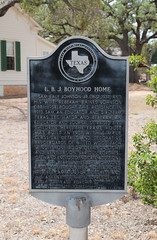
Texas Historical Marker #02828
L. B. J. Boyhood Home. Sam Ealy Johnson Jr. (1877-1937) and his wife Rebekah Baines Johnson (1881-1958) bought this residence in 1913. Sam, an educator and six-term Texas legislator, and Rebekah, an educator and journalist, raised five children here. The frame house was built in 1901, with simple Classical details and decorative bargeboards of milled wood. Each wing is one room deep for light and ventilation. Various porches, open and enclosed, indicate additions over the years. In 1937, the Johnson's eldest son, Lyndon (1908-1973), launched his first campaign for Congress, and his ascent to the U.S. presidency, from the east porch. Recorded Texas Historic Landmark - 1965. #2828
?, Johnson City, TX, United States
Subjects

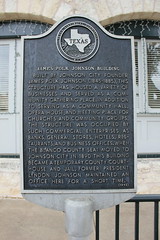
Texas Historical Marker #02829
James Polk Johnson Building. Built by Johnson City founder James Polk Johnson (1845-1885), this structure has housed a variety of businesses and served as a community gathering place. In addition to serving as a community hall, opera house, and meeting place for churches and community groups, the structure was occupied by such commercial enterprises as banks, general stores, hotels, restaurants, and business offices. When the Blanco County seat moved to Johnson City in 1890 this building became a temporary county courthouse and jail. Former president Lyndon Johnson maintained an office here for a short time. (1992) #2829
?, Johnson City, TX, United States
Subjects
Texas Historical Marker #02830
Johnson County. Named for Middleton T. Johnson (1810-1866), native of South Carolina, for 7 terms an Alabama legislator, a leading Texan after 1840. Served in 9th Texas Legislature; in Texas Rangers, Mexican War, Civil War. County created and organized 1854, from land earlier in counties of Ellis, Hill and Navarro. First county seat, Wardville, 1854-1856. Second was Buchanan, 1856-1867. Camp Henderson, at famous springs 3.5 miles southeast of Buchanan, a recruiting place in county during Civil War, in 1867 was made county seat and renamed in honor of a Confederate General Patrick Cleburne. #2830
?, Cleburne, TX, United States

Texas Historical Marker #02832
Johnson County Pioneers and Old Settlers Reunion. One of the largest events of its kind in Texas, the Johnson County Pioneers and Old Settlers Reunion traces its beginnings to 1892, when local farmer and newspaper correspondent John James (1852-1927) proposed the idea to some of his neighbors. Although met with initial rejection, James, together with some fellow newspaper writers, organized a picnic at Elm Grove in June 1893. Those in attendance voted to form an organization to oversee plans for an annual reunion. The first official Johnson County Pioneers and Old Settlers Reunion was held July 27-28, 1893, at Gathings Park northeast of Cleburne, with more than 2,000 people in attendance. Subsequent reunions were held in Alvarado, Grandview, Venus, and Cleburne, until the organization purchased land at this site for a permanent reunion campground. The first pavilion, built here in 1906, was later destroyed in a tornado, and the second one burned in 1965. It was replaced by a larger structure in 1966. Through the years, the reunion has grown to attract more than ten thousand participants to such events as carnivals; parades; queen, baby, and fiddle contests; and musical concerts. It has evolved into one of the area's most significant cultural institutions. #2832
?, Alvarado, TX, United States
Texas Historical Marker #02833
Johnson House, 1910. Built by W. A. Johnson, with cement blocks made on premises of his own sand and gravel. Interior oak woodwork by English carpenter. Recorded Texas Historic Landmark, 1964 #2833
CR 1117 off Ennis Creek Road, 15 mi. N of Snyder, Snyder, TX, United States
Texas Historical Marker #02834
Johnson Station Cemetery. Now part of Arlington, this area was established in the 1840s as a ranger station and trading post known as Johnson Station. This cemetery serves as a reminder of that early settlement. The oldest marked grave in the cemetery is that of Elizabeth Robinson, who died November 15, 1863. A number of unmarked graves may date from an earlier time period. A variety of gravestone styles may be found here, marking the burial sites of pioneer settlers, veterans of the Civil War, and charter members of an early Masonic Lodge. Texas Sesquicentennial 1836-1986. #2834
1100 block of W. Mayfield, Arlington, TX, United States
Texas Historical Marker #02835
James Polk Johnson. (August 24, 1845-October 20, 1885) A native of Georgia, James Polk Johnson came to Texas with his family and grew up in DeWitt County. Following his service in the Confederate army during the Civil War, he moved to Blanco County to join his uncles in the cattle business. He bought the business in 1871 and became successful in his own right. In 1879 he founded a new town, Johnson City, on the Pedernales River and was instrumental in its development. His dream of making Johnson City the seat of Blanco County was not realized until 1891, six years after his death. (1989) #2835
?, Johnson City, TX, United States
Texas Historical Marker #02836
Jesse H. Johnson. Jesse H. Johnson, born in Clarksburg, West Virginia, came to Texas in 1868 and settled here in Columbus, Colorado County. In May 1869 he was appointed sheriff of Colorado County, a position he held until the end of that year. Johnson became a part of Texas' legendary late 19th century cattle industry when in 1871 he led a cattle drive from Columbus to Abilene, Kansas, and delivered over 600 head of cattle. He was sworn in as Colorado County Justice of the Peace in 1872. In 1873 Johnson married Laura Glenn Harbert, a local landowner of some prominence and the daughter of an important county judge. He served as district clerk of Colorado County from 1876 to 1882 and became a director of the Columbus Meat and Ice Company in 1883. His last official position in Colorado County was that of tax collector from 1886 to 1894. Johnson joined the United States Foreign Service in 1899. He served as U.S. Consul in Coaticook, Quebec, Canada (1899-1901); Santos, Brazil (1901-1906); Swansea, Wales, U.K. (1907-1910); Matamoros, Mexico, (1910-1917); and at Regina, Saskatchewan, Western Canada, from 1917 to 1923. Johnson retired from the Foreign Service in 1923 and returned to Columbus. He died in Houston and his body was returned to Columbus by railroad for burial. #2836
1700 Milam Street, Columbus, TX, United States
Texas Historical Marker #02837
Johnson, Middleton T., Colonel; Cleburne, Patrick R., General. County named for Texas Confederate-- Colonel Middleton T. Johnson, 1810-1866 South Carolinian; Legislator Alabama came to Texas 1840. Member Republic of Texas Congress. Cavalryman in U.S. War with Mexico. Texas Ranger surveyor of early railroads. As colonel raised 14th Texas Cavalry regiment, taking them to Little Rock 1862 for induction C.S.A. service. Buried Mill Creek Cemetery, Arlington, Texas. Johnson County voted 500-50 for secession 1861. Soon raised 9 companies for C.S.A. service. 12th Texas Cavalry regt. which served in Arkansas, Louisiana, on Texas coast to prevent invasion Texas. Remaining eligible men western part county placed in state militia late 1863 to protect frontier. City named for Confederate-- General Patrick R. Cleburne 1828-1864 Born near Cork, Ireland came to U.S. 1849. Drug clerk in Ohio, became lawyer in Arkansas. Recruited 1st Arkansas Regt. for Confederacy. Elected colonel. Promoted brigadier general March 1862, made major general Dec. 1862. Rapidly earned reputation as a superb combat officer on numerous fields with army of Tennessee Eight. Texas regiments of Granbury's Brigade were under Cleburne, and in 1864 Atlanta campaign he said, "The piles of the (Union) dead were silent but sufficient eulogy upon Granbury and his noble Texans. "On Nov. 30, 1864 Cleburne, a savage fighter, met death six paces from the Federal lines in battle Franklin, Tenn. Became known as "Stonewall Jackson of the West." Erected by the State of Teas 1963. #2837
?, Cleburne, TX, United States