

Texas Historical Marker #03267
Mayberry Park Cemetery. The only remaining legible headstone in this graveyard reveals that the cemetery dates to the late 19th century. The grave of James Moses Cowan (1834-1888) is believed to be one of 12-20 burials. Other graves are marked with plain stones or remain unadorned. According to local tradition, members of the pioneer O.M. Hood family were interred in the cemetery. There was no specific name associated with the cemetery until the mid-20th century, when it became known as Mayberry Park Cemetery. The land became a part of Fort Hood in 1942. Texas Sesquicentennial 1836-1986 #3267
?, Killeen, TX, United States

Texas Historical Marker #03268
John and Ettie Mayfield House. This was the home of John Henry Mayfield (1865-1954), his wife Ettie Monroe Alsobrook (1869-1957) and their three daughters. The Mayfields moved to Holland about 1908 where Mr. Mayfield owned and operated a local cotton gin. Local contractors Frank Wood & Sons built this house in 1914. This Craftsman-influenced Prairie School building features emphasized horizontal lines, a wraparound porch, double gallery, and fine interior woodwork and craftsmanship. Recorded Texas Historic Landmark - 1995 #3268
400 W. Travis St., Holland, TX, United States
Texas Historical Marker #03269
Mazeland and Wilmeth. Mazeland (2 1/2 miles southwest) was founded in 1903 when a post office and store opened on A. B. Hutchinson's Ranch. Community was probably named for the corn or "maize" which grows in the area. A one-room school, built 1 mile west (1904), later served both places. By 1906 the settlement had enlarged, so this section was named in honor of Joe Wilmeth, a popular Ballinger banker. Before Wilmeth Post Office was established (1907) citizens would take turns bringing mail from Mazeland in horse-drawn wagons. In 1909, however, both post offices were discontinued. #3269
FM 383, Wilmeth, TX, United States
Texas Historical Marker #03270
McAllen First Methodist Church. The earliest record of Methodist church activity in the lower Rio Grande Valley dates to 1849. Circuit-riding ministers served an area along the Rio Grande from Brownsville to Roma. In 1909 the Rev. C.W . Godwyn was assigned to serve Methodists in McAllen, and a small frame sanctuary was built that year. It was replaced by a larger structure in 1913. Continued growth in the congregation led to construction of the present facility in 1928. This congregation continues to be an important part of the McAllen community. (1989) #3270
?, McAllen, TX, United States
Texas Historical Marker #03271
McAllen Lodge No. 1110, A.F. and A.M.. This lodge, organized by Master Mason R. M. Bounds and about 30 other Masons, was chartered on December 8, 1915. Meetings were held in the Joseph and Osborne buildings, two early downtown commercial structures, prior to the lodge erecting a temple at this site in 1927. Noted early teachers Isadore Moritz and Hugh R. Lockhart instructed a membership consisting of people from various masonic jurisdictions. The lodge is notable for having two members who became Grand Masters. Lodge No. 1110 continues to be active in local civic affairs. (1995) #3271
?, McAllen, TX, United States
Texas Historical Marker #03272
McAllen Post Office. Built in 1935, this was the sixth location of the McAllen Post Office after its creation in 1907. The facility was dedicated on January 22, 1936, and served as a postal facility until 1957. Since 1958, the building has been used for a variety of purposes, including Federal and city office space. The Spanish colonial revival structure features a baroque frontispiece around the front door, corbelled cornice, and red tile roof. Recorded Texas Historic Landmark - 1986. #3272
351 South Main Street, McAllen, TX, United States

Texas Historical Marker #03273
McAnelly Settlement. Threshold for settlement of Lampasas, San Saba counties. Commemorates homestead site of Robert D. McAnelly (1806-1888) who came here in early 1830's; was surveyor of large areas of surrounding land. McAnelly's Bend was named for him in 1858. His son, Cornelius, was first white child born in Lampasas County. #3273
?, Lampasas, TX, United States
Texas Historical Marker #03274
McBride Ranch House. A pioneer settler quarried Alibates dolomite from the canyon rim to build this house, mortared with lime burned on the site. Wood in ridge beams, door and window lintels, ice house, and corral came from old railroad bridge timbers salvaged from Canadian River. The floors are of masonry mortar. The builder, David Nichols McBride, was born Oct. 22, 1849, in Henry County, Ill., married Abigail Catharine Stringer at Fort Sill, Indian Territory, July 2, 1876; and settled near village of Amarillo Sept. 17, 1887--just 18 days after Potter County was organized. The McBrides had seven children. This site (in "Watered Homestead") and three alternate "Dry Grazing" school lands sections were situated in center of the famous LX Ranch, owned by the American Pastoral Company of London. Patent for his land was issued to McBride in 1901, upon proof of three years occupancy. The Homestead Section cost $1.50 an acre, with payments extending over 40 years at 3% interest. The grazing land cost $1.00 an acre. McBride died June 26, 1928, in Needles, Calif.; heirs sold this property in 1963 to the Canadian River Municipal Water Authority. It is now administered by the National Park Service, Sanford Recreation Area, Lake Meredith. Recorded Texas Historic Landmark - 1971. #3274
?, Amarillo, TX, United States
Texas Historical Marker #03275
McBryde Cemetery. Mancel T. McBryde (1821-1896), who brought his family here from Georgia in the early 1860s, began this family cemetery in 1885 upon the death of his wife, Jane W. Goar McBryde (1826-1885). A farmer and rancher, McBryde selected a site south of his family's home on which to bury his wife. The McBrydes had eight children, four of whom married into the Hoover family. McBryde and Hoover descendants are also interred here, the burials facing east. The oldest McBryde family graves are enclosed in stone. The McBryde Cemetery is maintained by descendants. (1986) #3275
?, Killeen vicinity, TX, United States
Texas Historical Marker #03276
McCamey. Founded 1926. Had 10,00 people in 1927. Named for Geo. B. McCamey, driller of discovery well that by 1964 had led way to opening of 31 oil and gas fields in Upton County. (Discovery well is 2.3 miles north of town). Center for horse, sheep, goat ranching. Has 5 parks. Home of Mendoza Trail Museum. Erected by Upton County Historical Survey Committee. #3276
US 385, one mile N of McCamey, McCamey, TX, United States
Texas Historical Marker #03277
McCamey Junior High School. Site is "Old High School," an outgrowth of 1920s oil boom. No school existed in McCamey prior to 1925, when 20 students were taught in a tin shack on 5th street. A year later school had 550 pupils in classes held in dance halls, skating rinks and 2 churches. Desks and seats were apple and orange crates. This building, erected in 1927, was community center-- setting for weddings, funerals, meetings of Draft Board, other activities. Used as high school until 1961. First superintendent, C. V. Compton, set high goals-- which since have guided the schools. #3277
112 E. 11th St., McCamey, TX, United States
Texas Historical Marker #03278
McCampell House. Mary Alice Ward McCampbell, widow of William Berry McCampbell, purchased land at 1421 Water Street in the old Irishtown section of Corpus Christi in 1908. Soon thereafter she hired local architect and builder William F. Bowles to design and build a home for herself and her three sons. Mrs. McCampbell later married G.E. Wilkinson. Located on beachfront property overlooking Corpus Christi Bay, the McCampbell house was in a precarious position when the hurricane of 1919 ravaged the city. As Mary and her sons watched from the porch on the second story, floodwaters rose to cover the first floor of the structure. Although the house survived the storm, family tradition holds that Mary contracted pneumonia while watching the storm and died of the disease in early 1920. After their mother's death, the McCampbell sons left Corpus Christi to attend military schools. They all returned to the city, however, and the house remained in the family until 1945. After a period of use as rental property, it was acquired by the city and relocated to Heritage Park in 1984. #3278
1513 North Chaparral St, Corpus Christi, TX, United States
Texas Historical Marker #03279
McClelland Library. -- #3279
1320 Austin Ave., Brownwood, TX, United States
Texas Historical Marker #03280
McCook Community. Named for a local storekeeper, this community was settled by descendants of the pioneers who in 1854 founded Panna Maria, Texas, the oldest Polish colony in the United States. Urban Kotzur, his son Leon, and their neighbor Frank Prukop bought land in this area in 1925 and the Kotzur family was the first to move here in 1926. Soon other families arrived to clear the brush land and begin cultivation. The farming village had a post office for several years during the 1930s. A school was started in 1929, and Immaculate Conception Catholic Church was built in 1950. (1979) #3280
?, McCook, TX, United States
Texas Historical Marker #03281
Home of Texas Attorney General George McCormick. In McCormick family 100 years. "Early Texas" cottage, built 1868, with square nails; of cypress and pine wood; had five rooms, detached kitchen, dining room. Born in Virginia, McCormick (1841-1905) came to Texas 1858; served in Confederate Army; in 1871 married Myrah Thatcher; had five children. He helped write Constitution of 1876; was attorney general 1878-1880; served 1884-1892 as judge of 25th Judicial District. #3281
736 Travis Street, Columbus, TX, United States

Texas Historical Marker #03283
McCrary House. James Madison McCrary (1845-1932) came to Comanche about 1870. With his father and brother he operated a mercantile on the town square and began the county's first cotton gin. He married Ella Griffith in 1872 and began construction of this house in 1876. Built of limestone quarried near Austin, the central-hall structure features segmental arches and gable-end chimneys. A recognized horticulturist, McCrary moved to a farm east of Comanche in 1910. He returned here to retire in 1926. The home was owned by McCrary descendants until 1987. Recorded Texas Historic Landmark - 1989 #3283
802 S. Austin St., Comanche, TX, United States
Texas Historical Marker #03284
Jesse L. McCrocklin. (November 8, 1800-March 22, 1888) Born in Kentucky. Moved to Texas in 1833. In Texas Revolution he fought in Siege of Bexar (1835) and Battle of San Jacinto (1836). In 1842 took part in Somervell Expedition against Mexico. Resided at Washington-on-the Brazos, present Kendall County; finally settled on his land grant in Blanco County. Worked as stock raiser, farmer, and blacksmith. Was member of the Masonic Order. Married Isabella Harris (1812-1902). They had four or more children. Recorded - 1972 #3284
?, Blanco, TX, United States
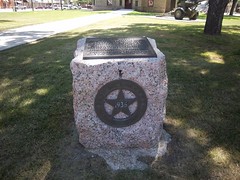
Texas Historical Marker #03285
McCulloch County. Created Aug. 27, 1856. One of 128 counties formed from Bexar County that extended from the Rio Grande to the Panhandle, and as far west as El Paso. Named for Texas hero, Ben McCulloch, who fought in Texas Revolution, Indian, Mexican and Civil Wars. Indian and frontier hazards made growth slow and 20 years passed before buffalo were hunted off and ranches established. Organized Aug. 4, 1876 with Brady, county seat. Became ranch, farm, recreation center. Site of geographical center of Texas and 1831 Calf Creek Battle, where James Bowie, Alamo hero, defeated 100 Indians. #3285
?, Brady, TX, United States
Subjects


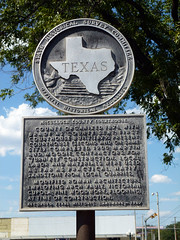
Texas Historical Marker #03286
McCulloch County Courthouse. County organized 1876, with Brady as county seat; first courthouse built 1879. Present courthouse (second and on same site) completed 1900; Martin and Moodie, contractors, for "turn key" construction. Local labor and materials were used as far as practical. Native sandstone from local quarries. Modified Roman architecture employing arch vault. Victorian cupola; pine woodwork, flooring, at time of construction. Recorded Texas Historic Landmark, 1967 #3286
?, Brady, TX, United States
Subjects
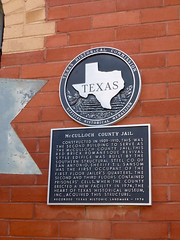
Texas Historical Marker #03287
McCulloch County Jail. Constructed in 1909-1910, this was the second building to serve as the McCulloch County Jail. This red brick Romanesque Revival style edifice was built by the Southern Structural Steel Co. of San Antonio. Sheriff T. L. Sansom was the first occupant of the first floor jailer's quarters. The second and third floors contained prisoners' cells. When the county erected a new facility in 1974, the Heart of Texas Historical Museum, Inc., acquired this structure. Recorded Texas Historic Landmark - 1976 #3287
117 N. High St., Brady, TX, United States