
Series 'Texas Historical Marker'

Texas Historical Marker #03498
Mount Zion Baptist Church. Mount Zion Baptist Church was organized on July 18, 1869, with fifteen charter members. The Rev. Mitchell Harrison (d. 1906) was the congregation's first pastor and is credited with naming the new church. The congregation worshiped in a number of places before permanently locating here in 1890. An outdoor brush arbor was built two miles north of Concrete (4.5 miles northwest), which was later replaced by a log structure south of Concrete. After a storm destroyed the log church a new wooden building was erected, which was disassembled and reconstructed at this site in 1890. The first worship service was held in the new building on October 31, 1890. The Rev. Mr. Harrison continued to serve as pastor of Mount Zion until his death. He was succeeded by the Rev. S. A. Pleasants, who served until 1923, at which time the Rev. N. E. Henderson became pastor, serving until his death in 1947. The church purchased a schoolhouse for use as a fellowship hall in 1951. The church building was renovated in 1956, with the original twin bell towers being replaced by a new steeple. At the time of its centennial in 1969 Mount Zion Baptist Church had been guided by only four pastors. Texas Sesquicentennial 1836-1986 #3498
?, Cuero, TX, United States
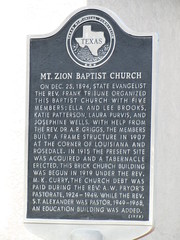
Texas Historical Marker #03499
Mount Zion Baptist Church. On Dec. 25, 1894, State Evangelist the Rev. Frank Tribune organized this Baptist church with five members: Ella and Lee Brooks, Katie Patterson, Laura Purvis, and Josephine Wells. With help from the Rev. Dr. A. R. Griggs, the members built a frame structure in 1907 at the corner of Louisiana and Rosedale. In 1915 the present site was acquired and a tabernacle erected. This brick church building was begun in 1919 under the Rev. M. K. Curry. The church debt was paid during the Rev. A. W. Pryor's pastorate, 1924-1949. While the Rev. S. T. Alexander was Pastor, 1949-1968, an education building was added.
1101 Evans St., Fort Worth, TX, United States
Subjects

Texas Historical Marker #03500
Mount Zion Baptist Church. The Reverend James Curry, a missionary from Sherman, Texas, organized this congregation in 1885. It is the oldest African American church in the city. The Reverend James Lewis served as first pastor of the congregation, which met in a small house near the railroad tracks until about 1907, when a sanctuary was erected at the corner of 4th and Cherry streets in the south part of town. The church moved to the north side of town in 1940. A part of Abilene history for well over a century, Mount Zion Baptist Church continues to serve the community with a variety of programs. (1995) #3500
520 Stafford St., Abilene, TX, United States
Texas Historical Marker #03501
Mount Zion Baptist Church and Jonestown Cemetery. In 1833 early settler Andrew Jackson Jones deeded four acres of land to be used for a church and cemetery. The earliest marked grave in the cemetery dates from that year. After the first church building burned in 1893, the members of Mount Zion Baptist Church met in the nearby Jones School until 1909 when they erected a one-room church building. In 1950 the lumber from the 1909 structure was used to construct the present building. The membership has supported mission work since 1902, and annual brush arbor meetings are traditional. #3501
CR 1280, S of Alvord, Alvord, TX, United States

Texas Historical Marker #03502
Mount Zion Cemetery. In 1879 this land was owned by Ezekel J. and Louisa J. McCleskey. According to McCleskey Family tradition M.M. McCluskey, a relative of Ezekel and Louisa from Georgia, died while visiting in 1879 and was the first person buried here. Eventually her grave site, near a church/school building, became a community cemetery named Veale for a local pioneer family. It was legally set aside as the Mount Zion Cemetery by the McCleskeys in 1907. The cemetery, enlarged over the years and maintained by an association formed in 1979, continues to serve the Frankell and LaCasa communities. #3502
On CR 127 off FM 717 via FM 207, Caddo, TX, United States
Texas Historical Marker #03503
Mountain Pass Station. Maintained from 1858 to outbreak of the Civil War in 1861 as a stage stop on the Butterfield Overland Main Route, which was the first mail and passenger line to link the east and west coasts of the United States. In 1870s this was a stop for branch of El Paso and San Antonio mail line. (1968) #3503
CR 351, SW of Merkel 32 mi., Merkel, TX, United States
Texas Historical Marker #03504
Mountain Springs School. Organized in 1847 in a pioneer woman's home, Mountain Springs School was Cooke County's first school. In 1853, it was moved to a log schoolhouse near this site. In 1884, when it became part of the public school system, this land was deeded for a larger frame structure, called "The Big School." By 1900, the academic year was lengthened to 6 months, beginning after harvest and ending before spring planting. This building, the fourth Mountain Springs School, was erected in 1920. In 1948, low enrollment led to consolidation with Valley View. The old school is now a community center. (1976) #3504
?, Gainesville, TX, United States
Texas Historical Marker #03505
Mountain Valley. Established in 1854 by 16 families of Mormons under the leadership of Lyman Wight (1796-1858). They abandoned their homes and mills in 1858 as the result of Indian depredations. Their lands are now beneath the waters of Medina Lake. Erected by the State of Texas - 1936. #3505
?, Mico, TX, United States
Texas Historical Marker #03506
Moye. Named for the Rev. John Martin Moye, founder (1762) of the Sisters of Divine Providence, religious order that opened school in Castroville in 1868, and built first part of this structure in 1873: first mother house of the order in the United States. Occupants since 1900 have been Providence Industrial School, St. Philip's Seminary, Refuge for Persecution Victims, and several other endeavors. Repurchased 1939 by Sisters of Divine Providence and used as military academy for boys. Now used as Training Center for Religious Life. 1972 #3506
?, Castroville, TX, United States
Texas Historical Marker #03507
Mr. and Mrs. W. P. Williams. William Patrick Williams (ca. 1818-1898) and his wife Elizabeth (Boles) (ca. 1822-1899) migrated to Texas from Mississippi during the Civil War. After a brief stay in Cherokee County, they settled in this area, arriving by wagon train. Their nearby homestead became the nucleus of the neighboring rural settlement, the site of an early school they helped establish. The Williamses and their six children survived many hardships, including Indian raids and a smallpox epidemic. William, often called "Mukewater Bill" for a stream near his home, was a pioneer area leader. (1981) #3507
?, Trickham, TX, United States
Texas Historical Marker #03508
Angelina Bell Peyton Eberly. (about 1800 - March 15, 1860) A Tennessean, Angelina Peyton came to Texas in 1822. With her husband, J. C. Peyton, she operated an inn in San Felipe, capital of the Austin colony. Peyton died in 1834; in 1836 the widow married Jacob Eberly. She and Eberly had a hotel in Austin by 1842, when Angelina Eberly discovered men secretly removing records from the capital. Firing a cannon, she started the "Archives War", and rescued the original records of the Republic of Texas. Later she lived at Indianola. Her burial place and marker (3/4 mile NW) were destroyed in a flood in 1875. Recorded - 1978 Erected by Calhoun County Historical Commission 1978. #3508
?, Port Lavaca, TX, United States
Texas Historical Marker #03509
Mrs. Cordia Sloan Duke. (Jan. 10, 1887 - July 23, 1966) Chronicler of a unique era in the history of the Southwest. Born in Belton, Mo. At 17, taught school in Indian Territory (Okla.) In 1907, she married Robert L. Duke, a ranch hand who had risen to division manager of the XIT Ranch (then world's largest). In addition to ther own family, she "looked after" the 150 cowboys who worked the 3,000,000-acre spread. Kept a diary of everyday events in ranch life around her and successfully encouraged 81 others to do likewise. Thus was preserved an authentic account of a passing phase of American life -- the cowboy and his work. (1969) #3509
?, Dalhart, TX, United States
Texas Historical Marker #03510
Mrs. J. A. B. Miller Public Library Building. Financed by the Self-Culture Club and other local women's organizations, this structure was erected in 1909 to provide a meeting place for the groups and to house the city's library collection. In 1924 when money was no longer available to pay a librarian, Mattie B. (Mrs. J. A. B.) Miller (1874-1969), pioneer ranch woman and civic leader, offered her services. For 41 years, as an unpaid librarian, she dedicated her time and resources to the project. In 1968 when the city took over operation, the library was named in her honor. (1977) #3510
?, Coleman, TX, United States
Texas Historical Marker #03511
Mrs. John L. Morris (Marjorie). Originator, promoter of the glove of the great southwest, world's most nearly authentic replica of the globe theater in England made famous by the plays of William Shakespeare. Mrs. Morris was educated at north Texas state university and joined the English faculty at Odessa college. In 1961 the college named her "Teacher of the years". She was honored 1961 as an outstanding teacher in Texas college. She also founded the permian basin museum and area "writers' roundup" contest, both of which are sponsored by Odessa college. Outstanding women of Texas series, 1967. #3511
?, Odessa, TX, United States
Texas Historical Marker #03512
Mrs. Lillie W. Cole. Outstanding and dedicated teacher; public benefactor. Born in Lavernia, Texas. Came to Pecos, 1906, with husband Wylie Moffitt Cole. They had two daughters. Widowed in 1912, started teaching career which lasted for 27 years. (1968) #3512
Cedar & 1st St., Pecos, TX, United States
Texas Historical Marker #03513
Mrs. Martha Rogers. (about 1795 to about 1865) According to family tradition, Martha Rogers was the daugther of United States Army General James Wilkinson (1757-1825) and his wife Ann Biddle of Philadelphia. When she married Benjamin Rogers (b. 1781) in Perry County, Ala., in 1809, Martha was disinherited. She and her husband had ten children. As a widow she moved to TX in 1847 with sons Allen Jefferson, M.C. ("Lum"), and James Rogers. A true Southwestern pioneer, she lived in Lost Prairie community. Recorded - 1978 #3513
FM 3371, Lost Prairie, TX, United States
Texas Historical Marker #03514
Mrs. Mary E. Reeves. (October 28, 1828 - January 7, 1917) Born in Georgia, a daughter of Mr. & Mrs. Ben Hawkins, Mary Ellephan Hawkins was married in 1847 in Alabama to William Jay Reeves. The couple and their young children moved to Texas about 1855. While her husband served in Company F, 15th Texas Cavalry, Sweet Regiment during the Civil War, Mary E. Reeves cared for the family at home. Descendants include physicians, lawyers, bankers, and citizens in many other walks of life. Recorded - 1978 #3514
?, Lost Prairie, TX, United States

Texas Historical Marker #03515
Mrs. Merriweather Post. Daughter of C. W. Post. Lived in Texas 1888-1891. Had part with father in locating colony here 1906; rescued local economy by aid after 1917 drought. Co-donor, site for Post Recreation Center. Donor, South Plains Council Boy Scouts Camp; books and paintings to South Plains College. A leading philanthropist in arts and humanities. Benefactress, C. W. Post College, Long Island University; founder "Music for Young America." Recipient of 30 citations for service, 3 honorary degrees, 6 foreign decorations. A woman endowed with true virtues of generosity and compassion. 1968 #3515
?, Post, TX, United States
Texas Historical Marker #03516
Mrs. Sarah Ann Hardin-Kelton. Widow of William Hardin before her marriage to Dr. O.P. Kelton. Many of the Mexican officers and men were placed in the care of Judge and Mrs. Hardin after the victory at San Jacinto and were mercifully treated by them. #3516
?, Belton, TX, United States
Texas Historical Marker #03517
Mt. Antioch Cemetery. In 1854, Ezekiel J. Billington came to this area of Texas from Kentucky with his wife, Kitty Ann, and their three children. Billington organized a Baptist church the following year and named it Mt. Antioch. The six charter members of the Mt. Antioch Baptist Church were Ezekiel and Kitty Ann Billington, Nancy Billington, Houghton Hughes, Medina Hughes, and M. J. Billington. The nearby spring was a favorite camping spot for travelers in the area. As early as 1846, this site was used for the burial of those who died while passing through, and the graves of these persons remain unmarked. The first marked grave in what became the Mt. Antioch Cemetery was that of George Kimmel (d. 1860), the infant son of early settler James Kimmel. Between 1860 and 1875 the community that developed around the Mt. Antioch Baptist Church and cemetery grew and prospered. About 1874, however, members of the church began moving to the town of Mt. Calm (2 mi. N), where they organized a new congregation. The cemetery continues to be used and maintained by the local residents and descendants of the early settlers. A good example of a pioneer graveyard, Mt. Antioch Cemetery stands as a reminder of the early heritage of this part of Limestone County. 1985 #3517
FM 339, 3 mi. S of Mount Calm, Mount Calm, TX, United States