
Series 'Texas Historical Marker'



Texas Historical Marker #03518
Mt. Calm Methodist Church. According to local tradition this congregation began in Mt. Calm, Limestone County, Texas, in the 1850s. By 1862 circuit preacher Andrew Davis held services in a schoolroom in the Mt. Calm Masonic Lodge. In 1883 the church erected a sanctuary here in the new town of Mt. Calm which had relocated to the Texas and St. Louis Railroad in Hill County. A new sanctuary was erected in 1906 and by 1910 the congregation sponsored a Sunday School and Woman's Home Mission Society. A new church building was erected in 1951. The church continues to serve the local community. #3518
?, Mount Calm, TX, United States

Texas Historical Marker #03519
Mt. Hiram Lodge No. 595, A.F. & A.M.. Mt. Hiram Lodge No. 595 was chartered on December 12, 1884. Lodge members shared their first facility, a two-story structure located near present-day downtown Copperas Cove, with a public school. In its early years the lodge participated in a local volunteer company of Minutemen and helped develop this area's economy. The lodge relocated in 1894 to Main Street and Ave. D, above the J. S. Clements & Bro. Mercantile Store. Growth in its membership led to the building of a new lodge facility at this site in 1970. This lodge continues to serve the local community. #3519
?, Copperas Cove, TX, United States
Texas Historical Marker #03520
Mt. Pleasant Missionary Baptist Church. Founded in 1891 by the Rev. Mr. Thurston and twelve charter members, this congregation was the first to be organized on the east side of Wichita Falls. The fellowship met in the homes of the members until 1894, when a small frame building was erected. That structure and the one that subsequently was built on Pecan Street were destroyed by dynamite, but the congregation continued to worship together despite these setbacks and relocated to 401 Sullivan in 1912. Mt. Pleasant Missionary Baptist Church experienced much growth in membership and expansion in programs and facilities during the 12-year pastorate of the Rev. E. J. McClendon (1876-1925). In 1928, under the leadership of the Rev. W. D. Davis, a new building was completed. It served the needs of the congregation until 1959, when the church moved to this site. Throughout its history, Mt. Pleasant Missionary Baptist Church has played a vital role in providing service and leadership to Wichita Falls' Negro community. The congregation has produced a number of pastors from among its members and has been active in Christian education and missionary work. (1984) #3520
809 Harding, Wichita Falls, TX, United States
Texas Historical Marker #03521
Mt. Sinai Baptist Church. Organized at Indianola (14 miles SE) in 1870, this church is one of the oldest black fellowships in Calhoun County. The first pastor was the Rev. Joseph Whitlock, an elder in the white Baptist congregation of the city. Several members of this church moved to Port Lavaca in 1875 after a hurricane destroyed the Indianola sanctuary. The remainder of the congregation joined them in 1886 following a second major storm. Known here originally as the Second Baptist Church, the members adopted the present name in 1905, during the 25-year pastorate of the Rev. A. K. Black. (1980) #3521
419 Center St., Port Lavaca, TX, United States
Texas Historical Marker #03522
Mike Muckleroy. (Sept. 27, 1808 - July 28, 1896) Pioneer, farmer, soldier, and county official Mike Muckleroy was born in Franklin County, Tennessee, and came to Texas in 1840. An early and long-time resident of Colorado County, he came to be affectionately known throughout the area as "Uncle Mike." Two years after his arrival in Texas and six years after Texas had won its Independence from Mexico, Muckleroy joined the campaign to expel General Adrian Woll from San Antonio. Woll, a French mercenary, was an officer in the Mexican Army who in 1842 led 1,000 troops to take San Antonio. The Texans soon forced their retreat into Mexico. Muckleroy returned to Colorado County, where he received a Republic of Texas land grant. He farmed the land and built a home near this site. His house, a two-story log structure with a watch tower to guard against Indian raids,was saved from demolition in the 1970s and moved to Henkel Square in Round Top (18 mi NW). From 1846 to 1852 and again from 1876 to 1878, Muckleroy served as a county commissioner. Mike Muckleroy sold his property in 1895 and moved to Terrell in Northeast Texas, where he lived with family members until his death. He is buried in the Muckleroy graveyard near his old homesite. #3522
?, Frelsburg, TX, United States

Texas Historical Marker #03523
Mud Creek Cemetery. Named for nearby Mud Creek, this graveyard has served residents of the Thrifty and Fry communities for more than 100 years. The first person known to be buried at the site was infant Martha Blackwell, who died in 1864. However, a rock slab that bears an illegible name indicates the cemetery was used as early as 1862. Others buried in Mud Creek Cemetery include pioneer settler Charles Mullins (1790-1880) who brought his family to the area in 1858, victims of Indian attacks, and persons involved in the 1926-27 area oil boom. (1983) #3523
?, Bangs, TX, United States
Texas Historical Marker #03524
Muehlhause House. German immigrant Fred Muehlhause, Sr. (1868-1947) arrived in Texas in 1885. He married Louise Albrecht in 1892, and later that year the couple moved to a home located adjacent to this homesite. Muehlhause worked as craftsman shoemaker and repairman, and in 1906 established the Belton Shoe Shop in the city's downtown business district. Muehlhause was active in community affairs and became a respected civic leader. In 1907 he was elected Belton city alderman. Prominent Belton builder James M. Scott constructed this residence in 1908 using written specifications provided by Fred Muehlhause. The structure exhibits elements of the Queen Anne architectural style and features a hipped roof with lower cross gables; a wraparound porch; a bay window; hipped dormers facing east, south, and west; and shingled gable ends. Water for domestic purposes was provided by an 18-foot deep spring-fed cistern lined with limestone blocks and located just to the rear of the house. Two of the Muehlhauses' seven children eventually lived in homes built by their father on nearby lots along this avenue. This house and its outbuildings, including a carriage house, wash house, and smoke house, remained in the Muehlhause Family until 1992. Recorded Texas Historic Landmark - 1994 #3524
620 S. Main St., Belton, TX, United States

Texas Historical Marker #03525
Muenster. In 1889 brothers Anton, August, and Emil Flusche contracted to sell 22,000 acres of this land along the Missouri, Kansas & Texas Railroad. Jot Gunter gave 25 acres for a school, church, cemetery, and park. The first Mass, celebrated Dec. 8, 1889, marked the official beginning of this German Catholic town. Despite drought, typhoid fever, and tornadoes destroying the first two church buildings, the area grew and farming and dairy business increased. Farmers established an insurance company and a marketing group for buying products in bulk. An oil boom in 1926 added to the prosperity. (1979) #3525
?, Muenster, TX, United States
Texas Historical Marker #03526
Mulberry Creek Bridge. Built in 1888 by the King Iron Bridge Company of Cleveland, Ohio, and its sub-contractor, A. J. Tullock and Company of Leavenworth, Kansas, this bridge provided easy access to the developing community of Schulenburg. Located on the Old Praha Road, it was part of a major travel route during the late 19th and early 20th centuries. The 60-foot iron structure, described as a single span, box-chord, pin-connected modified Pratt low truss bridge with counters, cost $1,422 at the time of its construction. It is one of the few bridges of this style still standing. Recorded Texas Historic Landmark - 1990 #3526
?, Schulenburg, TX, United States
Texas Historical Marker #03528
Mule Creek Cemetery. Established by pioneers of Mule Creek community, a small frontier settlement founded in 19th century. Said to be named either for (1) an early horse and mule ranch, or (2) a stagecoach mule that died at a creek which runs nearby. The Abilene-Fort Concho stage once served area. For years principal building in here was a combination school church, since 20th century, shift to urban living has diminished population of Mule Creek. Inscriptions of tombstones chronicle history of community. In spring, grounds are covered with bluebonnets, state flower. (1971) #3528
?, Tennyson vicinity, TX, United States
Texas Historical Marker #03530
Muleshoe National Wildlife Refuge. Founded in 1935 as a wintering area for migratory waterfowl, Muleshoe Wildlife Refuge is on the "central flyway" in a chain of refuges from Mexico to Canada. Migrating birds begin arriving in August and remain until April. The largest wintering concentration of sandhill cranes in North America is most noticeable here from October through March. The site, covering over 5,000 acres, provides habitat for many other species of birds and wildlife. Muleshoe is one of several national wildlife refuges in Texas that protect migratory waterfowl, endangered wildlife species, or unique natural habitats. (1967, 1985) #3530
?, Muleshoe vicinity, TX, United States
Texas Historical Marker #03531
Cookhouse - Muleshoe Ranch. Cookhouse built in Parmer County about 1897. Bought and moved here about 1902. Dodge City couple moving to Texas found shoe thrown by mule. Used it for good luck and as branding iron on ranch to which this old cookhouse belonged. Recorded Texas Historic Landmark, 1965 #3531
2000 Ash, Muleshoe, TX, United States
Texas Historical Marker #03532
Mullin United Methodist Church. Charles Mullins, for whom this town was later named, came here with cattle in 1857. By tradition, a Methodist circuit rider preached at his home. The date of the church's founding is uncertain. Worship was held in Mullin Schoolhouse for years. In 1893, Mr. and Mrs. J. E. Martin gave this site and in 1896 a building was constructed under leadership of The Rev. Marion Mills. After a 1919 cyclone wrecked that building the present native stone church was erected in 1920, using much material from original structure. #3532
RR 5735, S of US 84, Mullin, TX, United States
Texas Historical Marker #03533
Mullins Cemetery. Named for Isaac Mullins (1819-81), one of organizers of Tom Green County, member of first county commission, and state representative in 16th Texas Legislature. Born in Virginia, Mullins came to the Republic of Texas with his parents and their family in 1837. The family cattle brand, "IC", one of most famous in Texas, was registered in Bastrop, Fayette, Lampasas, Brown, Mills, Coleman, Runnels, and Tom Green counties. Mullins trailed herds to markets as far away as California. In the 1860's, he served as captain of a Texas Ranger company. Moving to this area, he bought land near San Angelo and became a leading citizen. He was foreman of noted "Ike Mullins Grand Jury" which indicted nine soldiers for rioting at Fort Concho in 1878. He gave land for a school, and selected this spot as his own last resting place, deeding cemetery site in 1881. Mullins and his wife, Susan Slack (d. 1854), had a son, Charles, and a daughter, Julia (who married H. D. Barron). Some members of his family are buried here, along with Civil War veterans, and many pioneers of former Mullins community, now called Veribest. George Jefferson Byrd, named by Mullins family as trustee, served until his death in 1951, bequeathing the trust to a son, Curtis Byrd, and Frank Johnson. #3533
Off FM 380 about 16 miles NE of San Angelo, San Angelo, TX, United States
Texas Historical Marker #03534
Mundt Place. Constructed 1871 as the Continental Hotel which operated until 1897. Bought by Prof. O.E. H. Mundt. Served as classroom building for his school, founded in 1893. School operated until 1904. In 1946, purchased from Mundt family by Post 4146, Veterans of Foreign Wars. (1966) #3534
103 S. Glass St., Victoria, TX, United States
Texas Historical Marker #03535
Municipal Power Plant. After attempts by Yoakum officials to purchase existing electric power facilities failed, the city voted in 1930, at a commission meeting attended by about 300 local residents, to build its own municipal power plant. This building was designed by the firm of Montgomery and Ward engineers of Wichita Falls and built by F. O. Crawford of Yoakum in 1932 on land purchased from the Spencer-Sauer Lumber Company. The building housed Yoakum's sole electric power plant until 1938 and continued in use as an auxiliary electric plant until the early 1960s. From 1964 to 1989 the building served as a municipal machine shop. In 1988 city officials offered the "Friends of the Library," a local organization organized in 1978 to promote the city library, an opportunity to utilize the building. The organization made use of state funds and generous donations by local citizens to convert the building into a public library. The project has earned recognition as a fine example of restoration and adaptive use of a historic building. The building is an excellent example of an industrial facility. It features a 3-bay primary facade, large metal sash windows, a 5-part parapet with incised name block, and gable roof with protruding clerestory windows. Recorded Texas Historic Landmark - 1993 #3535
810 Front Street, Yoakum, TX, United States

Texas Historical Marker #03536
Municipal Swimming Pool. In September 1936 a devastating flood swept down the South Concho River, inundating much of the city of San Angelo. Among the many properties lost or severely damaged were the city's parks and its public swimming pool. Plans were made to rebuild the parks and construct a new municipal swimming pool, but a bond election held in 1937 to finance the project was defeated by the voters. Once it was determined that the federal government would assist with Works Progress Administration funds and labor for the project, a new bond election was held and passed by sixty-six votes. Work on the project began in March 1938 and was completed in October. Opening ceremonies were held on April 29, 1939. During its first two days of operation, the pool hosted 795 swimmers. Designed by John G. Becker, the Pueblo revival complex features a two-story hexagonal stone structure flanked by one-story wings. Exposed vigas are symmetrically placed on the upper portion of the wings. The complex reflects the 1930's construction and planning activity of the Federal Works Progress Administration. RECORDED TEXAS HISTORIC LANDMARK - 1989. #3536
18 E. Ave. A, San Angelo, TX, United States
Texas Historical Marker #03537
Murchison Lodge No. 80, A.F. & A.M.. Considered oldest organized group in Lavaca County. Under dispensation granted March 29, 1850, Lodge was chartered January 31, 1851, and named for early Texas colonist and Masonic leader John Murchison, Fayette County. First officers: Isaac J. Foster, worshipful master; Silas Bennett, senior warden; Peter McDermott, junior warden. About 1855, Lodge built a 3-story hall, which was also used as a church and a school (called "Masonic College"). Lodge member Friench Simpson served as grand treasurer of the Grand Lodge of Texas in 1900. #3537
?, Hallettsville, TX, United States
Texas Historical Marker #03539
Murphy Home. Built 1897 combining southern plantation and New England Saltbox styles of architecture. Home of prominent Nursery citizens R. S. Fowler, John M. Horton, E.S. Jennings, Louie Carpenter,and for many years, W.M Murphy, Sr. Recorded Texas Historic Landmark - 1966 #3539
US 87, Nursery, TX, United States
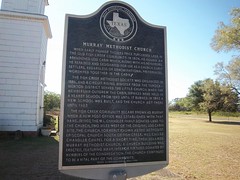
Texas Historical Marker #03540
Murray Methodist Church. When early pioneer Thomas Price purchased land in the old Fish Creek community in 1874, he found an abandoned log cabin which, along with his neighbors, he repaired and designated for use as a church. Early settlers, regardless of denomination preferences, worshiped together in the cabin. The Fish Creek Methodist Society was organized in 1886, and a circuit riding minister from the Throckmorton District served the little church. When the membership outgrew the cabin, services were held in a nearby school from 1893 until it burned in 1897. A new school was built, and the church met there until 1907. The Fish Creek community became known as Murray when a new post office was established with that name. In 1907, the W. L. Chandler family donated land to the church, two miles west of the original log cabin site. The church, formerly known as the Methodist Episcopal Church South of Fish Creek, was called Chandler Chapel for a short time, then renamed Murray Methodist Church. A church building was erected, featuring many interior fixtures donated by members of the congregation. The church continues to be a vital part of the community. #3540
FM 209, W of Graham, Graham, TX, United States