
Series 'Texas Historical Marker'
Texas Historical Marker #03680
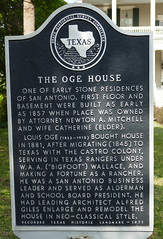
Oge House. One of early stone residences of San Antonio. First floor and basement were built as early as 1857 when place was owned by Attorney Newton. A. Mitchell and wife Catherine (Elder). Louis Oge (1832-1915) bought house in 1881, after migrating (1845) to Texas with the Castor Colony, serving in Texas Rangers under W.A.A. ("Bigfoot") Wallace, and making a fortune as a rancher. He was a San Antonio business leader and served as Alderman and school board president. He had leading architect Alfred Giles enlarge and remodel the house in Neo-Classical style. #3680
209 Washington St., San Antonio, TX, United States
Subjects

Texas Historical Marker #03681
Ogletree Stagestop and Post Office. After Marsden Ogletree (1819-1896) and his family migrated from Georgia, he recieved a land grant in 1878. Inscriptions on two stones in this house indicate the structure was erected the same year. It served as the family home, grain store, and stopping place for the Lampasas to Belton stagecoach. Since the mail arrived by stage, a post office was opened here in 1879 with Ogletree as postmaster. Legend says that the settlement received the name "Coperas Cove" from a copperas-tasting spring in the cove of a nearby mountain. Samuel Gilmore served as the second Postmaster. In 1881 Gilmore's father-in-law Jesse M. Clements (1822-1900) and his wife Charley deeded land for the right-of-way to the Gulf, Colorado & Santa Fe Railroad. The following year the railroad laid out the new townsite of Copperas Cove. Soon the center of the community, including the post office, moved over to the railroad. Later the town corrected the spelling of its name to "Copperas Cove." In 1891 Clements bought this house and used it as the headquarters for his large ranching operations. The old stone stagestop remains a visible link with the community's pioneer heritage. #3681
?, Copperas Cove, TX, United States

Texas Historical Marker #03682
Ohio Street Bridge. Planning for construction of the first bridge at this site began soon after the organization of Wichita County in 1882. The structure was built by the King Bridge Company of Cleveland, Ohio, and formally dedicated on July 4, 1886. This second span, located west of the original bridge, was completed in 1911. Both provided a vital connection between the downtown area of Wichita Falls and northern sections of the city. The bridges were closed to vehicles in 1972 because of unsafe structural conditions and the older span was demolished. (1980) #3682
Ohio Street, at Bridge, Wichita Falls, TX, United States

Texas Historical Marker #03683
Oil Industry in Gaines County. The first oil lease in Gaines County was in 1912 and the first drilling occurred in 1925. Ten years later the Landreth Company brought in the first producing well. In 1936 Amerada Oil Company opened up the Seminole Pool, a major field that yielded 350 wells within a decade. Less than 50 years after that discovery, Gaines County had produced over one billion barrels of crude oil. With several active fields, Gaines ranks as one of the top oil producing counties in Texas. The petroleum industry accounts for much of this area's prosperity. 1979 #3683
?, Seminole, TX, United States

Texas Historical Marker #03684
Oil and Gas Industry in Pecos County. Located in the petroleum-rich Permian Basin, Pecos is one of the most prolific oil- and gas-producing counties in Texas. The petroleum business here began about 1900 with the drilling of the Turney well near an ancient "seep", a traditional local source of oil for lubricating and medicinal purposes. A short-lived boom in 1921 caused by the discovery of the "Miracle Well" heralded the arrival of the fabulous Yates oil field (1926), indicating the area's great potential oil wealth. Since that year over 710 million barrels of oil have been produced from the Yates, Fort Stockton and other county fields. The presence of natural gas, known for years, was slow to be exploited because gas was considered an undesirable by-product of the oil business. The first commercial use of gas here was inspired after it was found by workers drilling a water well, in 1925. The discovery, about 1948, of Santa Rosa field spurred exploration that brought in the Puckett field in 1952. Subsequent deep drilling tapped many extensive pools, including in 1963 the prolific Gomez Field, which had produced over 478 billion cubic feet of gas as of 1970. Today petroleum is the single most important economic asset of Pecos County. #3684
1000 Railroad Avenue, Fort Stockton, TX, United States
Texas Historical Marker #03685
Old Harrison. Named for Confederate General James E. Harrison, kinsman of U.S. president Wm. Henry Harrison and close friend of Confederate President Jefferson Davis. Born in South Carolina. Early settler, political leader and landowner in McLennan and Falls counties. Member of the Texas seccession convention. As an adopted son of Chickasaw Indian Tribe, headed special Civil War missions in Indian Territory. As a stockholder in Waco tap railway, gave right-of-way and site for Harrsion Station. Town had post office, school, stores, churches, gins, gristmills. #3685
?, Waco, TX, United States
Texas Historical Marker #03687
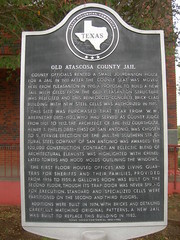
Old Atascosa County Jail. County officials rented a small Jourdanton house for a jail in 1911 after the county seat was moved here from Pleasanton in 1910. A proposal to build a new jail with cells from the old Pleasanton structure was rejected and this reinforced-concrete, brick-clad building with new steel cells was authorized in 1915. This site was purchased that year from W.M. Abernethy (1851-1931), who had served as County Judge from 1901 to 1912. The architect of the 1912 Courthouse, Henry T. Phelps (1881-1945) of San Antonio, was chosen to supervise erection of the jail. The Southern Structural Steel Company of San Antonio was awarded the $20,000 construction contract. An electic blend of architectural elements was highlighted with crenelated towers and hood molds outlining the windows. The first floor housed offices and living quarters for Sheriffs and their families, provided from 1916 to 1959. A gallows room was built on the second floor, though its trap door was never sprung for execution. Standard and specialized cells were partitioned on the second and third floors. Additions were built in 1974, with bricks and detailing carefully matching original patterns. A new jail was built to replace this building in 1982. Texas Sesquicentennial 1836-1986. #3687
711 Broadway, Jourdanton, TX, United States
Subjects
Texas Historical Marker #03688
Old B'Nai Zion Synagogue. Congregation B'Nai Zion was chartered in 1900, and the 35 members initially met in private homes or rented space. This building, the first Jewish synagogue in El Paso, was completed in 1912. The structure features an unusual combination of classical and Gothic revival styling. After B'Nai Zion congregation moved to larger facilities in 1927, this building housed El Paso's First Eastern Orthodox Church. St. Nicholas Greek Church worshiped here for a quarter of a century. Recorded Texas Historic Landmark, 1984. #3688
906 N. El Paso, El Paso, TX, United States
Texas Historical Marker #03689
Old Bay City Bank. Established 1898, four years after founding of Bay City. Private bank. Owners: Henry Rugeley, Frank Hawkins. This building erected 1903, site of many investment transactions important to Texas Gulf Coast development. Recorded Texas Historic Landmark, 1965 #3689
2044 Ave F, Bay City, TX, United States
Texas Historical Marker #03690
Old Binion Home. N/A #3690
2354 North Ranch Road 187, Sabinal, TX, United States
Texas Historical Marker #03691
Old Blasingame Home. Built about 1912 in Ochiltree. Designed by Mrs. John Blasingame; 19th century English, German influence. Constructed by Sam Whittaker; lumber and red brick hauled from Glazier. Luxurious home had attic, full basement. Heavy embossed picture moulding. Contained much intricate glass work - two leaded stained glass windows, of Bavarian design, on sides of living room mantels. Was moved to Perryton, 1961, by the Willard McLarty family. Recorded Texas Historic Landmark - 1967 #3691
1001 S Cedar, Perryton, TX, United States
Texas Historical Marker #03692
Old Boehm Store. This was site of first business in "New" Moulton, founded 1887 on advent of San Antonio and Aransas Pass Railroad. In the same year, Edward Boehm (1854-1920) built a frame store; enlarged it in 1897; and in 1906 rebuilt, using native stone. His sons Vladike and Edward, Jr., succeeded to ownership. 1971 #3692
S. Main St. & Moore Ave., Moulton, TX, United States
Texas Historical Marker #03693
Old Brandon Mill. One of earliest grist mills in Hill County. Built (1868) by Dr. Jas. T. Harrington, who also founded town of Brandon. Corn meal, basic to settlers' diet, was ground here. Dr. Harrington built a dam on White Rock Creek near here as a water source for power in the millhouse. His grist mill served a wide area for nearly 50 years. A grist mill was a primary need in every early community. Where bread could be made, settlements thrived. A good water supply and a grist mill were essential to a successful town. Today only stone foundations of Old Brandon Mill remain. #3693
?, Brandon, TX, United States
Texas Historical Marker #03694
Old Buck Ranch. Settled 1867 by former New Yorker, Judge Edward M. Ross, who had fought in Mexican war, then served in 1850's at Camp Verde, army's camel post near Bandera. House is hand-cut native stone. Daughter Kate Ross, wife of Ebenezer Buck, of a prominent pioneer family, inherited ranch in 1901. Offering fine foods and hospitality, the Bucks in 1920 established this as Bandera's first guest ranch, continuing it until their deaths in 1941. Recorded Texas Historic Landmark, 1966. #3694
?, Bandera, TX, United States
Texas Historical Marker #03695
Old Buffalo Road. Named for traffic in buffalo hides and bones, road from plains hunting grounds crossed this site. Hunters hauled thousands of hides to market in 1870s. The first settlers in late 1870s-80s sold bones for fertilizer and bought supplies to sustain life during hard times. Erected by Archer County Historical Survey Committee, 1973. #3695
?, Archer City, TX, United States
Texas Historical Marker #03696
The Old Buffalo Road. Named for its traffic in buffalo hides and bones, this north Texas road gave subsistence to pioneers while aiding in mass "harvest" of the American bison. As long as buffalo survived (providing food, shelter and clothing) the Indians were lords of the plains. Recognizing this, the authorities encouraged hunting. Harvested hides were taken to market over this road. The buffalo and Indians gone, permanent settlers arrived. In adverse years (while a man tried to get a start at farming, ranching or storekeeping), bones were salvaged and sold for grocery or seed money. This old road was route of hundreds of wagons taking buffalo hides to market before 1878 and hundreds of wagons taking bones to Wichita Falls and Henrietta before 1890. The road came east from the plains, near south line of Foard and Wilbarger counties to Guide Mound; then three miles east (near this marker) and south to Wichita River bridge; then to the county line three miles west of Holliday. Next it passed the north edge of Holliday, and south of Lake Wichita, then crossed at the Old Van Dorn crossing five miles south of Jolly. Pioneers also called it "Great North" Road or "Good Creek" Road. It proved invaluable to economy and mapping of area. #3696
SH 25, Electra, TX, United States
Texas Historical Marker #03697
Old Buffalo Wallow. The nearby depression survives from an epoch when great buffalo herds migrated through west Texas, many moving between present Canada and Mexico over two major trails in the Odessa area. Wallows began with individual buffalo rolling in the dirt to rid themselves of pests or shed their heavy winter coats in springtime. Repeated wallowing in the same spot by countless buffalo created an efficient depression to accomplish the cleaning ritual. Most wallows were eight to 12 feet across and two feet deep. Buffalo existed in the millions in north America, ranging throughout the western and central plains of Texas. They were pursued seasonally by the plains Indians, who subsisted on the food and clothing the buffalo provided. In the late 19th century, railroads bisected their trails, isolating the herds and providing transportation of meat and hides to distant markets. In Texas vast buffalo slaughters were encouraged in the 1870s by the army, who wanted to deprive Indians of their commissary; settlers, who had crops trampled and forage consumed by the passing herds; and hunters, who realized quick profit particularly from hides. The buffalo had all but disappeared from this area when Odessa was founded in 1886. (1986) #3697
4800 E. 42nd St., Odessa, TX, United States
Texas Historical Marker #03699
Old Camp Hospital. First permanent hospital in the Trans-Pecos area. Erected 1929 by pioneer physician and surgeon, Jim Camp, M.D. -- "Texas Doctor of the year" for 1950. "Dr. Jim" came to Pecos in 1900. In early days, he performed many operations using kitchen tables and other makeshift equipment. During 64 years of service, he strove to improve facilities, one of his goals being to build and to equip a modern hospital. Converted to office use 1954. Recorded Texas Historic Landmark, 1966. #3699
1703 W. 4th, Pecos, TX, United States

Texas Historical Marker #03700
Old Campsite of Jesse and Frank James. Famous western frontier outlaws, who had many Texas hideouts along a line from the Rio Grande to the Red River. The camps - extending into Missouri, their home state - were used for hiding stolen horses until posses could be thrown off the trail. The campsites were sometimes known to scattered settlers, who feared or befriended the bandits. Also, friendly with the James brothers (and also operating sometimes in Texas) were fellow Missouri outlaws, Cole Younger and "Bandit Queen" Belle Starr. This was an era of widespread lawlessness in Texas. Billy the Kid roamed into West Texas. The Daltons, John Wesley Hardin, Cullen Baker, Bill Longley, Sam Bass and many others found it easy to kill and rob and then hid in wild areas where they were beyond the reach of local officers, and food was plentiful. After reconstruction ended in 1874, Texas Rangers were reorganized, to restore respect for the law. Given special powers, in 1889-90 they arrested 579 wanted men (including 76 alleged murders). Jesse James and some other notorious badmen by then were dead. Frank, reformed, worked as a salesman in Dallas, Paris, and other Texas towns. #3700
US 380, E of Decatur, Decatur, TX, United States


