

Texas Historical Marker #08546
Frank Reaugh. (December 29, 1860 - May 6, 1945) Graphic historian of longhorn cattle, western trails, and range. Born in Illinois. Son of George W. and Clarinda Morgan Reaugh. In 1876 moved to Kaufman County, where on trail beside the family cotton farm was born his love for wild range cattle. Earning his way, studied in St. Louis and in Europe. Settled (1890) in Dallas, where style matured and he was influential. His significant works in pastel hang in Austin, Dallas, and other cities. #8546
?, Terrell, TX, United States

Texas Historical Marker #08547
Rockwall and Brin Church of Christ. Growing out of meetings held in members' homes, this church was organized in 1896. Services were held in Odd-Fellows Hall until 1900, when a small frame church was built on College Street. C. A. Norred became first full-time minister in 1914, the same year a brick sanctuary was erected. To accommodate the larger church membership, the present building was completed in May 1948 and enlarged in 1966. Southwestern Christian College in Terrell and the Boles Home for Children in Quinlan are actively supported by the congregation. #8547
401 W Brin, Terrell, TX, United States

Texas Historical Marker #08548
Roddy Lodge No. 734, A.F. & A.M.. The community of Roddy (4 mi. NE) was established by Stephen G. Roddy in 1884. The Roddy Masonic Lodge was chartered on May 14, 1892. The 24 charter members included Worshipful Master S. G. Roddy and many former members of the lodge in Prairieville, located a few miles northwest of Roddy. Early lodge meetings were held on the second floor of the Stanhiser General Merchandise Store in Roddy. In 1906 the lodge relocated to Mabank, at that time a rapidly growing railroad town established in 1900. The lodge met in several locations including the "Jones Building" located at the southwest corner of Third and Market Streets. Shortly after that building was destroyed by fire in 1914, the lodge met in a hall located above a post office at the northwest corner of Third and Market Streets. A new lodge hall, consisting of a large lodge room, reception room, kitchen, and preparation rooms was built near this site in 1958. The lodge, which has a history of raising funds to help local schools improve their facilities, has established an educational grant program which annually awards scholarships to two of the area's graduating high school seniors. Roddy Lodge also contributes to the Scottish Rite Children's Hospital of Dallas. #8548
106 W Market St, Mabank, TX, United States

Texas Historical Marker #08549
Rose Hill Cemetery. Wild roses covered this hillside when settlers from Tennessee camped here in 1866. The land was first used as a burial site after a son of W. R. Dickey died on Aug. 14, 1866. Dr. James R. Stovall, leader of the pioneers, later donated the property. The farming community of Rose Hill grew up around the cemetery and combination store, school, and church building that stood nearby. Rose Hill Cemetery Association, formed in 1913, cared for the graves after the village disappeared in the late 1930s. Descendants of early residents, led by Walter Wilson, created a perpetual care trust fund in 1973. #8549
?, Terrell, TX, United States

Texas Historical Marker #08550
Rosser Depot of the Texas Midland Railroad. Originally known as Trinidad, Rosser depended on the Trinity River for trade until 1882, when a line of the Houston and Texas Central Railroad was built here. The company was later renamed the Texas Midland Railroad by Mrs. Hetty Green of New York, who bought the line in 1892. Operated by her son Edward H. R. Green, it had a dramatic impact on the early growth of Kaufman County. Rosser supplied lumber for ties, gravel for roadbeds and water for the locomotives. The brick depot, built here in 1917, replaced an earlier frame depot which burned. #8550
?, Rosser, TX, United States

Texas Historical Marker #08551
Saint John Catholic Church. On oldest church site in Terrell, which became a town when Texas & Pacific Railroad was built to this point in 1873. The Rt. Rev. Claude-Marie Dubuis, Bishop of the Diocese, acquired the land on May 22, 1876. First church erected on site was dedicated Nov. 19, 1876. Outdoor shrine was built in 1945; the church was remodeled in 1949. Incise on back: Marker sponsored by Rossie Crawford Sullins and Family #8551
700 N Frances St, Terrell, TX, United States

Texas Historical Marker #08552
Captain Israel Spikes. (1824 - 1879) Pioneer patriot. Spikes Prairie named for him and his family. In 1875-1876 Spikes served as an elected spokesman from this district in state convention to reestablish free government. He rode horseback to Austin with John H. Reagan, former Confederate Postmaster General, later United States Senator. The Constitution these men helped write has been in force for nearly a century. Spikes, a Confederate veteran and Mason, had ten children. #8552
?, Kaufman, TX, United States

Texas Historical Marker #08553
Robert A. Terrell. (February 22, 1820 - March 8, 1881) A native of Tennessee, Robert Adams Terrell lived in Kentucky, Missouri, and Louisiana before coming to the Republic of Texas about 1840. A farmer and surveyor by trade, he was commissioned to locate headright land grants in several North Texas counties, receiving vast amounts of land as payment. He served the Republic of Texas as a soldier in several expeditions, and in 1861 enlisted in the Confederate Army. The town of Terrell, platted on land he surveyed, was named for him. His 1864 octagon-shaped house in Terrell is a Recorded Texas historic Landmark. #8553
?, Terrell, TX, United States

Texas Historical Marker #08554
Robert A. Terrell Home. This house replaced the 1845 log cabin of Robert A. Terrell (1820-1881), a pioneer settler for whom the town was named. Built for him in 1864, it is one of the few remaining octagon-shaped houses in Texas. Since 1897 it has been associated with a succession of schools, including Texas Military College and Southwestern Christian College, which moved here in 1950. It has served as home for college presidents, a dining hall, classroom building, and student union. Recorded Texas Historic Landmark - 1962 #8554
?, Terrell, TX, United States

Texas Historical Marker #08555
Terrell Elementary School. This location has been home to a school building for the students of the Terrell area since 1901. The site was selected to serve the children living north of the Texas and Pacific Railway tracks nearby. A two-story building named the North Primary School was completed here in September 1901 at a cost of $9,000, and contained six classrooms with facilities for 300 pupils. Over the years increased enrollment placed greater demand on the primary school and other schools. In 1931 the Terrell School Board decided to erect new school buildings with financial assistance provided by the Public Works Administration. Completed in 1936, this primary school was designed by Dallas architect Mark Lemmon, and contained 14 classrooms and an auditorium with a 12-foot stage. Still in use, this building is a fine example of Georgian revival architecture, featuring a 5-bay primary facade, rounded pedimented entry doors, round-arch windows on the auditorium, and chimney-like features at the gable ends. The school was renamed in 1979 in honor of Superintendent John E. Langwith (1889-1976) who served the Terrell School District from 1923-1959. Recorded Texas Historic Landmark - 1996 #8555
700 N Catherine St, Terrell, TX, United States

Texas Historical Marker #08556
Terrell State Hospital. Authorized 1883 by Legislature of Texas. Designed by J. N. Preston and sons, Austin. Built by John M'Donald. Opened in 1885 under administration of Dr. D. R. Wallace, superintendent, who was an internationally recognized pioneer psychiatrist. Admitted 330 patients during first year. Gradually enlarged with 2,300 patients by 1920; it was largest hospital of its kind west of Mississippi. No original buildings are left. Only the fountain in circular park and water tower remain from old hospital grounds. #8556
?, Terrell, TX, United States

Texas Historical Marker #08557
Terrell State Hospital Cemetery. Soon after the Terrell State Hospital opened in July 1885, a portion of the property was set aside for burial of patients who died while hospitalized. The first burial here occurred Oct. 22, 1885. The oldest gravestone is dated Jan. 19, 1888, but most of the graves are unmarked. A fence separates the Jewish section of the cemetery. Some graves date from a smallpox epidemic in 1907. During the 1950s and 1960s, there were 30 to 35 burials a year, but the number gradually declined. #8557
?, Terrell, TX, United States

Texas Historical Marker #08558
Texas Midland Railroad. A northeast line of the Houston and Texas Central Railroad was built through this area in 1882. In 1892 it was purchased by Mrs. Hetty Green and later reorganized as the Texas Midland Railroad. Under the innovative leadership of her son Edward H. R. Green, it was instrumental in the early economic development of area communities, especially Terrell, where maintenance facilities were located. Later part of the Southern Pacific System, the line was operated until 1958. This railroad car, found at Sand Lake, is typical of business cars used on the line. #8558
?, Terrell, TX, United States

Texas Historical Marker #08559
Texas & Pacific Railroad Freight Depot. Founded in 1873, the town of Terrell was located on the route of the Texas & Pacific Railroad. Robert A. Terrell, for whom the town was named, was a surveyor and landowner in Kaufman County. Portions of land were given to the Texas & Pacific by the Terrell Family, Judge W. D. Irvine, C. C. Nash, and John G. Moore, with the condition that a permanent depot be established within the donated land here. The first depot, a 20' x 60' frame structure, was completed by June 1873. The depot nearly doubled in size by 1884 to a 20' x 102' structure with an office, waiting room and freight room, surrounded by a freight platform of 8,360 square feet. By 1892 a separate passenger depot was built across the street. This freight depot was constructed in 1911, in an era of infrastructure expansion of the national rail system. This utilitarian building retains most of its original features, including three bays on its primary facade, a broad hipped roof, and freight doors on the north, south, and east sides. Once an integral part of the region's economy, this depot was closed in 1977. It remains a significant element of the town's railroad past. #8559
200 S Virginia St, Terrell, TX, United States

Texas Historical Marker #08560
R. L. Warren House. Unusual mansion built 1904 by prominent residents, Mr. and Mrs. Robert Lee Warren. Architect was J. E. Flanders, Dallas; Keith & Co., Kansas City, stencilled interiors. House has 18 rooms, including a formal reception hall, two large drawing rooms, a conservatory; ten fireplaces; a basement and attic. Robert Lee Warren (1865-1952), a 1911-15 State Senator, entertained many leading Texans in his home. Bought 1969, house was restored by Mr. and Mrs. Murphy L. Crowell. #8560
705 Griffith Ave, Terrell, TX, United States
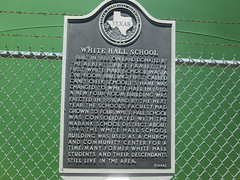
Texas Historical Marker #08561
White Hall School. Built in 1888 on land donated by the Albert T. Rice family, the first White Hall School was a one-room building. First called Caney Creek School, its name was changed to White Hall in 1910. A new four-room building was erected in 1928, and by the next year the school's faculty had grown to four. White Hall School was consolidated with the Mabank School District about 1949. The White Hall School building was used as a church and community center for a time. Many former White Hall students and their descendants still live in the area. #8561
?, Mabank, TX, United States

Texas Historical Marker #08562
Anderson Baptist Church. Organized November 11, 1844 Baptist General Convention of Texas organized here in 1848. Twenty-three of Texas thirty-four Baptist churches were represented. Present building was constructed with native rock by slave labor and finished in 1855. Burned February 6, 1955, and was restored, using original walls, and redecorated September 18, 1955. First Texas Baptist Woman's Missionary Society organized here in 1858. Sign and plaque given in memory of Carl H. and Effie Smith Bell #8562
300 Fanthorp Ave., Anderson, TX, United States

Texas Historical Marker #08563
Apolonia Cemetery. Known as Pine Grove for the Baptist church that was focus for community in the area, this burial ground was in use in 1860s. Tombstone of Mrs. Harriet Hobdy Kelley is dated 1869, but there may be earlier, unmarked graves. Land donors were (1886) J. L. and Eveline Mansfield. War veterans here: the Confederates Richard Butler, Henderson Green, and W. T. Wasson; also Wasson's son, Brosig T. Wasson, Grimes County's first fatality of World War I. When the church disbanded in 1929, the cemetery was renamed for area's defunct post office. At least one family has 3 generations here. #8563
?, Anderson, TX, United States

Texas Historical Marker #08564
Town of Bedias. Named for North and South Bedias creeks, which in turn were named for the Bidai Indians, an agricultural people reputed to have been the oldest inhabitants of the area. "Bidai" means "brushwood", which may refer to the building material used in their dwellings. The first white settlement in this vicinity was founded 1835 by Thomas P. Plaster, and for a while it was called Plasterville. In 1903, the community of "Old" Bedias surrendered most of its population to "New" Bedias after a branch of the International & Great Northern Railroad was built to the northeast. Townspeople from Pankey and Cotton also moved here. The name "Bedias" was retained, but only after a heated struggle in which determined citizens refused to have the town named for a railroad official. A famous, early resident of the Bedias area was Sarah Dodson, who in 1835 made the first "Lone Star" flag in Texas. She lived here from 1844 to 1848 and is buried in Old Bethel Cemetery, seven miles west. One of the most unique features of this region is the large number of Tektites (also called "Bediasites") found here. These are beautiful, glassy, meteor-like stones which fell to earth 34 million years ago. Amazingly, Indians called them "jewels of the moon." (1968) #8564
3652 Main St., Bedias, TX, United States

Texas Historical Marker #08566
Joseph Brooks Home. A native of England, Joseph Brooks (1831-89) migrated to Texas with his wife Mary Ann (Farrer) (1833-1900) in 1853. After serving in the Civil War, Brooks moved to Navasota, where he survived an 1867 yellow fever epidemic and became a leading area lumberman. In the 1870s he had this home built for his family. Originally Victorian in design, it was modified with classical revival detailing in 1909-11 by the Brooks' daughter Mary Elizabeth Brooks Salyer. Recorded texas Historic Landmark - 1981 #8566
612 E. Washington Ave., Navasota, TX, United States