

MIV Historical Plaques Program #0021
Mia Mia Mechanics' Institute. Established on this site in 1907. Extended and renovated in 1983. The Mechanics' Institute movement began in British urban industrial centres in the early 1800s. A "mechanic" was a person applying skills and technology. During the 19th century, most towns in Victoria established a Mechanics' Institute or Athenaeum with a library and meeting hall. Common objects were the "spread of useful knowledge" and provision for "rational recreation" in the community. This plaque, No. 21 in the MIV series, was erected on this historic building in 2007 to mark the centenary celebrations of this hall.
Mia Mia Hall, Valley Road, Mia Mia, Victoria, Australia
Subjects


MIV Historical Plaques Program #0022
Mortlake Mechanics' Institute. Established on this site 1869. The Mechanics' Institute movement began in British urban industrial centres in the early 1800s. A "mechanic" was a person applying skills and technology. During the 19th century, most towns in Victoria established a Mechanics' Institute or Athenaeum with a library and meeting hall. Common objects were the "spread of useful knowledge" and provision for "rational recreation" in the community. This plaque, No. 22 in the MIV series, was erected in 2008 to honour the memory of the people of Mortlake and district who have built and maintained our hall for the benefit of our community.
Mortlake Mechanics Institute, Mortlake, Victoria, Australia
Subjects
MIV Historical Plaques Program #0023
Kinglake West Mechanics' Institute. [Missing] [full inscription unknown]
1055 Whittlesea-Kinglake Road, Kinglake West, VI, Australia
MIV Historical Plaques Program #0024
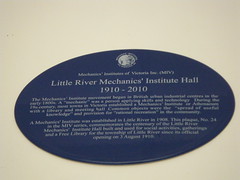
Little River Mechanics' Institute Hall. 1910-2010. The Mechanics' Institute movement began in British urban industrial centres in the early 1800s. A "mechanic" was a person applying skills and technology. During the 19th century, most towns in Victoria established a Mechanics' Institute or Athenaeum with a library and meeting hall. Common objects were the "spread of useful knowledge" and provision for "rational recreation" in the community. A Mechanics’ Institute was established in Little River in 1908. This plaque, No. 24 in the MIV series, commemorates the centenary of the Little River Mechanics’ Institute Hall built and used for social activities, gatherings and a Free Library for the township of Little River since its official opening on 3 August 1910.
8 Rothwell Road, Little River, Victoria, Australia
Subjects

MIV Historical Plaques Program #0025
EV’s Youth Centre. Croydon Mechanics' Institute. 1909-2009. The Mechanics' Institute movement began in British urban industrial centres in the early 1800s. A "mechanic" was a person applying skills and technology. During the 19th century, most towns in Victoria established a Mechanics' Institute or Athenaeum with a library and meeting hall. Common objects were the "spread of useful knowledge" and provision for "rational recreation" in the community. A Mechanics’ Institute was established in Croydon in 1908. This Plaque, No. 25 in the MIV series, commemorates the centenary of the Croydon Mechanics’ Institute Hall, built and used for social activities and has been utilised over the years as a Library, Cinema, Town Hall, and is currently used as Maroondah City Council’s Youth Centre.
212 Mount Dandenong Road, Croydon, VI, Australia
Subjects

MIV Historical Plaques Program #0026
Elmore Athenaeum Hall. Established on this site 1869-1924. The Mechanics' Institute movement began in British urban industrial centres in the early 1800s. A "mechanic" was a person applying skills and technology. During the 19th century, most towns in Victoria established a Mechanics' Institute or Athenaeum with a library and meeting hall. Common objects were the "spread of useful knowledge" and provision for "rational recreation" in the community. The Elmore Athenaeum Hall complex comprises the original 1869 building, the 1885 Athenaeum, the 1912 Supper Room and the 1924 Memorial Hall. It was the centre of the social activities and community gatherings by Elmore Residents. After falling into disuse, it faced demolition in 1992. But the community rallied and through individual effort, council assistance and government grants, the building has been restored and is once again a significant social and cultural centre for the Elmore community. This plaque, No. 26 in the MIV series, is dedicated to the local citizens who worked so diligently to achieve this result.
62 Michie Street, Elmore, VI, Australia
Subjects

MIV Historical Plaques Program #0027
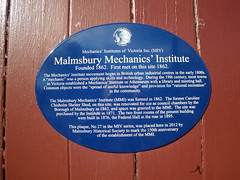
Malmsbury Mechanics' Institute. Founded 1862. First met on this site 1862. The Mechanics' Institute movement began in British urban industrial centres in the early 1800s. A "mechanic" was a person applying skills and technology. During the 19th century, most towns in Victoria established a Mechanics' Institute or Athenaeum with a library and meeting hall. Common objects were the "spread of useful knowledge" and provision for "rational recreation" in the community.The Malmsbury Mechanics’ Institute (MMI) was formed in 1862. The former Caroline Chisholm Shelter Shed, on this site, was renovated for use as council chambers by the Borough of Malmsbury in 1862, and space was granted to the MMI. The site was purchased by the Institute in 1871. The two front rooms of the present building were built in 1876, the Fedral Hall at the rear in 1895. This plaque, No. 27 in the MIV series, was placed here in 2012 by Malmsbury Historical Society to mark the 150th anniversary of the establishment of MMI.
Mollison Street, Malmsbury, Victoria, Australia
Subjects

MIV Historical Plaques Program #0028
Laen Mechanics' Institute. On this site 1886-1955. The Mechanics' Institute movement began in British urban industrial centres in the early 1800s. A "mechanic" was a person applying skills and technology. During the 19th century, most towns in Victoria established a Mechanics' Institute or Athenaeum with a library and meeting hall. Common objects were the "spread of useful knowledge" and provision for "rational recreation" in the community. The Laen Mechanics' Institute was built in 1186. It was a large (50ft x 20ft) galvanised iron hall, later lined with timber. The opening was celebrated with a concert and ball attended by 250 people. It was the lifeblood of a thriving rural community. There were dances, balls, school concerts, luncheons on picnic days, church services, and a library. It continued as a centre for community activities until the late 1940's. One of the last recorded events was a concert in 1951. In 1955 the building was sold and removed from the site. This plaque, No. 28 in the MIV series, is dedicated to Jack and Ron Della Vedova in recognition of their lifetime of service to the local community.
Donald-Laen Road, Laen, Victoria, Australia
Subjects
MIV Historical Plaques Program #0029
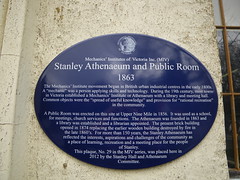
Stanley Athenaeum and Public Room. 1863. The Mechanics' Institute movement began in British urban industrial centres in the early 1800s. A "mechanic" was a person applying skills and technology. During the 19th century, most towns in Victoria established a Mechanics' Institute or Athenaeum with a library and meeting hall. Common objects were the "spread of useful knowledge" and provision for "rational recreation" in the community. The Public Room was erected on this site in Upper Nine Mile in 1856. It was used as a school, for meetings, church services and functions. The Athenaeum was founded in 1863 and a library was established and a librarian appointed. The present brick building opened in 1874 replacing the earlier wooden building destroyed by fire in the late 1860’s. For more than 150 years, the Stanley Athenaeum has reflected the interests, aspirations and challenges of the community as a place of learning, recreation and a meeting place for the people of Stanley. This plaque, No. 29 in the MIV series, was placed here in 2012 by the Stanley Hall and Athenaeum Committee.
Main Street, Stanley, Victoria, Australia
Subjects
MIV Historical Plaques Program #0030
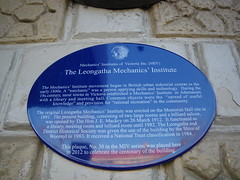
Leongatha Mechanics' Institute. The Mechanics' Institute movement began in British urban industrial centres in the early 1800s. A "mechanic" was a person applying skills and technology. During the 19th century, most towns in Victoria established a Mechanics' Institute or Athenaeum with a library and meeting hall. Common objects were the "spread of useful knowledge" and provision for "rational recreation" in the community. The original Leongatha Mechanics’ Institute was erected on the Memorial Hall site in 1891. The present building, consisting of two large rooms and a billiard saloon, was opened by The Hon. J. E. Mackey on 26 March 1912. It functioned as a library, meeting room and billiard room until 1982. The Leongatha and District Historical Society was given the use fo the building by the Shire of Woorayl in 1983. It received a National Trust classification in 1984. This plaque, No. 30 in the MIV series, was placed here in 2012 to celebrate the centenary of the building.
McCartin Street, Leongatha, Victoria, Australia
Subjects

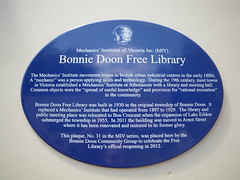
MIV Historical Plaques Program #0031
Bonnie Doon Free Library. The Mechanics' Institute movement began in British urban industrial centres in the early 1800s. A "mechanic" was a person applying skills and technology. During the 19th century, most towns in Victoria established a Mechanics' Institute or Athenaeum with a library and meeting hall. Common objects were the "spread of useful knowledge" and provision for "rational recreation" in the community. Bonnie Doon Free Library was built in 1930 in the original township of Bonnie Doon. It replaced a Mechanics’ Institute that had operated from 1897 to 1929. The library and public meeting place was relocated to Bon Crescent when the expansion of Lake Eildon Submerged the township in 1955. In 2011 the building was moved to Arnot Street where it has been renovated and restored to its former glory. This plaque, No. 31 in the MIV series, was placed here by the Bonnie Doon Community Group to celebrate the Free Library’s official reopening in 2012.
Arnot Street, Bonnie Doon, VI, Australia
Subjects
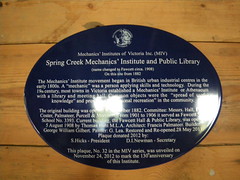
MIV Historical Plaques Program #0032
Spring Creek Mechanics' Institute and Public Library (name changed to Fawcett circa. 1908). On this site from 1882. The Mechanics' Institute movement began in British urban industrial centres in the early 1800s. A "mechanic" was a person applying skills and technology. During the 19th century, most towns in Victoria established a Mechanics' Institute or Athenaeum with a library and meeting hall. Common objects were the "spread of useful knowledge" and provision for "rational recreation" in the community. The original building was opened 8 September 1882. Committee: Messrs. Hall, Long, Coster, Palmateer, Purcell & Morrison. From 1901 to 1906 it served as Fawcett State School No. 3393. Current building, the Fawcett Hall & Public Library, was opened 5 August 1908 by Thomas Hunt M.L.A. Architect: Francis Palmateer. Builder: George William Gilbert. Painter: G. Lea. Restores and Re-opened 28 May 2011. Plaque donated 2012 by: S. Hicks - President; D. I. Newman - Secretary. This plaque, No. 32 in the MIV series, was unveiled on November 24, 2012 to mark the 130th anniversary of this Institute.
655 Spring Creek Road, Fawcett, VI, Australia
Subjects
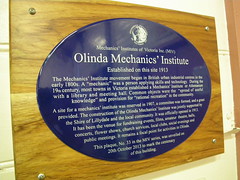
MIV Historical Plaques Program #0033
Olinda Mechanics' Institute. Established on this site 1913. The Mechanics' Institute movement began in British urban industrial centres in the early 1800s. A "mechanic" was a person applying skills and technology. During the 19th century, most towns in Victoria established a Mechanics' Institute or Athenaeum with a library and meeting hall. Common objects were the "spread of useful knowledge" and provision for "rational recreation" in the community. A site for a Mechanics' Institute was reserved in 1907, a committee was formed, and a grant provided. The construction of the Olinda Mechanics' Institute was jointly supported by the Shire of Lillydale and the local community. It was officially opened in 1913. It has been the venue for fundraising events, films, amateur theatre, balls, concerts, flower shows, church services, local clubs, social evenings and public meetings. It remains a focal point for activities in Olinda. This plaque, No. 33 in the MIV series, was unveiled on the 10th October 2013 to mark the centenary of this building.
Cnr The Georgian & Olinda-Monbulk Rds, Olinda, VI, Australia
Subjects
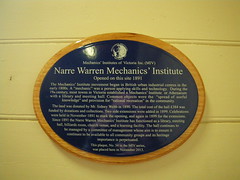
MIV Historical Plaques Program #0034
Narre Warren Mechanics' Institute. Opened on this site 1891. The Mechanics' Institute movement began in British urban industrial centres in the early 1800s. A "mechanic" was a person applying skills and technology. During the 19th century, most towns in Victoria established a Mechanics' Institute or Athenaeum with a library and meeting hall. Common objects were the "spread of useful knowledge" and provision for "rational recreation" in the community. The land was donated by Mr. Sidney Webb in 1890. The total cost of the hall £384 was funded by donations and collections. Two side extensions were added in 1899. Celebrations were held in November 1891 to mark the opening, and again in 1899 for the extensions. Since 1891 the Narre Warren Mechanics' Institute has functioned as a library, meeting hall, billiards room, church venue, and a learning facility. The hall continues to be managed by a committee of management whose aim is to ensure it continues to be available to all community groups and its heritage importance is perpetuated. This plaque, No. 34 in the MIV series, was placed here in November 2013.
59 Webb Street, Narre Warren, Victoria, Australia
Subjects
MIV Historical Plaques Program #0035
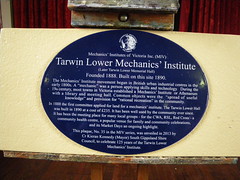
Tarwin Lower Mechanics' Institute (Later Tarwin Lower Memorial Hall). Founded 1888. Built on this site 1890. The Mechanics' Institute movement began in British urban industrial centres in the early 1800s. A "mechanic" was a person applying skills and technology. During the 19th century, most towns in Victoria established a Mechanics' Institute or Athenaeum with a library and meeting hall. Common objects were the "spread of useful knowledge" and provision for "rational recreation" in the community. In 1888 the first committee applied for land for a mechanics' Institute. The Tarwin Lower Hall was built in 1890 at a cost of £235. It has been well used by the community ever since. It has been the meeting place for many local groups - for the CWA, RSL, Red Cross - a community health centre, a popular venue for family and community celebrations, and its Market Days an ongoing highlight. This plaque, No. 35 in the MIV series, was unveiled in 2013 by Cr Kieran Kennedy (Mayor) South Gippsland Shire Council, to celebrate 125 years of the Tarwin Lower Mechanics' Institute.
Riverside Drive, Tarwin Lower, Victoria, Australia
Subjects


MIV Historical Plaques Program #0036
Footscray Mechanics’ Institute. Founded 1857. This building constructed 1913. The Mechanics' Institute movement began in British urban industrial centres in the early 1800s. A "mechanic" was a person applying skills and technology. During the 19th century, most towns in Victoria established a Mechanics' Institute or Athenaeum with a library and meeting hall. Common objects were the "spread of useful knowledge" and provision for "rational recreation" in the community. The Footscray Mechanics’ Institute first began in Pilgrim Street in 1857. It then moved to Austin Street, and later in 1870 to the corner of Napier and Nicholson Streets, where the old post office stands. The present building was constructed on this site in 1913, to replace the old wooden building. We are proud to celebrate our 100th year at this site. The Footscray Mechanics’ Institute is truly a part of the living history of the Western Suburbs of Melbourne.
209 Nicholson Street, Footscray, VI, Australia
Subjects
MIV Historical Plaques Program #0037
Kallista Mechanics’ Institute. Opened 20th December 1913. The Mechanics' Institute movement began in British urban industrial centres in the early 1800s. A "mechanic" was a person applying skills and technology. During the 19th century, most towns in Victoria established a Mechanics' Institute or Athenaeum with a library and meeting hall. Common objects were the "spread of useful knowledge" and provision for "rational recreation" in the community. This plaque, No. 37 in the MIV series, was unveiled on 21st December 2013 to commemorate the centenary of the building of the South Sassafras Mechanics’ Institute and Free Library (name changed to Kallista in 1925). It is dedicated to the pioneers who built this hall and to record its educational, social and cultural importance to the community.
6 Tom Roberts Road, Kallista, VI, Australia
Subjects
MIV Historical Plaques Program #0038
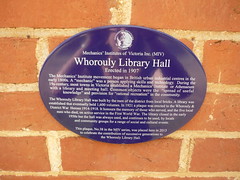
Whorouly Library Hall. Erected in 1907. The Mechanics' Institute movement began in British urban industrial centres in the early 1800s. A "mechanic" was a person applying skills and technology. During the 19th century, most towns in Victoria established a Mechanics' Institute or Athenaeum with a library and meeting hall. Common objects were the "spread of useful knowledge" and provision for "rational recreation" in the community. The Whorouly Library Hall was built by the men of the district from local bricks. A library was established that eventually held 1,600 volumes. In 1921 a plaque was erected to the Whorouly & District War Heroes 1914-1918. It honours the memory of those who served, the five local men who died on active service in the First World War. The library closed in the early 1950s but the hall was always used, and continues to be used, by locals and community groups for a range of social and cultural events.
12 Church Street, Whorouly, VI, Australia
Subjects

MIV Historical Plaques Program #0039
Alexandra Mechanics' Institute. A library service for Alexandra since 1877. The Mechanics' Institute movement began in British urban industrial centres in the early 1800s. A "mechanic" was a person applying skills and technology. During the 19th century, most towns in Victoria established a Mechanics' Institute or Athenaeum with a library and meeting hall. Common objects were the "spread of useful knowledge" and provision for "rational recreation" in the community. In 1877 residents of Alexandra formed a library committee and established a Mechanics' Institute and Free Library in the Protestant Hall. Despite those "who looked upon the venture as altogether too advanced for an outside township" the Alexandra Library and Mechanics Hall was built by Thomas Carrison at a cost of £467 and opened on 6 June 1883. This building was duplicated in 1891 for a Billiard Room, and in 1962 the library expanded into both buildings. in 2005 a new extension was opened. This plaque, No. 39 in the MIV series, was placed here in 2013 to mark the 130th anniversary of the building.
Grant Street, Alexandra, VI, Australia
Subjects


MIV Historical Plaques Program #0040
Lardner Mechanics' Institute [full inscription unknown]
255 Burnt Store Road, Lardner, VI, Australia