
The RSC is the largest organisation in Europe for advancing the chemical sciences. Supported by a worldwide network of members and an international publishing business, our activities span education, conferences, science policy and the promotion of chemistry to the public.
38 out of 40 (95%) plaques have been curated
48 subjects all or unphotographedGender Diversity

Sir Edward Frankland PhD FRS Professor of Chemistry 1851-1857 Organometallic compounds. Bonding and Valency. Water Analysis. First President of the Institute of Chemistry. Sir Henry Enfield Roscoe BA PhD FRS Professor of Chemistry 1857-1886. Vanadium. Photochemistry. Spectroscopy. First President of the Society of Chemical Industry. Active in the transfer of Owens College from this building to Oxford Road in 1873 and in the foundation of the Victoria University in 1880.
Manchester, Manchester, United Kingdom
Subjects


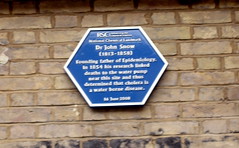
Dr John Snow (1813-1858) Founding father of Epidemiology. In 1854 his research linked deaths to the water pump near this site and thus determined that cholera is a water borne disease
Broadwick Street, London, United Kingdom
Subjects

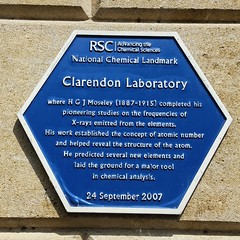
National Chemical Landmark: Clarendon Laboratory where H. G. J. Moseley (1887-1915) completed his pioneering studies on the frequencies of X-rays emitted from the elements. His work established the concept of atomic number and helped reveal the structure of the atom. He predicted several new elements and laid the ground for a major tool in chemical analysis.
Sherrington Road, Oxford, United Kingdom
Subjects


Chemistry Department University College London During the period 1930-1970 Professor Sir Christopher Ingold pioneered our understanding of the electronic basis of structure, mechanism and reactivity in organic chemistry, which is fundamental to modern-day chemistry.
Christopher Ingold Building, Gordon Street, WC1, London, United Kingdom
Subjects
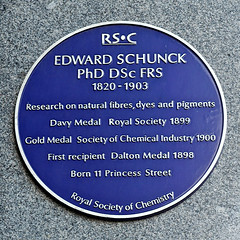
Edward Schunck PhD DSc FRS 1820-1903 Research on natural fibres, dyes and pigments Davy Medal Royal Society 1899 Gold Medal Society of Chemical Industry 1900 First recipient Dalton Medal 1898 Born 11 Princess Street
11 Princess Street, Manchester, United Kingdom
Subjects
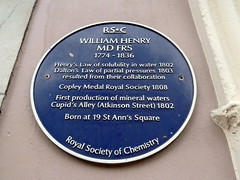
William Henry MD FRS 1774-1836 Henry's Law of solubility in water 1802 Dalton's Law of partial pressures 1803 resulted from their collaboration Copley Medal Royal Society 1808 First production of mineral waters Cupid's Alley (Atkinson Street) 1802 Born at 19 St Ann's Square
Mansfield Chambers, Manchester, United Kingdom
Subjects


Frederick Crace Calvert PhD FRS 1819-1873 1846 Professor of Chemistry at the Manchester Royal Institution (City Art Gallery) 1850 F C Calvert and Co near this site 1857 First commercial production of phenol, carbolic acid, used as a disinfectant in soaps and powders and for making dyes
Princess Street, Manchester, United Kingdom
Subjects
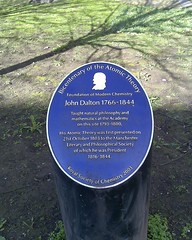
John Dalton 1766-1844 taught natural philosophy and mathematics at the Academy on this site 1793-1800. His Atomic Theory was first presented on 21st October 1803 to the Manchester Literary and Philosophical Society of which he was President 1816-1844
Peace Garden, Mosley St, Manchester, United Kingdom
Subjects

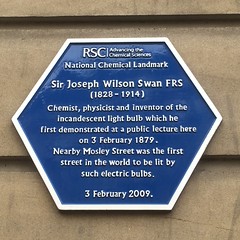
Sir Joseph Wilson Swan FRS (1828-1914) Chemist, physicist and inventor of the incandescent light bulb which he first demonstrated at a public lecture here on 3 February 1879. Nearby Mosley Street was the first street in the world to be lit by such electric bulbs.
The Lit & Phil, 23 Westgate Road, Newcastle upon Tyne, United Kingdom
Subjects

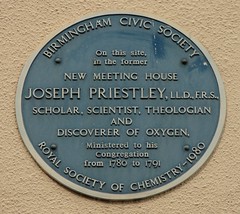
On this site in the former New Meeting House Joseph Priestley LLD FRS scholar, scientist, theologian and discoverer of oxygen ministered to his congregation from 1870 to 1791
St Michael's Catholic Church, New Meeting Street (off Moor Street Queensway), Birmingham, United Kingdom
Subjects

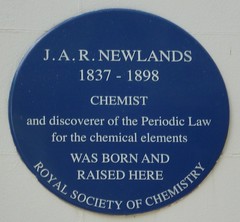
J. A. R. Newlands 1837-1898 chemist and discoverer of the Periodic Law for the chemical elements was born and raised here
19 West Square, Kennington, SE11, London, United Kingdom
Subjects


National Historic Chemical Landmark. Dyson Perrins Laboratory, University of Oxford. This laboratory was a major centre for Organic Chemistry from 1916-2003. It had only four Heads in that time, the Waynflete Professors W. H. Perkin Jnr, Sir Robert Robinson OM, Sir Ewart Jones, and Sir Jack Baldwin. Sir Robert was awarded the Nobel Prize in 1947 for work done here on natural products.
South Parks Road, Oxford, United Kingdom
Subjects


Sir William H. Perkin (1838-1907) discovered mauveine, the world’s first synthetic dyestuff, in 1856. He and his brother Thomas produced mauveine from a factory on this site in 1857, and later alizarin, thus laying the foundations of the organic chemicals industry. This replaces a centenary plaque unveiled by Sir R Robinson in 1957.
Howdens Joinery, Oldfield Lane North, Greenford, London, United Kingdom
Subjects

Sir Edward Frankland FRS 1825-1899, chemist & Sir John Ambrose Fleming FRS 1849-1945, physicist worshipped here in their youth.
High Street / Middle St, Lancaster, United Kingdom
Subjects

Sir Derek Barton FRS (1918-1998) 1938-1942 student, 1957-1978 professor, Imperial College. 1969 Nobel Laureate for new concept of organic conformational analysis
Chemistry Building, Imperial College Road, London, United Kingdom
Subjects
Sir Geoffrey Wilkinson FRS (1921-1996) 1939-1943 student, 1956-1996 professor, Imperial College. 1973 Nobel Laureate for pioneering studies on organometallic compounds
Chemistry Building, Imperial College Road, SW7, London, United Kingdom
Subjects

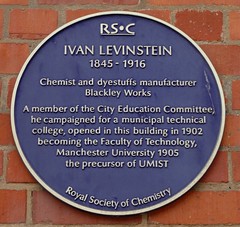
Ivan Levinstein, 1845-1916. Chemist and dyestuffs manufacturer Blackley Works. A member of the City Education Committee, he campaigned for a municipal technical college, opened in this building in 1902 becoming the Faculty of Technology, Manchester University 1905 the precursor of UMIST.
Sackville Street Building, Granby Row Entrance, Manchester, United Kingdom
Subjects

Glucose Sensor. In this laboratory on 20th July 1982, Allen Hill, Tony Cass and Graham Davis made the crucial discovery which led to the development of a unique electronic blood glucose sensor now used by millions of diabetics worldwide.
Chemistry Dept, Oxford University, Oxford, United Kingdom
Subjects

Inorganic Chemistry Laboratory where in 1980, John B. Goodenough with Koichi Mizushima, Philip C. Jones and Philip J. Wiseman identified the cathode material that enabled the development of the rechargeable lithium-ion battery. This breakthrough ushered in the age of the portable electronic devices.
South Parks Road, Oxford, United Kingdom
Subjects
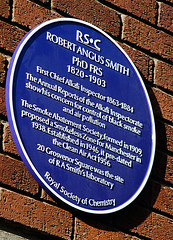
RSoC Robert Angus Smith PhD FRS 1820- 1903 First Chief Alkali Inspector 1863-1884 The Annual Reports of the Alkali Inspectorate show his concern for the control of black smoke and air pollution The Smoke Abatement Society, formed in 1909, proposed a Smokeless Zone for Manchester in 1938. Established in 1946, it pre-dated the Clean Air Act 1956 20 Gosvenor Square was the site of RA Smith's laboratory Royal Society of Chemistry
Oxford Rd, Manchester, United Kingdom
Subjects

Thomas Graham House. This plaque, at the home of the Royal Society of Chemistry's publishing operations, commemorates the 170th anniversary of the society's scientific publishing, which has made a profound contribution to the advancement of the chemical sciences.
Thomas Graham House, Science Park, Milton Road, Cambridge, United Kingdom
Subjects
Thomas Graham (1805-1869) Born in Glasgow and Professor of Chemistry at Anderson’s University (now University of Strathclyde) from 1830-1837. His famous contributions to Science were Graham’s Law of Diffusion and his pioneering work on dialysis. He founded the Chemical Society of London in 1841, and became Master of the Mint. He is commemorated by this building and by a statue in George Square.
295 Cathedral Street, Glasgow, United Kingdom
Subjects

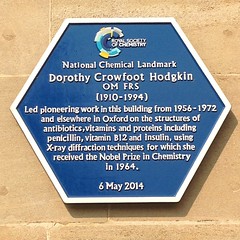
Dorothy Crowfoot Hodgkin OM FRS (1910-1994) led pioneering work in this building from 1956-1972 and elsewhere in Oxford on the structures of antibiotics, vitamins and proteins including penicillin, vitamin B12 and insulin, using X-ray diffraction techniques for which she received the Nobel Prize in Chemistry in 1964.
University of Oxford Inorganic Chemistry Laboratory, Oxford, United Kingdom
Subjects
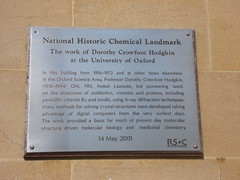
The work of Dorothy Crowfoot Hodgkin at the University of Oxford. In this building from 1956-1972 and at other times elsewhere in the Oxford Science Area, Professor Dorothy Crowfoot Hodgkin (1910-1994) OM FRS Nobel Laueate led pioneering work on the structure of antibiotics, vitamins and proteins, including pencillin, vitamin B12 and insulin, using X-ray diffraction techniques. Many methods for solving crystal structure were developed taking advantage of digital computers from the earliest days. The work provided a basis for much of present day molecular structure driven molecular biology and medicinal chemistry
Dyson Perrins Laboratory, University of Oxford, Oxford, United Kingdom
Subjects

In recognition of the outstanding scientific contribution made by Charles Suckling and others, close to this site in 1951, in the synthesis and subsequent commercial development of halothane, the world's first synthetic inhalation anaesthetic.
Catalyst Science Discovery Centre Mersey Road, Widnes, United Kingdom
Subjects
Sir Edward Frankland KCB, FRS 1825-1899 Professor of Chemistry. Attended this school 1837-1839, discovered many new chemical compounds, made important contributions to chemical theory and improved the quality of domestic water supplies, President of the Chemical Society and the Institute of Chemistry.
Lancaster Royal Grammar School, Lancaster, United Kingdom
Subjects

Sir William Henry Perkin established on this site in 1857 the first synthetic dye factory in the world. Respice prospice. 1838-1907.
Howdens Joinery, Oldfirled Lane North, Greenford, London, United Kingdom
Subjects
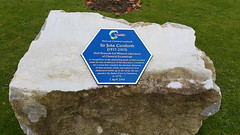
Sir John Cornforth (1917-2013) Shell Research Ltd Millstead Laboratory of Chemical Enzymology. In recognition of the pioneering work carried out here when he was co-director of the laboratory. Cornforth led a team that revealed the detailed chemistry of how enzymes work, and explained how cholesterol builds up in the body. He was awarded the Nobel Prize for Chemistry in 1975.
Shell UK’s Milstead Laboratory of Chemical Enzymology, Sittingbourne, United Kingdom
Subjects
Harwell Laboratory In recognition of the pioneering research and development work performed by scientists at Harwell since 1946. Their work has provided fundamental support in the development of nuclear power in the UK and a greater understanding of the chemistry of the actinide elements.
, Chilton, United Kingdom
Subjects
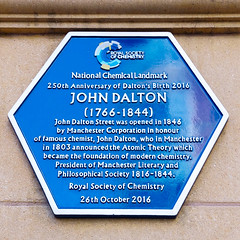
John Dalton (1766-1844). John Dalton Street was opened in 1846 by Manchester Corporation in honour of famous chemist, John Dalton, who in Manchester in 1803 announced the Atomic Theory which became the foundation of modern chemistry. President of Manchester Literary and Philosophical Society 1816-1844
28-30 John Dalton Street, Manchester, United Kingdom
Subjects

Ibuprofen In recognition of the pioneering research work, here on Pennyfoot Street, by Dr Stewart Adams and Dr John Nicholson in the Research Department of Boots which led to. the discovery of ibuprofen used by millions worldwide for the relief of pain.
Pennyfoot Street, Nottingham, United Kingdom
Subjects
-ibuprofen-3D-balls.png?width=250)

Chemical structures of simple sugars. Near this site in 1903, James Colquhoun Irvine, Thomas Purdie and their team found a way to understand the chemical structure of simple sugars like glucose and lactose. Over the next 18 years this allowed them to lay the foundations of modern carbohydrate chemistry, with implications for medicine, nutrition and biochemistry.
25 North Street, St Andrews, United Kingdom
Subjects

Institute of Cancer Research. ICR scientists on this site and elsewhere pioneered numerous new cancer drugs from the 1950s until the present day - including the discovery of chemotherapy drug carboplatin, prostate drug abiraterone and the genetic targeting of olaparib for ovarian and breast cancer
The Institute of Cancer Research, 123 Old Brompton Road, SW7 3RP, London, United Kingdom
Subjects


School of Chemistry, Bangor University, Professor Edward (Ted) D Hughes, who conducted ground breaking work on kinetics and mechanisms in organic chemistry 1943-48 played a prominent role in the 125 year (1884-2009) history of Chemistry at Bangor. 23rd October 2009
English translation:
, Bangor, Gwynedd, United Kingdom
Subjects
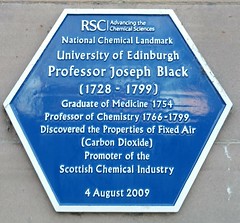
Professor Joseph Black (1728 - 1799). Graduate of Medicine 1754. Professor of Chemistry 1766 - 1799. Discovered the Properties of Fixed Air (Carbon Dioxide). Promoter of the Scottish Chemical Industry.
Joseph Black Building, David Brewster Road, Edinburgh, United Kingdom
Subjects


Sir Humphry Davy Bt MRI PRS (1778-1829) Apprentice apothecary to John Bingham Borlase in this building, 1795-1798. Progressed to the Medical Pneumatic Institution, Bristol, 1798 and to the Royal Institution, London, 1801. Davy established the nature of acids, identified 9 elements and invented the miner's safety lamp. National Chemical Landmark 17 September 2015
New Street, Penzance, United Kingdom
Professor Sir Harold Kroto FRS NL 1939-2016 In 1985, experiments initiated here at the University of Sussex led Kroto to discover a new form of carbon, which he named Buckminsterfullerene (C60 or Buckyball), sparking many applications in material science, electronics and nanotechnology. Kroto, with US collaborators, shared the Nobel Prize for discovery of these 'Fullerenes' in 1996. Kroto also passionately promoted science engagement, founding the VEGA Science Trust and GEOSET.
Sussex University, Brighton, United Kingdom
Subjects


AP de Silva Founded Fluorescent PET Sensing and Molecular Logic in the 1980’s alongside associates at the University of Colombo Sri Lanks, and at Queen’s University Belfast. This enabled the development of the PET sensors in a line of innovative portable blood analysers by HR He, MJP Leiner, JK Tusa and colleagues in the 1990’s. The analysers have helped save thousands of human and animal lives around the world
David Keir Building 39 Stanmillis Road, Belfast, United Kingdom
AstraZeneca Macclesfield Campus. Since 1966, teams of scientists based on this site have developed and manufactured over thirty human, consumer health and veterinary medicinal products, helping millions of patients worldwide
AstraZeneca Macclesfield Campus, Macclesfield, United Kingdom
Subjects

Thomas Henry FRS 1734 - 1816 Apothecary and chemist President 1807-1816 Manchester Literary and Philosophical Society Thomas and William Henry 1797 Chemical manufacturers 11 East Street Continued to 1932 Demolished 1970 Introduced Dalton to the new chemistry of Antoine Lavoisier
40 King Street, Manchester, United Kingdom