
Places, subjects, or plaques matching "Horatio Nelson"
2 subject matching "Horatio Nelson"

33 plaque matching "Horatio Nelson"
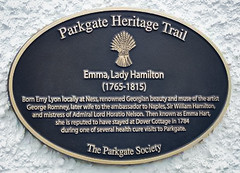
Emma, Lady Hamilton (1765-1815) Born Emy Lyon locally at Ness, renowned Georgian beauty and muse of the artist George Romney, later wife to the ambassador to Naples, Sir William Hamilton, and mistress of Admiral Lord Horatio Nelson. Then known as Emma Hart, she is reputed to have stayed at Dover Castle in 1784 during one of several health cure visits to Parkgate.
16 Station Road, Parkgate, United Kingdom
Subjects


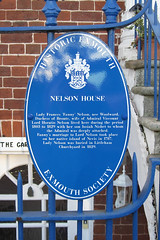
Nelson House. Lady Frances 'Fanny' Nelson, nee Woolward, Duchess of Bronte, wife of Admiral Viscount Lord Horatio Nelson lived here during the period 1803 to 1829 with her son Josiah Nisbet to whom the Admiral was deeply attached. Fanny's marriage to Lord Nelson took place on her native island of Nevis in 1787. Lady Nelson was buried in Littleham Churchyard in 1829.
Nelson House, The Beacon, Exmouth, United Kingdom
Subjects


Lady Emma Hamilton and Lord Horatio Nelson stayed here in 1801
The Royal Hotel, Beach Street, Deal, United Kingdom
Subjects
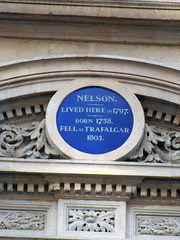
Horatio Nelson lived here in 1797. Born 1758, fell at Trafalgar 1805.
147 New Bond Street, London, United Kingdom
Subjects
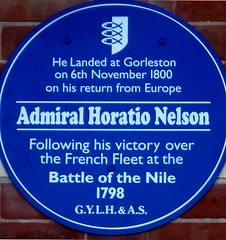
He landed at Gorleston on 6th November 1800 on his return from Europe Admiral Horatio Nelson following his victory over the French Fleet at the Battle of the Nile 1798 G.Y.L.H & A.S.
Harbour's Mouth, Gorleston-on-Sea , Great Yarmouth, United Kingdom
Subjects

In this house, then "The Three Cranes" Horatio Nelson and party stayed 17-18th August, 1802
Beaufort Square, Chepstow, United Kingdom
Subjects

Vice Admiral Lord Horatio Nelson On 21 May 1776 Horatio Nelson, then a midshipman being invalided back to England from the East Indies, arrived in Simon's Bay aboard the H.M.S. Dolphin. The ship remained here for a month and it is probable that Nelson did come ashore during this period.
St George's Street, Simon's Town, South Africa
Subjects

John Downman 1750-1824 portrait artist William Locker 1731-1800 mentor to Horatio Nelson lived here
72 Swan Street, West Malling, United Kingdom
Subjects
.jpg?width=250)

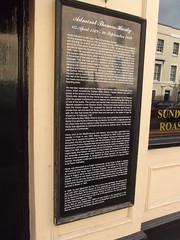
Admiral Thomas Hardy 05 April 1769 - 20 September 1839 Hardy was born on 5th April 1769 in Portisham, Dorset. He first entered the navy in 1781 on board the brig, HMS Helena. He remained with the ship for a short period after which, in 1782, he left the navy to attend school for three years. He joined the merchant navy for some years and in 1790, decided to rejoin the Royal Navy. His first appointment as midshipman was with HMS Hebe. He was later transferred to the sloop, HMS Tisphone, and followed the Captain, Anthony Hunt, when he was transferred to HMS Amphitrite in 1793. In November of that year, he was promoted to Lieutenant and appointed to HMS Meleager. This ship was part of a squadron off the coast of Genoa under the command of Captain Horatio Nelson. In August 1796, Hardy transferred to HMS Minerve with Captain Cockburn. At the end of the year, Nelson transferred to the Sabina, Hardy, along with Lieutenant Culverhouse, was in charge of a boarding party sent to claim her as a prize after her capture. They managed to draw off the rest of the Spanish squadron, but the ship was later re-captured after one of her masts was destroyed and Hardy was taken prisoner along with the rest of the boarding party. He was later repatriated with the Minerve at Gibraltar after an exchange of prisoners, which included the Captain of the Sabina. Captain Nelson was warm in praise of the actions of his lieutenants in this action. Shortly after rejoining his ship, Hardy was nearly captured again by the Spanish when he jumped overboard to save a seaman who was drowning after falling out of one of the boats. The current had carried them towards the lead ship of the Spanish squadron in the Gibraltar Straits. Nelson took instant action by ordering shorten their sail and stand off. Hardy and the seaman were rescued. A few days later, the ship had joined the British fleet and took part in the battle of Cape St Vincent on 14 February 1797. In the following Maym HMSs Minerve and Lively were patrolling around the bay of Santa Cruz and found a French brig, the Mutine. On the 29th, longboats from the two ships were sent to capture it under Hardy's command. It was successful and Hardy was appointed to command of the prize by Admiral Jervis. He also was promoted to Commander. Hardy went to the Mediterranean with Nelson, who had been appointed Commander in Chief. In July 1803, Nelson transferred to HMS Victory and Hardy joined him to resume his position as Flag Captain.During the following months and years, the ship was kept busy with the blockade of Toulon and continuing pursuit of the Franco-Spanish fleet across the Atlantic. Hardy, along with Captain Blackwood, witnessed Nelson's last will and during the battle of Trafalgar on October 21st 1805, was walking along side his Commander in chief when a French spiner fatally shot Nelson. As Nelson's Chief of Staff, he remained on duty during the remainder of the battle while keeping his dying friend and Commabder informed of the proceedings. In recognition for these services, he was created a baronet. He played a major part in the state funeral of Nelson on 9 January 1806 at St Paul's Cathedral. Hardy was decorated as a Knight Commander of the Order of Bath in January 1815 and returned to Britain in June of that year. On his return, he was appointed to command the Royal Yacht Princess Augusta. He served on her for three years. In August 1819, he was promoted to Commodore and appointed as Commander in Chief for the South American station. He transferred his flag to HMS Superb and his services during the war of independence that was being fought in the former Spanish colonies won him praise from the Admiralty. He eventually returned to Britain in 1824. In 1830, he was appointed as First Sea Lord at the Admiralty. He retained this post until 1834. During this period, he was appointed as Knight Grand Cross of the Order of Bath. At the end of his period as First Sea Lord, he was appointed as Governor of Greenwich Hospital. During his time as Governor, he introduced many changes to improve the lives of the pensioners. He was promoted as Vice Admiral in January 1837. Hardy died on 20th September 1839 and was buried in the mausoleum in the grounds of Greenwich Hospital. His wife and daughters survived him, but as he had no male heirs, his baronetcy became extinct.
The Admiral Hardy, 7 College Approach, Greenwich, London, United Kingdom
Subjects


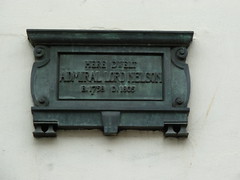
Horatio, Lord Nelson 1758-1805 lived here in 1798
103 New Bond Street, Westminster, W1, London, United Kingdom
Subjects
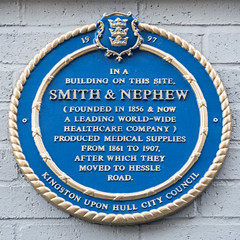
In a building on this site, Smith & Nephew (founded in 1856 & now a leading world-wide healthcare company) produced medical supplies from 1861 to 1907, after which they moved to Hessle Road.
10 North Church Side, Hull, United Kingdom
Subjects
The Cricket Green Opposite this clubhouse is the Cricket or Lower Green, part of the common or grazing land of medieval times which largely escaped enclosure in the 18th and 19th centuries. Cricket has been played there for at least 250 years. Lord Nelson was once a spectator.
Mitcham Cricket Club, Cricket Green CR4 4LA, London, United Kingdom
Subjects
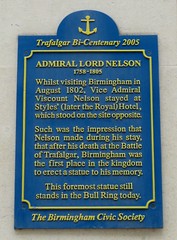
Trafalgar Bi-Centenary 2005 Admiral Lord Nelson 1758-1805 Whilst visiting Birmingham in August 1802, Vice Admiral Viscount Nelson stayed at the Styles' (later the Royal) Hotel, which stood on the site opposite. Such was the impression that Nelson made during his stay, that after his death at the Battle of Trafalgar, Birmingham was the first place in the kingdom to erect a statue in his memory. This foremost statue still stands in the Bull Ring today.
Temple Row, Birmingham, United Kingdom
Subjects
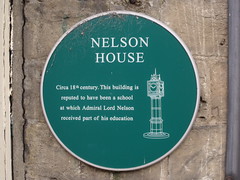
Nelson House Circa 18th century. This building is reputed to have been a school at which Admiral Lord Nelson received part of his education
Reeds Homestore - 17 Bridge Street, Downham Market, United Kingdom
Subjects
Merton Place. Sixty metres (200 feet) to the south east was ‘Merton Place’, the only house ever owned (1801 – 1805) by Admiral Lord Nelson and from which he set out for the Battle of trafalgar. Lady Hamilton also lived here 1801 – 1808.
Merton Place, nr Doel Close, Merton, London, United Kingdom
Subjects
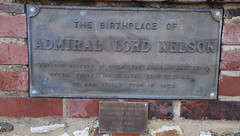
The Birthplace of Admiral Lord Nelson The Old Rectory in which the Admiral was born stood twenty yards back from this wall. It was pulled down in 1803
?, Burnham Thorpe, United Kingdom
Subjects
Lord Nelson visited Ross in 1802 and walked through these gardens.
Merton House Hotel, Edde Street, Ross-on-Wye, United Kingdom
Subjects
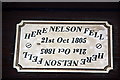

On Saturday 14th. September 1805, Admiral Lord Nelson boarded HMS Victory lying anchor off St. Helens near to this spot. HMS Victory with HMS Euryalus in company, sailed the following morning, Sunday 15th. September, to join the Fleet off Cadiz prior to the Battle of Trafalgar. 21st. October 1805.
?, St. Helens, Isle of Wight , United Kingdom
Subjects

East Rock House. Admiral Lord Nelson, Sir William and Lady Hamilton stayed here in 1802
St Julian Street, Tenby, United Kingdom
Subjects

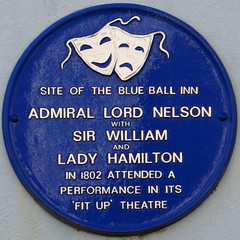
Site of The Blue Ball Inn. Admiral Lord Nelson with Sir William and Lady Hamilton in 1802 attended a performance in its 'Fit Up' theatre.
10 Upper Frog Street, Tenby, United Kingdom
Subjects
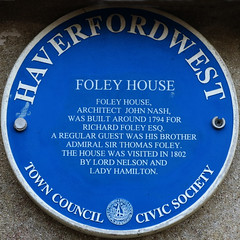
Foley House. Foley House, Architect John Nash, was built around 1794 for Richard Foley Esq. A regular guest was his brother Admiral Sir Thomas Foley. The house was visited in 1802 by Lord Nelson and Lady Hamilton.
Goat Street, Haverfordwest, United Kingdom
Subjects


City Arms. Site of North Gate of Saxon Town. Formerly the Town House of the Duke of Norfolk, this became the City Arms Hotel and Nelson stayed here 23rd August 1802
Barclays Bank - Broad Street, Hereford, United Kingdom
Subjects


Some Facts of Interest in the History of the Old Church The Church was built to replace the former Church of St John at Tyburn 1400 Francis Bacon was married here 1606 William Hogarth portrayed the interior of the Church 1735 James Gibbs Architect, pupil of Wren was buried here 1754 Richard Brinsley Sheridan married Miss Linley here 1773 Charles Wesley brother of John Wesley was buried here 1788 Lord Byron was baptized here 1788 Lord Nelson worshipped here and Horatia his only child was baptized here 1803
Garden of Rest, Marylebone High Street, London, United Kingdom
Subjects


Safodd cafarn coets fawr yma yn yr 18fed ganrif, wedi ei henwi ar ôl Dugiaid Beaufort, perchenogion llawer o'r tir oddi amgylch. Yma, yn 1802, arhosodd yr Arglwydd Nelson a Syr William a'r Fonhesig Hamilton, wedi iddynt deithio i Drefynwy ar hyd yr Afon Gwy.
English translation: The Beaufort Arms was an 18th century coaching inn, named after the Dukes of Beaufort, whose lands these once were. Admiral Lord Nelson stayed here in July 1802, with Sir William and Lady Emma Hamilton, arriving by boat on the River Wye.
The Beaufort Arms Hotel, Agincourt Square, Monmouth, United Kingdom
Subjects


Sydney Green Plaques Bicentennial project #041
Lord Nelson Hotel [full inscription unknown]
19 Kent Street, The Rocks, NSW, Australia
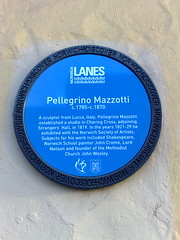
Pellegrino Mazzotti c.1785-c.1870 A sculptor from Lucca, Italy, Pellegrino Mazzotti established a studio in Charing Cross, adjoining Strangers' Hall, in 1819. In the years 1821-29 he exhibited with the Norwich Society of Artists. Subjects for his work included Shakespeare, Norwich School painter John Crome, Lord Nelson and founder of the Methodist Church John Wesley.
Charing Cross, Norwich, United Kingdom
Subjects

The Crown Inn. Admiral Villeneuve. Villeneuve was the French Commander-in-Chief defeated by Admiral Lord Nelson at the Battle of Trafalgar on 21st October 1805. Over 4,000 French Officers and Seamen were taken prisoner and sent to England. Villeneuve and 200 of his Officers were billeted in Bishop's Waltham, on parole. Most were quartered in houses around the town but the Admiral was accommodated here at the Crown Inn. Villeneuve was allowed to attend Nelson's funeral in London and then, in early 1806, he was repatriated to France in exchange for four British Navy Captains. He died at Rennes in April 1806 from multiple stab wounds to the chest. The verdict was suicide but many believed Napoleon had him murdered for his disastrous defeat at Trafalgar.
The Crown Inn, Bishop's Waltham, United Kingdom
Subjects


The Lord Nelson existed by 1824. It was an Inn, blacksmith's and slaughterhouse.
Coulter Lane, Burntwood, United Kingdom
Subjects

The Trafalgar Way #12
The Trafalgar Way. Crockernwell - 6th post-horse change. On Monday 21st October 1805 the Royal Navy decisively defeated a combined French and Spanish fleet off Cape Trafalgar on the south west coast of Spain. This victory permanently removed the threat of invasion of England by the armies of Napoleon Bonaparte. The first official dispatches with the momentous news of the victory,and the death in action of Vice Admiral Lord Nelson,were carried on board H.M. Schooner PICKLE by her captain Lieutenant John Richards Lapenotiere. Lapenotiere landed at Falmouth on Monday 4th November 1805 and set out "express by post-chaise" for London, following what is now known as The Trafalgar Way. He took some 37 hours to cover the 271 mile journey, changing horses 21 times. The 6th such change was made at Crockernwell very early on 5th November at a cost of one pound sixteen shillings and sixpence. Lapenotiere delivered his despatches to the Admiralty at 1a.m. on Wednesday 6th November. The news was at once passed to the Prime Minister and the King and special editions of newspapers were published later the same day to inform the nation.
?, Crockernwell, United Kingdom
Subjects


The Trafalgar Way #26
The Trafalgar Way Andover - 15th Post Chaise Horse Change On Monday 21st October 1805 the Royal Navy decisively defeated a combined French and Spanish fleet off Cape Trafalgar on the south west coast of Spain. This victory permanently removed the threat of invasion of England by the armies of Napoleon Bonaparte. The first official dispatches with the momentous news of the victory, and the death in action of Vice Admiral Lord Nelson, were carried to England on board H.M. Schooner Pickle by her captain, Lieutenant John Richards Lapenotiere. Lapenotiere landed at Falmouth on Monday 4th November 1805 and set out "express by post-chaise" for London. He took some 37 hours on the 271 mile journey, changing horses 21 times. The 15th such change was made at Andover in the late afternoon of 5th November at a cost of two pounds fifteen shillings. Lapenotiere delivered his dispatches to the Admiralty at 1a.m on Wednesday 6th November. The news was at once passed to the Prime Minister and the King, and special editions of newspapers were published later the same day to inform the nation. Erected by Test Valley Borough Council on 1st September 2005 to inaugurate The Trafalgar Way from Falmouth to London and to honour the men of Andover who fought for their country at Trafalgar.
The Guild Hall, Andover, United Kingdom
Subjects

The Trafalgar Way #39
The Trafalgar Way. Destination - The Admiralty. On Monday 21st October 1805 the Royal Navy decisively defeated a combined French and Spanish fleet off Cape Trafalgar on the south west coast of Spain. This victory permanently removed the threat of invasion of England by the armies of Napoleon Bonaparte. The first official dispatches with the momentous news of the victory,and the death in action of Vice Admiral Lord Nelson,were carried on board H.M. Schooner PICKLE by her captain Lieutenant John Richards Lapenotiere. Lapenotiere landed at Falmouth on Monday 4th November 1805 and set out "express by post-chaise" for London, following what is now The Trafalgar Way. He took some 37 hours to cover the 271 mile journey, changing horses 21 times, at a total cost of £46 19s 1d. Lapenotiere delivered his dispatches here to the Secretary of the Admiralty, William Marsden, at 1 a.m. on Wednesday 6th. Shortly thereafter a summary of the news was posted here and a crowd soon gathered. The news was passed to the Prime Minister and the King at once and special editions of newspapers were published later the same day to inform the nation.
The Admiralty, London, United Kingdom