
Leeds
Gender Diversity
The top 10


Sir John Barran MP Pioneered the Leeds ready-made clothing industry in the 1850s, introducing the band knife for cutting multiple layers of cloth. In 1887 he added this factory to his others in Park Square. As Mayor he secured the purchase of Roundhay Park for Leeds. 1821-1905
Josephs Well, Chorley, Leeds, United Kingdom
Subjects
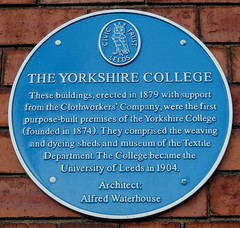
The Yorkshire College These buildings, erected in 1879 with support from the Clothworkers' Company, were the first purpose-built premises of the Yorkshire College (founded in 1874). They comprised the weaving and dyeing sheds and museum of the Textile Department. The College became the University of Leeds in 1904. Architect: Alfred Waterhouse
Yorkshire College, Leeds, United Kingdom
Subjects

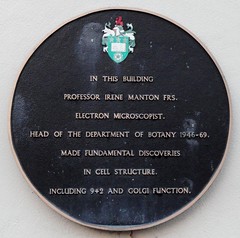
In this building Professor Irene Manton FRS, electron microscopist, Head of the Department of Botany 1946-69, made fundamental discoveries in cell structure, including 9+2 and Golgi Function.
Botany House, Leeds University, Leeds, United Kingdom
Subjects

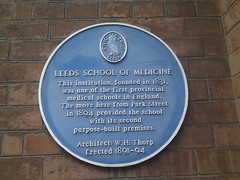
Leeds School of Medicine This institution, founded in 1831, was one of the first provincial medical schools in England. The move here from Park Street in 1894 provided the school with its second purpose-built premises. Architect: W. H. Thorp Erected 1891-94
Thoresby Place, Leeds, United Kingdom
Subjects
Honouring the bravery and sacrifice of Solomon Belinsky of Gipton Fire Station who suffered fatal injuries in the line of duty during the Leeds Blitz 15th March 1941
The Old Fire Station, Gipton, Leeds, United Kingdom
Subjects

Leeds Co-operative Society Was founded in 1847 when workers at Holbeck's Benyon & Co flax-spinning mill initiated the raising of funds in instalments from working-class families to rent a mill on this site. 'The People's Mill' provided them with wholesome, reasonably-priced flour. By 2007 co-operatives had spread worldwide with 700 million members - but Leeds Co-operative Society was still the oldest in existence.
Gatepost at the entrance of Leodis Court (opp. Temple Mill)., Leeds, United Kingdom
Subjects
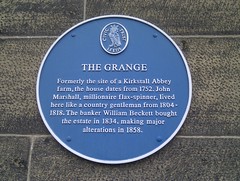
The Grange Formerly the site of a Kirkstall Abbey farm, the house dates from 1752. John Marshall, millionaire flax-spinner, lived here like a country gentleman from 1804-1818. The banker William Beckett bought the estate in 1834, making major alterations in 1858.
The Grange, Beckett Park, Leeds, United Kingdom
Subjects

Yorkshire Patent Steam Wagon Company. Steam road wagons featuring Yorkshire's characteristic transverse-mounted boiler were made here from 1902 until 1937. Later part of the Hestair Group, the firm then specialised in diesel-powered tankers, municipal gulley emptiers and road-sweepers 1900-1971
Off Pepper Road, Leeds, United Kingdom
Subjects
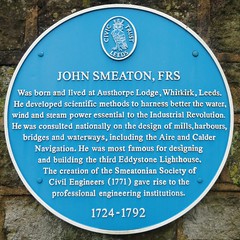
John Smeaton, FRS Was born and lived at Austhorpe Ledge, Whitkirk, Leeds. He developed scientific methods to harness better the water, wind and steam power essential to the Industrial Revolution. He consulted nationally on the design of mills, harbours, bridges and waterways, including the Aire and Calder Navigation. He was most famous for designing and building the third Eddystone Lighthouse. The creation of the Smeatonian Society of Civil Engineers (1771) gave rise to the professional engineering institutions. 1724-1792
Leeds Lock, Leeds, United Kingdom
Subjects

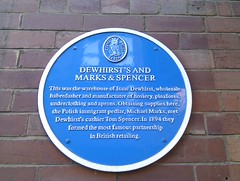
Dewhirst's and Marks & Spencer. This was the warehouse of Isaac Dewhirst, wholesale haberdasher and manufacturer of hosiery, pinafores, underclothing and aprons. Obtaining supplies here, the Polish immigrant pedlar, Michael Marks, met Dewhirst's cashier Tom Spencer. In 1894 they formed the most famous partnership in British retailing.
Harper Street, LS2, Leeds, United Kingdom
Subjects
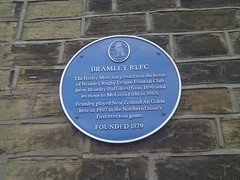
Bramley Rugby League Football Club The Barley Mow Inn ground was the home of Bramley Rugby League Football Club (now Bramley Buffaloes) from 1890 until its move to MacLaren Field in 1965. Bramley played New Zealand All Golds here in 1907 in the Northern Union's first ever tour game. Founded 1879
The Barley Mow Inn, Town Street, Bramley LS13, Leeds, United Kingdom
Subjects
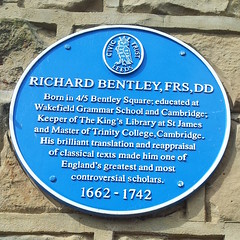
Richard Bentley FRS DD born in 4/5 Bentley Square; educated at Wakefield Grammar School and Cambridge; Keeper of The King's Library at St James and Master of Trinity College, Cambridge. His brilliant translation and reappraisal of classical texts made him one of England's greatest and most controversial scholars. 1662-1742
Bentley Square, Calverley Rd, Oulton, LS26, Leeds, United Kingdom
Subjects

.jpg?width=250)
Newton House Earl Cowper built this fine house c.1820 on part of Squire Pastures Farm, a fore-runner of the high class residential development of New Leeds. In 1843 Hutchinson Gresham, pawnbroker, purchased the villa. Joseph Lumley, mustard, cocoa and chicory manufacturer lived here in 1851.
Spencer Place, LS7, Leeds, United Kingdom
Subjects
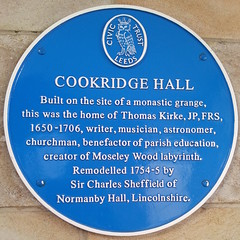
Cookridge Hall. Built on the site of a monastic grance, this was the home of Thomas Kirke, JP, FRS, 1650-1706, writer, musician, astronomer, churchman, benefactor of parish education, creator of Modeley Wood labyrinth. Remodelled 1754-5 by Sir Charles Sheffield of Normanby Hall, Lincolnshire.
Cookridge Lane, LS16, Leeds, United Kingdom
Subjects
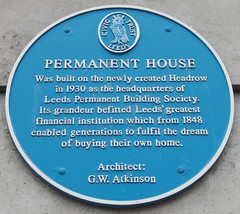
Permanent House Was built on the newly created Headrow in 1930 as the headquarters of Leeds Permanent Building Society. Its grandeur befitted Leeds' greatest financial institution which from 1848 enable generations to fulfil the dream of buying their own home. Architect: G. W. Atkinson
Browns Restaurant, The Light, The Headrow, Leeds, United Kingdom
Subjects

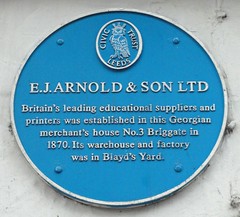
E. J. Arnold & Son Ltd Britain's leading educational suppliers and printers was established in this Georgian merchant's house No.3 Briggate in 1870. Its warehouse and factory was in Blayd's Yard.
3 Briggate, Leeds, United Kingdom
Subjects
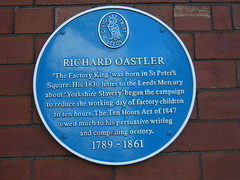
Richard Oastler 'The Factory King' was born in St Peter's Square. His 1830 letter to the Leeds Mercury about 'Yorkshire Slavery' began the campaign to reduce the working day of factory children to ten hours. The Ten Hours Act of 1847 owed much to his persuasive writing and compelling oratory. 1789 - 1861
The Wardrobe, St Peters Square (by BBC North HQ), Leeds, United Kingdom
Subjects

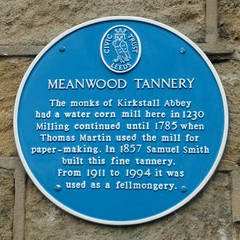
Meanwood Tannery. The monks of Kirkstall Abbey had a water corn mill here in 1230. Milling continued until 1785 when Thomas Martin used the mill for paper-making. In 1857 Samuel Smith built this fine tannery. From 1911 to 1994 it was used as a fellmongery.
Mill Pond Close, Leeds, United Kingdom
Subjects
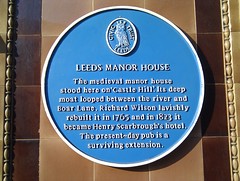
Leeds Manor House The medieval manor house stood here on 'Castle Hill'. Its deep moat looped between the river and Boar Lane. Richard Wilson lavishly rebuilt it in 1765 and in 1823 it became Henry Scarborough's hotel. The present-day pub is a surviving extension.
New Station Street, Leeds, United Kingdom
Subjects
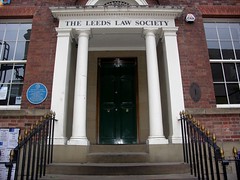
William Hey's House This impressive Georgian townhouse was built for William Hey (1736-1819) one of the founders and later Chief Surgeon of Leeds General Infirmary. For 50 years Hey was in the front rank of British surgeons. Architect: Thomas Johnson Erected 1794-5
2 Albion Pl, Leeds, United Kingdom
Subjects


Oakwood Clock Was made in 1904 by Potts and Sons, to the design of Leeming and Leeming as the centrepiece of the new Leeds Market Hall. alterations to the Market led to the inspired decision to erect the clock at Oakwood in 1912.
Roundhay Road, Oakwood, Leeds, United Kingdom
Subjects
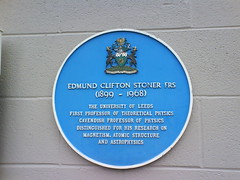
Edmund Clifton Stoner FRS (1899-1968) The University of Leeds first Professor of Theoretical Physics Cavendish Professor of Physics distinguished for his research on magnetism, atomic structure and astrophysics
E C Stoner Building, University of Leeds, Leeds, United Kingdom
Subjects
Louis Le Prince The pioneer of cinematography had a workshop on this site where he invented a one-lens camera and a projecting machine. Le Prince produced what are believed to be the world's first moving pictures taken on Leeds Bridge in 1888.
Blenheim Terrace, Leeds, United Kingdom
Subjects

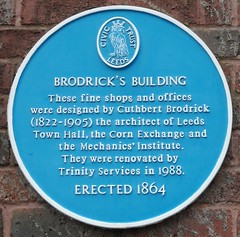
Brodrick's Building These fine shops and offices were designed by Cuthbert Brodrick (1822-1905) the architect of Leeds Town Hall, the Corn Exchange and the Mechanics' Institute. They were renovated by Trinity Services in 1988. Erected 1864
Cookridge Street, Leeds, United Kingdom
Subjects

The Yorkshire Ladies' Council of Education was founded in 1876 to promote the education of girls and women and occupied this building between 1928-1988, It served as an administrative centre for Council activities and housed The Yorkshire Ladies' Secretarial College.
Blenheim Terrace, Leeds, United Kingdom
Subjects
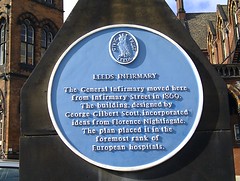
Leeds Infirmary The General Infirmary moved here from Infirmary Street in 1869. The building, designed by George Gilbert Scott, incorporated ideas from Florence Nightingale. The plan placed it in the foremost rank of European hospitals.
Portland Street, Leeds, United Kingdom
Subjects

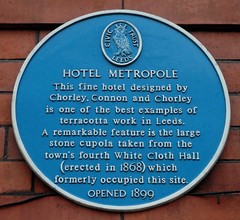
Hotel Metropole This fine hotel designed by Chorley, Connon and Chorley is one of the best examples of terracotta work in Leeds. A remarkable feature is the large stone cupola taken from the town's fourth White Cloth Hall (erected in 1868) which formerly occupied this site. Opened 1899
King Street, Leeds, United Kingdom
Subjects
Fletland Mills In 1887 Wright Bros., corn millers, acquired these late 18th and 19th century mills. they produced large quantities of flour and 'horse corn' for the Leeds district. In 1991 the buildings were splendidly converted to a high quality hotel.
The Calls, Leeds, United Kingdom
Subjects
Joshua Tetley (1778-1859) In 1822 Joshua Tetley bought William Sykes' brewery business which had stood here since 1792. Joshua's enterprise and fine quality ales created a reputation which for over 150 years has made the name 'Tetleys' synonymous with the City of Leeds.
Hunslet Road, Leeds, United Kingdom
Subjects
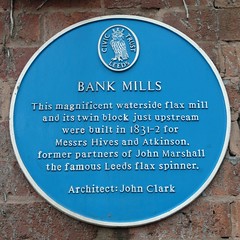
Bank Mills This magnificent waterside flax mill and its twin block just upstream were built in 1831-2 for Messrs Hives and Atkinson, former partners of John Marshall the famous Leeds flax spinner. Architect: John Clark
East Street, Leeds, United Kingdom
Subjects
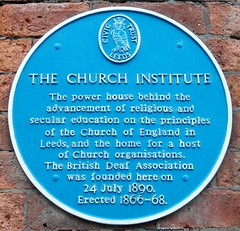
The Church Institute The power house behind the advancement of religious and secular education on the principles of the Church of England in Leeds, and the home for a host of Church organisations. The British Deaf Association was founded here on 24 July 1890. Erected 1866-68.
Albion Pl, Leeds, United Kingdom
Subjects
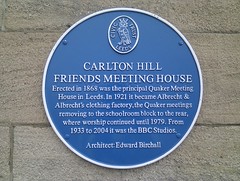
Carlton Hill Friends Meeting House Erected in 1868 was the principal Quaker Meeting House in Leeds. In 1921 it became Albrecht & Albrecht's clothing factory, the Quaker meetings removing to the schoolroom block to the rear, where worship continued until 1979. From 1933 to 2004 it was the BBC Studios. Architect: Edward Birchall
Woodhouse Lane, Leeds, United Kingdom
Subjects
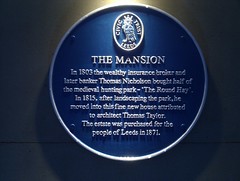
The Mansion In 1803 the wealthy insurance broker and later banker Thomas Nicholson bought half of the medieval hunting park - 'The Round Hay'. In 1815, after landscaping the park, he moved into this fine new house attributed to architect Thomas Taylor. The estate was purchased for the people of Leeds in 1871.
Mansion Lane, Leeds, United Kingdom
Subjects
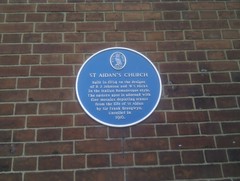
St Aidan's Church Built in 1894 to the designs of R J Johnson and W S Hicks in the Italian Romanesque style. The eastern apse is adorned with fine mosaics depicting scenes from the life of St Aidan by Sir Frank Brangwyn. Unveiled in 1916.
Roundhay Road, Leeds, United Kingdom
Subjects


Leeds Town Hall. This greatest of monuments to Victorian municipal government was opened by Queen Victoria on 7 September 1858. Its architect, Cuthbert Brodrick, created a civic palace with courts, council chamber, mayor's parlour, offices, bridewell and concert hall, the whole crowned by a magnificent tower.
Leeds Town Hal, Leeds, United Kingdom
Subjects

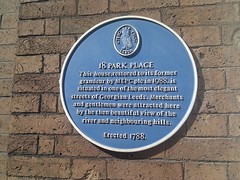
18 Park Place This house, restored to its former grandeur by MEPC plc in 1988, is situated in one of the most elegant streets of Georgian Leeds. Merchants and gentlemen were attracted here by the then beautiful view of the river and neighbouring hills. Erected 1788.
18 Park Place, Leeds, United Kingdom
Subjects
The crucible of darts. Opened in 1970 Leeds Irish Centre has become the social and cultural heart of the city's Irish Community. Now drawing millions of viewers televised darts was pioneered here in August 1973 when the Centre hosted Yorkshire Television's pub games series 'Indoor League' presented by Fred Trueman.
The Irish Centre, York Road, Leeds, United Kingdom
Subjects

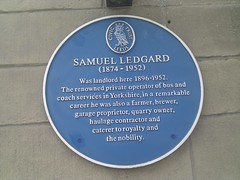
Samuel Ledgard (1874 - 1952) was landlord here 1896 - 1952. The renowned private operator of bus and coach services in Yorkshire, in a remarkable career he was also a farmer, brewer, garage proprietor, quarry owner, haulage contractor and caterer to royalty and the nobility.
Nelson Inn, 210-212 Armley Rd, Leeds, United Kingdom
Subjects
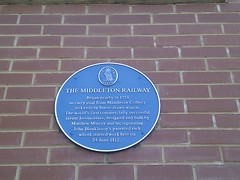
The Middleton Railway. Began nearby in 1758 to carry coal from Middleton Colliery to Leeds by horse drawn wagon. The world's first commercially successful steam locomotive, designed and built by Matthew Murray and incorporating John Blenkinsop's patented rack wheel, started work here on 24 June 1812.
Station, Moor Road, LS10, Leeds, United Kingdom
Subjects


.jpg)

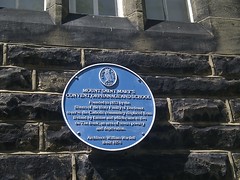
Mount St Marys Convent, Orphanage & School Founded in 1853 by the sisters of the Holy Family of Bordeaux to serve the Catholic community displaced from Ireland by famine and which came to live on the Bank, an area of severe poverty and deprivation. Architect: William Wardell Built 1858
Mt St Marys Catholic High School, Ellerby Road, LS9, Leeds, United Kingdom