
Places, subjects, or plaques matching "John Wesley"
3 subject matching "John Wesley"


86 plaque matching "John Wesley"

Texas Historical Marker #17341
Charlie Webb and John Wesley Hardin. #17341
?, , TX, United States
Subjects
Texas Historical Marker #10395
Near Boyhood Home of John Wesley Hardin. (1853-1895) Notorious outlaw who killed over 30 men. son of a Methodist minister. "Wes" was an ardent southerner. His resistance to Union occupation troops made him a hero and set him on his lawless career. He always claimed he shot only in self defense. He was killed in El Paso, 1895. #10395
?, Moscow, TX, United States
Subjects

On this site John & Charles Wesley first preached in Cork and here stood the 2nd Methodist Chapel built in Ireland (1752) John Wesley made his last visit here 1789
Mercy Hospital, Grenville Place, Cork, Ireland
Subjects

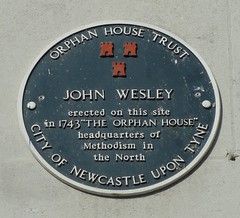
John Wesley erected on this site in 1743 "The Orphan House" headquarters of Methodism in the North
49-51 Northumberland Street, Newcastle upon Tyne, United Kingdom
Subjects
Wesley's Tree John Wesley visited Stony Stratford five times and it is reputed that at least once he stood beneath this tree and preached. This plaque was unveiled by Mr. J. A. Stead, vice-president of the Methodist Conference Saturday, 3rd June 1950.
Stony Stratford, Milton Keynes, United Kingdom
Subjects
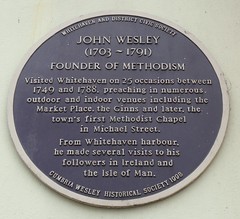
John Wesley (1703-1791) Founder of Methodism. Visited Whitehaven on 25 occasions between 1749 and 1788 preaching in numerous outdoor and indoor venues including the Market Place, the Ginns and later, the town's first Methodist Chapel in Michael Street. From Whitehaven harbour, he made several visits to his followers in Ireland and the Isle of Man.
Market Hall, Market Place, Whitehaven, United Kingdom
Subjects
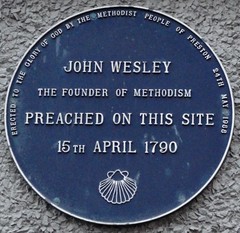
John Wesley the founder of Methodism preached on this site 15th April 1790.
Lowthian Street, Preston, United Kingdom
Subjects
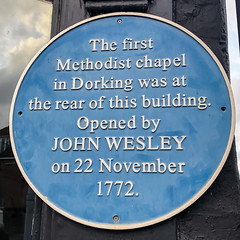
The first Methodist Chapel in Dorking was at the rear of this building. Opened by John Wesley on 22 November 1772
44 West Street, Dorking, United Kingdom
Subjects
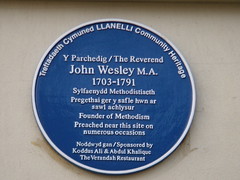
Y Parchedig/ The Reverend John Wesley M.A. 1703-1791 Sylfaenydd Methodistiaeth Pregethai ger y safle hwn ar sawl achlysur Founder of Methodism Preached near this site on numerous occasions
The Verandah Restaurant, Bridge Street, Llanelli, United Kingdom
Subjects
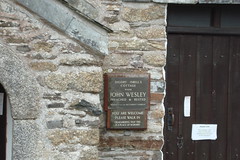
Digory Isbell's Cottage where John Wesley preached and rested
Wesley Way, Trewint, United Kingdom
Subjects
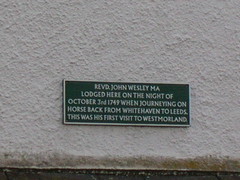
Revd. John Wesley MA lodged here on the night of October 3rd 1749 when journeying on horse back from Whitehaven to Leeds. This was his first visit to Westmorland.
Main Street, Old Hutton, United Kingdom
Subjects
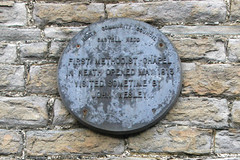
First Methodist chapel in Neath opened May 1813 Visited sometime by John Wesley
Moose Hall, Castle Street, Neath, United Kingdom
Subjects
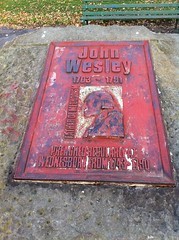
John Wesley 1703-1791 Father of Methodism Preached regularly at Wednesbury from 1743-1790
High Bullen, Wednesbury, United Kingdom
Subjects
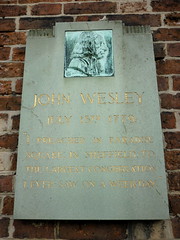
John Wesley July 15th 1779 "I preached in Paradise Square in Sheffield to the largest congregation I ever saw on a weekday ".
18 Paradise Square, Sheffield, United Kingdom
Subjects

John Wesley preached in the Small House Chapel near this site on 1st April 1762
Road between Neston & Parkgate, Neston, United Kingdom
Subjects

"All things are ready: come unto the marriage". At Barnaby's Farm, near this spot, the Reverend John Wesley preached on Friday, 16th April, 1784.
?, Wingates, United Kingdom
Subjects
C. 15th century Faversham's principal inn, and main centre of its coaching trade. Preacher John Wesley stayed here in 1743.
Market Place, Faversham, United Kingdom
Subjects

The upper storey of this building was the meeting place of York Methodists from 1753 to 1759. John Wesley, Charles Wesley and George Whitefield preached here on several occasions during that time. The actual room which the Methodists occupied was destroyed by fire and replaced by the present room about the year 1880.
Newgate, York, United Kingdom
Subjects
.jpg?width=250)
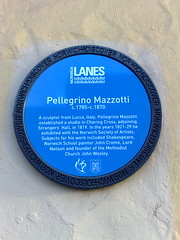
Pellegrino Mazzotti c.1785-c.1870 A sculptor from Lucca, Italy, Pellegrino Mazzotti established a studio in Charing Cross, adjoining Strangers' Hall, in 1819. In the years 1821-29 he exhibited with the Norwich Society of Artists. Subjects for his work included Shakespeare, Norwich School painter John Crome, Lord Nelson and founder of the Methodist Church John Wesley.
Charing Cross, Norwich, United Kingdom
Subjects
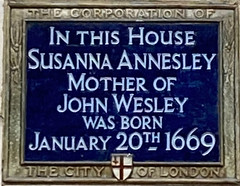
In this house Susanna Annesley Mother of John Wesley was born January 20th 1669
7 Spital Yard, EC2, London, United Kingdom
Subjects

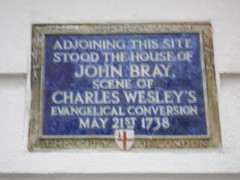
Adjoining this site stood the house of John Bray, scene of Charles Wesley's evangelical conversion May 21st 1738
13 Little Britain, EC1, London, United Kingdom
Subjects
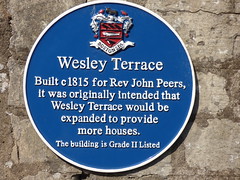
Wesley Terrace. Built c1815 for Rev John Peers, it was originally intended that Wesley Terrace would be expanded to provide more houses. The building is Grade II Listed.
221, High Street, Boston Spa, United Kingdom
Subjects
Texas Historical Marker #00292
Bandera Methodist Church. Built 1880 by members under leadership of B.F. Langford, Sr. Gothic architecture. Hand-cut limestone, with oak timbers. Though enlarged and remodeled, retains original charm. Rev. John Devilbiss (who helped found first Protestant church in San Antonio) held services here 1861. Church organized 1867 by Rev. A.J. Potter; charter members included Rugh, Langford, Stevens Families. Daniel Rugh organized first Sunday school, April 18, 1869. Recorded Texas Historic Landmark, 1967. #292
?, Bandera, TX, United States
Subjects
Texas Historical Marker #01192
The Rev. John Wesley DeVilbiss. Circuit Rider DeVilbiss came to republic to Texas in 1842 to minister on Hispanic Borders in the southwest. He pioneered among immigrants and native Texians to promote Harmony in varies cultures in this far outpost. In county clerk's office in April 1844 he delivered first sermon in English ever give in San Antonio--to lay foundations for confluence of civilizations. Inspired organization of Oak Island Church, 1867 or '68. This building of 1872 holds furniture mande by Devilbis and his son. #1192
3030 DeVilbiss Lane, San Antonio, TX, United States
Subjects
Texas Historical Marker #01897
First United Methodist Church of Victoria. When Victoria was settled in 1824, Texas was part of Mexico and there were no Protestant churches. Itinerant Methodist ministers began to visit this area soon after Texas won independence in 1836. The Rev.Jesse Hord (1808-86), a missionary sent to this region by the Mississippi Conference of the Methodist Church, preached here in 1839. This congregation, formed in 1840 with the Rev. Joseph P. Sneed (1804-81) as pastor, was the first Protestant church in Victoria. Among its early pastors were the Rev. John Wesley DeVilbiss (1818-83), who helped conduct the first Protestant service in San Antonio in 1844, and the Rev. James E. Ferguson (1824-76), the father of Texas governor James E. Ferguson (1871-1944). Methodists worshipped first on South Street, then moved in 1852 to a small, frame building on Santa Rosa Street. In 1876 the steadily growing congregation occupied a frame structure on this site. Between 1896 and 1910, the church was known as Callender Chapel in memory of a prominent member, lawyer W.L. Callender. Damaged by a hurricane in 1886, the frame sanctuary was destroyed by a fire in 1910 and replaced by a masonry structure in 1911. The present facility was built in 1960. In the 1970s, the historic fellowship recorded a membership of over 1400. (1976) #1897
407 N. Bridge Street, Victoria, TX, United States
Subjects
Texas Historical Marker #05553
Travis Park United Methodist Church. Founded by the Rev. John Wesley DeVilbiss (1818-83), missionary to Republic of Texas, who in 1844 preached first protestant sermon ever heard in San Antonio and in June 1846 organized his congregation in the courthouse. Villagers called him"the little priest that owns the bell, "as he rang calls to worship from vacant lot bought for church on Commerce Street and afterward preached there. The earliest methodist building was a chapel erected in 1852 on Soledad Street and named for Bishop Paine. Cultural life of the city was enriched in 1859 when San Antonio female college, later the University of San Antonio, opened in Paine Chapel. This institution was to merge with others nearly a century later to form trinity University (1942). The Travis Park edifice was begun in pastorate of Dr. W.J. Young (1882) with S.C. Bennett, Francis Crider, G. H. Johnston, James T. Thornton, W.L. Thompson, and William Votaw on building committee. Additions (1901,1910,1922,1941) modified the Romanesque Revival architecture. A 1955 fire prompted major remodeling. Memorial windows depict the congregation's history. Pastors have included many noted men, five having been elected bishops. #5553
230 E. Travis St., San Antonio, TX, United States
Subjects

Texas Historical Marker #07949
First United Methodist Church of Cameron. This congregation began as part of the early Methodist missionary effort in Texas. A camp meeting was held in Milam County in 1841, four years after the first Methodist preachers came to Texas. By 1847, the Rev. Josiah Whipple had helped to organize this church. Until 1885 the Methodist congregation in Cameron was part of a preaching circuit. Early ministers included the Rev. Pleasant M. Yell and the Rev. John W. Devilbiss. By 1885, the church had grown so that it was given a full-time pastor, the Rev. J. E. Green. Four years earlier, in 1881, the congregation had constructed its first church building, during the pastorate of the Rev. J. H. Collard. Larger facilities were needed by the end of the nineteenth century, and a new brick sanctuary was completed in 1901. The current building was first used for services in 1923. Over the years, First United Methodist Church of Cameron has provided significant service and leadership to the community. The congregation has been host to the Texas Annual Conference of Methodist Churches and has produced several ministers from its membership. Today the church continues to reflect the ideals and traditions of its founders. #7949
S. Travis and W. 2nd St., Cameron, TX, United States
Subjects
Texas Historical Marker #08833
First United Methodist Church of Marlin. Missionary preachers served Methodists in this area even before the establishment of Falls County or the city of Marlin. First sent was the Rev. John W. DeVilbiss in 1842. He was followed by other circuit riders until the Rev. Charles Brown was appointed full-time pastor for the Marlin congregation in 1874. In 1851 the Methodists selected a lot on which to build a church in the new town of Marlin. Adjoining lots were added to the property at Fannin and Williams streets in 1879 and 1881. In 1909, under the pastorate of the Rev. I. F. Betts, the church purchased this site. The building, still in use today, was completed in 1910. Bricks made from Brazos River bottom red clay were used, while the painted and stained glass windows were imported from Italy. The church bell was at one time used on a southern plantation. The congregation has established a long tradition of Christian service. The church held its first revival on record in 1865 and has twice been host for the Texas Annual Conference of Methodist Churches. Its women's groups have actively supported mission work at home and abroad. One member, Miss Maggie Rogers, served as a missionary in China from 1904 to 1943. Five of the church's members have entered the ministry. #8833
411 Coleman St., Marlin, TX, United States
Subjects
Texas Historical Marker #13377
Oak Island Methodist Church and Cemetery. Oak Island Methodist Church and Cemetery with Grave of the Reverend John Wesly DeVilbliss (1818-1885) Circuit rider DeVilbiss came to Republic of Texas in 1842 to minister on Hispanic borders in the southwest. He pioneered among immigrants and native Texians to promote harmony in varied cultures in this far outpost. In County Clerk's office in April 1844 he delivered first sermon in English ever given in San Antonio--to lay foundations for confluence of civilizations. Insipred organization of Oak Island Church, 1867 or '68. This building of 1872 holds furniture made by DeVilbiss and his son. (1967) #13377
2970 DeVilbiss Lane, San Antonio, TX, United States
Subjects
Texas Historical Marker #01011
Community of Pilgrim. Named in honor of Thomas J. Pilgrim (1804-1877), noted pioneer educator. Born in Connecticut, he came in 1828 to Texas, where in 1829 he organized a school at San Felipe, in Stephen F. Austin's Colony. Also started first Sunday School in Texas. In 1838 he received a land grant of 1,476 acres (including this site) from Texas Republic. Settled in Gonzales in 1840; started a Sunday School and was superintendent until 1871. Community became a prominent trading post in early 1840s and a hideout of famous gunman John Wesley Hardin in 1870s. #1011
?, Pilgrim, TX, United States
Subjects
Texas Historical Marker #01034
Concordia Cemetery. Known as Concordia during the 1840s, this area was the home of Chihuahua trader Hugh Stephenson. In 1856 his wife, Juana (Ascarate), was buried in what is now part of Concordia Cemetery. The graveyard gained widespread use in the 1880s when El Pasoans drove three miles to Concordia to bury their dead. By 1890 various sections had been purchased by different groups and were designated Catholic, Masonic, Jewish, Black, Chinese, Military, Jesuit, city, and county. Buried here are gunfighter John Wesley Hardin, and numerous civic leaders, pioneers, and war veterans. (1984) Concordia Cemetery Established 1856 Historic Texas Cemetery - 2005 #1034
3800 W. Yandell, El Paso, TX, United States
Subjects
Texas Historical Marker #02820
Hardin, John Wesley. Champion gunfighter in personal combat, Hardin was brought to justice for first time for murder of Deputy Sheriff Charles Webb here in Comanche in 1874. Served 15 years in prison. On release, opened law office in El Paso, 1894. Killed at age of 42 when shot in back, 1895. (1966) #2820
?, Comanche, TX, United States
Subjects
Texas Historical Marker #06864
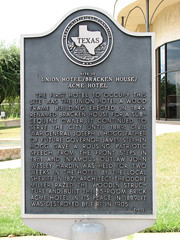
Site of the Union Hotel/Bracken House/Acme Hotel. The first hotel to occupy this site was the Union Hotel, a wood frame building erected in 1849. Renamed Bracken House for a subsequent owner, it continued to serve the city until 1889. Civil War General Joseph L. Hogg, father of future Governor James Stephen Hogg, gave a rousing patriotic speech from the front steps in 1861, and infamous outlaw John Welsey Hardin was held for two weeks in the hotel by the local sheriff in 1872. Architect Theodore Miller razed the wooden structure and built the 65-room brick Acme Hotel in its place in 1889. It was destroyed by fire in 1905. #6864
?, Rusk, TX, United States
Subjects
Texas Historical Marker #11857
John Wesley Hardin. (May 26, 1853 - August 19, 1895) Born in Bonham, Texas, John Wesley Hardin was named for the founder of Methodism. "Wes" Hardin grew into a family man, cowboy, and outlaw who claimed to have killed more than 30 men. An unusual sort of gunslinger, Hardin considered himself a pillar of society who killed to save his own life. Hardin served 15 years in state prison for murder, was pardoned, then opened a law office in El Paso in May 1895. He was killed 3 months later by John Selman, an El Paso city constable. (1998) #11857
?, El Paso, TX, United States
Subjects
Texas Historical Marker #12577
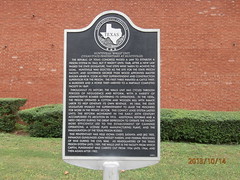
Huntsville "Walls" Unit. (Texas State Penitentiary at Huntsville) The Republic of Texas Congress passed a law to establish a prison system in 1842, but it wasn't until 1848, after a new law passed the state legislature, that steps were taken to achieve the goal. Huntsville was selected as the site for the state prison facility, and Governor George Tyler Wood appointed master builder Abner H. Cook as first superintendent and construction supervisor for the prison. The first three inmates -- a cattle thief, a murderer and a horse thief -- arrived to a partially completed facility in 1849. Throughout its history, the Walls Unit has cycled through periods of negligence and reform, with a variety of administrative boards governing its operations. In the 1850s, the prison operated a cotton and woolen mill with inmate labor to help generate its own revenue. In 1866, the state legislature enabled the superintendent to lease the prisoners for work in the private sector. This convict lease system lasted until the reform movement in the early 20th century accomplished its abolition in 1910. Additional reforms and a need created during the Great Depression to operate the facility more efficiently led to the establishment of canning operations, a license plate manufacturing plant, and the inauguration of the Texas Prison Rodeo. This penitentiary has held Kiowa chiefs Satanta and Big Tree, infamous gunslinger John Wesley Hardin, and Federal prisoners of war during the Civil War. As headquarters of the Texas prison system until 1989, the Walls Unit is the facility from which capital punishment was carried out from 1924 until 1964, and then again after 1982. (2001) #12577
?, Huntsville, TX, United States
Subjects
_Lived_here.jpg?width=250)

On this site The Revd. John Wesley (1703 - 1791) opened the second Methodist Preaching House in Manchester, 30th March 1781.
Central Hall, Oldham Street, Manchester, United Kingdom
Subjects
The site of the Hockley Methodist Chapel opened 4th April 1783 by the Reverand John Wesley and the Reverand Dr Thomas Coke
42 Goose Gate, Nottingham, United Kingdom
Subjects

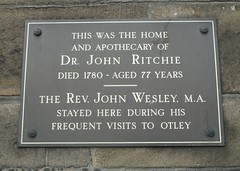
This was the home and apothecary of Dr John Ritchie died 1780 - aged 77 years. The Rev John Wesley MA stayed here during his frequent visits to Otley
Boroughgate, Otley, United Kingdom
Subjects
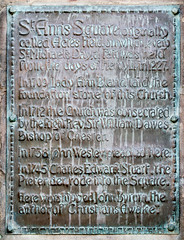
St. Ann's Square, originally called Acres Field on which every St. Michael's Day, a Fair was held from the days of Henry III in 1227. In 1709 Lady Ann Bland laid the foundation stone of this Church. In 1712 the Church was consecrated by the Right Rev Sir William Dawes, Bishop of Chester. In 1738 John Wesley preached here. In 1745 Charles Edward Stuart, the Pretender, rode into the Square. Here worshipped John Byrom, the author of Christians Awake.
St. Ann's Square, Manchester, United Kingdom
Subjects


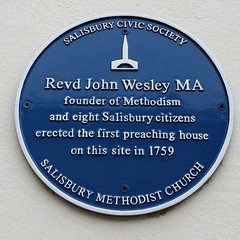
Revd John Wesley MA founder of Methodism and eight Salisbury citizens erected the first preaching house on this site in 1759
Methodist Church, St Edmund's Church Street, Salisbury, United Kingdom
Subjects

John Wesley preached in the Long Room of this building 1787
United Club, Church Street, St. Helier, Jersey
Subjects

On 14th July 1783 and on several subsequent occasions John Wesley preached in this building the first Methodist meeting house in Oxford
New Inn Hall Street, Oxford, United Kingdom
Subjects

John Wesley, 1703-1791 Founder of Methodism On the "trust lot" south of President Street and immediately west of this square stood in 1736-'37 the parsonage in which John Wesley resided. In the adjoining garden he read, prayed and meditated. Weekly meetings of members of his Christ Church congregation were held in the small wooden dwelling. According to Wesley, "The first rise of Methodism was in 1729, when four of us met together at Oxford. The second was at Savannah in 1736 when twenty or thirty persons met at my house." The monument here was dedicated in 1969. Wesley is depicted at the period of his Georgia ministry, wearing his Church of England vestments. The sculptor, Marshall Daugherty, says of this rendering: "The moment is as he looks up from his Bible toward his congregation, about the speak and stretching out his right hand in love, invitation and exhortation. In contrast, the hand holding the Bible is intense and powerful - the point of contact with the Almighty..."
?, Savannah, GA, United States
Subjects
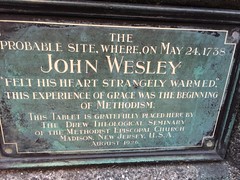
The probable site, where, on May 24, 1738 John Wesley "felt his heart strangely warmed". This experience of grace was the beginning of Methodism.
Aldersgate Street, EC1, London, United Kingdom
Subjects
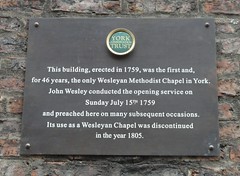
This building, erected in 1759, was the first and, for 46 years, the only Wesleyan Methodist Chapel in York. John Wesley conducted the opening services on Sunday July 15th 1750 and preached here on many subsequent occasions. Its use as a Wesleyan Chapel was discontinued in the year 1805.
60-62 Aldwark, York, United Kingdom
Subjects
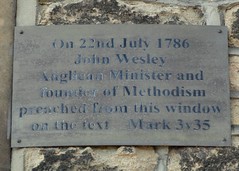
On 22nd July 1786 John Wesley Anglican Minister and Founder of Methodism preached from this window on the text Mark 3v35
9, Browgate, Baildon, United Kingdom
Subjects
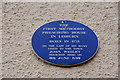
The first Methodist preaching house in Lisburn Built in 1772 On the last of his many visits to the town John Wesley preached here on 6th June 1789
Market Street, Lisburn, United Kingdom
Subjects

The Rev. John Wesley, A.M. Founder of Methodism, preached in this house on his first visit to Shrewsbury. March 16th 1761.
Wesley House, 1 Fish Street, Shrewsbury, United Kingdom
Subjects
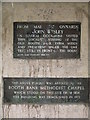
From May 1747 onwards John Wesley on several occasions visited this locality staying at the old Booth Bank Farm, Agden and preaching under the oak tree still in front of the house The above plaque was affixed to the Booth Bank Methodist Chapel which stood on this site from 1834 The building was demolished in 1972
Under motorway bridge, Reddy Lane, Millington, United Kingdom
Subjects

John Wesley (1703-1791) On February 6, 1736, John Wesley, the founder of Methodism, landed at Peeper (now Cockspur) Island near here and there preached to his fellow voyagers his first sermon on American soil. A monument has been erected on Cockspur Island to commemorate the event. Sent to Georgia by the Trustees as missionary, Wesley was the third minister of the Established Church in the colony. He preached in the scattered settlements of Georgia, journeying thither by boat and over Indian trails. Wesley returned to England in 1737 after differences with his parishioners. "I shook off the dust of my feet and left Georgia," he wrote, "having preached the Gospel there (not as I ought, but as I was able) one year and nearly nine months."
Fort Pulaski national monument, Savannah, GA, United States
Subjects
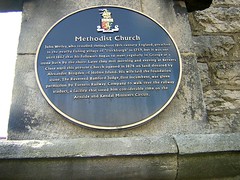
Methodist Church John Wesley, who travelled throughout 18th century England, preached in the nearby fishing village of "Fluckburgh" in 1759, but it was not until 1867 that his followers began to meet regularly in Grange at a stone barn by the shore. Later they met morning and evening at Berners Close until this present Church opened in 1874 on land donated by Alexander Brogden of Holme Island. His wife laid the foundation stone. The Reverend Bamford Judge, first incumbent, was given permission by Furness Railway Company to walk over the railway viaduct, a facility that saved him considerable time on the Arnside and Kendal Ministers Circuit.
Kents Bank Road, Grange-over-Sands, United Kingdom
Subjects
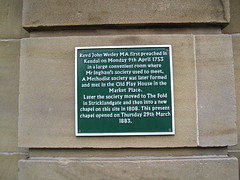
Revd John Wesley MA first preached in Kendal on Monday 9th April 1753 in a large convenient room where Mr Ingham's society used to meet. A Methodist society was later formed and met in the Old Play House in the Market Place. Later the society moved to The Fold in Stricklandgate and then into a new chapel on this site in 1808. The present chapel opened on Thursday 29th March 1883.
Stricklandgate, Kendal, United Kingdom
Subjects
Part of this building is Mawnan's 'Old Meeting House' and where John Wesley is said to have stayed c.1750.
Wesley Cottage, Carwinion Road, Mawnan Smith, United Kingdom
Subjects
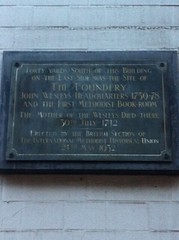
Forty yards south of this building on the last side of the site of The Foundery, John Wesley's headquarters 1750-78 and the first Methodist book room. The mother of the Wesleys died there 30th July 1742.
Tabernacle Street, London, United Kingdom
Subjects
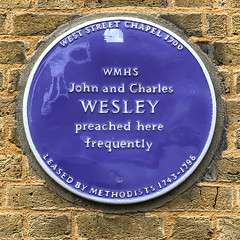
West Street Chapel 1700 leased by Methodists 1743-1798. WMHS John and Charles Wesley preached here frequently
26 West Street, London, United Kingdom
Subjects
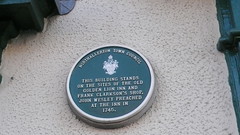
This building stands on the sites of the old Golden Lion Inn and Frank Clarkson's shop. John Wesley preached at the Inn in 1745.
209 High Street, Northallerton, United Kingdom
Subjects
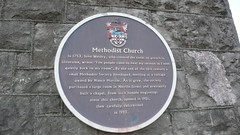
METHODIST CHURCH. In 1753, John Wesley, who crossed the sands to preach in Ulverston, wrote: "Few people came to hear my sermon so I went quietly back to my room". By the end of 18th century a small Methodist Society developed, meeting at a cottage owned by Nancy Moister. As it grew, the society purchased a large room in Neville Street and eventually built a chapel. From such humble beginnings arose this church, opened in 1901, then carefully refurbished in 1992.
Neville Street, Ulverston, United Kingdom
Subjects
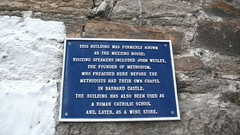
This building was formerly known as the Meeting House; visiting speakers included John Wesley, the founder of Methodism, who preached here before the Methodists had their own chapel in Barnard Castle. The building has also been used as a Roman Catholic school and, later, as a wine store.
Queen Street, Barnard Castle, United Kingdom
Subjects

This building, originally known as Broadgates Chapel, was the first Methodist chapel to be built in Barnard Castle. Much of the labour in erecting it was undertaken by men and women of the congregation. John Wesley, the founder of Methodism, preached at the opening service on Saturday, 13th April 1765. The house in the adjoining garden was built later as the minister's residence.
Old School Close, Barnard Castle, United Kingdom
Subjects
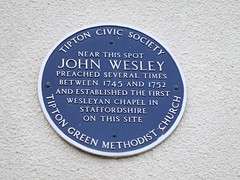
Near this spot John Wesley preached several times between 1745 and 1752 and established the first Wesleyan chapel in Staffordshire on this site.
167 Park Lane, Tipton, United Kingdom
Subjects
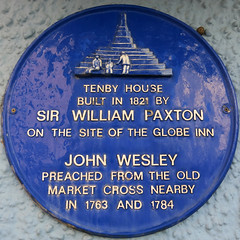
Tenby House built in 1821 by Sir William Paxton on the site of the Globe Inn. John Wesley preached from the Old Market Cross nearby in 1763 and 1784
Tenby House Hotel, Tudor Square, Tenby, United Kingdom
Subjects

Near this spot on August 15th 1790 Rev. John Wesley M.A. then in his eighty-eighth year and on the last of his fourteen visits to the town preached to the people of Haverfordwest. His text was, "The Kingdom of God is at hand; repent ye, and believe the Gospel". Mark,1.15.
Haverfordwest Library, Dew Street, Haverfordwest, United Kingdom
Subjects
"Epworth Villa" 14 Gloucester Street Reverend John Wesley, AM preached here on 6 September 1776 thereby making it the first Methodist meeting house in Weymouth (Melcombe Regis)
14 Gloucester St, DT4 7AP, Weymouth, United Kingdom
Subjects

John Wesley preached 14 times in a chapel on this site 1759-1790.
10 Church Stairs Street, Scarborough, United Kingdom
Subjects
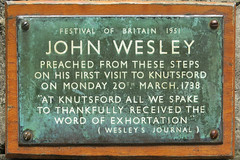
John Wesley preached from these steps on his first visit to Knutsford on Monday 20th March 1738. "At Knutsford all we spake to thankfully received the word of exhortation" (Wesley's journal)
Princess Street, Knutsford, United Kingdom
Subjects
.jpg?width=250)
This tablet is erected to the glory of God in commemoration of the Evangelical Conversion of the Rev. John Wesley, M.A., on May 24, 1738. (This site of the meeting room of the Religious Society was probably 28 Aldersgate Street). And of the Rev. Charles Wesley, M.A., on May 21, 1738. The site of the house is near St Batholomew's Hospital. (No12 Little Britain). Erected by the International Methodist Historical Union. May 24 1926.
Aldersgate Street, London, United Kingdom
Subjects
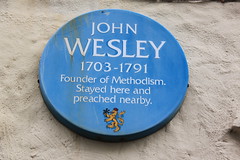
John Wesley 1703 - 1791 Founder of Methodism. Stayed here and preached nearby.
Braye Street, Alderney, United Kingdom
Subjects

Wesley Place Methodist Chapel built in 1782 near the spot where John Wesley preached in 1774 and 1780 enlarged 1848 closed for worship 1975
Stapleford House, Wesley Place, Stapleford, United Kingdom
Subjects
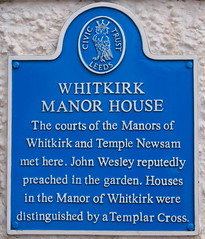
Whitkirk Manor House. The courts of the Manors of Whitkirk and Temple Newsam met here. John Wesley reputedly preached in the Garden. Houses in the Manor of Whitkirk were distinguished by a Templar Cross.
Colton Road. LS15 9AA, Leeds, United Kingdom
Subjects

John Wesley preached his last open air sermon here, on 7th October 1790. Wesley's Chapel is 1st left, then left again.
Monks' Walk, Winchelsea, United Kingdom
Subjects
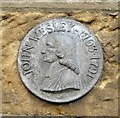
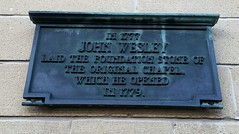
In 1777 John Wesley laid the foundation stone of the original chapel which he opened in 1779.
New King Street, Bath, United Kingdom
Subjects

This plaque commemorates the crossing from the ferry near the English stones during the 18th century of John and Charles Wesley Founders of Methodism on their journeys to Wales and Ireland Dedicated for the 250th anniversary of their conversion, May 28th 1988
Severn Beach, Bristol, United Kingdom
Subjects
John Wesley founder of the Methodist Church preached here on 27th March 1783
Trinity Community Church, 61 Stockwell Head, Hinckley, United Kingdom
Subjects

Revd JOHN WESLEY 1703 - 1791 Founder of Methodism Preached near this site on several occasions in the 1780s
Methodist Church, Maguiresbridge, United Kingdom
Subjects

Here on the site of The Coinage Hall John Wesley preached 27th August 1776 and on other occasions "Ye are saved through faith"
1 Duke Street, Truro, United Kingdom
Subjects
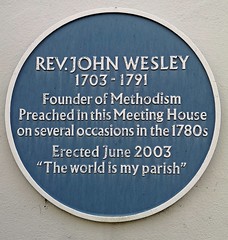
Rev. John Wesley Founder of Methodism Preached in this Meeting House on several occasions in the 1780s Erected June 2003 "The world is my parish"
, Tunbridge Wells, United Kingdom
Subjects
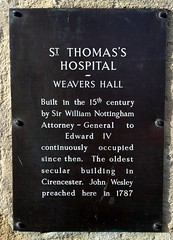
St Thomas's Hospital Weavers Hall Built in the 15th century by Sir William Nottingham Attorney-General to Edward IV continuously occupied since then. The oldest secular building in Cirencester. John Wesley preached here in 1787.
, Cirencester, United Kingdom
Subjects

The Old Chapel The date on this former Chapel records the first occasion on which John Wesley, the founder of Methodism, preached here on June 28th 1779. Author Leo Walmsley attended the school at the rear of the building and wrote vivid accounts of his schooldays in his novels.
The Old Chapel, Chapel Street, Robin Hood's Bay, United Kingdom
Subjects
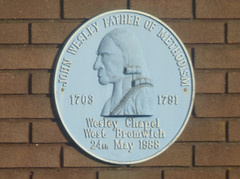
John Wesley Father of Methodism 1703 - 1791 Wesley Chapel West Bromwich
Wesley Methodist Church - High Street, West Bromwich, United Kingdom
Subjects

On this site the Revd John Wesley 1703 - 1791 preached from a butchers block 26 June 1742 "The best of all is, God is with us"
Shambles Market Street, Stroud, United Kingdom
Subjects
John Wesley preached here April 18th 1786
Southfield Methodist Chapel, Burnley, United Kingdom
Subjects

Some Facts of Interest in the History of the Old Church The Church was built to replace the former Church of St John at Tyburn 1400 Francis Bacon was married here 1606 William Hogarth portrayed the interior of the Church 1735 James Gibbs Architect, pupil of Wren was buried here 1754 Richard Brinsley Sheridan married Miss Linley here 1773 Charles Wesley brother of John Wesley was buried here 1788 Lord Byron was baptized here 1788 Lord Nelson worshipped here and Horatia his only child was baptized here 1803
Garden of Rest, Marylebone High Street, London, United Kingdom
Subjects


John Wesley 1703-1791 Founder of Methodism rested at the White Lion Inn (later the Blue Lion) on 18th February 1747. He also preached to a large crowd at the back of a house on Watergate on 9th July 1781
Lindpet House, 5 Market Place, Grantham, United Kingdom