

Texas Historical Marker #00207
Arney School. Among the early settlers in northeast Castro County were George & Jim Arney, two brothers from Missouri, for whom Arney community was named. A school was started in 1901 for the children of settlers and ranch hands. The first schoolhouse, a one-room frame structure, also housed services of Arney Baptist Church, which was organized in 1905. Arney school operated until 1953, when it was consolidated with other districts. The school building then served as a community center and polling place. (1985) #207
?, Nazareth, TX, United States
Texas Historical Marker #00208
Arno Schwethelm Building. Prominent local merchant Arno Schwethelm had this building constructed in 1916 to house his mercantile business, a leading Hill Country establishment. Designed by L. Harrington of San Antonio and built by stonemason Otto Bartel, it combines the function of a twentieth century commercial structure with the detail of German craftsmanship. Incorporated in the native limestone building are materials from an earlier structure at this site. Recorded Texas Historic Landmark - 1981 #208
?, Comfort, TX, United States
Texas Historical Marker #00209
Aron-Harris House. Designed by Putnam Russell, an architect from New York, this house was constructed in 1889 for local merchant Morris Aron and his wife Henrietta. In 1897 the home was purchased by Plummer and Josie Harris and it remained in their family until 1951. The Queen Anne styling features intricate ornamentation and a corner turret with a bell-shaped roof. The interior includes ornate woodwork and marble detailing. Recorded Texas Historic Landmark - 1980*** #209
523 W. Hunt St., McKinney, TX, United States
Texas Historical Marker #00210
Texas & Pacific Railway. Railroad made this "Cattle Capital of West Texas" in 1880s. Cattlemen Frank Byler, Clay Mann, Winfield Scott, C.C. Slaughter and others brought herds here early as 1877, when last of the buffalo were being exterminated. A Texas Ranger unit was stationed in area to guard against straggling Indians. After Texas & Pacific locators staked course through this valley, rancher George Waddell persuaded A.W. Dunn of Coleman to build a store here. Lumber came by wagon from Round Rock (about 300 mi. SE), and was sparingly used. Store had tarpaulin roof, dirt floor, and was opened in late summer 1880. Soon two saloons were also in business. Railroaders--including bridge crew of A.J. Coe--arrived in the fall. By April 16, 1881, when the Texas & Pacific initiated train service to this site, some 350 people lived here in tents and dugouts, and had a newly organized county government, a school, post office and newspaper. This was terminus for months, while river bridge was being built. Then and until late 80s, this was shipping point for such remote places as ranches of Charles Goodnight and the XIT, near present Amarillo. The T. & P. freighted in tons of windmills and barbed wire, shipped out thousands of cattle--giving this city renown. (1970) #210
Elm and Main St., Colorado City, TX, United States
.jpg?width=250)
Texas Historical Marker #00211
Arroyo de Juan Lorenzo. Name used by Spaniards of Presidio de San Saba (in existence from 1757 to 1770) for this stream now called Celery Creek. Stone to build Presidio was quarried from bluffs along the creek, and deep banks let hostile Indians approach undiscovered, to attack the Presidio, half a mile to the southwest. #211
US 90 at Celery Creek Bridge, Menard, TX, United States
Texas Historical Marker #00212
Arsenal Magazine. At the urging of United States Secretary of War Jefferson Davis, land was secured at San Antonio in 1858 for an arsenal. In 1859, the State of Texas added 16 acres, and the arsenal became headquarters for the U.S. Army's department of Texas. Under construction when the Civil War (1861-65) began, this magazine was included in Federal property surrendered in 1861. The building was completed for Confederate Texas by local contractor J.H. Kampmann. Carefully spaced vents and cavities in the walls permitted air circulation and reduced the danger of sparks igniting stored gunpowder. The arsenal supplied arms for south Texas and frontier defense, as well as the Sibley expedition to New Mexico in 1862. Reoccupied by Federal forces in 1865, this became the principal supply depot for the line of Forts defending frontier settlements. It served the U.S. Army until 1947, when the Arsenal was closed. The long, narrow one-story structure features walls of extremely thick ashlar limestone construction. Details include end gables extended above the roofline, lintels which protrude as hood molds, and date stone in relief over the side entry. #212
646 S. Main, San Antonio, TX, United States
Subjects

Texas Historical Marker #00213
Artesian Park and Sulphur Well. After a convention of Republic of Texas citizens accepted terms on July 4, 1845, for annexation to the United States, General Zachary Taylor brought 4,000 men of the U.S. 3rd infantry to Corpus Christi to defend the embryonic state from indians or foreign powers. He remained eight months; more than two months after Texas became a state he marched to the Rio Grande. Among his troops in Corpus Christi were three future United States presidents (Taylor, Pierce, and Grant), and many other future celebrities. A landmark of Taylor's sojourn was a sulphur-rich artesian well he had drilled adjacent to the camp. In 1854, out of regard for the significant well and campsite, and to give the city he had founded (1839) a public park, H.L. Kinney deeded and dedicated the well site and an acre of surrounding land to the municipality. This park is one of the earliest in Texas to have been given by an individual to the public. By 1900--when a bandstand, drinking fountain and walks had been installed by civic or private means--the park was regarded as an historic, greatly cherished city facility. More land was added in 1907--08 through efforts of the Woman's Monday Club. Use and improvements have continued over 120 years. #213
Twigg St. at Chaparral, Corpus Christi, TX, United States
Texas Historical Marker #00214
Arthur Carroll Scott, Sr., M.D.. (July 12, 1865-October 27, 1940) Born in Gainesville, Texas, Arthur Scott graduated from Bellevue Medical College in 1886. In 1892 he became Chief Surgeon of the Santa Fe Hospital in Temple. He formed a partnership with Dr. R.R. White, Jr., in 1897, and they founded the Temple Sanitarium (later Scott and White Hospital) in 1904. A specialist in surgery, Dr. Scott became a well known authority in cancer diagnosis and treatment. After a remarkable career, he died in 1940. Recorded - 1997 #214
1601 N. Main St., Temple, TX, United States
Texas Historical Marker #00215
Arthur Carroll Scott, Sr., M.D.. (1865-1940) Born in Gainesville, Texas, Arthur C. Scott graduated from Bellevue Medical College in 1886 and won an internship at the Western Pennsylvania Hospital. Returning to Gainesville, he married Maud M. Sherwood in 1889 and began a private medical practice. In 1892 Dr. Scott was appointed Chief Surgeon of the Gulf, Colorado and Santa Fe Hospital in Temple. In 1895 he hired Dr. Raleigh R. White, Jr., and they formed a private partnership in 1897. In 1904 they founded the Temple Sanitarium which they directed jointly until Dr. White's death in 1917. Subsequently, Dr. Scott established a partnership with Dr. G.V. Brindley, Sr., and Dr. M.W. Sherwood and changed the name of the hospital to Scott and White Hospital in 1922. A specialist in surgery, Dr. Scott became an internationally respected authority in the diagnosis and treatment of cancer. Scott and White received accreditation from the American College of Surgeons as a cancer treatment center in 1933, the earliest in Texas. Dr. Scott was active in many medical and community organizations. The institution he co-founded became a multi-specialty health system renowned in the Southwest. He died in 1940. (1997) #215
2401 S. 31st St., Temple, TX, United States
Texas Historical Marker #00216
Arthur Henry Vollentine. Arthur Henry Vollentine was born in New Jersey or Virginia about 1807. He came to Texas about 1833 as a colonist of Empresario Martin de Leon and in 1834 he married Maryland native Mary Ann May. They moved to a Mexican land grant on Brushy Creek near present-day Yoakum, Texas, that Henry had acquired in 1835. From October 1835 through January 1836 Vollentine served in the Republic of Texas Army at Fort Goliad. They left their South Texas home in March 1836 during the Runaway Scrape, lived in the Nacogdoches district for several years, then returned to this area by 1840. Mary Ann died about 1841. In 1845 Vollentine married her cousin, Mariah Brown, whose grandfather Bernard Brown donated land for St. Mary's Church and cemetery in 1841. Texas granted Vollentine land on the Lavaca River near Hallettsville in 1846. They farmed and ranched on their Brushy Creek and Lavaca River properties. The Vollentine cattle brand appeared as V5. Vollentine, appointed one of Lavaca County's first county commissioners soon after its creation in 1846, was instrumental in the selection of Hallettsville as county seat in 1852. Arthur H. Vollentine, his wife Mariah, and many of his descendants are buried here. #216
?, Hallettsville, TX, United States
Texas Historical Marker #00217
Arthur Pendleton Bagby. (May 17, 1833 - February 21, 1921) Star and Wreath Native Alabamian, last surviving member of West Point class of 1852, lawyer, colonel in 7th Texas Confederate Cavalry, participant in Sibley's New Mexico campaign, commanded volunteer land troops on board Confederate ship Neptune during Battle of Galveston, wounded and commended for role in engagement near Berwick Bay in Louisiana, led brigade at battles of Mansfield and Pleasant Hill in Louisiana, major-general in Confederate Army. Buried in city cemetery, Hallettsville. 1963 #217
315 S. Dowling Street, Hallettsville, TX, United States
Texas Historical Marker #00218
Arwine Cemetery. Pioneer Daniel Arwine (1830-1887) migrated to Texas from Indiana in 1865. A deputy U.S. Marshall, Arwine deeded six acres for a school, church and cemetery in 1879. The schoolhouse served for worship services and gatherings. First burial in this cemetery was Arwine's daughter Katy (d. 1879). The grave of Enoch Sexton (d. 1890), an uncle of Arwin, has the oldest stone. Arwine, his wife and parents are among those buried in the 279 known graves. Relatives and local Boy Scouts have maintained the graveyard. In 1975 the Arwine Cemetery Association was organized. (1977) #218
700 block of Arwine Court, Hurst, TX, United States
Texas Historical Marker #00219
Ash Creek Baptist Church. On September 9, 1871, the Rev. J.C. Powers led 48 charter members in organizing Ash Creek Missionary Baptist Church. Guarding against Indians, Rev. Powers preached with a gun beside his Bible and men kept rifles on their knees. A meeting house was erected at this site in 1891 under the Rev. T.H. Sturges. In summers, brush arbors were built and prayer meetings held on the grounds. The women sold all eggs laid on Sundays to buy Sunday school literature. In 1965 a new auditorium was built and the original structure used for a Fellowship Hall. (1979) #219
300 S. Stewart St., Azle, TX, United States
Texas Historical Marker #00220
Ash Creek Cemetery. The oldest known graves in this community burial ground are those of Dave Morrison (1849-1874) and W. P. Gregg (1833-1874). Dr. James Azle Stewart, for whom Azle is named, and John Giles Reynolds, early grist mill operator, each donated an acre of land to establish the cemetery. Both Stewart and Reynolds are buried here. The Azle Cemetery Association was organized in 1922 to care for the site and to keep burial records. The Association bought additional land in 1932, 1947 and 1959 and constructed a tabernacle on the grounds. There are over 2,000 graves in Ash Creek Cemetery. (1985) #220
310 S. Stewart St., Azle, TX, United States
Texas Historical Marker #00221
Aston House. When Hood County native Andy C. Aston (1857-1917) married young Dorothy Ficklin (1875-1961), he promised her a fine home. He had gifted designer and builder E.J. Holderness erect this ornate Queen Anne Style House in 1905. A warm-hearted person, active in her church and community, Mrs. Aston often opened the house to large gatherings. An Andy Aston grandchild was born here before the property passed from the family in 1925. #221
221 E. Bridge St., Granbury, TX, United States

Texas Historical Marker #00222
Aston-Landers Building. Erected 1893 as a saloon by Andy Aston and George Landers; of native stone, with patented iron front. Here occurred a 1901 duel that badly injured a non-participating horseman on the square. Crusader Carrie Nation visited Granbury in 1905, and in 1906 voters outlawed liquor. Afterward Aston had his buggy and harness shop in the building, employing fine leather craftsmen Charlie Maxwell and Wilkes McCuen. Later the building housed shops of many kinds. #222
113 Bridge St., Granbury, TX, United States
Texas Historical Marker #00223
Atascosa County. As early as 1722 El Camino Real (The King's Highway) from the Rio Grande to San Antonio was well established in this area. The Spanish word "Atascosa," denoting boggy ground that hindered travel, gave region its name. The county was created in 1856 from land formerly in Bexar County. Jose Antonio Navarro, whose 1831 claim was the first grant recorded in area, gave land in 1857 for first county seat, Navatasco. County seat moved to Pleasanton in 1858, to Jourdanton in 1911. Livestock, oil, gas and strawberries are well-known products of the county. #223
?, Jourdanton, TX, United States
Subjects

.jpg)

Texas Historical Marker #00224
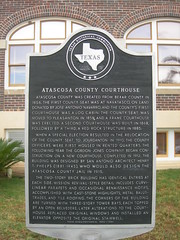
Atascosa County Courthouse. Atascosa County was created from Bexar County in 1856. The first county seat was at Navatasco, on land donated by Jose Antonio Navarro, and the county's first courthouse was a log cabin. The county seat was moved to Pleasanton in 1858, and a frame courthouse was erected. A second courthouse was built in 1868, followed by a third, a red rock structure in 1885. When a special election resulted in the relocation of the county seat to Jourdanton in 1910, the county officers were first housed in rented quarters. The following year the Gordon-Jones Company began construction on a new courthouse. Completed in 1912, the building was designed by San Antonio architect Henry T. Phelps (1881-1945), who would also design the Atascosa County Jail in 1915. The two-story brick building has identical entries at each side. Mission Revival-style detail includes curvilinear parapets and occasional Renaissance motifs, accomplished with cast-stone highlights, metal balustrades, and tile roofing. The corners of the building are turned with three-story tower bays, each topped by an open belvedere. Later alterations to the courthouse replaced original windows and installed an elevator opposite the original stairwell. Texas Sesquicentennial 1836-1986. #224
?, Jourdanton, TX, United States
Subjects
Texas Historical Marker #00225
Atascosa County Courthouse. This log cabin is a replica of first courthouse built 1856 near Amphion (Navatasco) 9 miles to the orthwest, on site given by Jose Antonio Navarro out of his 1828 grant from Coahuila and Texas. A signer of the Texas Declaration of Independence, he helped organize this county. First court term, 1857. First officials: Sheriff, James H. French; Chief Justice, Marcellus French; District Clerk, Edward Walker; County Clerk, Daniel Tobin; Tax Assessor-Collector, Thomas R. Brite; County Treasurer, Baylor Winn; District Attorney, James Paul; District Judge, E.F. Buckner. (1964) #225
?, Jourdanton, TX, United States
Subjects
Texas Historical Marker #00226
Thomas Henry Borden. Site of the home of Thomas Henry Borden one of the "Old Three Hundred" of Austin's colonies. Surveyed the town of Galveston. Editor and one of the founders in 1835 of the "Telegraph and Texas Register. Born in Norwich, New York, January 28, 1804;died in Galveston, Texas March 17, 1877. #226
?, Galveston, TX, United States