

Texas Historical Marker #00040
50th Anniversary of Battle of Galveston. Jan. 1, 1863 --- Jan. 1, 1914 In commemorating the 50th anniversary of the capture of Galveston by the Southern Confederacy. Gen. Arthur P. Bagby commanding the "Neptune." Dedicated to the heroes who wore the gray at the battle of Galveston. Jan. 1, 1863 Capt. J. T. Whitfield Lieut. J. W. Carson Private Jno. Buchanan Capt. Jas. Walker Sergeant W. H. Turk Capt. J. W. Whitfield In memory of Lavaca Co. men who fought in the Civil War. Capt. James Walker Gen. John B. Magruder Col. Tom Green Col. Arthur P. Bagby Com. Leon Smith Co. G. W. H. H. Brazier Banners may be furled but heroism lives forever. #40
Third & Main Streets, on Courthouse lawn, Hallettsville, TX, United States
Subjects
Texas Historical Marker #00041
Historic Trails. During the mass slaughter of buffaloes in the Panhandle, two trails arose to meet the needs of the hunters and their ever-hungry markets. Started about 1876, both moved vast convoys of wagons across the plains. Charles Rath-- transporting gun powder, lead, tobacco, whiskey, and food staples-- blazed a road from Dodge City to the Double Mountains. In two years, however, the best hunting was over and the route fell into disuse. Ed Jones and Joe Plummer forged a trail from Kansas to Fort Elliott. Their route became a freight road and finally a cattle road. (1969) #41
?, Canadian, TX, United States
Texas Historical Marker #00042
6666 Dixon Creek Ranch. Takes name from creek where noted buffalo hunter and scout Billy Dixon established first dugout home on High Plains, 1874. Ranch founded, 1882, by Francklyn Land and Cattle Co., English firm backed by Cunard Steamship Co. Fenced, 1884, with barbed wire hauled here from railroad at Dodge City; posts were of Palo Duro Canyon cedars. Purchased in 1903 by S. Burk Burnett (1849-1922), trail driver, rancher; an organizer and for 45 years on executive board, Texas Cattle Raisers Association. Host during 1905 wolf hunt to U.S. President Theodore Roosevelt. (1965) (Ranch not open to public.) #42
?, Panhandle, TX, United States
Subjects

Texas Historical Marker #00043
Andrew Herron Home. **BUILDING GONE** #43
906 Mill Road, Seguin, TX, United States
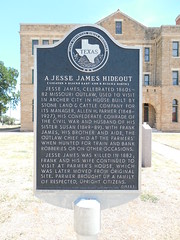
Texas Historical Marker #00044
A Jesse James Hideout. Jesse James, celebrated 1860s-1882 Missouri outlaw, used to visit in Archer City in house built by Stone Land and Cattle Company for its manager, Allen H. Parmer (1848-1927), his Confederate comrade of the Civil War and husband of his sister Susan (1849-89). With Frank James, his brother and aide, the outlaw chief hid at the Parmers' when hunted for train and bank robberies or on other occasions. Jesse James was killed in 1882; Frank and his wife continued to visit at Parmer's house, which was later moved from original site. Parmer brought up a family of respected, upright citizens. Erected by Archer County Historical Survey Committee. House is shown only by appointment, 1972. #44
?, Archer City, TX, United States
Subjects


Texas Historical Marker #00045
Civil War Education in Texas. Baylor University (including the "Female Department" later to become Mary Hardin-Baylor) had operated at Independence for 15 years before 1861. In the Civil War it suffered the setbacks of Texas education in general. This was despite leadership of its 1861-63 president George W. Baines (ancestor of U.S. President Lyndon B. Johnson) and loyalty of such patrons as Mrs. Sam Houston and her mother, who donated dried fruit for the tables in the dining hall. State bounties for education that previously had aided Texas colleges stopped in 1861. Many of the 2,416 students of 1860 became soldiers; many of the 25 Texas colleges had to close. Schools for younger children also suffered. The 1861 legislature passed free school laws, but could give no funds to schools. Children who waved from classroom doors to marching soldiers were going to subscription schools, paid for by their own parents. Old men, women and the disabled were the teachers. A mother or older sister often would "hear lessons" in the home. Books were scarce. Paper was unobtainable for replacing those that wore out. Writing was done on slates or in sand spread smooth on a table. (1964) #45
?, Belton, TX, United States
Texas Historical Marker #00046
A. B. Robertson Ranch. A noted pioneer in the West Texas cattle industry, Andrew Briggs ("Sug") Robertson was born in 1855 in Indiana. While still a young boy he came to Texas and learned the skills of a cowboy. Iin 1901 he bought land in this area and established the "V" ranch, stocked it with Hereford cattle, and made a specialty of raising that breed. This two-story brick home, constructed in 1911 by contractors C. Raymond and Clifford Westerman, served as ranch headquarters and as the Robertson family residence. It became headquarters for the "C Bar" ranch in 1950. Texas Sesquicentennial 1836-1986. #46
?, Lorenzo, TX, United States
Texas Historical Marker #00047
A. A. and Susanna Head Homestead. Alanson Asbury (A. A.) Head (1843-1925) and his wife, Susanna Alabama Bethany (1843-1924) built a two-story residence here about 1877. Over the years A. A. and Susanna, known as Uncle Ben and Aunt Sukie, terraced about 300 acres here on which they cultivated various orchards, vineyards, and berry patches. Their farm prospered and in 1903 they donated two acres across the road from their home for the building of the Head Chapel Methodist Church. In 1908 the Heads donated an adjoining 2 acres to establish the Bethany Rest Cemetery, where they were later buried side by side. (1993) #47
?, Alvarado, TX, United States
Texas Historical Marker #00048
A. B. Medlan Home. Built of brick made on this farm, settled 1855 by A.B. Medlan, Texas Ranger, Church leader and builder, treasurer and commissioner of Young County. Recorded Texas Historic Landmark, 1964. #48
SH 67 & County Road, SW of Graham, Graham, TX, United States
Texas Historical Marker #00050
A.C. Purvis House. San Benito was a "paper" town with no Anglo-American residents when Albanus Clemens Purvis (1850-1919) came here from Ohio to seek health. He became first Justice of the Peace, sold real estate, and farmed. His daughter Kate (later Mrs. J. Scott Brown) taught first school in 1907; daughter Emma (later Mrs. Asa Agar) was an early Postmaster, in 1911. A former mill owner and a skilled craftsman, Purvis in 1911 built this house for himself, his wife Margaret Ann (householder), and the two youngest of their nine children. The property still remains in the ownership of a descendant. (1974) #50
441 N. Reagan, San Benito, TX, United States
Texas Historical Marker #00051
A. C. Schreiner, Jr. Home. Prominent Kerrville rancher, businessman, philanthropist, and civic leader Charles A. Schreiner built the original part of this house in 1897 as a wedding gift for his son C. A., Jr. In 1912 it became the home of Schreiner's grandson A. C. Schreiner, Jr. (1890-1963), also an active area business leader. The second floor, arched porch, and tile roof were added in 1927. Designed by noted San Antonio architect Alfred Giles, they reflect influences of the Spanish style. Recorded Texas Historic Landmark - 1981 #51
?, Kerrville, TX, United States
Subjects
Texas Historical Marker #00052
A. H. Fortenberry. In the 1850s, A. H. ("Sevier") Fortenberry and his second wife Jane (Odell) moved from Arkansas to the wilderness then existing in this section of Texas. Living as a farmer and stock raiser, Fortenberry joined neighbors in warding off Indian raids which endangered the settlements. On October 30, 1868, at a site 3/4 of a mile northwest of this marker, he was intercepted and killed by Indians while trying to join a defensive posse. He was buried in the Pollard Cemetery, Denton County. It is thought that he was the last fatality in the Indian Wars in this vicinity. (1977) #52
FM 51, Slidell, TX, United States
Texas Historical Marker #00053
A. J. Moore High School. In 1875 professor A.J. Moore of Paul Quinn College, concerned over the lack of quality education for Waco's negro population, began teaching small groups of children in his home. The first schoolhouse, a frame building that had been relocated east of this site, had formerly served as a hospital. In 1923, the frame schoolhouse was replaced with a brick building. The school was renamed for its founder, A.J. Moore, who served as principal from 1881 to 1905. As the first school in Waco designated to educate the city's negro youth, A.J. Moore High School was an important institution in the community. Until 1952, Moore High housed students from grades one through twelve from 1952 to 1971 it served grades seven through twelve only. Moore High was closed in 1971. More than 4,000 students were graduated form A.J. Moore High School during its nearly 100 years of service. Many of them have made significant contributions in the fields of education, medicine, religion, law, public health, business, engineering, law enforcement, social services,theater, sports, and military service. (1985) #53
?, Waco, TX, United States
Texas Historical Marker #00054
A. J. Northington House. With first part built 1872 by a Hood's Texas Brigade veteran, county commissioner, Legislator, whose historic store also survives, on the town square. This was only frame home standing in the creek area after the 1873 flood. Two-story section, built later, made an ell of the old house. (1964) #54
803 S. Live Oak St., Lampasas, TX, United States

Texas Historical Marker #00055
A. J. Warren Building. Farmer and rancher A. J. Warren (1870-1933) moved to this area in 1902 and helped to organize Lynn County in 1903. He built this 2-story brick and concrete edifice in 1925 to house the First National Bank, chartered that year. Competition from another bank led to merger of the two and abandonment of this building in 1926. Various stores and offices occupied the structure before it was acquired by the city of O'Donnell in 1973. It became the O'Donnell Museum in 1974. Recorded Texas Historic Landmark - 1975 #55
corner of 8th and Doak Streets, O'Donnell, TX, United States
Texas Historical Marker #00056
A. M. Brownfield Home. A. M. Brownfield, for whose family this town was named, came to Terry County as a rancher in 1900. An early community leader, he organized the Brownfield State Bank in 1905. Built as a home for his family in 1928, this structure exhibits influences of the Spanish colonial style of architecture. The concrete and clay building materials were used to make the home as fireproof as possible, since an earlier family residence had been destroyed by fire in 1915. Recorded Texas Historic Landmark, 1985. #56
600 E. Cardwell, Brownfield, TX, United States
Texas Historical Marker #00057
A.T. & S.F. No. 5000 "Madam Queen". A star of the age of steam transportation. Pride of Atchison, Topeka & Santa Fe Railway, which came into Texas in 1886, has its Panhandle and Santa Fe General Offices in Amarillo, and served much of this area. Manufactured at the cost of $133,902.80 by world-famed Baldwin Locomotive Works, according to designs made by Santa Fe engineers. "Pilot" locomotive of its type, a model and champion in power and speed. When this locomotive went into service in December 1930, Santa Fe (like other American railways) had ceased to name engines for officers or celebrities, but called them by number. This was No. 5000. But one of the first engineers to steer it over the rails affectionately called it "Madam Queen", for a character in radio's popular "Amos and Andy" show. Gallant, faithful, swift, and strong, "Madam Queen" ran for more than 1,750,000 miles. Prior to diesels, this was the greatest of Santa Fe's locomotives. Its tender held 20,000 gallons of water and 7,107 gallons of fuel. Locomotive and tender weighed 662,500 pounds. Tractive force was 93,000 pounds. Boiler pressure, 300 pounds per square inch. Retired from service, November 1953, the "Queen" was given to City of Amarillo on April 19, 1957. (1965) #57
Santa Fe Station, 4th & Grant St., Amarillo, TX, United States
Texas Historical Marker #00058
Baden-Sproule House. Designed by noted Galveston architect Nicholas J. Clayton, this house was built in 1899 by Ida B. Baden on land once known as Thomas Borden's farm. West Island landowner John D. Settle sold Miss Baden the land and assisted here in the architectural arrangements. A wealthy property owner, Baden owned considerable stock in the Galveston Wharf Company, which was highly unusual. She died in 1906 at 43, following a sudden illness in her uptown residence, 2407 Avenue E. Her sister of Boston inherited the estate. The house was sold in 1913 to Benno Sproule, the principal in an ocean freight brokerage business. Following Sproule's death in 1932, his family continued to occupy the home until 1959. A fine example of the Queen Anne style of architecture, the house features a wraparound veranda with paired turned posts. Bow windows can be seen at the first and second floor levels, and fishscale shingles appear on the second floor. A balconette in the front gable exhibits a Palladian-inspired motif. Outstanding features also include the paneled and pedimented fireplace back and corbelled chimney caps. The home stands as an important element of Galveston's development and architectural history. Recorded Texas Historic Landmark - 1989 #58
1919 37th St., Galveston, TX, United States
Texas Historical Marker #00059
Arden Community. This ranching community was named for John Arden, a sheep raiser who arrived in 1876. After 1900, small homesteaders moved into the area. Joe Funk gave land for a school and cemetery in 1903. Baptist Church of Christ and Methodist congregations shared the schoolhouse for worship. Camp meetings were held at "the Grove" on Rocky Creek. In 1916 the school moved to a brick building at this site. Following a series of droughts, Arden began to decline. The post office closed in 1942 and the school in 1947. A frame polling station replaced the brick schoolhouse here. (1979) #59
?, Mertzon, TX, United States