
36 out of 39 (92%) plaques have been curated
45 subjects all or unphotographedGender Diversity
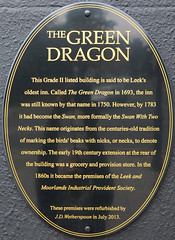
The Green Dragon. This Grade II listed building is said to be Leek's oldest inn. Called The Green Dragon in 1693, the inn was still known by that name in 1750. However, by 1783 it had become the Swan, more formally the Swan With Two Necks. This name originates from the centuries-old tradition of marking the bird's beaks with nicks, or necks, to denote ownership. The early 19th century extension at the rear of the building was a grocery and provision store. In the 1860s it became the premises of the Leek and Moorlands Industrial Provident Society.
2 St Edward Street, Leek, United Kingdom
Subjects
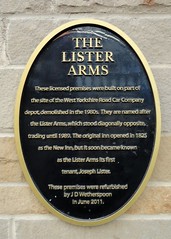
The Lister Arms. These licensed premises were built on part of the site of the West Yorkshire Road Car Company depot, demolished in the 1980s. They are named after the Lister Arms, which stood diagonally opposite, trading until 1989. The original inn opened in 1825 as the New Inn but it soon became known as the Lister Arms its first tenant, Joseph Lister.
South Hawksworth Street, Ilkley, United Kingdom
Subjects


The Peter Cushing. These licensed premises are named after the critically acclaimed actor who lived in Whitstable. This building is the former Oxford Cinema, which first opened its doors on 27 July 1936. it was built around the Oxford Picture Hall which, itself, opened in 1912 in what had been Oxford 'concert and music hall'. These premises were refurbished by J D Wetherspoon in July 2011.
The Peter Cushing, High Street, Whitstable, United Kingdom
Subjects
.jpg?width=250)
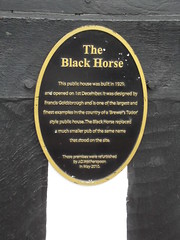
The Black Horse This public house was built in 1929 and opened on 1st December. It was designed by Francis Goldsbrough and is one of the largest and finest examples in the country of a 'Brewer's Tudor' style public house. The Black Horse replaced a much smaller pub of the same name that stood on the site. These premises were refurbished by J.D. Wetherspoon in May 2010.
The Black Horse - Bristol Road South, Northfield, Birmingham, United Kingdom
Subjects

The Layton Rakes Blackpool took shape as a seaside resort from the 18th century, in a sparsely populated area at the seaward end of Layton Rakes (now Church Street). 'Rake' is the Scandinavian word meaning path. Layton Rakes led inland to the centuries old village of Layton with Warbreck. In late Victorian times the site of these licensed premises were occupied by Whitehead's Fish, Game, Poultry and Oyster Warehouse, which boasted "a magnificent oyster room" These premises were built by J.D. Wetherspoon and opened in November 2011
Market Street, Blackpool, United Kingdom
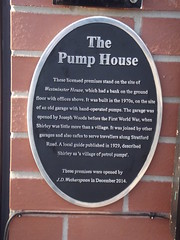
The Pump House These licensed premises stand on the site of Westminster House, which had a bank on the ground floor with offices above. It was built in the 1970s, on the side of an old garage with hand-operated pumps. The garage was opened by Joseph Woods before the First World War, when Shirley was little more than a village. It was joined by other garages and also cafes to serve travellers along Stratford Road. A local guide published in 1929, described Shirley as 'a village of petrol pumps'. These premises were opened by J.D. Wetherspoon in December 2014.
The Pump House - Parkgate Shirley - Stratford Road, Shirley, Solihull, United Kingdom
Subjects

The Gooseberry Bush These Licensed Premises were built in 1984, on part of the site occupied by Nottingham Women's Hospital. The hospital had replaced a Victorian mansion, called Southfield House. The first patients arrived in January 1930. The last baby born here was in January 1981. The hospital closed, with the site then partly cleared for The Gooseberry Bush, named after the place where babies were said to arrive.
Peel Street, Nottingham, United Kingdom
Subjects
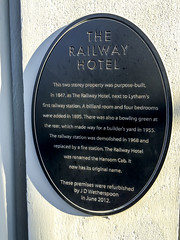
The Railway Hotel This two storey property was purpose-built, in 1847, as The Railway Hotel, next to Lytham's first railway station. A billiard room and four bedrooms were added in 1895. There was also a bowling green at the rear, which made way for a builder's yard in 1955. The railway station was demolished in 1968 and replaced by a fire station. The Railway Hotel was renamed the Hansom Cab. It now has its original name.
Station Road, Lytham St Annes, United Kingdom
Subjects
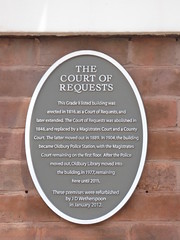
The Court of Requests This Grade II listed building was erected in 1816, as a Court of Requests, and later extended. The Court of Requests was abolished in 1846 and replaced by a Magistrates Court and a County Court. The latter moved out in 1889. In 1904, the building became Oldbury Police Station, with the Magistrates Court remaining on the first floor. After the Police moved out, Oldbury Library moved into the building, in 1977, remaining here until 2011. These premises were refurbished by J D Wetherspoon in January 2012.
The Court of Requests - 21 Church Street, Oldbury, United Kingdom
Subjects
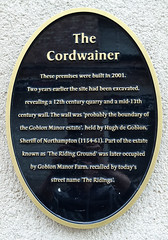
The Cordwainer These premises were built in 2001. Two years earlier the site had been excavated, revealing a 12th century quarry and a mid-13th century wall. The wall was 'probably the boundary of the Gobion Manor estate', held by Hugh de Gobion, Sheriff of Northampton (1154-61). Part of the estate known as 'The Riding Ground' was later occupied by Gobion Manor Farm, recalled by today's street name 'The Ridings'.
The Ridings, Northampton, United Kingdom
Subjects
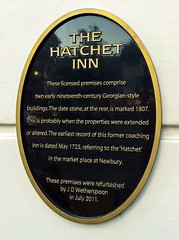
The Hatchet Inn These licensed premises comprise two early nineteenth-century Georgian-style buildings. The date stone, at the rear, is marked 1807. This is probably when the properites were extended or altered. The earliest record of this former coaching inn is dated May 1725, referring to the 'Hatchet' in the market place at Newbury
12 Market Place, Newbury, United Kingdom
Subjects
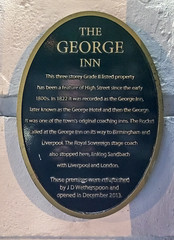
The George Inn This three storey Grade II listed property has been a feature of High Street since the early 1800's. In 1822 it was recorded as the George Inn, later known as the George Hotel and then the George. It was one of the town's original coaching inns. The Rocket called at the George Inn on its way to Birmingham and Liverpool. The Royal Sovereign stage coach also stopped here, linking Sandbach with Liverpool and London
39 High Street , Sandbach, United Kingdom
Subjects
The Rose Salterne. These licensed premises are named after the heroine of Westward Ho!. This famous historical novel is set in Bideford, where it was written by Charles Kingsley, in 1854. In the early 19th century the Rev. Alford, Master of Bideford Grammar School, lived in a house more-or-less on this site. It was replaced by 'a set of Public Rooms', in 1871 which later became the Palace Cinema. The cinema closed in 1962 and was, itself, replaced by Ford & Lock's supermarket, later a carper and furnishing store and now a Wetherspoons feehouse.
, Bideford, United Kingdom
Subjects
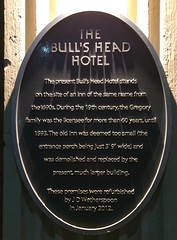
The Bull's Head Hotel The present Bull's Head Hotel stands on the site of an inn of the same name from the 1690's. During the 19th century, the Gregory family was the licencee for more than 60 years, until 1893. The old inn was deemed too small (the entrance porch being just 3'9" wide) and was demolished and replaced by the present much larger building.
12 High Street, Walkden, United Kingdom
Subjects
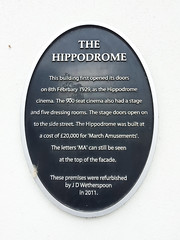
This building first opened its doors on 8th February 1929, as the Hippodrome cinema. The 900 seat cinema also had a stage and five dressing rooms. The stage doors open on to the side street. The Hippodrome was built at a cost of £20,000 for 'March Amusements'. The letters 'MA' can still be seen at the top of the facade
Dartford Road, March, United Kingdom
Subjects
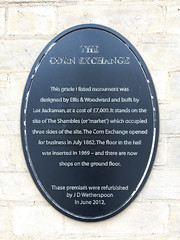
The Corn Exchange This grade I listed monument was designed by Ellis & Woodward and built by Lot Jackaman, at a cost if £7,000. It stands on the site of The Shambles (or 'market') which occupied three sides of the site. The Corn Exchange opened for business in July 1862. The floor in the hall was inserted in 1969 - and there are now shops on the ground floor
Abbeygate, Bury St Edmunds, United Kingdom
Subjects
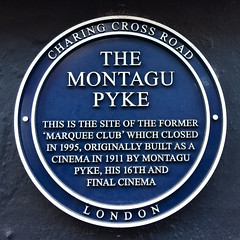
The Montagu Pyke This is the site of the former 'Marquee Club' which closed in 1995, originally built as a cinema in 1911 by Montagu Pyke, his 16th and final cinema
105-107 Charing Cross Rd, London, United Kingdom
Subjects

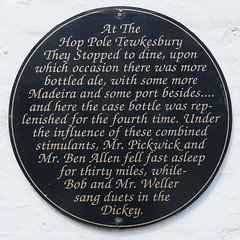
At the Hope Pole Tewkesbury they stopped to dine, upon which occasion there was more bottled ale, with some more Madeira and some port besides..... and here the case bottle was replenished for the fourth time. Under the influence of these combined stimulants, Mr. Pickwick and Mr. Ben Allen fell asleep for thirty miles, while Bob and Mr. Weller sang duets in the Dickey.
Church Street, Tewkesbury, United Kingdom
Subjects
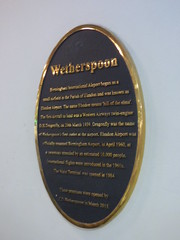
Wetherspoon Birmingham International Airport began as a small airfield in the Parish of Elmdon and was known as Elmdon Airport. The name Elmdon means 'hill of the elms. The first aircraft to land was a Western Airways twin-engine D.H. Dragonfly, on 20th March 1939. Dragonfly was the name of Wetherspoon's first outlet at the airport. Elmdon Airport was officially renamed Birmingham Airport, in April 1960, at a ceremony attended by an estimated 10,000 people. International flights were introduced in the 1960s. The Main Terminal was opened in 1984. These premises were opened by J.D. Wetherspoon in March 2015.
Wetherspoon - Departures Lounge - Birmingham Airport, Solihull, United Kingdom
Subjects
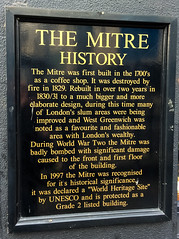
The Mitre History The Mitre was first built in the 1700's as a coffee shop. It was destroyed by fire in 1829. Rebuilt in over two years in 1830/31 to a much bigger and more elaborate design, during this time many of London's slum areas were being improved and West Greenwich was noted as a favourite and fashionable area with London's wealthy. During World War Two the Mitre was badly damaged with significant damage caused to the front and first floor of the building. In 1997 the Mitre was recognised for it's historical significance, it was declared a "World Heritage Site" by UNESCO and is protected as a Grade 2 listed building
291 Greenwich High Rd, Greenwich, United Kingdom
Subjects

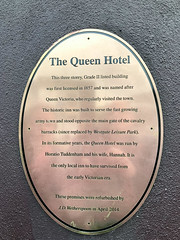
This three story Grade II listed building was first licensed in 1857 and was named after Queen Victoria, who regularly visited the town. The historic inn was built to serve the fast-growing army town and stood opposite the main gate of the cavalry barracks (since replaced by Westgate Leisure Park). In its formative years, the Queen Hotel was run by Horatio Toddenham and his wife, Hannah. It is the only local inn to have survived from the early Victorian era.
1 High Street, Aldershot, United Kingdom
Subjects
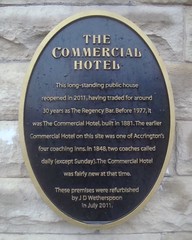
The Commercial Hotel. This long-standing public house reopened in 2011, having traded for around 30 years as The Regency Bar. Before 1977, it was The Commercial Hotel, built in 1881. The earlier Commercial Hotel on this site was one of Accrington's four coaching inns. In 1848, two coaches called daily (except Sunday). The Commercial Hotel was fairly new at that time.
1, Church Street, Accrington, United Kingdom
Subjects

The Master Mariner These licensed premises form part of Union Terrace, originally a short row of lodging houses built for the seaside resort of New Brighton, created in the 1830's. Henry Cubbon, 'Master Mariner', was one of the Terrace's early residents. Captain Cubbon died in 1855, aged 40. His death was announced in the Liverpool Mercury. By the 20th century the lodging houses had been converted into cafes and public houses
3–5 Union Terrace Marine Promenade, New Brighton, United Kingdom
Subjects
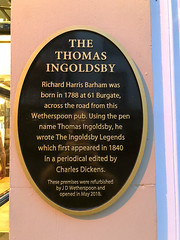
The Thomas Ingoldsby Richard Harris Barham was born in 1788 at 61 Burgate, across the road from this Wetherspoon pub. Using the pen name of Thomas Ingoldsby, he wrote The Ingoldsby Legends which first appeared in 1840 in a periodical edited by Charles Dickens.
St George's Street, Canterbury, United Kingdom
Subjects
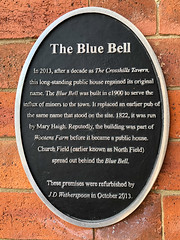
The Blue Bell In 2013, after a decade as The Crosshills Tavern, this long standing public house regained its original name. The Blue Bell was built in c1900 to serve the influx of miners to the town. It replaced an earlier pub of the same name that stood on the site. 1822, it was run by Mary Haigh. Reputedly, the building was part of Wootens Farm before it became a public house. Church Field (earlier known as North Field) spread out behind the Blue Bell.
Barnsley Road, Hemsworth, United Kingdom
Subjects
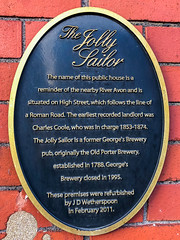
The Jolly Sailor The name of this public house is a reminder of the nearby River Avon and it situated on High Street, which follows the line of a Roman Road. The earliest recorded landlord was Charles Coole, who was in charge 1853-1874. The Jolly Sailor is a former George's Brewery pub, originally the Old Porter Brewery, established in 1788. George's Brewery closed in 1995.
High Street, Bristol, United Kingdom
Subjects
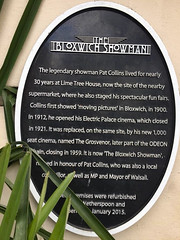
The Bloxwich Showman The legendary showman Pat Collins lived for nearly 30 years at Lime Tree House, now the site of the nearby supermarket, where he also staged his spectacular fun fairs. Collins first showed 'moving pictures' in Bloxwich, in 1900. In 1912, he opened his Electric Palace cinema, which closed in 1921. It was replaced, on the same site, by his new 1,000 seat cinema, named The Grosvenor, later part of the ODEON chain, closing in 1959. It is now 'The Bloxwich Showman', named in honour of Pat Collins, who was also a local councillor, as well as MP and Mayor of Wallsall.
156 High St, Bloxwich, United Kingdom
Subjects
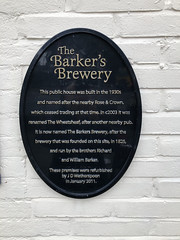
The Barker's Brewery This public house was built in the 1930s and named after the nearby Rose & Crown, which ceased trading at that time. In c2003 it was renamed The Wheatsheaf, after another nearby pub. It is now named the Barkers Brewery, after the brewery that was founded on this site, in 1825, and run by the brothers Richard and William Barker.
Archway Road, Liverpool, United Kingdom
Subjects
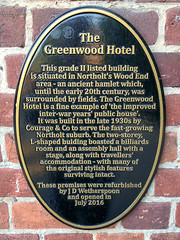
The Greenwood Hotel This grade II listed building is situated in Northolt's Wood End area - an ancient hamlet which, until the early 20th century, was surrounded by fields. The Greenwood Hotel is a fine example of 'the improved inter-war years' public house'. It was built in the late 1930's by Courage & Co to serve the fast growing Northolt suberb. The two-storey, L-shaped building boasted a billiards room and an assembly hall with a stage, along with travellers' accommodation - with many of the original stylish features surviving intact.
674 Whitton Ave West, London, United Kingdom
Subjects
The Royal Enfield These licensed premises are named after the famous motorcycle manufacturer that was based in Redditch for around sixty years, producing a stream of successful models. This building is the former Danilo cinema. Designed by Ernest Roberts, it was officially opened on 4th February 1937. The last picture show was in 1999. These premises were refurbished by J D Wetherspoon in May 2010.
The Royal Enfield - Unicorn Hill, Redditch, United Kingdom
Subjects

The Booking Office. This historic building, part of a UNESCO World Heritage Site, looks west across Princes Street Gardens. In 1846, The North British Railway Company built a station at this end of the gardens - now, all that remains is the much-modelled booking office. Originally, it had nine arches at the front. The wings on either side were slightly set back, each being three arches wide and seven arches deep. The booking office later became the parcels office, until around 1984. It was then converted into licensed premises, before becoming a restaurant and later this Wetherspoon free house. These premises were refurbished by J D Wetherspoon and opened in June 2016.
, Edinburgh, United Kingdom
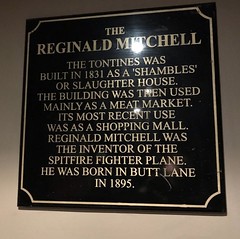
The Reginald Mitchell The Tontines was built in 1831 as a 'Shambles' Or Slaughter House. The Building was then used mainly as a meat market. its most recent use was as a shopping mall reginald Mitchell was the inventor of the Spitfire Fighter Plane, he was born in Butt Lane in 1895.
The Tontine 20 Parliament Row, Hanley, United Kingdom
Subjects


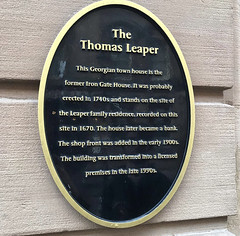
The Thomas Leaper This Georgian town house is the former Iron Gate House. It was probably erected in 1740s and stands on the site of the Leaper family residence, recorded on this site in 1670. The house later became a bank. The shop front was added in the early 1900s. The building was transformed into a licensed premises in the late 1990s.
Iron Gate, Derby, United Kingdom
Subjects
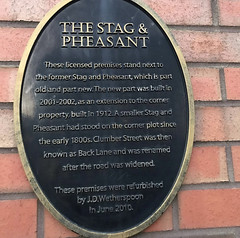
The Stag & Pheasant These licensed premises stand next to the former Stag and Pheasant, which is part old and part new. The new part was built in 2001-2002, as an extension to the corner property, built in 1912. A smaller Stag and Pheasant had stood on the corner plot since the early 1800s. Clumber Street was then known as Back Lane and was renamed after the road was widened. These premises were refurbished by J.D.Wetherspoon in June 2010.
Clumber St, Mansfield, United Kingdom
Subjects
The Commercial Hotel This pub was designed reflect The Commercial Hotel in its heyday, during the early 1900s' Art Nouveau period. The design also reflects Accrington-born designer Joseph Briggs, instrumental in the popularity of the Tiffany Stained Glass Company. We have used these references throughout the pub from the Tiffany inspired light fittings to the welcoming Art Nouveau bar. The design gives this historic coaching inn a sense of quality and character which carries on throughout the pub to its fantastic secluded beer garden
1 Church Street, Accrington, United Kingdom
Subjects

The Lantokay This Wetherspoon freehouse originally occupied the two middle cottages in this High Street terrace and has since expanded into an adjoining property. The four cottages are shown on the 1886 OS map, but are much older. After World War Two, one became a grocer's shop, in the 1970s, it was combined with the cottage next door to form Fine Shoes. In 2002, the premises were converted into The Lantokay, which was named after the earliest known settlement here. It means the sacred enclosure of Kay, who was a Celtic saint. During the 12th century the Roman causeway across the marshes was restored and Lantokay was called Street, from the Latin word 'strata', meaning a paved road. These premises were opened by J D Wetherspoon in January 2002 and refurbished in April 2017.
The Lantokay - 111-113 High Street, Street, United Kingdom
Subjects

The Thomas Waghorn This classic Edwardian-style building first opened its doors, in 1902, as Chatham's new Head Post Office. It was built for the General Post Office (GPO) by its Office of Works, under the direction of William Oldrieve. It is now named after the Chatham-born naval officer and merchant seaman Thomas Waghorn, who was also a postal pioneer. Waghorn developed a new postal route from Great Britain to India. His new 6,000-mile overland route replaced the 16,000-mile sea journey, reducing the time taken from around three months to between 35 and 40 days.
14 Railway Street, Chatham, United Kingdom
Subjects

The Greyhound This building is the second Greyhound public house on this site. Its predecessor was a three storey Georgian style property, built around 1797. The Greyhound Stands on the High Street section once occupied by The Grete (or Great) House. It was first recorded in 1532, when owned by the London brewer thomas Knight, and it was not demolished undi 1868.
205 High St, Bromley, United Kingdom
Subjects

The Railway Inn. In recent years this long-standing public house was named the Corner Flag and Arbuckles before that. Now the Railway Inn again, it was named after the (now closed) railway station, in 1894. Before the station opened it had been the New Inn, with thatched cottages on either side. A lavish reception was held at the New Inn in September 1879. The inn was probably "new" around this time. These premises were refurbished by J.D. Wetherspoon in June 2011.
143 High Street, Rushden, United Kingdom