
Gender Diversity
The top 10


.jpg?width=250)


The Cross Keys dates from 1904 and was built by Frank Raney of Stonegate. The current building replaced an earlier inn of the same name on the same site. The new building, standing on the corner of Goodramgate and Deangate, can be viewed and accessed from both streets. Goodramgate was created in the Viking period, around 1100 years ago, as a street to connect the former Eastern Roman gateway with the former Northern Roman gateway. The street was originally called Gutherumgate after a local warrior, though some people believe it was after King Guthrum, who was defeated by King Arthur.
34 Goodramgate, York, United Kingdom
Subjects

Centenary Of Cinema 1996 #262
John Barry (born 3rd November 1933) Oscar winning film music composer lived here 1933-1947
Hull Road, York, United Kingdom
Subjects



Blue Bridge. The first bridge built on this site in 1738 was a small wooden drawbridge painted blue. In 1767 it was replaced by a fixed stone bridge and again by a wooden 'Turning Bridge' in 1792, which allowed boats to proceed up the Foss. Another replacement in 1834 gave way to an iron lifting bridge built in 1858. The current bridge dates from 1929-30. Two platforms were erected at the St George's field end of the bridge to support two cannons captured at the Battle of Sebastopol in 1855. These formed the City's Crimean War Memorial. The metal guns were melted down during the Second World War.
Blue Bridge Lane, York, United Kingdom
Subjects
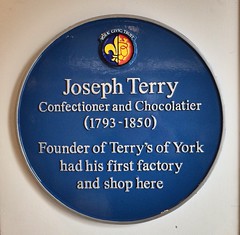
Joseph Terry confectioner and chocolatier (1793-1850) founder of Terry's of York had his first factory and shop here
3-5 St Helen’s Square, York, United Kingdom
Subjects


The south west wall of the Roman fortress lies buried below this store.
20 Feasegate, York, United Kingdom

Near to this place, Margaret Clitherow of York, Saint of the Catholic Church, was martyred for her Christian faith, on 25th March 1586.
Ouse Bridge, York, United Kingdom
Subjects

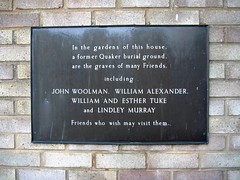
In the gardens of this house, a former Quaker burial ground, are the graves of many Friends, including John Woolman, William Alexander, William and Esther Tuke and Lindley Murray. Friends who wish may visit them.
Tuke House, Cromwell Road, York, United Kingdom
Subjects


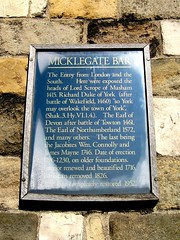
Micklegate Bar. The entrance from London and the South. Here were exposed the heads of Lord Scope of Masham 1415, Richard Duke of York (after Battle of Wakefield, 1460) "so York may overlook the town of York", (Shak.3.Hy.VI.1.4.). The Earl of Devon after battle of Towton 1451. The Earl of Northumberland 1572, and many others. The last being the Jacobites Wm. Connolly and James Mayne 1746. Date of erection 1196-1230, on older foundations. Exterior renewed and beautified 1716. Barbican removed 1826. The Bar was completely restored 1952.
Micklegate Bar, York, United Kingdom
Subjects

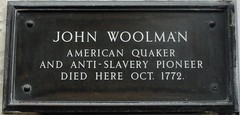
John Woolman American Quaker and anti-slavery pioneer died here Oct. 1772.
Marygate Lane, York, United Kingdom
Subjects
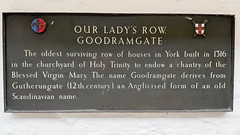
Our Lady's Row, Goodramgate. The oldest surviving row of houses in York built in 1316 in the churchyard of Holy Trinity to endow a chantry of the Bless Virgin Mary. The name Goodramgate derives from Gutherungate (13th. century) an Anglicised form of an old Scandinavian name.
70 Goodramgate, York, United Kingdom
Subjects
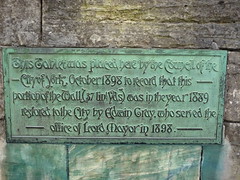
This Tablet was placed here by the Council of the City of York, October 1898 to record that this portion of the Wall (37 lin Yds) was in the year 1889 restored to the City by Edwin Gray, who served the office of Lord Mayor in 1898.
city walls, York, United Kingdom
Subjects
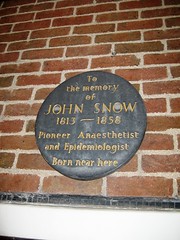
To the memory of John Snow 1813-1858. Pioneer anaesthetist and epidemiologist born near here.
Park Inn, North Street, York, United Kingdom
Subjects


Stonegate. The Via Praetoria of the Roman fortress of Eboracum and in daily use for about 1900 years. Its name derived from the fact that it was a Roman stone-paved street.
41 Stonegate, York, United Kingdom
Subjects
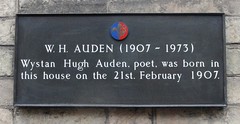
W. H. Auden (1907-1973). Wystan Hugh Auden, poet, was born in this house on the 21st February 1907.
54 Bootham, York, United Kingdom
Subjects

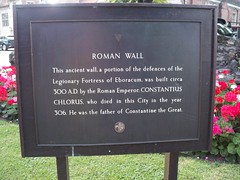
Roman Wall. This ancient wall, a portion of the defences of the Legionary Fortress of Eboracum, was built circa 300 A. D. by the Roman Emperor, Constantius Chlorus, who died in this City in the year 306. He was the father of Constantine the Great.
St. Leonard's Place, York, United Kingdom
Subjects

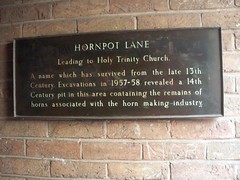
Hornpot Lane. Leading to Holy Trinity Church. A name which has survived from the late 13th Century. Excavations in 1957-58 revealed a 14th century pit in this area containing the remains of horns associated with the horn making industry.
Low Petergate, York, United Kingdom
Subjects
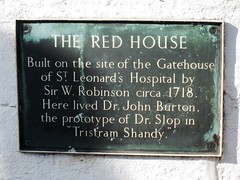
The Red House Built on the site of the Gatehouse of St. Leonard's Hospital by Sir W. Robinson circa 1718. Here lived Dr. John Burton, the prototype of Dr. Slop in "Tristram Shandy".
The Red House, York, United Kingdom
Subjects

The Mansion House. The residence of the Lord Mayor during his year of office. It was built in 1725-30.
Saint Helen's Square, York, United Kingdom
Subjects

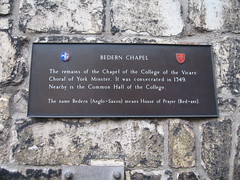
Bedern Chapel. The remains of the Chapel of the College of the Vicars Choral of York Minster. It was consecrated in 1349. Nearby is the Common Hall of the College. The name Bedern (Anglo-Saxon) means House of Prayer (Bed-aer).
Bartle Garth, York, United Kingdom
Subjects
Castlegate House site of The Mount Friends' Girls' School 1831 - 1857
29 Castlegate, York, United Kingdom
Subjects

St Williams College. A unique survival of a non-monastic religious building, the college is named after Archbishop William Fitzherbert who was canonised in 1227. The college was founded in 1461 as a residence for priests serving chantry altars in the Minster. Sold after the reformation it was owned by Sir Henry Jenkyns in 1642 and housed the printing presses of King Charles I during the Civil War. Restored by Frank Green in the 1900s, the Dean and Chapter of York became Trustees in 1972.
College Street, York, United Kingdom
Subjects
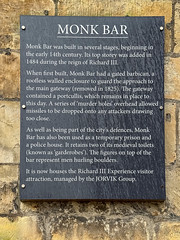
Monk Bar. Probably so named after the monks of a neighbouring monastery, not as erroneously supposed after General Monk 1660. The vaulted chambers above were the Freemen's Prison. The Arms of England are quartered with those of France on the outer side of Bar. The original portcullis still remains. This Bar is on line of Roman Wall, erected on Roman foundations in the 13th century and enlarged in the 15th century. Barbican removed 1825. The Bar completely restored 1953 and strengthened in 1979.
Goodramgate, York, United Kingdom
Subjects

In commemoration of the boys and girls of the Blue and Gray Coat schools, founded in 1705 for orphan children of the City of York. This charity was amalgamated with St. Stephen's Orphanage to form the York Children's Trust, which erected this plaque in 1996.
Peasholme Green, York, United Kingdom
Jaques Sterne, Precentor of York Minster lived here, from 1742 to 1759.
Minster Yard, York, United Kingdom
Subjects
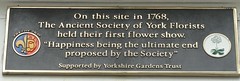
On this site in 1768, The Ancient Society of York Florists held their first flower show. "Happiness being the ultimate end proposed by the Society". Supported by Yorkshire Gardens Trust.
24-26 Colliergate, York, United Kingdom
Subjects

This Observatory was built by the Yorkshire Philosophical Society following the inaugural meeting of the British Association for the Advancement of Science in 1831. It has an earlier rotating roof designed by John Smeaton who also designed the Eddystone Lighthouse. The Observatory housed what was for many years the largest refracting telescope in the world, designed and built by Thomas Cook of York, whose firm also built the Greenwich transit instrument. It was restored and refitted to mark the British Associations 150th Anniversary meeting in York in 1981 and was officially opened by its President H.R.H. the Duke of Kent, G.C.M.G., G.C.V.O.
Museum Gardens, York, United Kingdom
Subjects

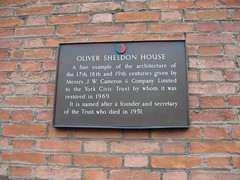
Oliver Sheldon House. A fine example of the architecture of the 17th, 18th and 19th centuries given by Messrs. J. W. Cameron & Company Limited to the York Civic Trust by whom it was restored in 1969. It is named after a founder and secretary of the Trust who died in 1951.
17-19 Aldwark, York, United Kingdom
Subjects
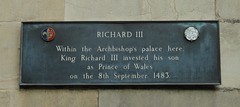
Richard III. Within the Archbishop's palace here, King Richard III invested his son as Prince of Wales on the 8th September, 1483.
Dean's Park, York, United Kingdom
Subjects


The upper storey of this building was the meeting place of York Methodists from 1753 to 1759. John Wesley, Charles Wesley and George Whitefield preached here on several occasions during that time. The actual room which the Methodists occupied was destroyed by fire and replaced by the present room about the year 1880.
Newgate, York, United Kingdom
Subjects


.jpg?width=250)
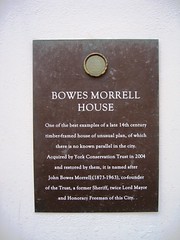
Bowes Morrell House. One of the best examples of a late 14th century timber-framed house of unusual plan, of which there is no known parallel in the city. Acquired by York Conservation Trust in 2004 and restored by them, it is named after John Bowes Morrell (1873-1963), co-founder of the Trust, a former Sheriff, twice Lord Mayor and Honorary Freeman of this City.
111 Walmgate, York, United Kingdom
Subjects

The St. Andrew Society of York. The Society was founded in the Coffee Rooms in these premises on the 7th. December 1894.
19 High Ousegate, York, United Kingdom
Subjects
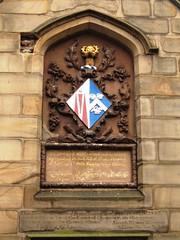
This Hospital was founded and endowed by Dame Sarah the Relict of Sir John Hewley of the City of York, Knight. Anno Domini 1700. Thou O God hast prepared of thy goodness for the poor. PS 68 10
St Saviourgate, York, United Kingdom
Subjects

York County Hospital 1740-1977 This building was designed by J. B. and W. Atkinson. Architects of York. The foundation stone was laid in 1849 and the 100 bedded hospital and Nurses Training School was opened in 1851.
Monkgate, York, United Kingdom
Subjects
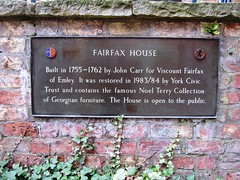
Fairfax House. Built in 1755-1762 by John Carr for Viscount Fairfax of Emley. It was restored in 1983/84 by York Civic Trust and contains the famous Noel Terry Collection of Georgian furniture. The House is open to the public.
Castlegate, York, United Kingdom
Subjects
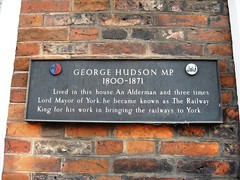
George Hudson M.P. 1800-1871 Lived in this house. An Alderman and three times Lord Mayor of York, he became known as The Railway King for his work in bringing the railways to York.
44 Monkgate, York, United Kingdom
Subjects


Walmgate Bar. Probably built in the reign of Edward I. The wood and plaster building on the inner side is of the Elizabethan period. This Bar was greatly damaged during the siege of York 1644 by Parliamentarians' battery fire from Lamel Hill. The portcullis and gates remain and this Bar alone retains its barbican which was erected in the reign of Edward III. The Arms of Henry V are on the outer side. The Bar was restored in 1648 and completely renovated in 1959.
Walmgate Bar, York, United Kingdom
Subjects

Roman Fortress. This plaque marks the site of the Porta Principalis Dextra or North Western Gate of the Roman Fortress of which the foundations as rebuilt circa A.D.300 lie just below ground.
Bootham Bar, York, United Kingdom
Subjects
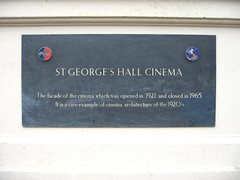
St George's Hall Cinema. The facade of the cinema which was opened in 1921 and closed in 1965. It is a rare example of cinema architecture of the 1920's.
Castlegate, York, United Kingdom
Subjects
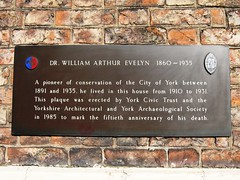
Dr. William Arthur Evelyn 1860-1935. A pioneer of conservation of the City of York between 1891 and 1935, he lived in this house from 1910 to 1931. This plaque was erected by York Civic trust and the Yorkshire Architectural and York Archaeological Society in 1985 to mark the fiftieth anniversary of his death.
33 Bootham, York, United Kingdom
Subjects
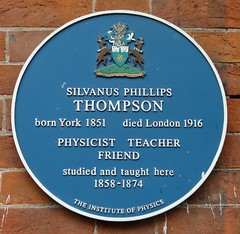
Silvanus Phillips Thompson born York 1851 died London 1916 physicist teacher friend studied and taught here 1858-1874
51 Bootham, York, United Kingdom
Subjects


Tower Gardens. Originally part of "The Long Walk" extending downstream to the confluence of the Rivers Ouse and Foss at Blue Bridge. A gateway was broken through the city wall and a handsome iron palisade gate was set in a stone arch (now removed) with an inscription stating that it was erected during the Mayoralty of Jonas Thompson (1731 to 1732). This gate was located where South Esplanade now enters the gardens. As the first public gardens in the city, the current arrangement was laid out in 1880-81, during the construction of Skeldergate Bridge, and the walk passed under the bridge through the short tunnel to St. George's field.
Tower Gardens, York, United Kingdom

Castlegate House. Designed by John Carr, Architect, of York (1723-1807) for Peter Johnson, Recorder of York, and completed in 1763.
29 Castlegate, York, United Kingdom
Subjects
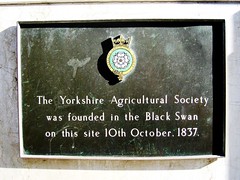
The Yorkshire Agricultural Society was founded in the Black Swan on this site 10th October, 1837.
44 Coney Street , York, United Kingdom
Subjects

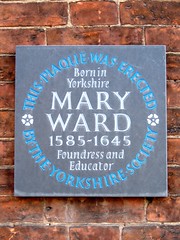
Born in Yorkshire. Mary Ward 1585-1645. Foundress and Educator.
Bar Convent, Blossom Street, York, United Kingdom
Subjects


Here stood the Black Swan one of York's oldest coaching inns. In the early 18th century the journey to London took four days.
44 Coney Street , York, United Kingdom
Subjects
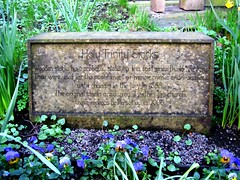
Holy Trinity Stocks. Wooden stocks have probably stood on this spot since the 16th century. They were used for the punishment of minor crimes and nuisance until changes in the law in 1858. The original stocks are displayed within the church, these replicas being set up in 2006.
Holy Trinity churchyard, Micklegate, York, United Kingdom
Subjects
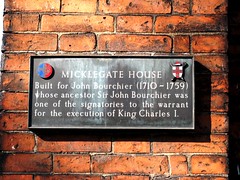
Micklegate House. Built for John Bourchier (1710-1759) whose ancestor Sir John Bourchier was one of the signatories to the warrant for the execution of King Charles I.
88-90 Micklegate, York, United Kingdom
Subjects
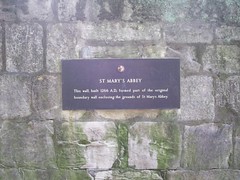
St Mary's Abbey. This wall, built 1266 A.D., formed part of the original boundary wall enclosing the grounds of St Mary's Abbey.
Off Exhibition Square, York, United Kingdom
Subjects
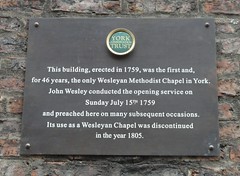
This building, erected in 1759, was the first and, for 46 years, the only Wesleyan Methodist Chapel in York. John Wesley conducted the opening services on Sunday July 15th 1750 and preached here on many subsequent occasions. Its use as a Wesleyan Chapel was discontinued in the year 1805.
60-62 Aldwark, York, United Kingdom
Subjects
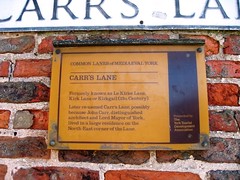
Carr's Lane. Formerly known as Le Kirke Lane, Kirk Lane or Kirkgail (13th Century). Later re-named Carr's Lane, possibly because John Carr, distinguished architect and Lord Mayor of York, lived in a large residence on the North-East corner of the Lane.
Carr's Lane, York, United Kingdom
Subjects

This is the location of the ancient Jewish cemetery of York. Some of the remains were re-interred 8th July 1984 8th Tammuz 5744 in the presence of the Chief Rabbi Sir Immanuel Jakobovits and representatives of the Jewish community. The re-interment site was kindly provided by J Sainsbury plc to whom the Jewish community is most grateful.
Jewbury, York, United Kingdom
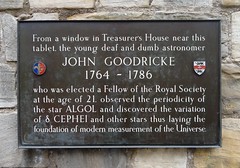
From a window in Treasurer's House near this tablet, the young deaf and dumb astronomer John Goodricke 1764 - 1786 who was elected a Fellow of the Royal Society at the age of 21, observed the periodicity of the star ALGOL and discovered the variation of δ CEPHEI and other stars thus laying the foundation of modern measurement of the Universe.
Minster Yard, York, United Kingdom
Subjects
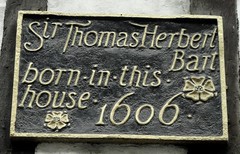
Sir Thomas Herbert, Bart., born in this house 1606.
Sir Thomas Herbert’s House, Pavement, York, United Kingdom
Subjects

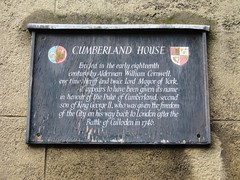
Cumberland House. Erected in the early eighteenth century by Alderman William Cornwell, one time Sheriff and twice Lord Mayor of York. It appears to have been given its name in honour of the Duke of Cumberland, second son of King George II, who was given the freedom of the City on his way back to London after the battle of Culloden in 1746.
Cumberland Street, York, United Kingdom
Subjects
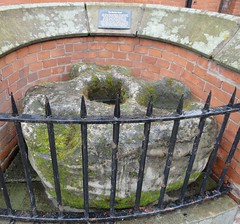
The Burton Stone. This stone, first recorded in 1575 and named after the local Burton family, is believed to be the base of a cross which formed a city boundary marker after the dissolution of the nearby St. Mary Magdelene Hospital. During York's worst bout of plague in 1604-05, when a third of its citizens died, people placed money, immersed in vinegar in the hollows, to safely pay outsiders for food or other goods.
Jnt of Bootham/Burton Stone Lane, York, United Kingdom
Subjects
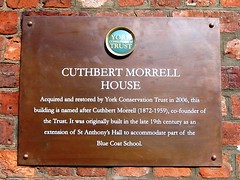
Cuthbert Morrell House. Acquired and restored by York Conservation Trust in 2006, this building is named after Cuthbert Morrell (1872-1959), co-founder of the trust. It was originally built in the late 19th century as an extension of St Anthony's Hall to accommodate part of the Blue Coat School.
47 Aldwark, York, United Kingdom
Subjects

The Yorkshire Philosophical Society transferred the Yorkshire Museum and Gardens to the citizens of York on January 2nd 1961
Yorkshire Museum, York, United Kingdom
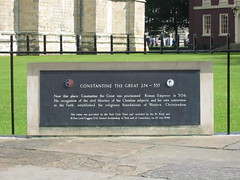
Constantine The Great 274-337 Near this place, Constantine was proclaimed Roman Emperor in 306. His recognition of the civil liberties of his Christian subjects, and his own conversion to the Faith, established the religious foundations of Western Christendom.
Deangate, York, United Kingdom
Subjects

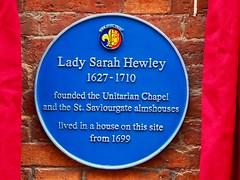
Lady Sarah Hewley 1627-1710 founded the Unitarian Chapel and the St. Saviourgate almshouses lived in a house on this site from 1699
31 St. Saviourgate , York, United Kingdom
Subjects

William Milner In memory of William Milner - born 1900, died 1942 Station foreman William Milner, a keen member of the LNER first-aid movement, gave his life in an attempt to obtain a box of medical supplies, urgently needed for treating air-raid casualties. He entered a blazing building near this site at the height of the attack on 29 April 1942 which caused extensive damage to the station. When his body was found, he was still holding the box of first-aid equipment. Mr Milner was posthumously awarded the King's commendation for gallantry
Station Road, York, United Kingdom
Subjects
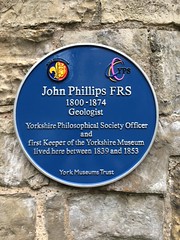
John Phillips FRS 1800-1874 Geologist Yorkshire Philosophical Officer and first keeper of the Yorkshire Museum Lived here between 1839 and 1853
St Mary's Lodge, Marygate, York, United Kingdom
Subjects

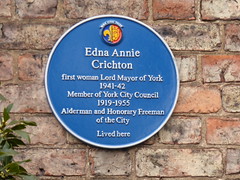
Edna Annie Crichton first woman Lord Mayor of York 1941-42 Member of York City Council 1919-1955 Alderman and Honorary Freeman of the City Lived here
30, Clifton, York, United Kingdom
Subjects
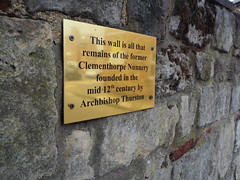
This wall is all that remains of the former Clementhorpe Nunnery founded in the mid 12th century by Archbishop Thurston
Clementhorpe, York, United Kingdom
Subjects
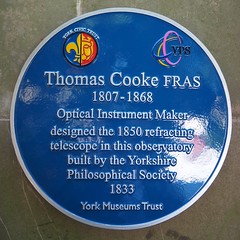
Thomas Cooke FRAS 1807-1868 Optical Instrument Maker designed the 1850 refracting telescope in this observatory built by the Yorkshire Philosophical Society 1833
York Observatory, Museum Trust, York, United Kingdom
Subjects
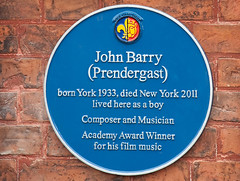
John Barry (Prendergast) born York 1933, died New York 2011 lived here as a boy. Composer and musician. Academy Award Winner for his film music
York Pavilion Hotel, York, United Kingdom
Subjects
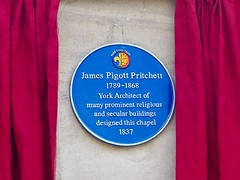
James Pigott Pritchett 1789-1868 York Architect of many prominent religious and secular buildings designed this chapel 1837
The Chapel, York Cemetery, Cemetery Road, York, United Kingdom
Subjects
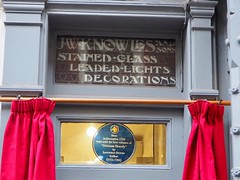
Here in December 1759 were sold the first volumes of 'Tristram Shandy' by Laurence Sterne Author (1713-1768)
35 Stonegate, York, United Kingdom
Subjects

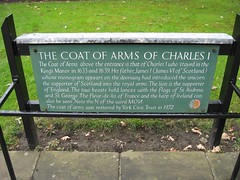
The Coat of Arms of Charles I. The Coat of Arms above the entrance is that of Charles I who stayed in the King's Manor in 1633 and 1639. His father James I (James VI of Scotland) whose monogram appears on the doorway had introduced the unicorn the supporter of Scotland into the royal arms. The lion is the supporter of England. The two beast hold lances with the flags of St Andrew and St George. The fleur-de-lis of France and the harp of Ireland can also be seen. Note the N of the word MOИ. The coat of arms was restored by the York Civic Trust in 1972.
King's Manor, Exhibition Square, York, United Kingdom
Subjects

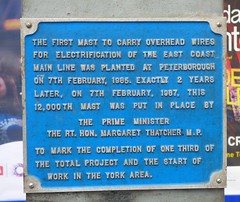
The First Mast to carry overhead wires for electrification of the East Coast Main Line was planted at Peterborough on 7th February, 1985. Exactly 2 years later, on 7th February, 1987, this 12,000th mast was put in place by The Prime Minister The Rt. Hon. Margaret Thatcher M.P. to mark the completion of one third of the total project and the start of work in the York Area.
at the end of Platform 1, York Railway Station, Station Road,, York, United Kingdom
Subjects

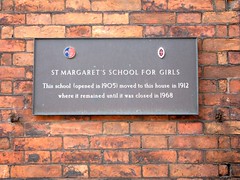
St Margaret's School For Girls. This school (opened in 1905) moved to this house in 1912 where it remained until it was closed in 1968.
54 Micklegate, York, United Kingdom
Subjects

Above may be seen a facsimile of the type of shutter which was used in medieval times to guard the bowman against a return flight of arrows. The Abbey wall which is 13th and 14th century is unique in that its battlements retain the grooves for these shutters which swing on trunnions the wooden guard after the bowman had fired his arrows in quick succession was swung down to protect him. The grooves do not exist anywhere else on the City walls and it is doubtful if there are any others in England except possibly at Alnwick.
Marygate, York, United Kingdom
Subjects
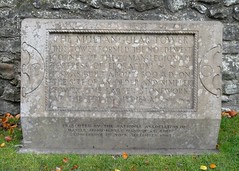
The Multangular Tower. This tower formed the north west corner of the Region legionary fortress of Eboracum. It was built about 300 A.D. on the site of an older and simpler tower. The larger stonework at the top is medieval.
Museum Gardens, York, United Kingdom
Subjects
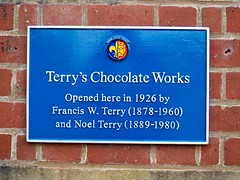
Terry's Chocolate Works Opened here in 1926 by Francis W. Terry (1878-1960) and Noel Terry (1889-1980)
The Chocolate Works, Bishopthorpe Road, York, United Kingdom
Subjects

City of York. Flood heights at Ouse Bridge.
Tower Gardens (by Tower Street entrance), York, United Kingdom

St. Antony's Hall the ancient hall of the guild of St. Anthony which was founded prior to 1418 and dissolved in 1627. From 1705 to 1946 it housed the York Blue Coat Boys' School.
St Anthony's Hall, Peasholme Green, YO1 7PW, York, United Kingdom
Subjects
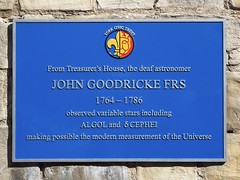
From Treasurer's House, the deaf astronomer John Goodricke FRS 1764 - 1786 observed variable stars including ALGOL and δCEPHEI making possible the modern measurement of the Universe
Minster Yard, York, United Kingdom
Subjects

This hospital was founded by Sir Henry Thompson of Middlethorp, sometime Lord Mayor of this city and Dame Anne his wife for the relief of six poor men. Anno Christi 1700.
Middletons Hotel, Cromwell Road, York, United Kingdom
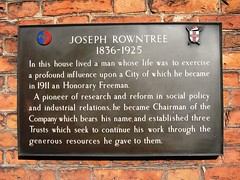
Joseph Rowntree 1836-1925. In this house lived a man whose life was to exercise a profound influence upon a City of which he became in 1911 an Honorary Freeman. A pioneer of research and reform in social policy and industrial relations, he became Chairman of the Company which bears his name, and established three Trusts which seek to continue his work through the generous resources he gave to them.
49 Bootham, York, United Kingdom
Subjects
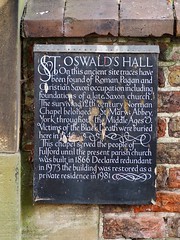
St. Oswald’s Hall. On this ancient sites traces have been found of Roman, Pagan and Christian Saxon occupation including foundations of a late, Saxon church. The surviving 12th century Norman Chapel belonged to St. Mary’s Abbey, York throughout the Middle Ages. Victims of the Black Death were buried here in 1349. This chapel served the people of Fulford until the present parish church was built in 1866. Declared redundant in 1973 the building was restored as a private residence in 1981.
St. Oswald’s Road, York, United Kingdom
Subjects

William Court stands on the site of the former head office of the Shepherd Building Group from 1927-1995. William Shepherd (c. 1664-1734) Merchant Taylor Freeman of the City of York is the earliest recorded ancestor of the Shepherd family.
1 William Court, York, United Kingdom
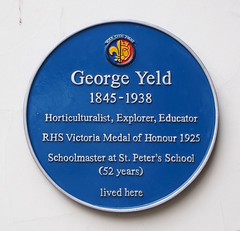
George Yeld 1845-1838 Horticulturalist, Explorer, Educator RHS Victoria Medal of Honour 1925 Schoolmaster at St. Peter’s School (52 years) lived here
29 Clifton , York, United Kingdom
Subjects

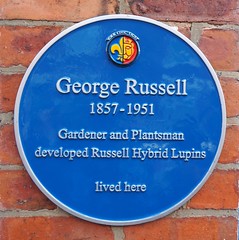
George Russell 1857-1951 Gardener and Plantsman developed Russell Hybrid Lupins lived here
20 Kensington Street, York, United Kingdom
Subjects
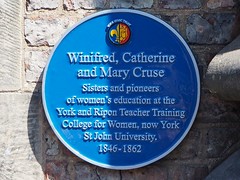
Winifred, Catherine and Mary Cruse Sisters and pioneers of women’s education at the York and Ripon Teacher Training College for Women, now York St John University. 1846-1862
York St John University, Lord Mayor's Walk, York, United Kingdom
Subjects

The Swan by virtue of its architectural interest merits the title a Tetley Heritage Inn
16 Bishopgate Street, York, United Kingdom
Subjects
Peasholme House Erected in 1752 and almost certainly the work of John Carr, architect, of this city. Acquired and completely restored by York Civic Trust in 1975, being European Architectural Heritage Year.
St. Saviour’s Place, York, United Kingdom
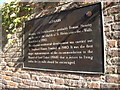
Aldwark. Meaning Old Fortification - probably Roman. Nearby was the site of St. Helen-on-the-Walls, demolished c. 1550. The adjacent residential development was carried out by Shepherd Homes Limited in 1980. It was the first major implementation of the recommendation in the Report of Lord Esher (1968) that a return to living within the city walls should be encouraged.
Aldwark , York, United Kingdom
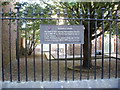
Unitarian Chapel. The earliest of York’s surviving Nonconformist churches, built 1692-1693 as a Presbyterian Chapel but later to become Unitarian. Charles Wellbeloved, an eminent scholar and historian, was minister here from 1800-1858 and is buried here.
31 St Saviourgate, York, United Kingdom
The Swann by virtue of its architectural interest merits the title a Tetley Heritage Inn
16 Bishopgate Street, York, United Kingdom
Subjects
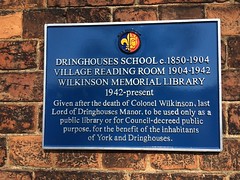
Dringhouses School c.1850-1904 Village Reading Room 1904-1942 Wilkinson Memorial Library 1942-present. Given after the death of Colonel Wilkinson, last Lord of Dringhouses Manor, to be used only as a public library or for Council-decreed public purpose, for the benefit of the inhabitants of York and Dringhouses.
Dringhouses Library, York, United Kingdom
Subjects
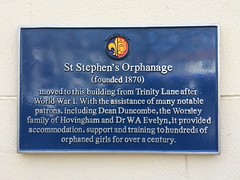
St Stephen's Orphanage (founded 1870) moved to this building from Trinity Lane after World War I. With the assistance of many notable patrons, including Dean Duncombe, the Worsley family of Hovingham and Dr W A Evelyn, it provided accommodation, support and training to hundreds of orphaned girls for over a century.
89 The Mount, York, United Kingdom
Subjects
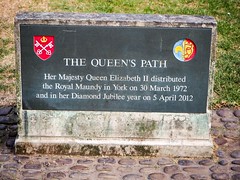
The Queen’s Path. Her Majesty Queen Elizabeth II distributed the Royal Maundy in York on 30 March 1972 and in her Diamond Jubilee year on 5 April 2012.
The Queen’s Path, York, United Kingdom
Subjects

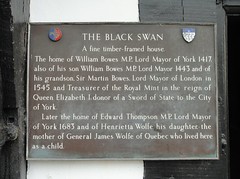
The Black Swan A fine timber-framed house. The home of William Bowes MP, Lord Mayor of York 1417; also of his son William Bowes MP, Lord Mayor 1443 and of his grandson Sir Martin Bowes, Lord Mayor of London, in 1545 and Treasurer of the Royal Mint in the reign of Queen Elizabeth I; donor of a Sword of State to the City of York. Later the home of Edward Thompson M.P., Lord Mayor of York 1683 and of Henrietta Wolfe, his daughter, the mother of General James Wolfe of Quebec who lived here as a child.
23 Peasholme Green, York, United Kingdom
Subjects

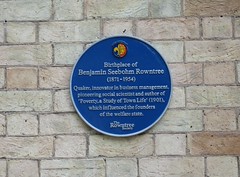
Birthplace of Benjamin Seebohm Rowntree (1871-1954) Quaker, innovator in business management, pioneering social scientist and author of 'Poverty, a Study of Town Life' (1901), which influenced the founders of the welfare state.
Penn House, 38 St Mary's, York, United Kingdom
Subjects
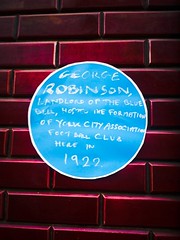
George Robinson, landlord of the Blue Bell, hosted the formation of York City Association Football Club here in 1922.
53 Fossgate, York, United Kingdom
Subjects

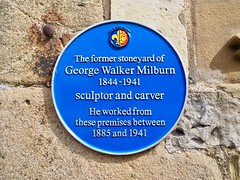
The former stoneyard of George Walker Milburn 1844-1941 sculptor and carver. He worked from these premises between 1855 and 1941
St Leonard’s Place, York, United Kingdom
Subjects
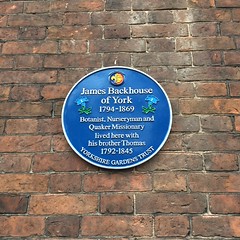
James Backhouse of York 1794-1869 Botanist, Nurseryman and Quaker Missionary lived here with his brother Thomas 1792-1845
92 Micklegate, York, United Kingdom
Subjects
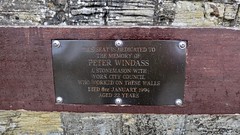
This seat is dedicated to the memory of Peter Windass a stonemason with York City Council who worked on these walls died 8th January 1994 aged 22 years
city walls, York, United Kingdom
Subjects

On 3rd July 1938 this locomotive attained a world record speed for steam traction of 126 miles per hour
National Railway Museum, Leeman Road, York, United Kingdom
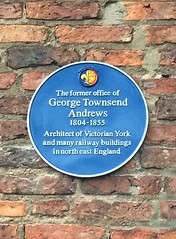
The former office of George Townsend Andrews 1804-1855 Architect of Victorian York and many railway buildings in north east England
31 Castlegate, York, United Kingdom
Subjects
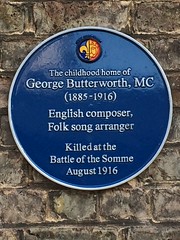
The childhood home of George Butterworth, MC (1885-1916) English composer, Folk song arranger Killed at the Battle of the Somme August 1916
5 Driffield Terrace, York, United Kingdom
Subjects
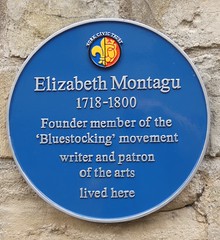
Elizabeth Monatagu 1718-1800 Founder member of the 'Bluestocking' movement writer and patron of the arts lived here
Treasurer’s House, Minster Yard, York, United Kingdom
Subjects

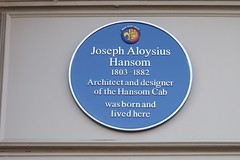
Joseph Aloysius Hansom 1803-1882 Architect and designer of the Hansom Cab was born and lived here
114 Micklegate, York, United Kingdom
Subjects

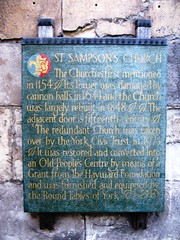
St Sampson's Church. The Church is first mentioned in 1154. Its Tower was damaged by cannon balls in 1644 and the Church was largely rebuilt in 1848. The adjacent door is fifteenth century. The redundant Church was taken over by the York Civic Trust in 1974. It was restored and converted into an Old People's Centre by means of a Grant from The Hayward Foundation and was furnished and equipped by the Round Tables of York.
Church Street, York, United Kingdom
Subjects

Located in the King’s Manor House the Yorkshire School for the Blind was founded in 1833 in memory of William Wilberforce MP It was closed in 1968 to form part of the University of York.
King’s Manor, Exhibition Square, York, United Kingdom
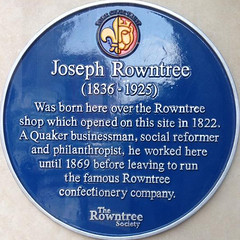
Joseph Rowntree (1836-1925) was born here over the Rowntree shop which opened on this site in 1822. A Quaker businessman, social reformer and philanthropist, he worked here until 1869 before leaving to run the famous Rowntree confectionery company.
10 Pavement, York, United Kingdom
Subjects
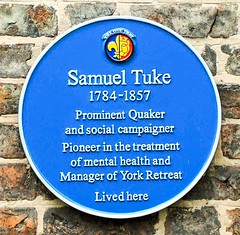
Samuel Tuke 1784-1857 Preeminent Quaker and social campaigner. Pioneer in the treatment of mental health and Manager of York Retreat lived here
Tuke House, Lawrence Street, York, United Kingdom
Subjects


George Hudson MP 1800-1871. An Alderman and three times Lord Mayor of York, he became known as The Railway King for his work in bringing the railways to York. It was here that he had his original draper's shop.
1 College Street, York, United Kingdom
Subjects

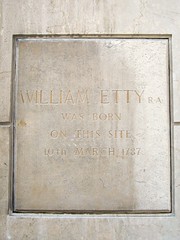
William Etty R.A. (1787-1849). Painter of York and one of the founders of the York Footpath Preservation Society lived in a house nearby.
City Screen, 13 - 17 Coney Street, York, United Kingdom
Subjects
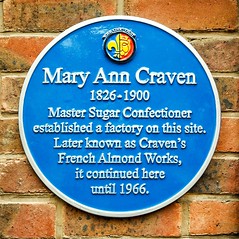
Mary Ann Craven 1826-1900 Master Sugar Confectioner established a factory on this site. Later known as Craven’s French Almond Works, it continued here until 1966.
Coppergate, York, United Kingdom
Subjects
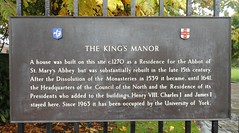
The King's Manor. A house was built on this site c.1270 as a Residence for the Abbot of St. Mary's Abbey but was substantially rebuilt in the late 15th century. After the Dissolution of the Monasteries in 1539 it became, until 1641, the Headquarters of the Council of the North and the Residence of its Presidents who added to the buildings. Henry VIII, Charles I and James I stayed there. Since 1963 it has been occupied by the University of York.
Exhibition Square, York, United Kingdom
Subjects


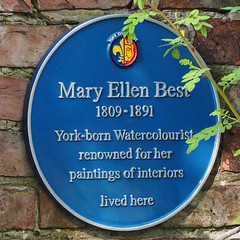
Mary Ellen Best 1809-1891 York-born watercolourist, renowned for her paintings of interiors lived here
14 Clifton, York, United Kingdom
Subjects

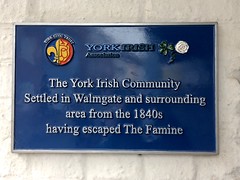
The York Irish Community settled in Walmgate and surrounding area from the 1840s having escaped The Famine
64 Walmgate, York, United Kingdom
Subjects
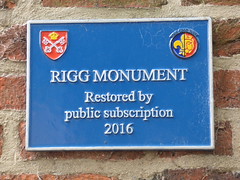
Rigg Monument - Restored by public subscription 2016
St. Lawrence's Churchyard, Lawrence Street, York, United Kingdom
Subjects
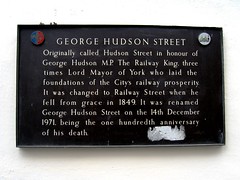
George Hudson Street. Originally called Hudson street in honour of George Hudson M.P. The Railway King, three times Lord Mayor of York who laid the foundations of the City's railway prosperity. It was changed to Railway Street when he fell from grace in 1849. It was renamed George Hudson Street on the 14th December 1971, being the one hundredth anniversary of his death.
1 George Hudson Street, York, United Kingdom
Subjects
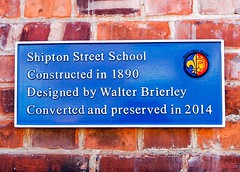
Shipton Street School Constructed in 1890 Designed by William Brierley Converted and preserved in 2014
Shipton Street, York, United Kingdom
Subjects
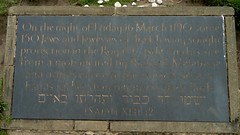
On the night of Friday 16 March 1190 some 150 Jews and Jewesses of York having sought protection in the Royal Castle on this site from a mob incited by Richard Malebisse and others chose to die at each others hands rather than renounce their faith. יָשִׂימוּ לָּד כָּבוֹד וּתְהִלָּתוֹ בָּאִיִּים Isaiah XLII 12
Clifford's Tower, York, United Kingdom
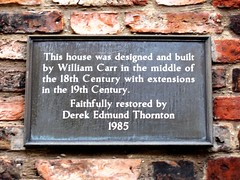
This house was designed and built by William Carr in the middle of the 18th Century with extensions in the 19th Century. Faithfully restored by Derek Edmund Thornton 1985.
17 Bishophill Senior, York, United Kingdom
Subjects
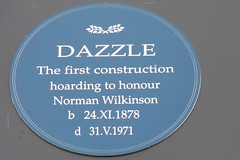
DAZZLE The first construction hoarding to honour Norman Wilkinson b 24.XI.1878 d 31.V.1971
79, Fishergate, York, United Kingdom
Subjects

On Easter Sunday 1834, Anne Lister and Ann Walker had their marriage solemnised in Holy Trinity Church. Anne Lister - widely known as Gentleman Jack - recorded in her diary: 'The first time I ever joined Miss W[alker] in my prayers - I had prayed that our union might be happy'.
Holy Trinity Church, 70 Goodramgate, York, United Kingdom
Subjects
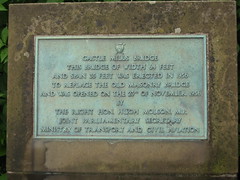
Castle Mills Bridge This bridge of width 64 feet and span 35 feet was erected in 1956 to replace the old masonry bridge and was opened on 23rd November 1956 by the Right Hon. Hugh Molson M.P. Joint Parliamentary Secretary Ministry of Transport and Civil Aviation
Castle Mills Bridge, York, United Kingdom
Subjects

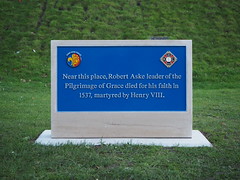
Near this place, Robert Aske leader of the Pilgrimage of Grace died in 1537, martyred by Henry VIII.
Tower Street, York, United Kingdom
Subjects
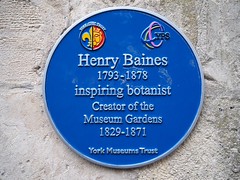
Henry Baines (1737-1878) inspiring botanist creator of Museum Gardens 1829-1871
Museum Gardens, York, United Kingdom
Subjects
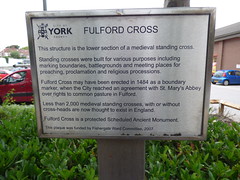
Fulford Cross This structure is the lower section of a medieval standing cross. Standing crosses were built for various purposes including marking boundaries, battlegrounds and meeting places for preaching, proclamation and religious processions. Fulford Cross may have been erected in 1484 as a boundary marker, when the City reached an agreement with St. Mary's Abbey over rights to common pasture in Fulford. Less than 2,000 medieval standing crosses, with or without cross-heads, are now thought to exist in England. Fulford Cross is a protected Scheduled Ancient Monument.
256, Fulford Road, York, United Kingdom
Subjects

Fossgate Banner 2018 Fish were sold on Fossgate and Foss Bridge from the 13th Century
5, Fossgate, York, United Kingdom
Subjects

York Railway Station. This plaque commemorates completion in November 1984 of the new Travel Centre and restoration of damage sustained by the station during an air-raid in 1942.
York Railway Station, York, United Kingdom
Subjects
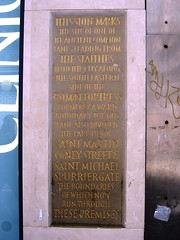
This stone marks the site of one of the ancient common lanes leading from the staithes into the city along the south eastern side of the Roman fortress. Formerly a ward boundary, the old lane also divided the parishes of Saint Martin Coney Street & Saint Michael Spurriergate the boundaries of which now run through these premises.
43 Coney Street, York, United Kingdom
Subjects
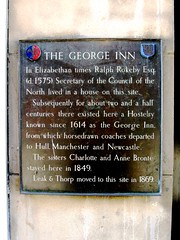
The George Inn. In Elizabethan times Ralph Rokeby Esq. (d. 1575) secretary of the Council of the North lived in a house on this site. Subsequently for about two and a half centuries there existed here a Hostelry known since 1614 as the George Inn, from which horsedrawn coaches departed to Hull, Manchester and Newcastle. The sisters Charlotte and Anne Brontë stayed here in 1849. Leak & Thorp moved to this site in 1869.
19 Coney Street, York, United Kingdom
Subjects


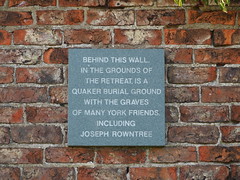
Behind this wall, in the grounds of the Retreat, is a Quaker burial ground with the graves of many York Friends, including Joseph Rowntree.
Walmgate Stray, York, United Kingdom
Subjects
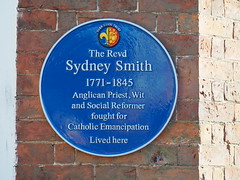
The Revd Sydney Smith 1771-1845 Anglican Priest, Wit and Social Reformer fought for Catholic Emancipation Lived here
More House, Heslington Lane, York, United Kingdom
Subjects

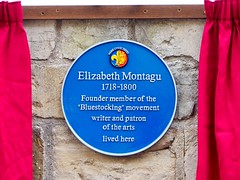
Elizabeth Montagu (1718-1800) Founder member of the ‘Bluestocking’ movement writer and patron of the arts lived here
Treasurer’s House, Minster Yard, York, United Kingdom
Subjects
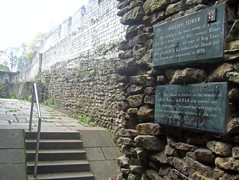
Anglian Tower This building is the lower storey of a tower built into a breach in the 4th-century Roman fortress wall perhaps in the reign of King Edwin 616-632 A.D. It was hidden under Danish and later ramparts and rediscovered in 1839.
Museum Gardens, York, United Kingdom
Subjects

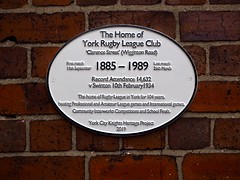
The Home of York Rugby League Club ‘Clarence Street’ (Wigginton Road) First match 19 September 1885 - 1989 Last match 26th March Record attendance 14,632 v Swinton 10th February 1934 The home of Rugby League in York for 104 years, hosting Professional and Amateur League games and International games, Community Interworks Competitions and School Finals.
The Hut, Wigginton Road, York, United Kingdom
Subjects
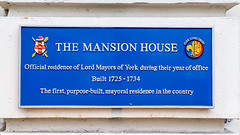
The Mansion House Official residence of Lord Mayors of York during their year of office Built 1725-1734 The first, purpose-built, mayoral residence in the country
St Helen's Square, York, United Kingdom
Subjects

This Gateway was broken through the Abbey Wall July 1503 in honour of the Princess Margaret daughter of Henry VII, who was the guest of the Lord Abbot of St Mary's for two days on her journey to the North as the Bride of James IV of Scotland.
Exhibition Square, York, United Kingdom
Subjects

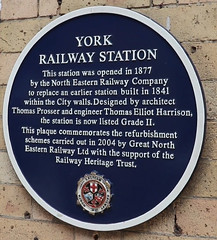
York railway station. This station was opened in 1877 by the North Eastern Railway Company to replace an earlier station built in 1841 within the City walls. Designed by architect Thomas Prosser and engineer Thomas Elliot Harrison, the station is now listed Grade II. This plaque commemorates the refurbishment schemes carried out in 2004 by Great North Eastern Railway Ltd with the support of the Railway Heritage Trust.
Station, York, United Kingdom
Subjects


York Railway Station. One of the great buildings of Victorian England built 1873-7 (when it was then said to be the largest station in the world) to an original design by Thomas Prosser. It was opened on the 25th June 1877, and this plaque was erected by the York Civic Trust in 1977 to mark the centenary.
York Railway Station, York, United Kingdom
Subjects
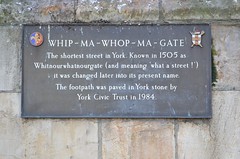
Whip-Ma-Whop-Ma-Gate. The shortest street in York. Known in 1505 as Whitnourwhatnourgate (and meaning 'what a street !') it was changed later into its present name. The footpath was paved in York stone by York Civic Trust in 1984.
St Crux, Whip-Ma-Whop-Ma-Gate, York, United Kingdom
Subjects

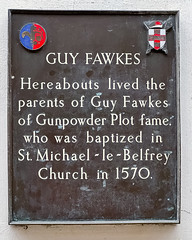
Guy Fawkes Hereabouts lived the parents of Guy Fawkes of Gunpowder Plot fame, who was baptized in St. Michael-le-Belfrey Church in 1570.
Stonegate, York, United Kingdom
Subjects
.jpg?width=250)
The Shambles. The ancient street of the Butchers of York, mentioned in the Domesday Book of William the Conqueror. It takes its name from the word 'Shamel', meaning the stalls or benches on which the meat was displayed - later versions of which can still be seen. It was rebuilt about 1400, when it assumed its present character.
5-6 Kings Court, York, United Kingdom
Subjects
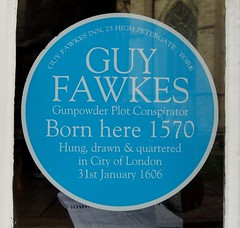
Guy Fawkes Gunpowder Plot Conspirator Born here 1570 Hung, drawn & quartered in City of London 31st January 1606
25 High Petergate, York, United Kingdom
Subjects
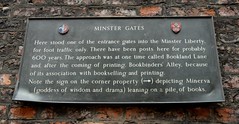
Minster Gates. Here stood one of the Entrance Gates into the Minster Liberty, for foot traffic only. There have been posts here for probably 600 years. The approach was called at one time Bookland Lane and, after the coming of printing, Bookbinders Alley, because of its association with bookselling and printing. Note the sign on the corner property (→) depicting Minerva (goddess of wisdom and drama) leaning on a pile of books.
Minster Gates, York, United Kingdom
Subjects
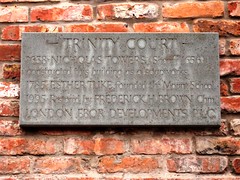
Trinity Court. 1638 Nicholas Towers (Sheriff 1656) constructed this building as a soapworks. 1785 Esther Tuke founded the Mount School. 1995 Restored by Frederick H. Brown Chm. London Ebor Developments Plc.
Trinity Court, Trinity Lane, York, United Kingdom
Subjects

William Milner (1900-1942) Station Foreman. Robert W. Smith (1877-1942) Railway Policeman. Killed in the 'Baedeker' air raid, April 29th 1942, in which York Railway Station was targeted as a principal part of the national rail network and severely damaged.
York railway station, York, United Kingdom

Patrick Waddington 1901-1987 Merchant Adventurer Pilot and Actor This building was restored with his legacy.
Rear of 39 Fossgate, York, United Kingdom
Subjects

The house of Margaret Clitherow who was martyred in York March 25th 1586 canonised October 25th 1970
35 Shambles, York, United Kingdom
Subjects

Davygate. A thoroughfare for over 800 years and named after David, the King's Lardiner in the reign of King Stephen (1135) whose great grandfather had come over with William the Conqueror. He had control over the nearby Forest of Galtres and supplied the Royal Larder therefrom.
St. Helen's Stonegate Church, 5 St. Helen's Square, York, United Kingdom
Subjects

Praetorian Gate. Near here stood the principal entrance into the City in the days of the Romans. Original date uncertain but probably rebuilt circa 300A.D.
1 Saint Helen's Square, York, United Kingdom
Subjects

York College for Girls. Non Nobis Solum This house was occupied by the College from its foundation in 1908 to its closure in 1997
62 Low Petergate, York, United Kingdom
Subjects
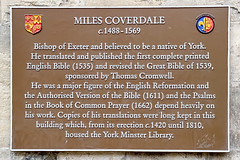
Miles Coverdale c.1488-1569. Bishop of Exeter and believed to be a native of York, he translated and published the first complete printed English Bible (1535) and revised the Great Bible of 1539 sponsored by Thomas Cromwell. He was a major figure of the English Reformation and the Authorised version of the Bible (1611) and the psalms in the Book of Common Prayer (1662) depend heavily on his work. Copies of his translations were long kept in this building which, from its erection c.1420 to 1810, housed York Minster Library.
Minster Yard, York, United Kingdom
Subjects

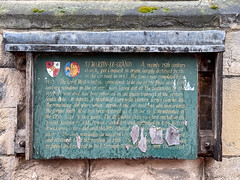
St Martin-le-Grand. A mainly 15th century church, pre Conquest in origin, largely destroyed by fire in the air raid in 1842. The tower was completed before 1437. The Great West Window, considered to be one of the finest early 15th century windows in the country was taken out at the beginning of the 1939-45 war and has been rehoused in the quasi-transept of the restored South aisle. It depicts St Martin of Tours with thirteen scenes from his life. The remaining old glass which survived the air raid has also been restored. The former South Aisle has been restored as a Shrine of Remembrance of the City's fallen in two wars. the distinctive clock was first erected in its present position in 1668. It was overhauled and renovated in 1754 in 1778 it was given a new dial, and the little admiral with his sextant was placed upon it. The clock was badly damaged in the raid in 1942 and was restored and returned to its old position in 1966. The adjoining churchyard was re-paved and restored in 1968 through the initiative of York Civic Trust.
St Martin-le-Grand, Coney Street, York, United Kingdom
Subjects
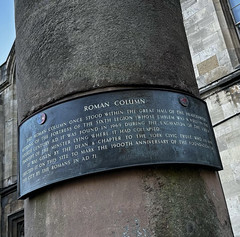
Roman Column. This Roman column once stood within the great hall of the headquarters building of the fortress of the Sixth Legion (whose emblem was a bull) in the fourth century A.D. It was found in 1969 during the excavation of the south transept of the Minster, lying where it had collapsed. It was given by the Dean & Chapter to the York Civic Trust, who in 1961 erected it on this site to mark the 1900th anniversary of the foundation of the city in A.D. 71.
Deangate, York, United Kingdom
Subjects
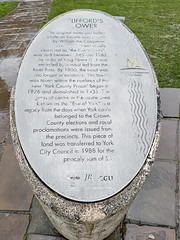
Clifford's Tower. The original motte and bailey castle on this site was erected by William the Conqueror. The present tower usually described as "the Great Tower", was built between 1245 and 1262 by order of King Henry III. It was encircled by a moat fed from the River Foss. By 1800, the moat was no longer in existence. The tower was taken within the confines of the new 'York County Prison' begun in 1826 and demolished in 1935. The grassed centre of the castle area known as the "Eye of York" is a legacy from the days when York castle belonged to the Crown. County elections and royal proclamations were issued from the precincts. This piece of land was transferred to York City Council in 1988 for the princely sum of £1.
Tower Street, York, United Kingdom
Subjects


St. George's Roman Catholic Church Foundation Stone laid October 1849 Church opened September 1850 This was the Cathedral Church for the whole of Yorkshire from 1850 to 1864. It was designed in the Early decorated Style by Joseph Aloysius Hansom (1803-1882), who was a native of York - lived in Micklegate - and was architect for many notable churches and civic monuments both in England and abroad. He was also the inventor of the Hansom cab. This fine church was built in 11 months at a cost of £3,550.
St. George's Roman Catholic Church, George Street, York, United Kingdom
Subjects
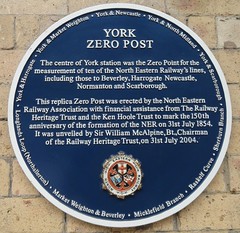
York Zero Post. The centre of York station was the Zero Point for the measurement of ten of the North Eastern Railway's lines, including those to Beverley, Harrogate, Newcastle, Normanton and Scarborough. This replica Zero Post was erected by the North Eastern Railway Association with financial assistance from The Railway Heritage Trust and the Ken Hoole Trust to mark the 150th anniversary of the formation of the NER on 31st July 1854. It was unveiled by Sir William McAlpine, Bt., Chairman of the Railway Heritage Trust, on 31st July 2004
York station, York, United Kingdom
Subjects


Masonic Hall This building was purpose built & opened in 1846 as the Institute for Popular Science and Literature (the forerunner of todays York College and University Centre) The building was purchased by the Eboracum Lodge No1611 in 1882 It was opened as a Masonic Hall in 1884 and remains so today
Masonic Hall, St Saviourgate, York, York, United Kingdom
Subjects
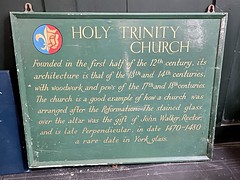
Holy Trinity Church. Founded in the first half of the 12th century, its architecture is like that of the 13th and 14th centuries, with woodwork and pews of the 17th and 18th centuries. The church is a good example of how a church was arranged after the Reformation. The stained glass over the altar was the gift of John Walker, Rector, and is late Perpendicular, in date 1470-1480 a rare date in York glass.
70 Goodramgate, York, United Kingdom
Subjects

The Siege of York 1644. On the 16th July 1644 the Royalists surrendered the City (after three months of siege) to the besieging Parliamentary forces at this point. The terms of surrender were generous and it was due to Ferdinando Fairfax and his son, Thomas Fairfax, second and third Lords Fairfax of Cameron, that the City (and in particular the Minster glass) was preserved from destruction. This plaque was unveiled on the 350th Anniversary of the surrender by Nicholas, 14th Lord Fairfax of Cameron, and the Rt. Hon. The Lord Mayor of York (Coun. David Wilde).
2 Blossom Street, York, United Kingdom
Subjects
_by_Robert_Walker_and_studio.jpg?width=250)

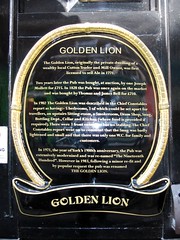
Golden Lion. The Golden Lion, originally the private dwelling of a wealthy local Cotton Trader and Mill Owner, was first licensed to sell Ale in 1771. Two years later the Pub was bought, at auction, by one Joseph Mollett for £715. In 1828 the Pub was once again on the market and was bought by Thomas and James Bell for £710. In 1902 The Golden Lion was described in the Chief Constables report as having:- 5 bedrooms, 3 of which could be set apart for travellers, an upstairs Sitting-room, a Smokeroom, Dram Shop, Snug, Bottling Dept., Cellar and Kitchen (where food is provided if required). There were 3 front entrances but no Stabling. The Chief Constables report went to comment that the Snug was badly lightened and small and that there was only one W.C. for family and customers. In 1971, the year of York's 1900th anniversary, the Pub was extensively modernised and was re-named "The Nineteenth Hundred". However in 1983, following a minor re-fit and by popular request the pub was renamed The Golden Lion.
9 Church Street, York, United Kingdom
Subjects
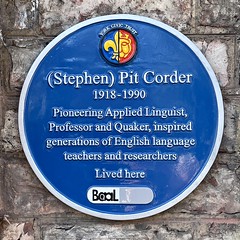
(Stephen) Pit Corder 1918-1990 Pioneering Applied Linguist, Professor and Quaker, inspired generations of English language teachers and researchers Lived here
4 Bootham Terrace, York, United Kingdom
Subjects

This 19th Century North Eastern Railway Distant Signal, one of the last to remain in use on a passenger line, was taken out of service in 1984. Signals of this type on former North Eastern Railway routes were painted red until after 1928, so it has been restored to its original condition, and placed here as a memento of York's Railway Heritage, with assistance from the North Eastern Railway Association.
York Railway Station, Station Road, York, United Kingdom
Subjects
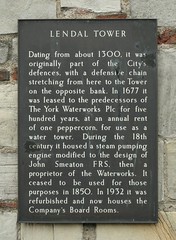
Lendal Tower. Dating from about 1300, it was originally part of the City's defences, with a defensive chain stretching from here to the Tower on the opposite bank. In 1677 it was leased to the predecessors of The York Waterworks Plc for five hundred years, at an annual rent of one peppercorn, for use as a water tower. During the 18th century it housed a steam pumping engine modified to the design of John Smeaton FRS, then a proprietor of the Waterworks. It ceased to be used for those purposes in 1850. In 1932 it was refurbished and now houses the Company's Board Rooms.
Lendal Bridge, York, United Kingdom
Subjects
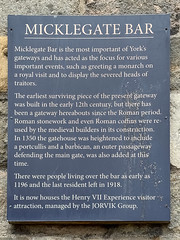
Micklegate Bar is the most important of York’s gateways and has acted as the focus for various important events, such as greeting a monarch on a royal visit and to display the severed heads of traitors. The earliest surviving piece of the present gateway was built in the earliest 12th century, but there has been a gateway hereabouts since the Roman period. Roman stonework and even Roman coffins were reused by the medieval builders in its construction. In 1350 the gatehouse was heightened to include a portcullis and a barbican, an outer passageway defending the main gate, was also added at this time. There were people living over the bar as early as 1196 and the last resident left in 1918.
Micklegate , York, United Kingdom
Subjects
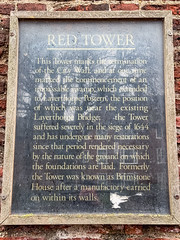
Red Tower. This Tower marks the termination of the City Walls, and at one time marked the commencement of an impassable swamp, which extended to Layerthorpe Postern, the position of which was near the existing Layerthorpe Bridge; the Tower suffered severely in the siege of 1644 and has undergone many restorations since that period rendered necessary by the nature of the ground on which the foundations are laid. Formerly the Tower was known as Brimstone House after a manufactory carried on within its walls.
Foss Island Road, York, United Kingdom
Subjects
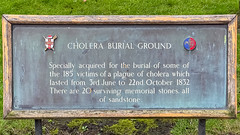
Cholera Burial Ground Specially acquired for the burial of some of the 185 victims of a plague of cholera which lasted from 3rd June to 22nd October 1832. There are 20 surviving memorial stones, all of sandstone.
Lendal Bridge, York, United Kingdom
Subjects

All Saints North Street The finest of York's many mediaeval churches, its architecture is of the 12th, 13th, 14th and 15th centuries. It is notable for its exceptionally fine stained glass of the 14th and 15th centuries and the 15th century hammer-beam roofs with good bosses and angels: an excellent example of mediaeval wood carving. Note also the pulpit (1675) and the mayoral board (18c) and the 18c. benefaction boards. The screen is by Ridsdale Tate (early 20c). The church was restored by the York Civic Trust 1977.
North Street, York, United Kingdom
Subjects
.jpg?width=250)
On this track the LNER Streamline Pacific locomotive Sir Ralph Wedgwood was destroyed during an air raid on the night of 28/29 April 1942 nearby class B16 No. 925 was also destroyed. This plaque was placed in remembrance by the Gresley Society on the fiftieth anniversary 29 April 1992
, York, United Kingdom
Subjects
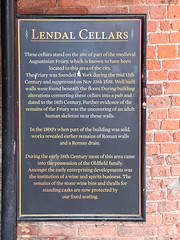
These cellars stand on the site of part of the medieval Augustinian Friary, which is known to have been located in this area of the city. The Friary was founded a York during the mid 13th Century and suppressed on Nov 25th 1538. Well built walls were found beneath the floors During building alterations converting these cellars into a pub and dated to the 14th Century. Further evidence of the remains of the Friary was the uncovering of an adult human skeleton near these walls. In the 1800's when part of the building was sold, works revealed earlier remains of Roman walls and a Roman drain. During the early 18th Century most of this area came into the possession of the Oldfield family. Amongst the early enterprising developments was the institution of a wine and spirits business. The remains of the stone wine bins and thralls for standing casks are now protected by our fixed seating.
26 Lendal, York, United Kingdom
Subjects
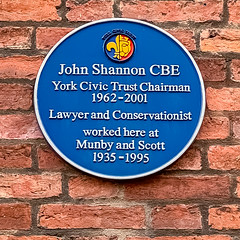
John Shannon CBE York Civic Trust Chairman 1962-2001 Lawyer and Conservationist worked here at Munby and Scott 1935-1995
18 Blake Street, York, United Kingdom
Subjects
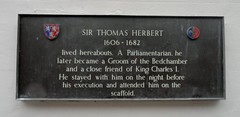
Sir Thomas Herbert 1606-1682 lived hereabouts. A Parliamentarian, he later became a Groom of the Bedchamber and a close friend of Charles I. He stayed with him on the night before his execution and attended him on the scaffold.
7 High Petergate, York, United Kingdom
Subjects
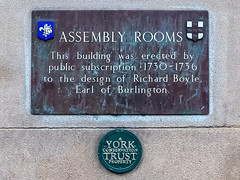
Assembly Rooms This building was erected by public subscription 1730-1736 to the design of Richard Boyle, Earl of Burlington.
Blake Street, York, United Kingdom
Subjects


St. Michael-Le-Belfrey the only pre-Reformation church in York to have been built all at one time (1525-1536) by John Forman, Master Mason to the Minster. Guy Fawkes was baptized here on 16th April 1570
St. Michael-Le-Belfrey, York, United Kingdom
Subjects
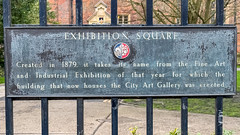
Exhibition Square. Created in 1879, it takes its name from the Fine Art and Industrial Exhibition of that year for which the building that now houses the City Art Gallery was erected.
Exhibition Square, York, United Kingdom
Subjects

The Yorkshire Gentlemen's Cricket Club The YGCC was formed at a meeting held on this site, in Harker's Hotel, on 30th September 1863.
4 Davygate, York, United Kingdom
Subjects
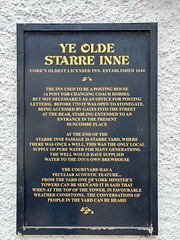
York's oldest licensed inn, established 1644 the inn used to be a posting house (a post for changing coach horses. But not necessarily as an office for posting letters). Before 1733 it was open to Stonegate. Being accessed by gates into the street at the rear, stabling extended to an entrance in the present Duncombe Place at the end of the Starre Inne passage is Starre Yard, where there was once a well, this was the only local supply of pure water for many generations. The well would have supplied water to the inn's own brewhouse the courtyard has a peculiar acoustic feature... from the yard one of York Minster's towers can be seen and it is said that when at the top of the tower, in favourable weather conditions, the conversations of people in the yard can be heard
40 Stonegate, York, United Kingdom
Subjects

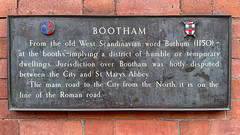
Bootham. From the old West Scandinavian word "Buthum" (1150) - "at the booths" - implying a district of humble or temporary dwellings. Jurisdiction over Bootham was hotly disputed between the City and St. Mary's Abbey. The main road to the City from the North, it is on the line of the Roman road.
6 Bootham, York, United Kingdom
Subjects

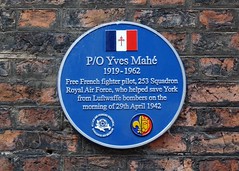
P/O Yves Mahé 1919-1962 Free French fighter pilot, 253 Squadron Royal Air Force, who helped save York from Luftwaffe bombers on the morning of 29th April 1942
13 Coney Street, York, United Kingdom
Subjects
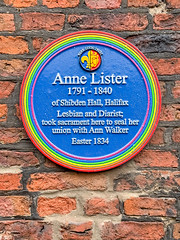
Anne Lister 1791-1840 Gender-nonconforming entrepreneur. Celebrated marital commitment, without legal recognition, to Ann Walker in this church. Easter, 1834.
Holy Trinity Church, Goodramgate , York, United Kingdom
Subjects
This plaque marks the site of York Aerodrome and is dedicated to the memory of all RAF and Handley Page personnel who served here from 1939 - 1948 and to the original members of Yorkshire Aviation Services who operated the airfield between 1936 and 1939.
Corner of Clifton Moor Gate and Kettlestring Lane., York, United Kingdom
Subjects
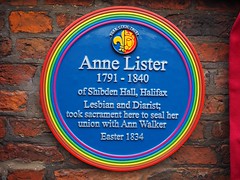
Anne Lister 1791-1840 of Shibden Hall, Halifax Lesbian and Diarist; took sacrament here to seal her union with Ann Walker Easter 1834
Holy Trinity Church, Goodramgate, York, United Kingdom
Subjects

Pikeing Well. Several wells existed along this stretch of the river. In 1740 New Walk was extended from Blue Bridge past Pikeing Well. In 1749 the corporation of York agreed to “contract with proper workmen for the making of a hansom fountain at Pikeing Well”. A well house was built in 1752 to the designs of John Carr who later become Yorkshire most notable Georgian Architect. In 1858 a re-building of this well house by Thomas Pickersgill the City Surveyor. The structure is now listed grade II*. Water from the well was thought to have medicinal qualities, particularly in the treatment of sore eyes. The Pikeing Well was restored in the year 2000 as part of the Millennium Bridge Project.
New Walk, York, United Kingdom
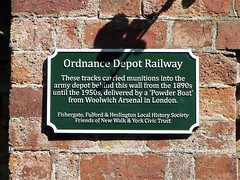
Ordnance Depot Railway These tracks carried munitions into the army depot behind this wall from the 1890s until the 1950s, delivered by a ‘Powder Boat’ from Woolwich Arsenal in London.
New Walk, York, United Kingdom
Subjects
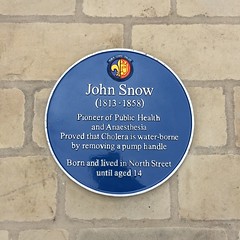
John Snow (1813-1858) Pioneer of Public Health and Anaesthesia Proved that Cholera is water-borne by removing a pump handle Born and lived in North Street until aged 14john snow
North Street Gardens, North Street, York, United Kingdom
Subjects
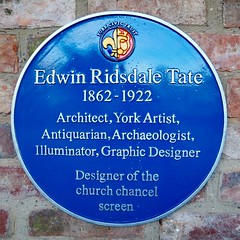
Edwin Ridsdale Tate 1862-1922 Architect, York Artist, Antiquarian, Archaeologist, Illuminator, Graphic Designer. Designer of the church chancel screen.
All Saints Church, North Street, York, United Kingdom
Subjects
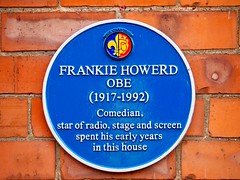
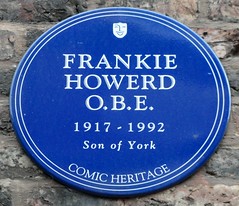
Frankie Howerd OBE (1917-1992) Comedian, star of radio, stage and screen spent his early years in this house
53 Hartoft Street, York, United Kingdom
Subjects

Petergate. The Via Principalis of the Roman fortress. The street derives its name from the Minster, which is dedicated to St. Peter.
54 Low Petergate, York, United Kingdom
Subjects
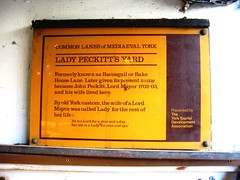
Lady Peckitt's Yard. Formerly known as Bacusgail or Bake House Lane. Later given its present name because John Peckitt, Lord Mayor 1702-03, and his wife lived here. By old York custom, the wife of a Lord Mayor was called 'Lady' for the rest of her life:- 'He is a Lord for a year and a day, But she is a Lady for ever and aye.'
Lady Peckitt's Yard, York, United Kingdom
Subjects

York has been a centre of railway management since 1840. This building, now the Headquarters of British Rail, Eastern Region, was the Head Office of the North Eastern Railway from 1906 (designed by William Bell and Horace Field). The badges above are of the York and North Midland Railway (top), the Leeds Northern Railway (left), and the York, Newcastle and Berwick Railway (right), which formed the North Eastern Railway in 1854 and in 1923 became part of the London and North Eastern Railway.
The Grand, Station Rise, York, United Kingdom
Subjects


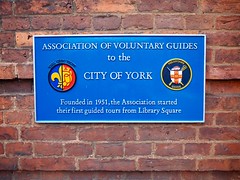
Association of Voluntary Guides to the City Of York Founded in 1951, the Association started their first guided tours from Library Square
Library Square, Museum Street, York, United Kingdom
Subjects
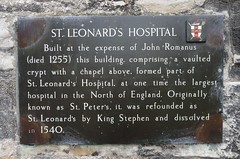
St. Leonard's Hospital. Built at the expense of John Romanus (died 1255) this building comprising a vaulted crypt with a chapel above, formed part of St. Leonard's Hospital, at one time the largest hospital in the North of England. Originally known as St. Peter's, it was refounded as St. Leonard's by King Stephen and dissolved in 1540.
Library Square, York, United Kingdom
Subjects

The London Underground Accessibility Award presented to Great North Eastern Railway Limited for York Station Improvements to Customer Facilities by John Armitt Chief Executive, Network Rail 2005
York Railway Station, York, York, United Kingdom
Subjects


.jpg)


.jpg)


These mounting steps are very rare (mounting blocks being more common) They were restore by the Cork Civic Trust, prior to the major restoration of the premises, undertaken in 1982/83
80 Goodramgate, York, United Kingdom
Subjects
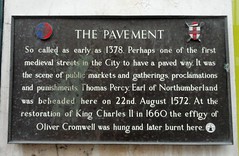
The Pavement So called as early as 1378. Perhaps one of the first medieval streets in the City to have a paved way. It was the scene of public markets and gatherings, proclamations and punishments. Thomas Percy, Earl of Northumberland, was beheaded here on 22nd August 1572. At the restoration of King Charles II in 1660 the effigy of Oliver Cromwell was hung and later burnt here.
9 The Pavement, York, United Kingdom
Subjects

Phileas Fry Born 26.10.1318 Apothecary Proprietor Master Potions Maker & Believer In Magic Lived Here
Shambles, York, United Kingdom
Subjects

On this site in the 13th century stood the York Synagogue and the house of Aaron of York, a significant figure in civic, Jewish and national life and Justiciar for the Jews to Henry III
19 Coney Street, York, United Kingdom
Subjects

Norman House. Originally a two storey building of good Norman freestone, it would have had an undercroft of wood supporting the first floor which was probably also of wood. The hall on the first floor was lit by windows, one of which remains and has a shaft with a water leaf capital between the two lights. The windows were rebated at the inside for shutters but were never glazed. The house was probably at one time the Prebendal house of Osbaldwick, a village near York, and indeed a house on the site was used by the Minster Clergy until the 19th century. The few decorative details and the masonry fix the date of the house at c.1180. It is without doubt the oldest dwelling house of which any substantial remains still stand in situ in the City. The courtyard was restored in 1969 through the initiative of the York Civic Trust.
52A Stonegate, York, United Kingdom
Subjects
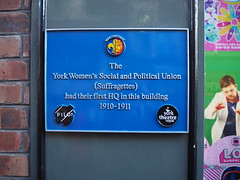
The York Women’s Social and Political Union (Suffragettes) had their first HQ in this building 1910-1911.
36 Coney Street , York, United Kingdom
Subjects

In tribute to Frank Pick 1878-1941 a scholar of this school. He served his fellow-men, made transport an art and sought beauty and good design in all things.
St Peter's School, York, United Kingdom